Bihar's AI Policy Is a Power Play, Not a Tech Bet
Samrat Choudhary is using AI to signal a faster, cleaner Bihar — but the real test is whether the policy changes how the state governs.
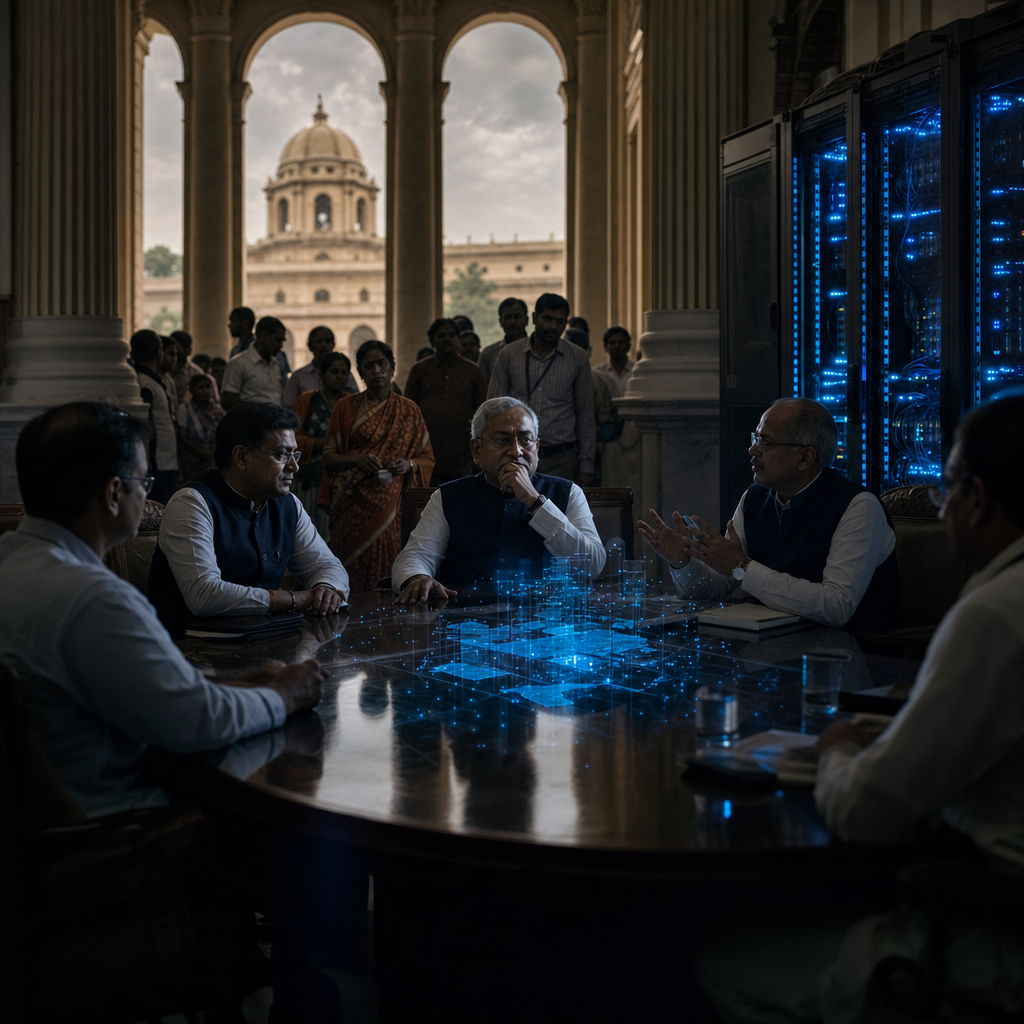
Chief Minister Samrat Choudhary said Bihar will “soon” introduce an AI policy and aim to turn the state into an AI hub, making the announcement at the Bihar AI Summit 2026 in Patna on Saturday ( The Hindu;
  PTI via NewsDrum). The message is clear: AI is being framed as an instrument of state power, not just a technology story.
The real target is the bureaucracy
The most concrete part of the pitch is administrative. Choudhary urged departments to use AI to improve transparency in welfare schemes and speed up public service delivery, with special reference to the state’s “Sahyog Shivirs” grievance camps ( The Economic Times; PTI via NewsDrum). ET reported that he tied this to a hard deadline: complaints must be resolved within 30 days, or the officer concerned faces suspension on day 31 (The Economic Times).
That is the leverage point. Bihar is not starting from a position of technological depth; it is starting from a position of bureaucratic friction. An AI policy can help only if it becomes a discipline mechanism — routing complaints, flagging delays, tracking welfare leakage, and pushing departments into measurable service standards. Otherwise it becomes another summit announcement.
Why Bihar is making this bet now
The politics are straightforward. Bihar has long lost labor to migration, and Choudhary used the summit to appeal to migrant Biharis to return and help build the state’s future (The Hindu). That fits the larger development narrative his government is selling: better roads, better power, better schools, and now digital governance as the next stage of modernization (The Economic Times).
This also tells you who benefits first. The obvious winners are the IT department, local AI startups, systems integrators, and politically the chief minister’s office, which gets a new language for efficiency and control. The presence of Bihar IT minister Nitish Mishra and BharatGPT founder Ankush Sabharwal at the summit suggests the government wants to anchor the policy in an Indian ecosystem, not a foreign template (The Hindu; PTI via NewsDrum).
The losers are the departments that have survived on delay, discretion, and opaque file movement. Once complaint tracking and welfare monitoring become digitized, that slack gets narrower. In  India, that is the real significance of a state AI policy: not innovation theater, but an attempt to rewire administrative incentives.
What to watch next
The next decision point is whether Bihar releases an actual draft policy — with procurement rules, data safeguards, pilot departments, and training plans — or keeps this at the level of speeches and summit branding. Watch first for whether grievance redress, policing, or welfare delivery is named as the pilot use case. If the policy arrives with clear implementation rules, this could become a serious governance experiment. If not, it is mostly a signal that Bihar wants to be seen as digitally ambitious before it is demonstrably capable.