Davis Plants the Flag for Security Council
Bahamas PM launches bid for UN Security Council seat
Model Diplomat4 min readamericas
Davis Plants the Flag: Why a Tiny Caribbean Nation Is Auditioning for the Security Council
Bahamas PM Philip Davis used his UNGA 2025 address to launch a 2032–33 Security Council bid while making concrete demands on Haiti, Cuba, and climate finance — all calibrated for maximum leverage in a fractured multilateral system.
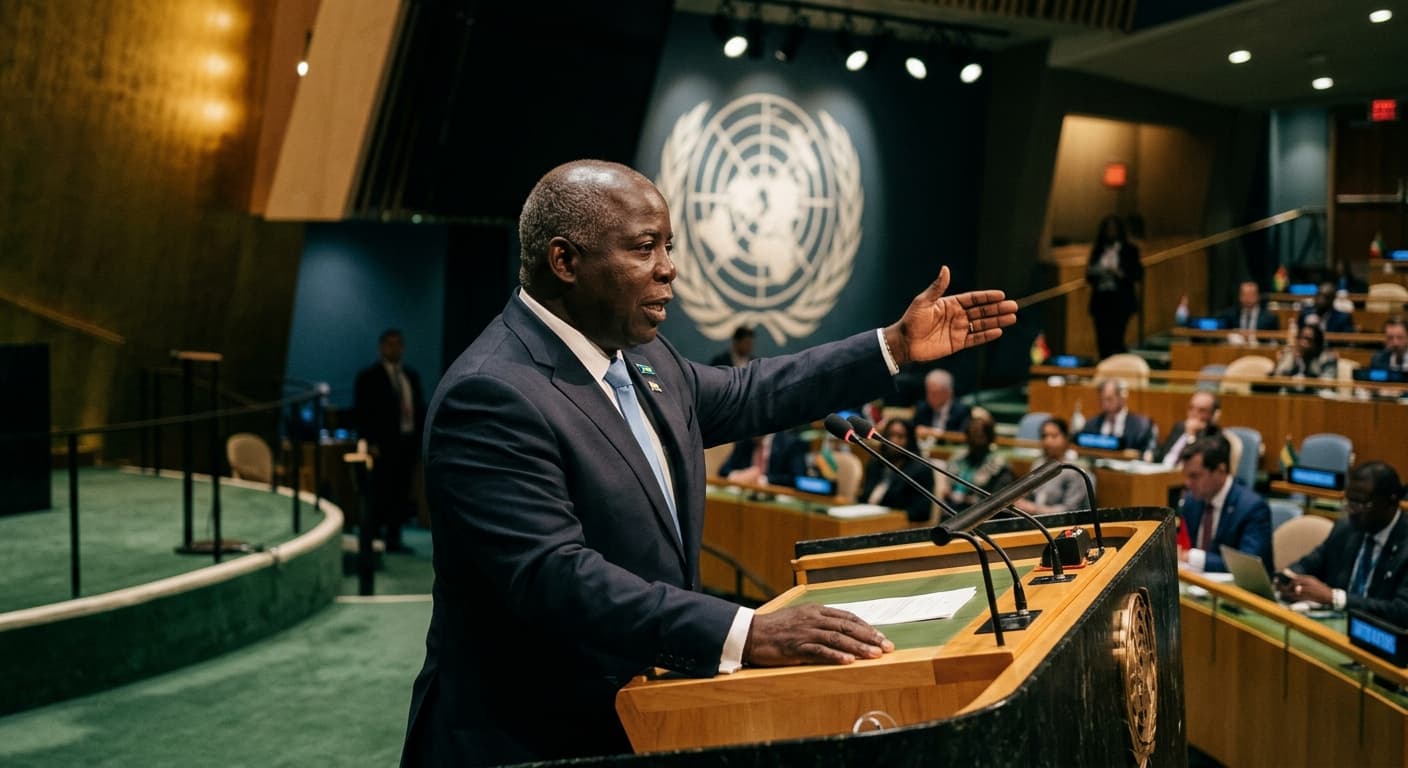
On September 27, 2025, Prime Minister Philip Davis of The Bahamas took the podium at the UN's 80th General Debate and delivered a speech that was part moral indictment, part job application. His address — titled "From the Ashes of History to the Challenges of Today: Why We Must Stand Together" — formally launched the Bahamas' candidacy for a non-permanent Security Council seat for the 2032–33 term, framing it not as vanity but as representation. "This is not a candidacy just for ourselves," Davis said. "It is for every small state that not only insists that its voice must count, but also knows that we have much to contribute in matters of global peace."
UN General Debate
The power play is layered. Davis, fresh off a historic re-election in May 2026 — the first Bahamian leader since 1997 to win two consecutive terms — has political capital to spend, and he's spending it on a long-game diplomatic campaign. The 2032–33 timeline gives Nassau nearly seven years to build the coalition needed to win a Security Council vote, while positioning itself as the credible voice of the 38-member Alliance of Small Island States (AOSIS). Barbados PM Mia Mottley used the same UNGA stage days earlier to demand a rotating permanent seat for island nations, telling the chamber: "You cannot ask us to show up for family photos and votes when you need them, and then exclude us from the family's decision-making." Al Jazeera The Caribbean is no longer asking — it's organising.
The Neighborhood Demands: Haiti and Cuba
The most operationally significant section of Davis's speech concerned Haiti. The Kenya-led Multinational Security Support Mission (MSS), which the Bahamas has contributed personnel to, was approaching its mandate expiry at the end of September 2025 with little to show. Davis was blunt: "That mission must evolve into a force strong enough to meet the still-present threat of violence and lawlessness." But his real ask was institutional — a dedicated United Nations Support Office for Haiti, a permanent coordinating body to "sustain international attention, strengthen institutions, and nurture democracy."
Bahamaspress.com
This was shrewdly timed. The Brookings Institution reported that the Trump administration had already proposed moving toward a UN Support Office for Haiti in August 2025, and the Security Council approved a new "Gang Suppression Force" on September 30 — three days after Davis spoke. Brookings Davis aligned the Bahamas with a policy direction that Washington was already pursuing, while adding a harder edge: "The lack of security in Haiti disproportionately, adversely impacts the security of The Bahamas. And we can no longer continue to carry so much of the burden."
On Cuba, Davis's language was unequivocal: "The time has come. Lift the embargo." He framed it as a matter of efficacy, not ideology — the embargo "has punished ordinary people without changing policy" — and offered engagement as the only viable alternative. The call aligns with an overwhelming UNGA consensus (the body voted 187–2 against the embargo in October 2025 for the 33rd consecutive year) but gains weight coming from a neighboring Caribbean state that must manage the real-world spillover of Cuban migration and instability. Al Jazeera
Climate as the Existential Through-line
Davis used the speech's emotional register — rising at times to an almost desperate pitch — to reframe climate action as self-interest for the powerful, not charity for the vulnerable. "Even if we do not agree on the causes," he said, "our lived reality is that our storms and hurricanes are your fires and floods." The Bahamas, a nation of roughly 400,000 people with a $12 billion economy, emits "far less than 1 percent of carbon generated by human activity," he noted, yet faces what he called "critical, urgent and existential" threats from rising seas and intensifying storms. UN General Debate
The line designed to travel was this: "If The Bahamas were to collapse because of the disproportionate risks we face from climate change, economic vulnerabilities and external geopolitical pressures, the world would lose more than the best tourist destination on the planet." It's a threat assessment dressed as a plea — and it worked precisely because it refused to beg. "We ask not for your pity. We do not ask for charity. We ask simply that you act in your own, enlightened self-interest."
What to Watch
The immediate deliverable is Haiti. Davis's call for a UN Support Office landed in an environment where the Security Council was already pivoting from the under-resourced MSS model to a more robust "Gang Suppression Force." Whether that force materialises at its envisioned 5,500 personnel — and whether the Bahamas' burden-sharing complaint translates into concrete burden-shifting — will be the first test of whether Davis's UNGA moment was theater or leverage.
The longer play is the Security Council bid. With seven years to campaign, Davis is betting that the small-state bloc's frustration with Security Council dysfunction — and Barbados's parallel push for structural reform — creates momentum no single big power can ignore. The Bahamas' vote count in 2032 will depend on whether Davis can convert a well-delivered speech into sustained diplomatic relationships. That work begins now.
Discover more

US Politics
Virginia GOP Rallies Rural Voters Against Red
Virginia Republicans are mobilizing rural voters against a Democratic-led redistricting referendum, a fight seen as pivotal to control in the 2026 midterms.
Global Politics
Xi Jinping Calls China-Russia Ties 'Precious'
Xi Jinping's description of China-Russia ties as 'precious' reflects a strategic imbalance, with Beijing dictating terms in the partnership.
US Politics
Virginia's Redistricting Referendum
Virginia's redistricting referendum is drawing a flood of dark money, shaping future elections and the fight for congressional control amid party stakes.

Economics
Fed's Amex AML order puts correspondent banking on notice
Federal Reserve's Amex AML order requires board-level controls and a 90-day plan; OCC fined the bank $350 million over enterprise-wide deficiencies.