Beijing's Legal Challenge to Philippine Sea
Decoding China's new legal strategy in the South China Sea
Model Diplomat9 min readAsia
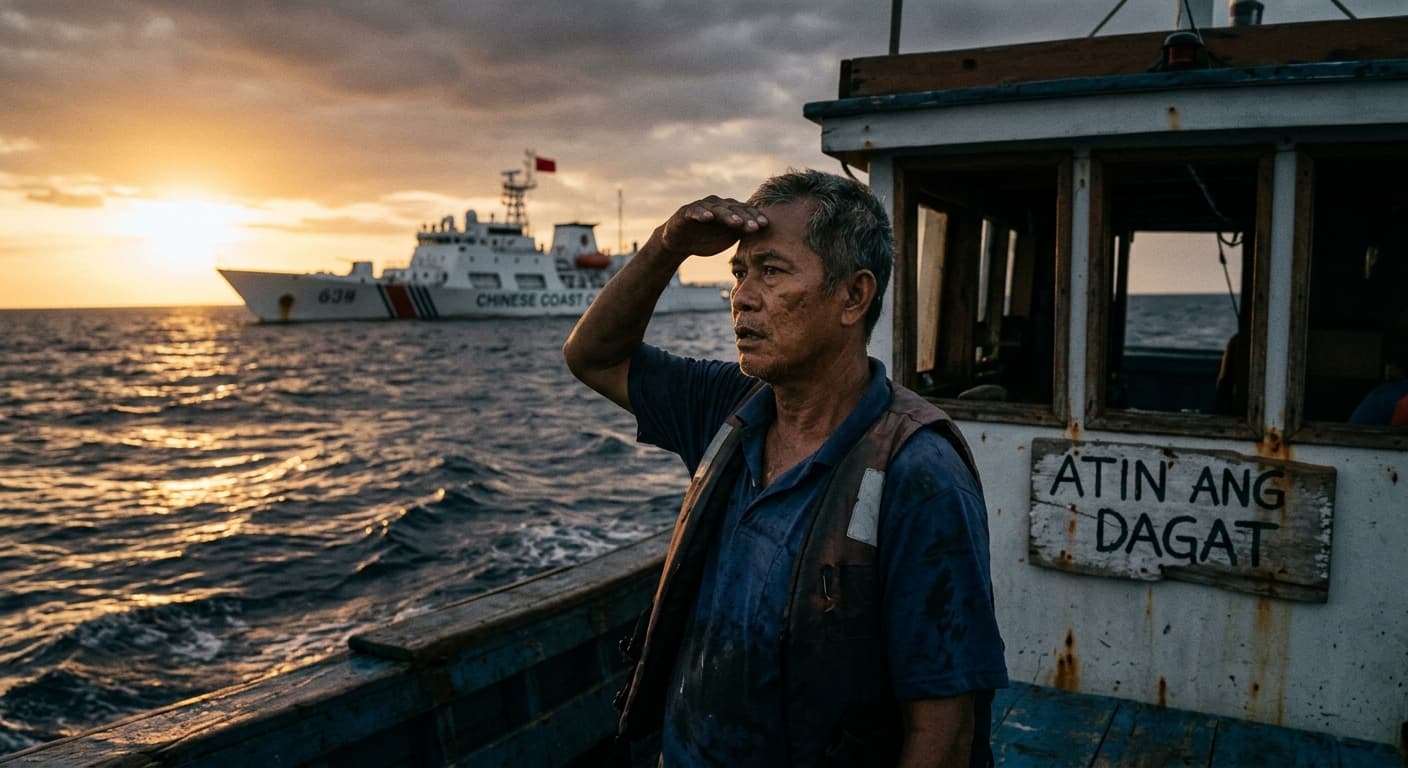
South China Sea: Beijing's legal blitz on Philippine claims, decoded
A Chinese think-tank report on July 8, 2026 reframes the South China Sea fight four days before the 10th anniversary of the Hague ruling. Here is what it means for Indo-Pacific security.
Beijing opened a new front in the South China Sea on July 8, 2026 — not with a coast guard cutter, but with a 400-page legal broadside timed to land four days before the 10th anniversary of the Permanent Court of Arbitration's ruling against China. The "Historical and Legal Critique of the Philippines' Territorial Claims in the South China Sea," released in Beijing by the China Institute for Marine Affairs under the Ministry of Natural Resources, argues that Manila's post-2022 assertion of the 2016 award constitutes illegal expansionism that "undermines the international legal system." The report is not aimed at Manila. It is aimed at the roughly 139 undecided UN member states whose votes will decide whether the arbitral award becomes a global reference point or a decade-old footnote — and it lands exactly as the Philippines, this year's ASEAN chair, prepares to convert its legal victory into concrete regional architecture.
What Beijing actually released
The document was produced by the China Institute for Marine Affairs together with the Chinese Academy of History, Wuhan University, Nanjing University, Beijing Jiaotong University, Guangdong University of Foreign Studies and Huaiyin Normal University, according to a summary published by China News Service. Its core claim is not new but is now packaged for export: Manila's title to Huangyan Dao (Scarborough Shoal) and features in the Nansha Qundao (Spratlys) sits outside the territorial limits fixed by the 1898 Treaty of Paris, the 1900 Treaty of Washington, the 1930 US–UK Convention, and the 1935 and 1987 Philippine constitutions.
That treaty-line argument is technically defensible on its own narrow terms — India's MP-IDSA conceded a decade ago that "strictly speaking, as per the facts presented, the Chinese contention is correct" on the Treaty of Paris boundary, before noting that Manila grounds its title on effective occupation and UNCLOS, not the treaty. What is new is the deployment. State outlet
CGTN framed the release as a broadside against Philippine "expansion," and
Xinhua's English wire pushed the "threat to the post-WWII order" line into third-country media within hours.
The choreography matters. Beijing timed the drop to July 8, four days before the arbitral anniversary, and to the run-up to the ASEAN Foreign Ministers' Meeting Manila will host. It is a preemptive strike on the diplomatic ground the Philippines intends to occupy.
Why the ground has actually shifted — and it is not the Philippines that moved
The CGTN framing — "shifting Philippine claims" — inverts the record. Under President Ferdinand Marcos Jr., Manila has done the opposite of shifting: it has hard-wired the 2016 award into statute. On November 8, 2024, Marcos signed the Philippine Maritime Zones Act and the Archipelagic Sea Lanes Act, which, CSIS's Greg Poling notes, "do not change the Philippines' claims … but clarify them while enshrining … UNCLOS and the findings of the 2016 South China Sea arbitration into domestic law." Those laws insulate the claims from any future Duterte-style pivot toward Beijing.
Manila also submitted an extended continental shelf claim to the UN Commission on the Limits of the Continental Shelf. The Philippine Note Verbale, available in the UN CLCS filings, explicitly anchors the submission in the 2016 award's finding that "none" of the disputed Spratly features generate an exclusive economic zone under Article 121(3) of UNCLOS. It is the arbitration turned into a hydrocarbon and seabed claim.
What has actually moved is Beijing. According to a February 2024 assessment by CSIS, China responded to the Maritime Zones Act on November 10, 2024, by publishing territorial baselines around Scarborough Shoal — the first time it had drawn baselines there since seizing the atoll from Philippine control in 2012. The Heritage Foundation's Edward Owen
documents that on April 10, 2026, Chinese vessels again used floating barriers to block Filipino fishermen at Scarborough, ten years after the tribunal ruled that exact behavior unlawful.
The July 8 report is the diplomatic cover for those facts. Every water-cannon incident and baseline decree adds reputational cost; the report is designed to argue that Manila's underlying title is void, so the coercion is enforcement rather than aggression.
The audience: the 139 fence-sitters
The scoreboard is where the real fight is. According to CSIS's Poling and Ray Powell, the number of governments publicly calling on China to comply with the 2016 ruling has grown from eight when Marcos took office in July 2022 to 27 plus the European Union today. China, by contrast, has public support from seven UN member states, two of which — Montenegro and Vanuatu — would likely abstain in a General Assembly vote. That leaves 139 members with no declared position.
Philippine officials have been quietly canvassing those capitals since the September 2024 UN General Assembly, where Manila convened senior officials from more than 20 states "to give a signal to China" that it is not isolated, according to CSIS. Manila is also weighing a second UNCLOS Annex VII case focused on environmental damage — the tribunal already found in 2016 that Chinese island-building caused "severe harm to the coral reef environment."
Beijing's July 8 report is aimed squarely at these audiences. Its authorship — a multidisciplinary panel spanning the Chinese Academy of History, Wuhan and Nanjing Universities — is designed to travel in English-language legal circles in a way that a Foreign Ministry statement cannot. Read the report closely and its footnotes point to a UN General Assembly information campaign, not to Manila.
Manila's leverage: ASEAN chair, and a first-island-chain that is filling up with allies
The Philippines' 2026 ASEAN chairmanship is where the July 8 salvo has its most immediate effect. Foreign Secretary Ma. Theresa Lazaro told ISEAS in February that Manila's "Peace and Security Anchors" pillar aims to "conclude an effective and substantive ASEAN-China Code of Conduct" within 2026. Beijing's report undercuts that pledge in one move: if Philippine claims are legally suspect, then a Code that references the 2016 award, UNCLOS Article 121(3), or Philippine baselines is unacceptable to China.
Analysts already treat the deadline as rhetorical. CSIS's post-Kuala Lumpur assessment judges that "meaningful progress in addressing ongoing security challenges will depend less on ASEAN consensus and more on [the Philippines'] expanding network of defense partnerships, particularly with the United States." The
Lee Kuan Yew School of Public Policy is blunter: internal divisions between Marcos and Vice President Sara Duterte over China policy are already "undermining Manila's credibility as 2026 ASEAN Chair."
The compensating move is the first-island-chain build-up. In testimony before the House Armed Services Committee on April 22, 2026, the Pentagon reported that the Department of War has committed "over $300M in infrastructure investments at EDCA locations to date," with an additional $144 million for FY2026, and is deploying HIMARS, the Navy-Marine Expeditionary Ship Interdiction System, and the Typhon missile system to Philippine EDCA sites. Balikatan 2026, run from April 20 to May 8, involved roughly 17,000–18,000 troops and saw
Japan's Self-Defense Forces conduct live-fire operations in the Philippines for the first time — a transformation from previous humanitarian-only roles.
Japan's Philippines relationship was upgraded to a Comprehensive Strategic Partnership in May 2026, and the Japan–Philippines Reciprocal Access Agreement, signed in 2024, entered into force in 2025, according to ISEAS. The "SQUAD" — Australia, Japan, the Philippines, and the United States — now meets at defense-ministerial level. Australia has committed to construction and maintenance at eight defense infrastructure projects across five Philippine bases, according to the
Australian Institute of International Affairs.
This is the Indo-Pacific realignment that the CGTN framing is designed to arrest. The Philippines is no longer a single treaty ally testing Beijing at Second Thomas Shoal. It is the pivot of a networked first-island-chain denial architecture whose legal justification is the arbitral award.
The primary document, and what it says
The load-bearing primary source in this dispute remains a public record. The Congressional Research Service, in its January 2025 update, flatly states:
An arbitral tribunal convened under the United Nations Convention on the Law of the Sea (UNCLOS) ruled in 2016 that the "Nine-Dash Line," which China uses to mark its territorial claims in the SCS, has "no legal basis," and that several PRC actions in the SCS violated the Philippines' sovereign rights. The tribunal found that Second Thomas Shoal, Scarborough Shoal, and the PRC-occupied Mischief Reef fall within the Philippines' EEZ.
The 2023 US–Philippines Bilateral Defense Guidelines, referenced in the same CRS document, extend Mutual Defense Treaty coverage to attacks "anywhere in the South China Sea" — including on coast guard vessels. That is the escalation ladder Beijing must navigate around, and it is why the fight has migrated to law and narrative.
Philippine Defense Secretary Gilberto Teodoro Jr. put the stakes in official terms at the Shangri-La Dialogue on May 31, 2026: "This landmark ruling affirmed the fundamental principle that maritime entitlements are derived not from 'historic rights' but from international law, particularly the 1982 United Nations Convention on the Law of the Sea." Beijing responded by barring him from entry to China — a measure of how central the personality is to the argument, and of how thin Beijing's legal case is when it must be enforced by visa denial.
What could revise the forecast
Three specific developments would shift the analysis:
- A Philippine UNGA resolution on the 2016 award. Manila retains the votes and is now equipped legally to file. Failure to file in September 2026 would signal that ASEAN cohesion still trumps arbitration diplomacy — and would validate Beijing's bet that the ruling is being quietly retired.
- A binding Code of Conduct that omits UNCLOS or the 2016 award. If Marcos closes a COC by December 2026 that Beijing can present as superseding the arbitration, the July 8 report will have paid for itself many times over. This is the
central concern among Singapore-based analysts.
- A serious kinetic incident at Scarborough or Second Thomas Shoal. The
2024 provisional resupply arrangement has held, but the Heritage Foundation counts 260 Chinese vessels in West Philippine Sea waters in early 2025 and repeated barrier deployments in April 2026. A single fatality would activate the Mutual Defense Treaty debate and blow through any legalistic scaffolding either side has erected.
Watch these dates:
- July 12, 2026 — Tenth anniversary of the arbitral award. Expect a Philippine ASEAN-chair statement, a US Senate resolution (S.Res. 760,
already introduced), and a coordinated response from Japan and Australia.
- September 2026 — UN General Assembly high-level week. Manila's third canvass of undecided states.
- November 2026 — ASEAN Summit in Manila. The moment the Code of Conduct deadline either delivers or does not.
Diplomat View
The July 8 report is Beijing conceding the legal terrain and fighting on narrative. That is a tell. For a decade, China's position has been that the arbitration is "null and void" and beneath comment. Publishing a 400-page rebuttal, in English-friendly form, through a Natural Resources Ministry think tank rather than the MFA, means Beijing now believes silence is losing it votes — particularly among the 139 UN member states whose stance is still up for grabs and among the ASEAN neighbors it hoped to keep out of the arbitration frame. The Philippines' shift is not in its claims, which are more legally consolidated than at any point since 1898; it is in its willingness to build a first-island-chain deterrence architecture on top of them, with Japan's live-fire units in Luzon and $300 million of American concrete at EDCA sites. If Marcos delivers a UNGA resolution and a COC that references UNCLOS by name before December, this analysis holds and Beijing's report will read as a rearguard action. Revise the forecast if Manila fails to file at UNGA in September, or if a Duterte-aligned bloc peels off ASEAN cohesion at the November summit — in which case the 10th anniversary will mark not the entrenchment of the arbitral award, but the beginning of its slow burial.
The bottom line: Beijing's July 8, 2026 report is the clearest signal yet that China is losing the legal argument on the South China Sea, and knows it. The question is no longer whether the 2016 award is valid — it is whether Manila and its allies can convert a decade of legal wins into an enforcement architecture before Beijing can normalize its coast guard, baselines, and now scholarship as facts on the water. The next four months will decide it.
Discover more
US Politics
SNAP Food Assistance Faces Legal Challenges
In 2026, SNAP faces stricter eligibility rules and mounting legal challenges, threatening food assistance for the millions of Americans who rely on the program.
Global Politics
Trump's Conflicting Messages on Iran War
Trump's mixed messages on Iran reflect a strategy of audience management, benefiting Tehran amid a complex geopolitical landscape.

India
BJP's Misunderstanding of Women's Quota Needs
The BJP's linking of the Women Reservation Bill to delimitation risks delaying women's empowerment in India, misreading the aspirations of female voters.

Economics
Fed's Amex AML order puts correspondent banking on notice
Federal Reserve's Amex AML order requires board-level controls and a 90-day plan; OCC fined the bank $350 million over enterprise-wide deficiencies.