BarMar Hydrogen Pipeline Enters FEED Phase
NaTran's BarMar pipeline moves to detailed engineering; Germany joins political table.
Model Diplomat8 min readEurope
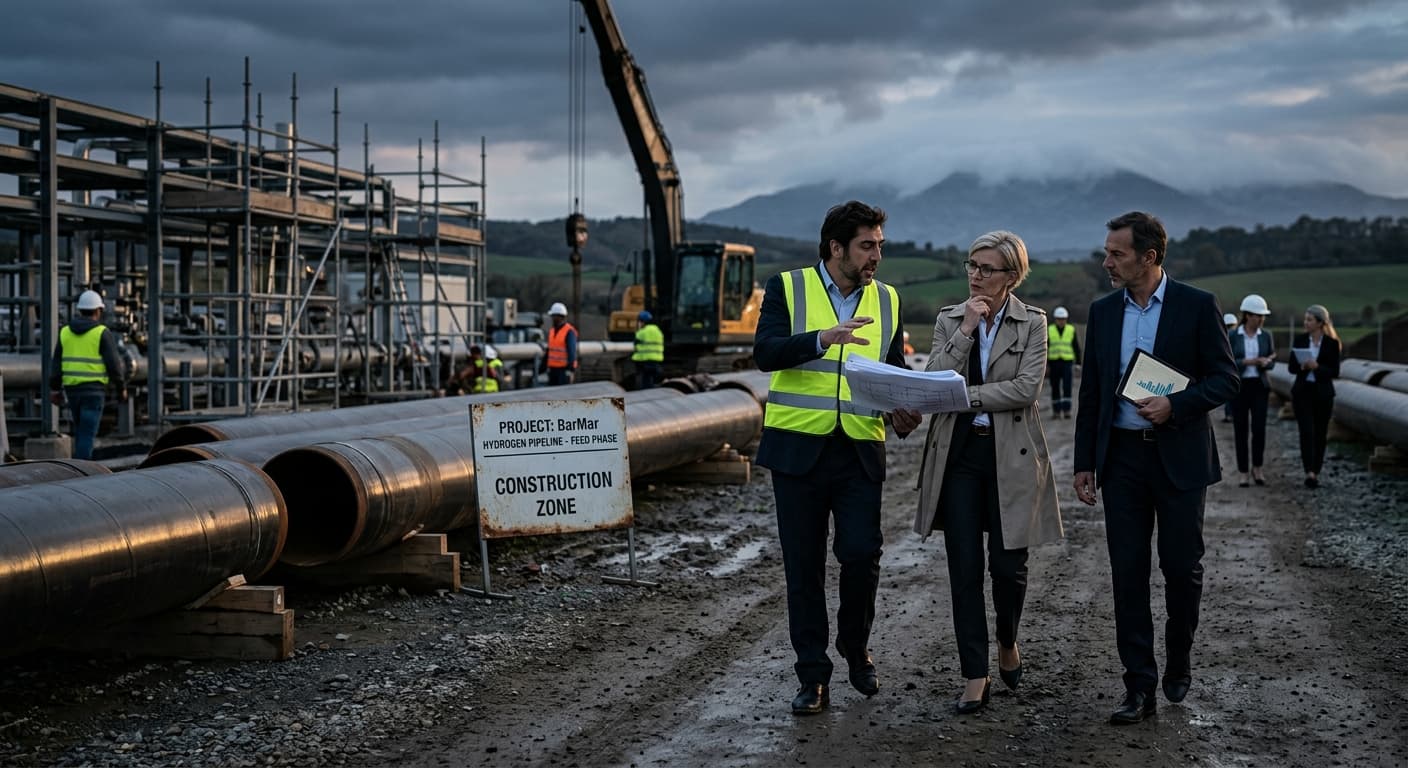
BarMar Enters Detailed Engineering — and Germany Finally Joins the Table
NaTran's July 16, 2026 announcement that the Barcelona–Marseille hydrogen pipeline has moved into Front-End Engineering Design marks the corridor's escape from the MidCat graveyard — but the real battle now is whether 2 Mt/year of demand materializes at a price European industry will pay.
On July 16, 2026, the H2med consortium confirmed that BarMar, the planned subsea hydrogen pipeline linking Barcelona and Marseille, has cleared pre-engineering studies and officially entered its Front-End Engineering Design (FEED) phase — the last technical gate before a Final Investment Decision, with a commercial operation target of 2032. The milestone is real: pre-FEED confirmed technical feasibility, an advanced corridor route is defined, and the EU has already committed €28.3 million in Connecting Europe Facility funding to underwrite the studies. But the decisive shift is political. Ten days earlier, on July 6, Germany sat down at the South-West Europe energy table for the first time — joining the French, Spanish, and Portuguese ministers and European Energy Commissioner Dan Jørgensen in Paris. That meeting, not the engineering paperwork, is what tells you the corridor has finally cleared the political gravity well that killed its predecessor.
NaTran
From MidCat's corpse to a hydrogen backbone
BarMar is not a greenfield idea. It is the second coming of MidCat, the gas pipeline that France and Spain argued over for a decade before financing collapsed in 2019. The strategic geography is identical: the Iberian Peninsula is Europe's most renewable-rich and most grid-isolated corner, walled off from the continental market by the Pyrenees and French reluctance to host a transit route. Spain and its gas network operator Enagás were pushing to revive cross-border links as early as 2022, with Madrid estimating its side of a Pyrenean pipeline could be operational within months — but only if Paris dropped its opposition. Al Jazeera MidCat died on French opposition and weak demand signals. BarMar survives because the fuel changed — hydrogen, not gas — and because Berlin's calculus changed with it.
Germany's entry into the South-West Europe High-Level Group is the project's quiet turning point. For years, the corridor was a Franco-Iberian project with German ambivalence. Now, with Russian pipeline gas gone and German industry scrambling for decarbonized feedstock, Berlin needs southern hydrogen the way it once needed eastern gas — and it needs a route that does not depend on a single supplier. The corridor's PCI architecture, formally designated as corridor 9.1 in the EU's second PCI/PMI list adopted December 1, 2025, strings together six links: Portuguese backbone, CelZa (Portugal–Spain), Spanish backbone, BarMar (Spain–France), HyFen (France–Germany), and H2Hercules South (Germany). European Commission BarMar is the subsea keystone. Without it, Iberian hydrogen has nowhere to go. With it, the corridor can theoretically carry up to 2 million tonnes of green hydrogen per year — roughly 10% of the EU's targeted early-2030s consumption.
Enagás
The consortium structure tells you who holds the leverage. BarMar is led by NaTran — the former GRTgaz, rebranded as France's dedicated hydrogen and gas TSO — with Teréga and Enagás as partners. The Spanish side brings the renewable resource and the production ambition; the French side controls the physical exit point at Fos-sur-Mer and the compressor station at Barcelona. BarMar CEO Francisco de la Flor framed the FEED entry as "moving from feasibility studies to concrete industrial modelling, a key step towards supporting Europe's decarbonisation objectives." NaTran The phrasing is deliberate: until now, BarMar has been a slide deck. FEED is where numbers get attached to steel.
The engineering phase and what it must produce
FEED is not a formality. According to NaTran's July 16 release, the phase must deliver four concrete outputs before construction procurement can begin: confirmation of the final pipeline route and design, finalization of the Barcelona compressor station layout, preparation of permitting files, and technical specifications for material procurement. The next step is awarding the FEED engineering contract and an offshore detailed marine survey. The FEED studies will also produce the technical basis partners and investors need to reach a Final Investment Decision — the moment capital commits and the project either breaks ground or stalls. NaTran
The environmental dimension is live. The release notes that an environmental impact assessment is still ongoing and that public consultations in France and Spain concluded in July 2026. In France, concertation guarantors will publish a feedback report with recommendations the promoters must absorb. This is the MidCat lesson applied: cross-border energy infrastructure in this region dies in permitting and public opposition, not in engineering. The fact that the corridor route was already adjusted based on initial EIA findings signals the promoters know this. Catalan activists have already mapped resistance along the H2med route, framing it as "energy colonisation" that diverts Iberian land and water resources to serve distant northern European markets. Observatori del Deute en la Globalització
The EU's funding architecture is the scaffolding holding this together. CINEA, the Commission's infrastructure executive, confirms BarMar received €28,336,978 under the 2024 CEF-E call, with NaTran as lead and GRTgaz, Teréga, and Enagás as partners — formally listed in the Commission's implementing decision as project 9.1.4-FRES-S-M-24-H2Med BarMar. European Commission That grant covers studies, marine surveys, environmental assessments, and permitting — not construction. The second PCI/PMI list, adopted December 1, 2025 and formally published April 29, 2026, retained BarMar as PCI 9.1.4, preserving its accelerated permitting and regulatory advantages.
European Commission A new CEF-E call worth €600 million opened April 30, 2026, giving the consortium a fresh funding window for the next phase.
CINEA
Who wins, who loses, and what could break
The named winners are specific. Enagás secures a future beyond natural gas, positioning Spain as the entry point for a new European energy commodity. NaTran cements its role as France's hydrogen infrastructure monopolist before the market even exists. Germany gets a diversified supply route that does not depend on North Sea terminals or North African shipping. The Iberian Peninsula — long Europe's energy island — finally gets a physical bridge to continental demand, turning solar and wind surplus into a tradable export. Spanish Prime Minister Pedro Sánchez put the subsea segment's cost at roughly €2.5 billion in December 2022, with total H2med costs shared among Spain, Portugal, and France and EU funds sought to cover up to half. Reuters
The named losers are equally specific. Incumbent natural gas pipeline operators with no hydrogen transition plan face stranded assets. Regions along the route that bear environmental costs without local benefit — a dynamic Catalan civil society groups have already flagged — lose if compensation mechanisms are inadequate. ODG And European taxpayers and consumers lose if the pipeline is built and demand fails to materialize, leaving ratepayers to amortize a €2.5 billion asset through tariffs. The Institute for Energy Economics and Financial Analysis has warned that H2med risks becoming "a gas pipeline in disguise," noting that branding a project as hydrogen does not guarantee hydrogen will flow through it.
IEEFA
The demand question is the project's existential risk. Green hydrogen in Europe is not yet cost-competitive. Research published in Nature Energy in June 2025 found that African green hydrogen delivered to Rotterdam as ammonia would cost €4.2–4.9 per kilogram by 2030 without European de-risking — barely competitive with European domestic production estimated at €3–5 per kilogram. Nature Energy The first European Hydrogen Bank auction yielded a lowest bid of €2.8 per kilogram in Spain, suggesting that Iberian production costs are already among the continent's lowest — but still well above the €1–2 range that would make hydrogen competitive with natural gas in most industrial applications. BarMar's economics depend on closing that gap by 2032.
Academic research on bulk hydrogen transport at sea offers a mixed verdict on the pipeline approach. A 2023 study in the journal Energy compared submarine pipelines against compressed and liquefied hydrogen shipping across distances from 100 km to 5,000 km. For the 100 km distance, pipelines were the clear winner. For 2,500 km — roughly the BarMar route — the optimal choice depended on volume: at 100 kt/year, compressed hydrogen shipping won; at 1 Mt/year, either compressed or liquid shipping was competitive; only at very high volumes did pipelines regain the edge. d'Amore-Domenech et al., Energy BarMar's 2 Mt/year target sits at the high-volume end, which is where pipelines become most defensible. But that presupposes the demand exists to fill the pipe.
A 2025 techno-economic analysis from TU Berlin reinforced the case for pipeline infrastructure over ammonia conversion for European hydrogen distribution, finding that gaseous hydrogen via pipeline remained the cheapest import option at 99 €/MWh in 2030, beating ammonia by roughly 40%. The authors recommended that policymakers "prioritise pipeline infrastructure for hydrogen distribution" and cautioned against long-term reliance on ammonia as a hydrogen carrier. arXiv / TU Berlin This is the intellectual backing for BarMar's existence: if hydrogen is going to flow at scale across Europe, pipelines beat ships — but only if the scale arrives.
The Diplomat View
BarMar's entry into FEED is engineering progress, but the decisive variable is not the pipeline's design — it is Germany's commitment and the demand signal behind it. The July 6 ministerial in Paris, where Berlin joined the South-West Europe group for the first time, is the political event that gives the project its best chance of avoiding MidCat's fate. Germany's entry changes the corridor from a Franco-Iberian ambition into a four-country architecture with a credible demand anchor at the Rhine end.
The forecast: BarMar reaches Final Investment Decision by late 2027 if FEED completes on schedule, permitting clears in both countries, and at least one major German industrial offtaker signs a long-term hydrogen purchase agreement. Commissioning by 2032 is achievable but tight — a two-year slippage is the base case. The project fails or stalls if any of three conditions materialise: French permitting resistance revives the MidCat pattern, green hydrogen production costs in Iberia stay above €3.50/kg, or Germany secures cheaper hydrogen via North Sea or North African shipping routes first. The first FID catalyst to watch is the FEED contract award, expected in late 2026. The second is the next CEF-E funding round, where BarMar will seek construction-phase support. The third is whether a German chemicals or steel major — BASF, Thyssenkrupp, or Salzgitter — signs an offtake letter before the 2027 FID window closes.
What to watch
- FEED contract award and offshore marine survey tender — expected Q4 2026, per NaTran's July 16 release.
- French concertation guarantor report — the public-consultation feedback document, due in late 2026, will signal whether permitting opposition is manageable or MidCat redux.
- CEF-E 2026 call results — the €600 million round opened April 30, 2026; award decisions expected by early 2027 will determine whether BarMar gets construction-phase EU money.
- German offtake signals — any bilateral hydrogen purchase agreement between a German industrial major and an Iberian producer before FID would lock in demand and de-risk the investment case.
The bottom line: BarMar's survival past MidCat's grave is a real political achievement, but the pipeline's fate will be decided not by subsea engineering or EU grants — it will be decided by whether German industry signs hydrogen purchase contracts at a price that covers Iberian production costs. If it does, Europe gets its first hydrogen corridor by 2032. If it does not, BarMar becomes the most expensive feasibility study in EU history.
Discover more

US Politics
House Ethics Committee Pushes Sexual Miscond.
The House Ethics Committee has shifted responsibility for sexual harassment settlement records to the Office of Congressional Workplace Rights, complicating disclosure efforts.

India
BJP's Misunderstanding of Women's Quota Needs
The BJP's linking of the Women Reservation Bill to delimitation risks delaying women's empowerment in India, misreading the aspirations of female voters.

India
Delhi CM Rekha Gupta Blasts Opposition's Delm
Delhi CM Rekha Gupta's remarks on women's quota defeat reveal BJP's strategy for the 2029 Lok Sabha elections, focusing on delimitation.

Conflict & Security
Drone Warfare Killing Aid Workers at Unprec
Over 1,000 humanitarian workers killed in three years as cheap armed drones collapse legal protections. Gaza, Sudan, Ukraine, and DRC see deliberate targeting of aid convoys and hospitals with zero prosecutions.