Bangladesh debt repayments to double by 2029
Grace periods expire on Rooppur, Padma Rail, Metro as debt service hits $7.565B
Model Diplomat10 min readSouth Asia
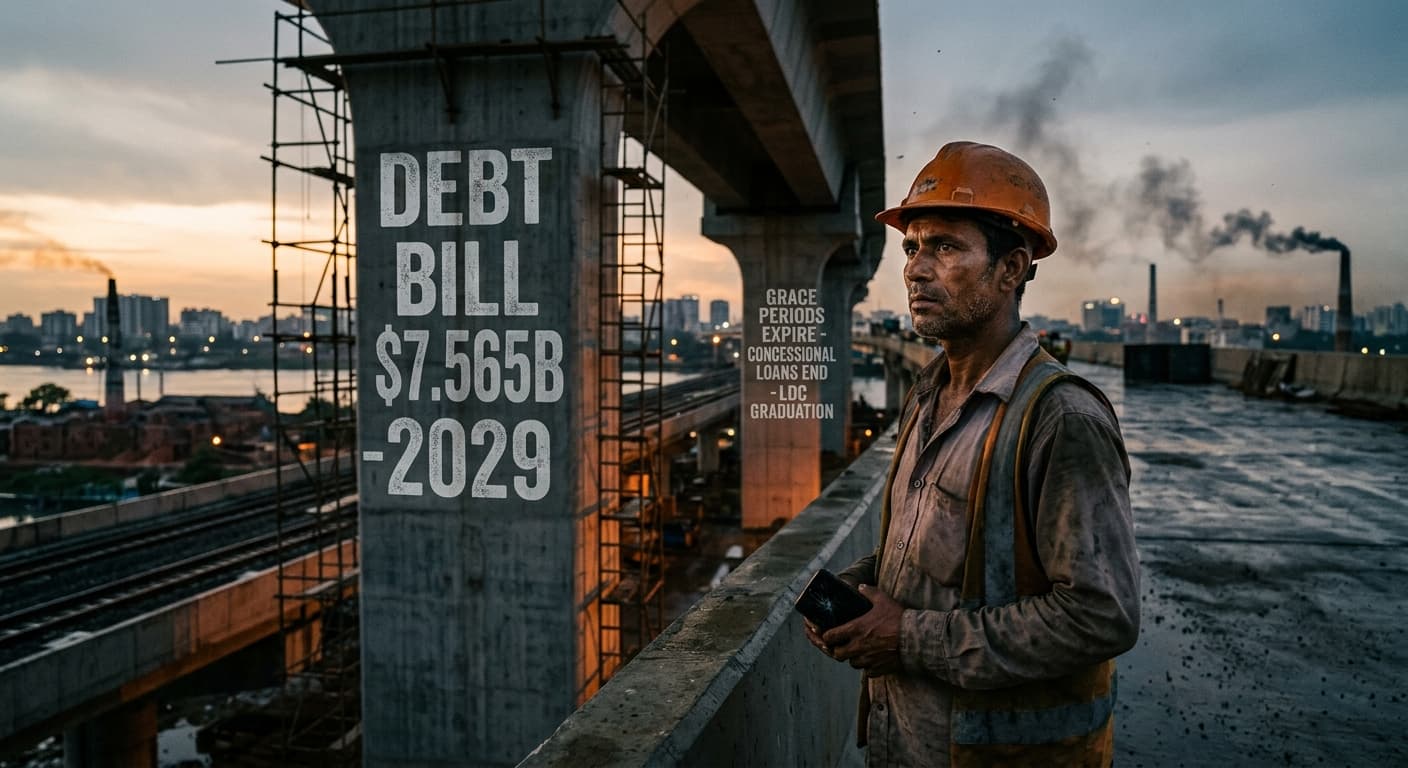
The bill arrives: Bangladesh's $7.5 billion debt reckoning lands in 2029 — and the grace periods are gone
External debt repayments projected to nearly double to $7.565 billion by FY2029 as megaproject grace periods expire, LDC graduation curtails concessional finance, and sanctions complicate the single largest repayment — just as Dhaka negotiates a new IMF programme.
On July 19, 2026, government projections published by Bangladesh's Finance Division and Economic Relations Division confirmed what analysts have warned about for months: the country's external debt-servicing obligations will hit $7.565 billion in fiscal year 2029 — nearly twice the $4.09 billion record set in FY2025. The Financial Express reports the numbers, but the story is the timing. Bangladesh's long-deferred infrastructure bill is arriving all at once, driven by the synchronized expiration of grace periods on three megaprojects, the scheduled November 2026 graduation from Least Developed Country status, and a sanctions regime that has turned the repayment of the country's single largest loan into a diplomatic puzzle.
The figure is not a forecast. It is a contractual certainty embedded in loan agreements signed over the past decade. The convergence is what makes it dangerous: Bangladesh is losing its concessional discount window at the exact moment the premium-rate bills come due.
The arithmetic: interest eats the room
The four-year trajectory reveals the mechanism. In FY2025, Bangladesh's total external debt servicing stood at $4.09 billion — $2.6 billion in principal and $1.49 billion in interest. The Financial Express reports that by FY2029, principal repayments alone will reach $4.276 billion, while interest payments balloon to $3.289 billion. That represents a 121 percent increase in interest costs over four years, far outpacing the growth in principal.
The accelerating interest bill is not an accident. A senior Economic Relations Division official cited in the FE article identified the shift from concessional, fixed-rate borrowing to market-based, floating-rate credits tied to benchmarks like the Secured Overnight Financing Rate (SOFR) as the primary driver. The CPD's 2026 economic review quantified the shift: debt service payments rose from $3.2 billion in FY2020 to $7.2 billion in FY2025 — a 128.2 percent increase in five years. CPD The SOFR itself, while moderating, averaged 3.74 percent as of May 2026, still well above the near-zero rates that prevailed when many of these loans were negotiated.
The math is unforgiving. In July 2025 alone, Bangladesh repaid $446.68 million in principal and interest to development partners while receiving only $202.75 million in new disbursements — a net outflow of nearly $244 million in a single month. BSS The "net negative resource transfer" that analysts warned about is no longer theoretical. It has already begun.
Meanwhile, the total outstanding foreign debt stood at approximately $78 billion as of February 2026, Finance Minister Amir Khosru Mahmud Chowdhury informed Parliament. BSS Broader measures that include private sector and state-owned enterprise borrowing place the figure closer to $113.5 billion.
Al Jazeera
The megaproject reckoning
Three projects dominate the repayment cliff, and each has its own political-economy story.
The Rooppur Nuclear Power Plant is the largest and most geopolitically complicated. The $12.65 billion project — 90 percent financed through a Russian state credit of $11.38 billion at LIBOR plus 1.75 percent, capped at 4 percent, repayable over 28 years with a 10-year grace period — is now entering its repayment phase. BIISS The first uranium shipment arrived in October 2023.
Al Jazeera Commercial operation of the first unit was expected to begin in 2024, though delays have pushed the timeline.
But repaying Russia has become a sanctions-era gauntlet. After major Russian banks were cut off from SWIFT, Bangladesh's $300 million interest payment was rerouted through Chinese renminbi channels — using China's Cross-Border Interbank Payment System, according to a Western estimate — after Russia initially refused the currency on concerns of conversion losses. CSIS Bangladesh reportedly owed Russia nearly $1 billion in accumulated interest and related costs as of early 2025.
Observer Research Foundation A repayment account was eventually established in Dhaka, but the funds remain trapped within Bangladesh's financial system — a workaround, not a solution.
The Padma Rail Link Project is a simpler but no less significant line item. China Eximbank provided a $2.684 billion preferential buyer's credit with a 2 percent fixed interest rate, a 6-year grace period, and a 20-year maturity. AidData The fixed rate insulates it from SOFR volatility, but the principal repayments are now beginning — just as China's overall bilateral exposure to Bangladesh reached $6.63 billion by end-2024, making Beijing one of the country's three largest bilateral creditors alongside Japan and Russia.
World Bank
The Dhaka Metro Rail and the broader portfolio of 20 megaprojects — which together cost approximately Tk 556,955.74 crore, with 61.17 percent financed by foreign assistance — have entered or are entering their repayment phases. The Daily Star Roughly 57.5 percent of the loans carry 10-year grace periods and 72.5 percent have repayment terms of 20 years or more, meaning the principal repayments only started becoming visible recently.
The cumulative weight is what matters. During the 2008-09 to 2025-26 period, Bangladesh received $85.99 billion in foreign loans but repaid only $22.33 billion in principal and $8.7 billion in interest — a manageable net inflow. BSS That era is ending.
LDC graduation: the discount window closes
On November 24, 2026, Bangladesh is scheduled to graduate from the UN's Least Developed Country category. CPD The milestone — hard-won through decades of rising per capita income and human development gains — carries a fiscal sting: access to concessional borrowing from multilateral and bilateral lenders will phase out precisely when Bangladesh needs it most.
The World Bank's International Development Association, the Asian Development Bank's concessional windows, and bilateral soft-loan programmes will shift toward market-based terms. The IMF's January 2026 Article IV already moved Bangladesh's debt distress risk from "low" to "moderate," citing downward revisions of export data for FY23 and FY24 that pushed the present value of debt-to-exports and debt service-to-exports ratios above thresholds under stress scenarios. IMF Fitch subsequently revised the outlook to negative in May 2026.
CPD
The Economic Relations Division has sent a letter to the UN Committee for Development Policy requesting a deferral of graduation until 2029. CPD Whether it is granted is uncertain — the country continues to meet all three graduation criteria — but the request itself signals the depth of official anxiety.
Dr Fahmida Khatun, Executive Director of the CPD, described the dynamic plainly: "Repayment time has arrived for several of the loans that were taken. Since 2024, the pressure of loan repayment has been increasing." CPD Foreign aid commitments fell 22.5 percent and disbursements 16.63 percent in FY2025, even as repayment obligations rose.
Who wins, who loses
The redistribution is already visible. Russia and China — the non-Paris Club bilateral creditors — are structurally protected. Russia's Rooppur loan is denominated in dollars with interest capped at 4 percent; China's Padma Rail Link credit carries a fixed 2 percent rate. Both will get paid, albeit through alternative corridors in Russia's case. The principal risk lies not with the creditors but with the debtor.
Multilateral lenders — the World Bank's IDA, the ADB — hold preferred creditor status and receive priority in debt service. Their exposure to Bangladesh ($45.9 billion in outstanding multilateral debt by 2024, with IDA alone accounting for $20.7 billion) is large but secured. World Bank
The losers are domestic. The Tk 403 billion required for interest payments alone in FY2029 — equivalent to roughly $3.289 billion at current exchange rates — will be drawn from the national budget, directly competing with the Annual Development Programme, education, and healthcare. The Financial Express With a tax-to-GDP ratio of just 6.9 percent in FY2025 — among the lowest in the world, and below the IMF's already-modest target of 7.2 percent for FY2026 — the fiscal capacity to absorb the shock is extremely limited.
IMF
The banking sector adds a second layer of vulnerability. Non-performing loans reached 30.6 percent of total banking sector loans as of December 2025. CPD A stressed banking system cannot absorb a sovereign that is simultaneously crowding out private borrowers through increased domestic debt issuance to fund its dollar purchases for external repayment.
The undisbursed pipeline — estimated at $41.7 billion — sits as a paradox: money committed but not flowing, contingent on project implementation speeds that have slowed amid political uncertainty. The Financial Express
The IMF factor and the exit strategy
On July 16, 2026, the IMF confirmed that staff discussions on a new programme — a replacement for the $5.5 billion arrangement the current government exited after some conditions were deemed misaligned with national priorities — would occur "in the coming months." CNA The Fund's June 3 statement was calibrated: any new arrangement "would need to be based on Bangladesh's balance-of-payments needs and strong policy commitments anchored by a credible reform agenda."
IMF
The IMF's existing exposure to Bangladesh is manageable — projected total payments to the Fund in 2026 are SDR 87 million — but the signal matters. IMF A Fund programme provides not just liquidity but a policy anchor: exchange rate flexibility through the crawling peg adopted in 2025, revenue-enhancing measures, and banking-sector restructuring.
There are buffers. Reserves stood at $36.66 billion gross in July 2026, with remittances — a record $3.775 billion in March 2026 alone — providing a stabilising inflow. BSS
BSS But the reserves are adequate only in peacetime arithmetic. An external shock — a commodity price spike from the Middle East conflict, a remittance slowdown, a further depreciation of the taka — would accelerate the timeline.
Policy Exchange Bangladesh Chairman Dr Masrur Reaz has called for "strict restrictions on high-interest, short-term commercial borrowing" and prioritisation of long-term concessional lines. The Financial Express The government's FY2027 budget speech signalled an intention to move "away from a debt-driven growth model" and restore Bangladesh's debt risk rating from "moderate" to "low" through stronger revenue mobilisation.
BSS
Diplomat View
Bangladesh is not Sri Lanka. The external debt-to-GDP ratio is 19.2 percent — sustainable by any conventional metric. World Bank Reserves cover roughly 4 months of imports. The IMF assesses capacity to repay the Fund as adequate, though risks are elevated. There is no balance-of-payments crisis — yet.
But the conventional metrics are backward-looking. They measure the stock of debt against last year's GDP. They do not capture the compression of repayment schedules, the shift from concessional to market-rate terms, the sanctions-induced payment-channel fragility, or the fiscal crowding-out that will intensify as the government absorbs Tk 403 billion in annual interest payments into the domestic budget — at precisely the moment the LDC graduation strips away trade preferences and concessional access.
The historical parallel is not Sri Lanka's 2022 default — Bangladesh's creditor structure is more multilateral and its debt stock more concessional. The parallel is the structural trap that catches countries precisely at the transition from low-income to middle-income status: reduced access to concessional finance before the domestic tax base has expanded enough to replace it. The IMF's own alternative policy scenario models what happens if fiscal and banking reforms are delayed: dampened growth, elevated inflation, accelerated depreciation, and significant reserve depletion through negative feedback loops. IMF
The next 18 months are decisive. If the LDC graduation deferral is denied and the new IMF programme locks in revenue reforms that raise the tax-to-GDP ratio toward the projected 9.3 percent by FY2027, the debt trajectory remains manageable and reserves buffer the transition. If the graduation proceeds without adequate transitional trade arrangements — the EU's GSP+ extension and the WTO's post-LDC support measures remain under negotiation — and the revenue reforms stall at the 7.2 percent plateau, the forecast is a slow fiscal asphyxiation, with debt service consuming an ever-larger share of a stagnant revenue base.
The bill has been printed. The question is whether Dhaka can change the payment terms before it comes due.
Key Takeaways
- FY2029 debt service: $7.565 billion projected — nearly double the $4.09 billion FY2025 record. Interest costs ($3.289 billion) grow faster than principal ($4.276 billion), driven by the shift from concessional fixed-rate to SOFR-linked floating-rate debt.
- Megaproject grace periods expire simultaneously: Rooppur Nuclear ($11.38 billion Russian loan), Padma Rail Link ($2.68 billion Chinese credit), and Dhaka Metro Rail enter repayment phases, ending the net-inflow era.
- Sanctions complicate the largest repayment: Russia's exclusion from SWIFT has forced Rooppur payments through Chinese renminbi channels and blocked Dhaka-based accounts — a fragile, unguaranteed workaround that adds geopolitical risk to fiscal risk.
- LDC graduation on November 24, 2026 phases out concessional borrowing access. Dhaka has requested a deferral to 2029. The request's outcome will determine whether the discount window stays open through the peak repayment years.
- Tax-to-GDP ratio at 6.9 percent — one of the world's lowest — leaves no fiscal space to absorb the Tk 403 billion in annual interest payments. The IMF programme and domestic revenue reform are non-negotiable.
- Reserves at $36.66 billion provide a buffer, but an external shock — commodity spike, remittance decline, taka depreciation — would compress the timeline dramatically.
What to watch
- November 24, 2026: Bangladesh's scheduled LDC graduation date. The UN Committee for Development Policy's response to Dhaka's deferral request will be the single most consequential decision for the debt trajectory.
- IMF programme negotiations: Scheduled "in coming months" as of mid-July 2026. The programme's conditionality — particularly on revenue mobilisation, exchange rate flexibility, and banking-sector restructuring — will define the fiscal space available through the peak repayment years.
- Rooppur Unit 1 commercial operation: Rosatom expects first power in 2026. Whether the plant generates enough revenue to service its own debt — or becomes a net drain consuming dollars for fuel imports — is the under-watched variable.
- EU GSP+/FTA negotiations: The three-year post-graduation extension of EU preferential market access expires in November 2029. Without an Economic Partnership Agreement or FTA, Bangladesh's exporters face MFN tariffs — compounding the external-sector pressure at the exact moment debt service peaks.
Correction: An earlier version of this article stated that Bangladesh's scheduled LDC graduation carries a fiscal sting on concessional borrowing. The LDC graduation primarily affects preferential trade access and LDC-specific funds, not all concessional borrowing, which is determined by income classification. The text has been updated for accuracy.
Discover more
Global
Cameroon's $1.4B AfDB Paradox
Cameroon's AfDB portfolio disburses at just 26% despite record approvals of $1.4 billion. Seven projects worth $473 million risk cancellation as state capacity lags behind ambition.

Economics
Debt Offices: Key to Crisis Prevention
OMFIF argues that low-income countries need statutory debt offices to prevent recurring financial crises, as seen with Chad, Ethiopia, Ghana, and Zambia.
Global
Ghana's $700M Eurobond Early Repayment
Ghana pays $700 million Eurobond debt early, showcasing a new model for Sub-Saharan Africa's debt management amid economic recovery.
Economics
Nigeria's Economic Reforms: A Fragile Success
Nigeria's economic reforms have led to a fragile stabilization, with inflation at 15.4% and reserves at $49bn, but risks loom ahead.