Cameroon's $1.4B AfDB Paradox
AfDB approves $1.4B but Cameroon spends only 26%
Model Diplomat8 min readAfrica
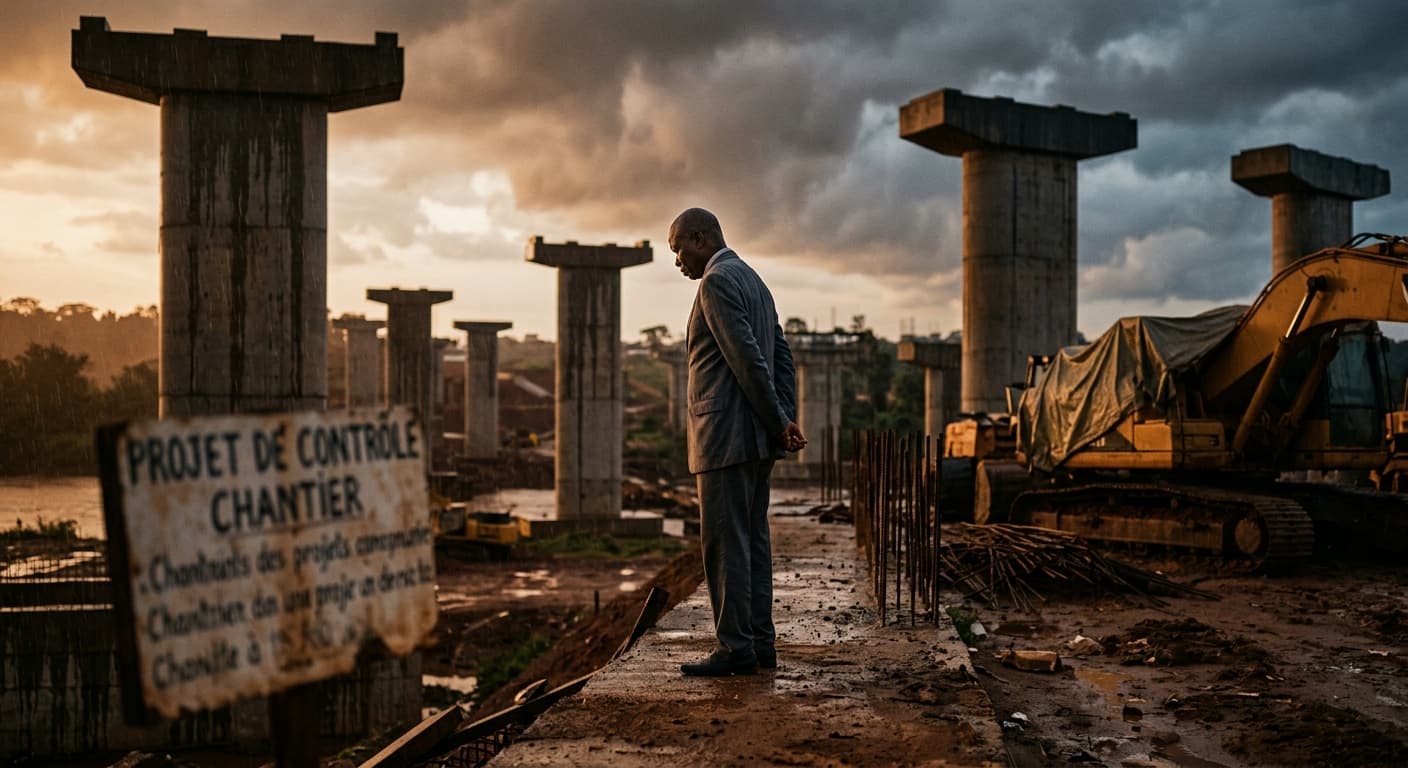
Cameroon's $1.4 Billion AfDB Paradox: The Bank Keeps Writing Cheques the Country Can't Cash
Cameroon has secured 67.9% of its five-year AfDB envelope in under three years, but barely a quarter of the active portfolio has been spent. The real bottleneck is not money — it is the machinery of the state.
YAOUNDÉ — The African Development Bank has approved 833.8 billion CFA francs in new financing for Cameroon since the launch of its 2023–2028 Country Strategy Paper, equivalent to roughly $1.4 billion, according to data the institution published on July 17, 2026. That represents 67.9 percent of the five-year indicative envelope of 1,227.5 billion CFA francs — committed in barely half the strategy period. Yet across the entire active portfolio, now standing at 1,629.2 billion CFA francs, the cumulative disbursement rate has stalled at 26 percent.
The numbers were presented four days earlier, on July 14, during a joint review in the Cameroonian capital. They tell two stories. The first is one of growing confidence: the AfDB has raised its overall commitments to Cameroon by nearly 31 percent since the CSP began, to 1,603.6 billion CFA francs, and expanded the country's annual borrowing headroom under the sovereign window by 57.1 percent, to 429.4 billion CFA francs. The second — and the one that will define the remainder of the strategy period — is that Cameroon cannot convert approvals into concrete fast enough, and the clock is running.
The Absorption Gap, in Numbers
The 26 percent disbursement figure covers the entire active portfolio, including operations predating the 2023–2028 CSP, according to Business in Cameroon. It does not mean only 26 percent of the newly approved 833.8 billion CFA francs has been spent. But it captures the structural drag that has become Cameroon's signature in the multilateral development finance landscape: approval velocity far outpacing execution velocity.
This is not an AfDB-only problem. As of June 30, 2026, Cameroon's World Bank portfolio disbursed at 18.7 percent across 21 active projects — national projects at 20.3 percent, regional ones at just 17.2 percent, reported Business in Cameroon separately. Only five national projects had crossed the 50-percent disbursement threshold. At the same time, total World Bank commitments to Cameroon had swelled to roughly $4.5 billion, with $826 million added since April 2023.
The parallel is striking: both the AfDB and the World Bank are lending to Cameroon at record levels. Cameroon is not spending it.
As of September 30, 2025, Cameroon was sitting on 5,641.9 billion CFA francs in idle external financing, according to the Caisse Autonome d'Amortissement — the national debt office. Of that, 4,714.7 billion CFA francs represented signed loans with zero disbursement yet. Another 927.2 billion awaited final loan agreements. Roughly 63 percent of the undisbursed funds, or about 2,856.4 billion CFA francs, were classified as "constrained" by donor no-objection delays, counterpart-funding shortfalls, expropriation procedures, and rights-of-way disputes, Investir au Cameroun reported.
Where the Money Is (and Isn't) Going
The AfDB portfolio reveals a near-total bet on hard infrastructure. Transport absorbs 53.83 percent of active financing — roughly 877 billion CFA francs — followed by energy at 22.32 percent, or around 364 billion CFA francs. Together they command more than three-quarters of the Bank's exposure.
Agriculture accounts for 10.8 percent. The social sector gets 9.19 percent.
The Economy Ministry, for its part, points to tangible deliverables: over 570 kilometers of roads built, the 420-megawatt Nachtigal hydropower plant now operational, and more than 133,000 metric tons of fertilizer and improved seeds distributed. Ongoing operations are projected to create over 14,500 direct jobs, with emphasis on youth and women.
The risk is not in the ambition — it is in the pipeline. Infrastructure projects are the most procurement-intensive, the most exposed to land-acquisition delays, and the most vulnerable to security disruptions. Cameroon's Anglophone regions remain in conflict, and the Far North faces Boko Haram spillover. The Babadjou–Bamenda road corridor, a flagship transport project co-financed by the World Bank, had to restructure repeatedly because of cost overruns, resettlement of 356 project-affected persons, and security conditions that slowed civil works to a crawl. As of mid-March 2026, the Bamenda urban crossing had reached just 16 percent physical progress, according to a World Bank implementation status report archived in April 2026.
The 292-Billion-Franc Warning
The consequences of delayed execution are material. Seven AfDB-funded operations valued at roughly 292 billion CFA francs — about $473 million — are at risk of cancellation because financing agreements were not signed within the Bank's deadlines, or, in one case, a signed project has seen no disbursement for more than 15 months, according to Business in Cameroon.
The largest single exposure is the Cross-Border Economic Basin Connectivity Program, specifically the Ngoura–Yokadouma road component, valued at roughly 207 billion CFA francs — more than 71 percent of the total at-risk funds. That project alone would connect some of Cameroon's most isolated southeastern territories to regional markets. It has not been signed.
Cameroon's administrative timelines reveal the scale of the problem against AfDB benchmarks, Africa Business Insight reported. The country averages 12 months to sign a financing agreement after project approval — against a three-month target. It takes 16 months for agreements to become legally effective, against a five-month benchmark. From approval to first disbursement, the average stretches to 21 months, nearly double the 12-month institution-wide standard.
Each month of delay incurs commitment fees on the unused balances. Inflation erodes the real value of the money before a single excavator breaks ground.
Léandre Bassolé, the AfDB's director general for Central Africa, captured the imperative at the July review:
"We need to shift the focus from procedures to results."
A Flicker of Improvement
Not every indicator runs in the wrong direction. The share of projects flagged red — those facing critical threats to their schedules or objectives — fell from 48 percent at the end of February 2026 to 26 percent in mid-July, a 22-point decline that brings Cameroon within a single percentage point of the AfDB's institutional target of 25 percent.
The turnaround follows an acceleration plan adopted jointly in February 2026. It mandates performance contracts for project managers, monthly sector-level reviews, and priority treatment of signed operations that have gone more than 15 months without a single disbursement.
The improvement is real but should not be mistaken for accelerated spending. Moving a project out of red-flag status lowers its operational risk profile. It does not pay contractors, pour concrete, or lay transmission lines. The disbursement rate — the only metric that measures money actually leaving the Bank's accounts — remains at 26 percent across the portfolio.
Why This Matters Beyond Yaoundé
Cameroon is the largest economy in the CEMAC zone, with a GDP of roughly $45 billion. Its performance as a borrower shapes the terms on which its neighbors — Chad, the Central African Republic, Gabon — access multilateral capital. When Cameroon underperforms on disbursement, it weakens the region's aggregate absorption data, which in turn influences AfDB and World Bank country performance ratings that govern future allocations.
The World Bank's FY25–FY29 Country Partnership Framework for Cameroon, published by the Bank, explicitly flags fragility, governance, and institutional capacity as binding constraints. Cameroon's IDA Resource Allocation Index for 2024 scored the country a 2.5 out of 6 on property rights and rule-based governance, and 3.0 on quality of public administration — both below the average for IDA borrowers. These are not abstract governance metrics. They are direct predictors of procurement delays, contract disputes, and the administrative friction that turns a 26 percent disbursement rate into a structural feature.
The AfDB's own Country Strategy Paper for 2023–2028, available through the Bank's document portal, anchors the partnership on transport corridor development and energy sector reform. Both are capital-intensive, procurement-heavy, and land-dependent — precisely the sectors where Cameroon's institutional weaknesses hit hardest.
The International Monetary Fund's seventh review of Cameroon's Extended Credit Facility, published in 2025, noted that the AfDB and the French Development Agency provided budget support in 2024, while World Bank budget support was delayed to end-March 2025. The program remains fully financed, but the warning is embedded: external partners are advancing money; the state is struggling to route it to the ground.
The 2026–2028 Stretch: A Race Against the Envelope
With 67.9 percent of the indicative CSP envelope already approved and the strategy not yet halfway through, the second half will be defined not by fundraising but by execution. There are only two paths.
If the acceleration plan holds — if performance contracts and monthly reviews actually compress signature-to-disbursement timelines — Cameroon could close the CSP period having spent what it borrowed and made a credible case for a larger envelope in 2028. The 57.1 percent increase in annual borrowing headroom suggests the AfDB wants that outcome.
If the current trajectory persists, the country faces a different scenario: a growing mountain of approved-but-idle commitments, incremental project cancellations, and a reputational penalty that will express itself in harder conditions, lower headroom, and less donor patience when the next strategy cycle opens.
The cancellation risk is not theoretical. The 292 billion CFA francs already flagged are roughly 18 percent of total new approvals under the CSP. Lose those, and the disbursement problem becomes self-reinforcing: fewer projects to spend on, less political urgency to fix the administrative machinery, and a worsening absorption ratio that scares off the co-financiers — the AFD, the EIB, the World Bank — who underwrite the most ambitious projects.
Diplomat View
The narrative that Cameroon has a financing problem is backwards. The AfDB has demonstrated it can approve money faster than Cameroon can spend it. The institution raised commitments by 31 percent and expanded borrowing capacity by 57 percent. The bottleneck is entirely on the receiving end — inside the ministries, the procurement commissions, the land registries, and the Treasury accounts where counterpart funds sit unprogrammed.
This is not a story of donor stinginess. It is a story of state capacity catching up with state ambition, and losing the race. The acceleration plan adopted in February 2026 is a credible intervention, but its success will be measured by one data point alone: whether the cumulative disbursement rate breaks above 35 percent by the next joint review. If it does not, expect the AfDB to quietly decelerate new approvals in the 2027–2028 window — not because Cameroon's creditworthiness has deteriorated, but because the Bank's own portfolio performance metrics will force it to prioritize borrowers that can actually spend the money they have already been promised.
Three catalysts to watch:
- December 2026: The next bi-annual joint portfolio review. If red-flagged projects stay at or below 25 percent but disbursement remains at 26 percent, the acceleration plan is improving paperwork but not outcomes.
- First quarter 2027: The deadline for several of the seven at-risk projects — including Ngoura–Yokadouma — to sign financing agreements or face formal cancellation by the AfDB Board.
- Mid-2027: The CSP mid-term review, at which the AfDB will formally re-assess the indicative envelope. A disbursement rate still below 30 percent would almost certainly trigger a downward revision — not in commitments already made, but in the pace of new ones.
The Bottom Line
Cameroon's 26 percent AfDB disbursement rate is not a statistic — it is the difference between 570 kilometers of roads and the thousands more that were promised, between Nachtigal's 420 megawatts and the grid that should have been built to carry them. The Bank has done its part. The question now is whether the state that secured the money can deliver the machinery to spend it before the window closes.
Discover more

US Politics
US Launches $166B Tariff Refund Portal
The US is launching a $166 billion tariff refund portal to aid importers hit by Trump-era tariffs, with major implications for trade and supply costs.
India
Rajnath Singh's Durga Squad for 2026 Polls
Rajnath Singh's Durga Squad promised women's safety in Bengal but has since disappeared from the agenda, revealing BJP's true priorities.
India
700 Activists Accuse PM Modi of MCC Breach
Over 700 activists allege PM Modi breached election code with a televised address attacking opposition parties just before state elections.

Economics
Fed's Amex AML order puts correspondent banking on notice
Federal Reserve's Amex AML order requires board-level controls and a 90-day plan; OCC fined the bank $350 million over enterprise-wide deficiencies.