Nigeria's Economic Reforms: A Fragile Success
Exploring Tinubu's high-cost reforms and their impact
Model Diplomat8 min readAfrica
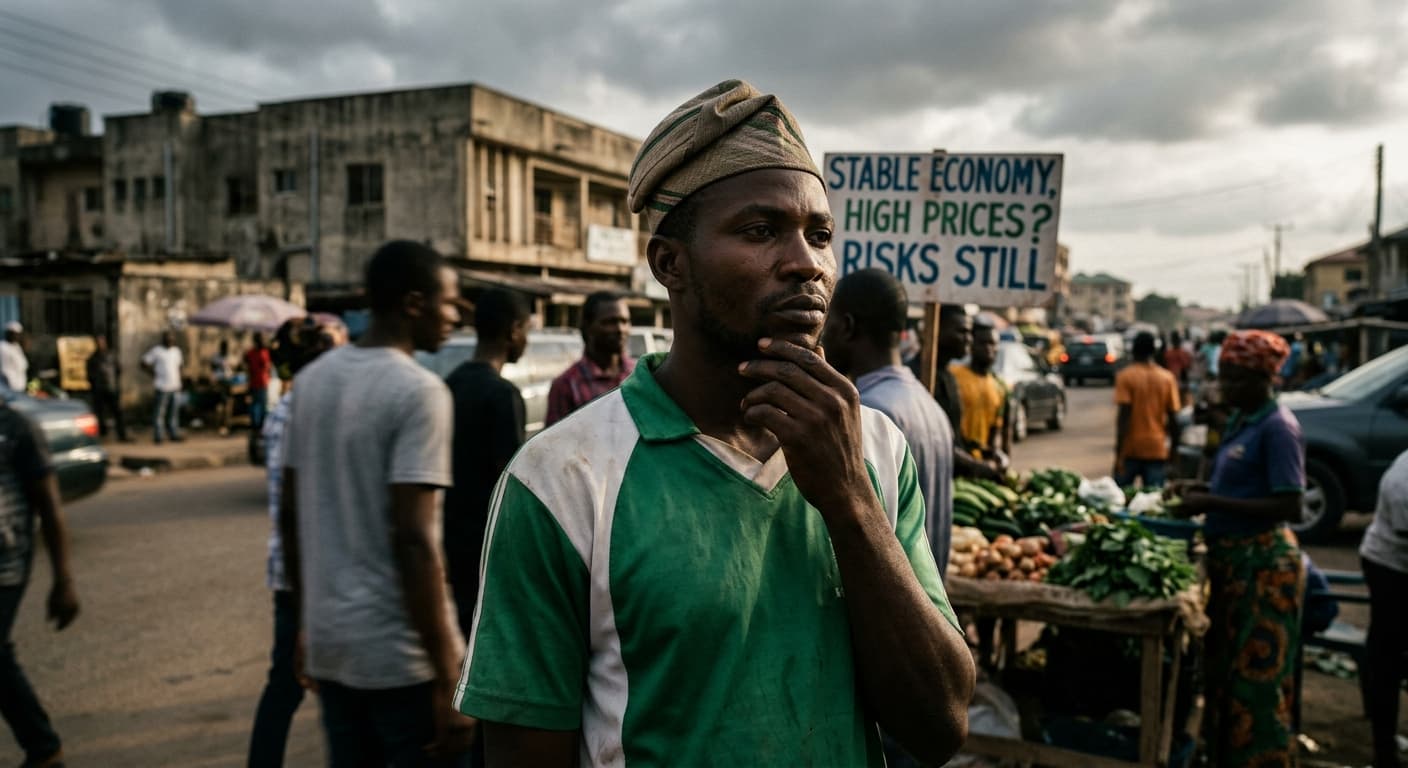
Nigeria Escapes Collapse: Inside Tinubu's High-Cost Reform Bet
The IMF now scores Nigeria's shock therapy a stabilisation success — inflation at 15.4%, reserves at $49bn, ratings on the mend. The next test is political.
Nigeria has walked back from the edge of a sovereign debt spiral, but the price of that escape — a 66% naira devaluation, a policy rate at 26.5%, and 63% of the population under the national poverty line — is the reason foreign capital is now paying attention again. The 2026 Article IV assessment from the International Monetary Fund, published on June 9, 2026, confirms what Finance Minister Taiwo Oyedele told the Nigeria Employers' Summit on July 1: the worst phase of restructuring is over, and Africa's most populous economy has moved from crisis management to a fragile, disinflationary stabilisation. The real question for policymakers and portfolio managers is no longer whether the reforms worked — it is whether Abuja can hold the line long enough for growth to reach households before the next external shock, or the next election, undoes them.
The rescue, in numbers
Three data points define the turn. First, headline inflation, which peaked near 34% in early 2024 on the rebased CPI, has fallen to 15.4% year-on-year in March 2026, according to the IMF's 2026 Article IV Consultation — the lowest print in more than three years. Second, gross international reserves rose to US$46 billion at end-2025 from US$40 billion a year earlier, and hit US$49 billion on a 30-day moving average by end-March 2026, per the same
IMF staff report. Third, the naira actually appreciated 10% against the dollar in the year to March 2026, an outcome unthinkable in late 2024 when it briefly cleared 1,700 to the dollar.
None of that erases the cost. The World Bank's June 2024 assessment estimated that removing the petrol subsidy and unifying exchange rates pushed some 7 million additional Nigerians into poverty in the first year alone, according to the Bank's own review of the reform sequence. Fund staff now put the national poverty headcount at 63%, with 27 million Nigerians estimated to have faced food insecurity by autumn 2025. That gap between macro repair and household reality is the political fault line the Tinubu administration is now trying to close.
The reform sequence that avoided default
Nigeria's escape was engineered by a three-part reform stack that the IMF and World Bank had urged, unsuccessfully, on two prior administrations. On May 29, 2023, Bola Tinubu announced in his inaugural address that "fuel subsidy is gone" — a payment that had cost the treasury more than 8.6 trillion naira between 2019 and 2022, or roughly 15% of the 2023 federal budget, according to the World Bank. Two weeks later the Central Bank of Nigeria unified the multiple exchange-rate windows and let the naira float. IMF Selected Issues Paper 2026/045 documents the mechanics: within months the parallel-market premium had collapsed to roughly 9%, and by 2024 Nigeria was operating what
Fund economist Cecilia Melo Fernandes calls a genuinely floating regime.
The third leg was monetary. Between February 2024 and August 2025 the Monetary Policy Committee raised the benchmark rate by 875 basis points, a tightening cycle the IMF explicitly commends as "appropriate" in Country Report 25/157. The cash reserve requirement was pushed to 50%, and — crucially — the CBN stopped monetary financing of the deficit through the notorious "ways and means" facility. Only in February 2026, once inflation had fallen for more than a year, did Governor Olayemi Cardoso's committee deliver its first cut, trimming the rate by 50 basis points to 26.5% and easing the CRR to 45%.
The market noticed. Nigeria returned to the Eurobond market on December 2, 2024, with a US$2.2 billion issue, and followed with a US$2.3 billion sale in 2025, per the IMF. Non-residents added roughly US$6 billion in net purchases of CBN open-market operation bills in 2025 alone. S&P raised its outlook from stable to positive and delivered a credit rating upgrade in April 2025 — the first for Nigeria in years, as noted in the 2025 Article IV. Nigeria was also removed from the Financial Action Task Force grey list.

Why the money is coming back
Foreign capital is not returning because Nigeria has become cheap — it is returning because Nigeria has become legible. Under Governor Godwin Emefiele's tenure, which ended with his suspension in June 2023 and subsequent criminal charges, foreign investors were rationed dollars at three or four different official rates and forced to clear repatriations through opaque backlogs, as BBC Pidgin reported when the CBN finally cleared some US$7 billion in overdue FX obligations. The current framework, by contrast, is a market rate, a positive real policy rate, and a rule-based intervention framework aligned with the IMF's Integrated Policy Framework.
Alan Gelb and other Chatham House analysts have argued that the devaluation itself is the fiscal engine. In his March 2025 note Nigeria's economy needs the naira to stay competitive, former IMF and World Bank economist John Hawkins-adjacent scholarship documents how the naira's fall — combined with subsidy removal — narrowed the federal deficit from 6.4% of GDP in early 2023 to 4.4% by early 2024. Because oil and gas royalties, customs duties and a large share of corporate income tax are dollar-linked, a weaker naira converts to more revenue in local currency terms. That is why the World Bank has long insisted a misaligned exchange rate hurt the budget more than the petrol subsidy did.
The current-account picture explains the FX turnaround. Nigeria posted a 9.0% of GDP current-account surplus in 2024 and 4.8% in 2025, driven by hydrocarbon exports and — critically — a collapse in refined fuel imports as the Dangote refinery, one of the world's largest, ramped up production. On June 29, 2026, the World Bank Group approved a US$1.25 billion NAIJA Development Policy Financing operation and a new 2026–2032 Country Partnership Framework aimed at translating the macro gains into 32 million new energy connections and 58 million new broadband users. That is unusual scale — and unusual confidence — for a Bank engagement in a low-income country.
The angle that gets missed
Here is the piece of this story that Bloomberg terminals do not price: Nigeria's stabilisation is not primarily an inflation-fighting story. It is a sovereign debt story. The IMF's May 2026 staff report contains a single number that reframes everything: interest payments consumed 53% of federal government revenue in 2025, up from 41% in 2024. That is a debt-servicing ratio associated with pre-default sovereigns, not stabilisation successes. It is why the Fund is telling Abuja to run a neutral fiscal stance in 2026 despite an April budget the IMF characterises as expansionary, with a projected federal deficit of 4.4% of GDP versus 3.5% in 2025.
In other words, the reforms worked exactly hard enough to keep Nigeria out of the debt-restructuring queue that swallowed Zambia, Ghana and Ethiopia. Fund staff estimate private-sector credit is still only 12% of GDP, one of the lowest ratios in emerging markets, and note that the CBN remains reliant on "expensive portfolio inflows that pose a rollover risk." That reliance is the vulnerability. The IMF's April 2026 Global Financial Stability Report shows that a one-standard-deviation shock to the VIX cuts sovereign bond issuance from emerging markets with heavy non-bank investor exposure by 28%. Nigeria fits that profile precisely.
The tax reform package Tinubu signed on June 26, 2025 — four laws consolidating 50-plus levies, exempting small firms with turnover below 50 million naira, and cutting the corporate rate from 30% to 27.5% in 2025 and 25% thereafter — was designed to address that revenue-servicing gap without a VAT hike that would have crushed household demand. Whether the medium-term revenue gains that Oyedele's committee estimates at up to 4.2% of GDP actually materialise is now the single most important variable in Nigeria's medium-term debt sustainability.
What could still break it
Four things could unwind the escape. The first is oil. The IMF's baseline assumes Brent averages US$68 in 2026 and Nigerian production climbing from 1.55 to 1.71 million barrels per day. A sustained sub-US$60 environment would restore the twin deficits. The second is the temptation to let the naira strengthen too far. Chatham House warns that "Nigeria's history of failed exchange-rate devaluations" stems from policymakers repeatedly allowing the currency to appreciate after each adjustment, wiping out competitiveness gains. The 10% appreciation the IMF has already recorded is close to the edge of that risk.
The third is election-cycle fiscal slippage. Tinubu faces a 2027 vote, and the pattern in Nigerian political economy — as documented across three previous election cycles — is a spending surge in the eighteen months prior. The 2026 budget's expansionary tilt, signed only in mid-April, is a warning shot. The fourth is security: banditry in the northwest and insurgency in the northeast continue to depress agricultural output and food-inflation control, and the Fund's own baseline flags security spillovers as its top structural risk.
Diplomat View
Nigeria's escape from collapse is real, but it is a hair-trigger stabilisation, not a durable turnaround. Our call: the naira holds between 1,350 and 1,550 to the dollar through end-2026; the CBN cuts the policy rate by another 100–150 basis points in the second half if food inflation continues to moderate; and Nigeria retains market access with Eurobond yields staying inside 300 basis points over US Treasuries. The forecast breaks if any two of the following hit — Brent below US$55 for a full quarter, a pre-election spending package above 5% of GDP, or a shock that pushes non-resident OMO holders to the exit. What would change the call: a credible medium-term revenue framework with binding annual targets, or an S&P upgrade to B/B+, either of which would signal that the Tinubu reforms have crossed from stabilisation into structural repair. Neither is impossible. Neither is baked in.
What to watch
- July 21–22, 2026: CBN Monetary Policy Committee meeting. Consensus is a hold; a second 50 bps cut would signal confidence that the March inflation uptick was transitory.
- September 2026: Q3 GDP release from the National Bureau of Statistics — the first full quarter under the new tax regime, which took effect January 1, 2026.
- Q4 2026: Debut of an inflation-targeting framework the CBN has committed to under IMF technical assistance; the target specification is the political tell.
- 2027 budget cycle: The first pre-election fiscal document under the Tinubu administration; the neutral fiscal stance the IMF has demanded will be tested in the appropriations committee, not the Villa.
The Bottom Line
Nigeria did not stumble into stability — it was pushed there by a subsidy removal, a currency float, and an 875 basis-point rate hike that between them cost the poorest households roughly a third of their real incomes and bought Abuja three years of runway. The reforms are working as macro repair; they have not yet worked as development. Whether they do turns on a single number: whether the federal government's 53% interest-to-revenue ratio falls before the next oil shock, election, or global risk-off episode hits.
Discover more
US Politics
Congress Targets AI Chatbot Access for Terror
The House passed the Generative AI Terrorism Risk Assessment Act, focusing on AI's role in terrorism and potential surveillance implications.
India
Rajnath Singh's Durga Squad for 2026 Polls
Rajnath Singh's Durga Squad promised women's safety in Bengal but has since disappeared from the agenda, revealing BJP's true priorities.
India
Romanian Coalition Party Demands PM Resign
Romania's Social Democrats withdrew from coalition, joining far-right AUR to topple PM Bolojan, risking €10 billion in EU funds by August 2026.

Economics
Fed's Amex AML order puts correspondent banking on notice
Federal Reserve's Amex AML order requires board-level controls and a 90-day plan; OCC fined the bank $350 million over enterprise-wide deficiencies.