Australia's Defence Strategy Under Pressure
Canberra's military posture faces new challenges ahead.
Model Diplomat4 min readAsia-Pacific
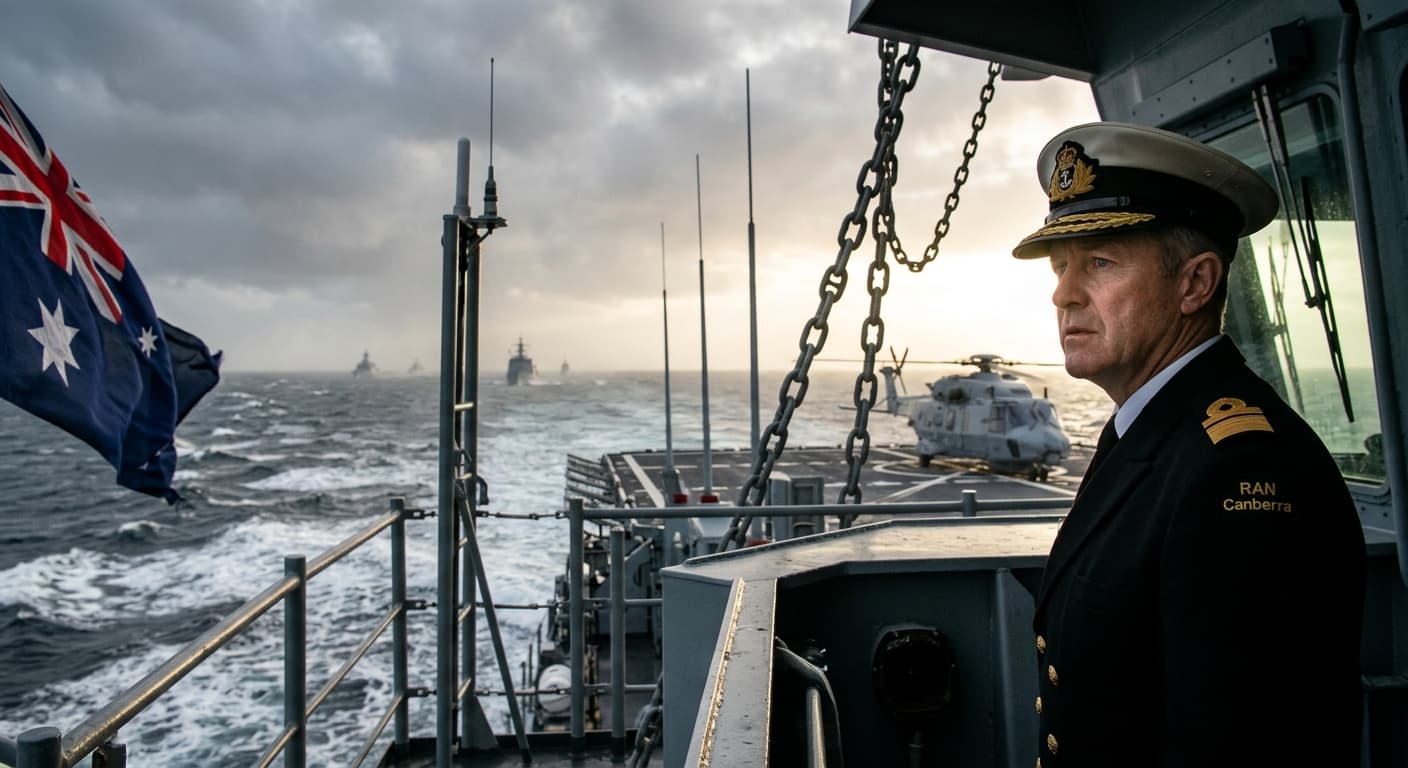
On July 6, China fired a nuclear-capable submarine-launched ballistic missile into the South Pacific — hours after Australia and Fiji signed a new defence pact. The Council on Foreign Relations notes that Australia's 2024 National Defence Strategy nearly doubles the annual defence budget over the coming decade, framed around "the most complex and challenging strategic environment since the Second World War." The NDS explicitly adopts a "Strategy of Denial" spanning maritime, land, air, space and cyber domains, and locks in AUKUS as the centrepiece of the underwater component. A revised NDS is due later in 2026; the flares, the SLBM test, and the AUKUS review will shape its language — and the thesis of this piece is that Canberra will spend the next 24 months paying rising costs to defend a posture its primary partner in the dispute may soon abandon.
The AUKUS complication Washington has already introduced
The clean 2023 "Optimal Pathway" is gone. USNI News reported in June 2026 that Washington will now sell Australia three in-service Virginia-class boats rather than the earlier mix of one new-build and two used. The Congressional Research Service, in its
October 2024 report to Congress, had already flagged the problem: Virginia production has been running at 1.2 to 1.4 boats per year against a nominal rate of two, with the Navy targeting 2.33 boats per year to cover Australian sales.
Layered on top, the Trump administration's AUKUS review — led by Under Secretary of Defense for Policy Elbridge Colby — has run through 2025 and 2026. Colby's own account, in a CFR conversation, is that the review "came out with a framework" but only after squeezing allies on burden-sharing and industrial-base contributions. That leverage does not end on delivery day. As the UPI piece flags, because Australia will depend on U.S. technology, training and reactor support to operate the boats, Washington retains a functional veto over how they are used. If Canberra ever contemplates trailing a Type-094 out of Longpo on Hainan — where U.S. Strategic Command
now assesses China's six Jin-class SSBNs as its first credible sea-based deterrent — the mission profile will be written in Washington, not Canberra.
The 2024 U.S.–Japan–Australia Trilateral Defense Ministers' joint statement already flagged this direction, committing the three militaries to expand trilateral ISR cooperation and to run a joint air-and-missile defence live-fire in Australia at Exercise Talisman Sabre 2027. That is the political framework inside which any RAN Virginia deployment will happen.
The scenario Canberra is least prepared for
Two of the three UPI scenarios are already partly running. Beijing's flare campaign is the calibrated-escalation track. Washington's AUKUS renegotiation is the alliance-dependence track. The scenario Australia has not seriously war-gamed is the first one: a China–Philippines détente that quietly deprives Canberra of the moral and operational rationale for its patrols.
That scenario is not fanciful. In July 2024, the Philippines and China struck a provisional deal on Second Thomas Shoal resupply that visibly reduced ramming incidents there — even as tensions migrated to Scarborough. Beijing's September 2025
announcement of a Scarborough nature reserve is best read, per the
Asia Maritime Transparency Initiative, as an attempt to reframe a coercive fait accompli as environmental stewardship — a move designed to be negotiated over, not fought over.
If a Marcos successor in 2028 or a second-term Marcos under U.S. pressure quietly accepts a Chinese-controlled but demilitarised Scarborough, the joint patrols Australia has built around Philippine invitation lose their political cover. The 3,600-personnel Exercise ALON 2025 that Al Jazeera covered — the largest Australian combat airlift since East Timor 1999 — was structured around Philippine hosting. Take that away, and Canberra is left conducting freedom-of-navigation operations that ASEAN states may increasingly view as gratuitous.
Diplomat View
The forecast: Australia will spend the next 24 months paying rising costs to defend a South China Sea posture that its own primary partner in the dispute may soon abandon. Manila is the pivot. If the Marcos government holds its line through 2028 — and if U.S. treaty commitments to the Philippines survive the current administration's transactional turn — Canberra's patrols retain their political architecture, and the Virginia-class boats arriving in 2032 slot into a coalition mission. If Manila softens, Australia is left as the loudest non-claimant in a dispute the claimants are settling around it, holding U.S.-controlled hardware pointed at Hainan under Chinese SLBM range.
What would change this call: a public China–Philippines Scarborough framework before 2028 (falsifies the coalition path); a Colby-driven decision to condition the 2032 Virginia transfer on Australian force-employment concessions (accelerates alliance-dependence); or a Chinese flare incident that damages a P-8A or injures RAAF personnel (forces Canberra to escalate or visibly retreat). Any one of those triggers ends the current bipartisan consensus.
What to watch
- Late 2026: Australia's revised National Defence Strategy. Watch whether "Strategy of Denial" expands to name South Pacific SSBN threats following the July 6 test.
- 2027 Talisman Sabre: First trilateral U.S.–Japan–Australia live-fire air and missile defence exercise — the clearest benchmark yet for how far Canberra will integrate under U.S. command.
- Philippine 2028 election cycle: Whether Marcos's successor sustains the Enhanced Defense Cooperation Agreement basing pattern and the joint-patrol invitation that gives Australian operations their political cover.
- 2032 first Virginia transfer: The date the alliance-dependence problem stops being theoretical.
The Bottom Line
Australia's South China Sea presence looked cheap because Beijing had not yet decided to make it expensive; that decision has now been taken and demonstrated, on the same day Canberra locked in Fiji. The country's next defence strategy will be written under Chinese SLBM range, with U.S.-owned reactors underwriting its most consequential platforms and a Philippine partner whose appetite for confrontation is no longer guaranteed. The bipartisan era of Australian activism in the South China Sea is ending; what replaces it will be determined in Washington and Manila before it is decided in Canberra.
Discover more

India
Congress Accuses Modi of Stalling Women's Law
Congress accuses Modi of stalling women's reservation law by linking it to delimitation, revealing a deeper electoral strategy.

India
Delhi CM Rekha Gupta Blasts Opposition's Delm
Delhi CM Rekha Gupta's remarks on women's quota defeat reveal BJP's strategy for the 2029 Lok Sabha elections, focusing on delimitation.
US Politics
SNAP Food Assistance Faces Legal Challenges
In 2026, SNAP faces stricter eligibility rules and mounting legal challenges, threatening food assistance for the millions of Americans who rely on the program.

Conflict & Security
Drone Warfare Killing Aid Workers at Unprec
Over 1,000 humanitarian workers killed in three years as cheap armed drones collapse legal protections. Gaza, Sudan, Ukraine, and DRC see deliberate targeting of aid convoys and hospitals with zero prosecutions.