Australia's Security Pact with Fiji vs China
A pivotal defense pact against China in the Pacific
Model Diplomat8 min readOceania
Australia–Fiji Ocean of Peace Alliance vs China Explained
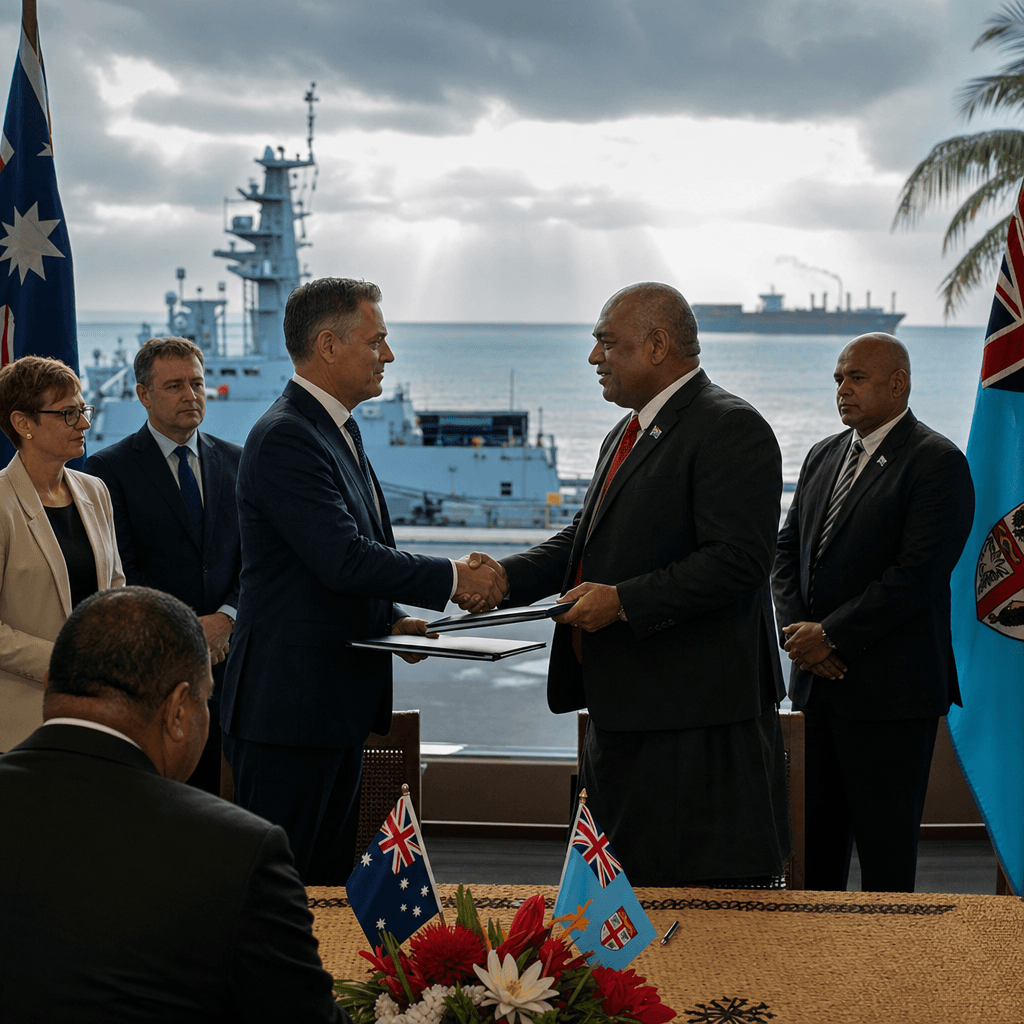
Australia's July 6, 2026 mutual defence pact with Fiji — the Ocean of Peace Alliance — is Canberra's fourth alliance ever, and its most consequential Pacific move against Beijing since AUKUS.
Australia signed a mutual defence treaty with Fiji in Suva on July 6, 2026 that is best understood not as a bilateral upgrade but as the load-bearing pillar of an expandable, Pacific-wide alliance system designed to lock China out of Melanesia — and Beijing responded within hours by test-firing a long-range ballistic missile into the South Pacific. The Ocean of Peace Alliance is only Australia's fourth treaty alliance, after the United States, New Zealand and Papua New Guinea, and Fiji's first ever. That fact, more than the language of any single clause, is the story.
What was actually signed
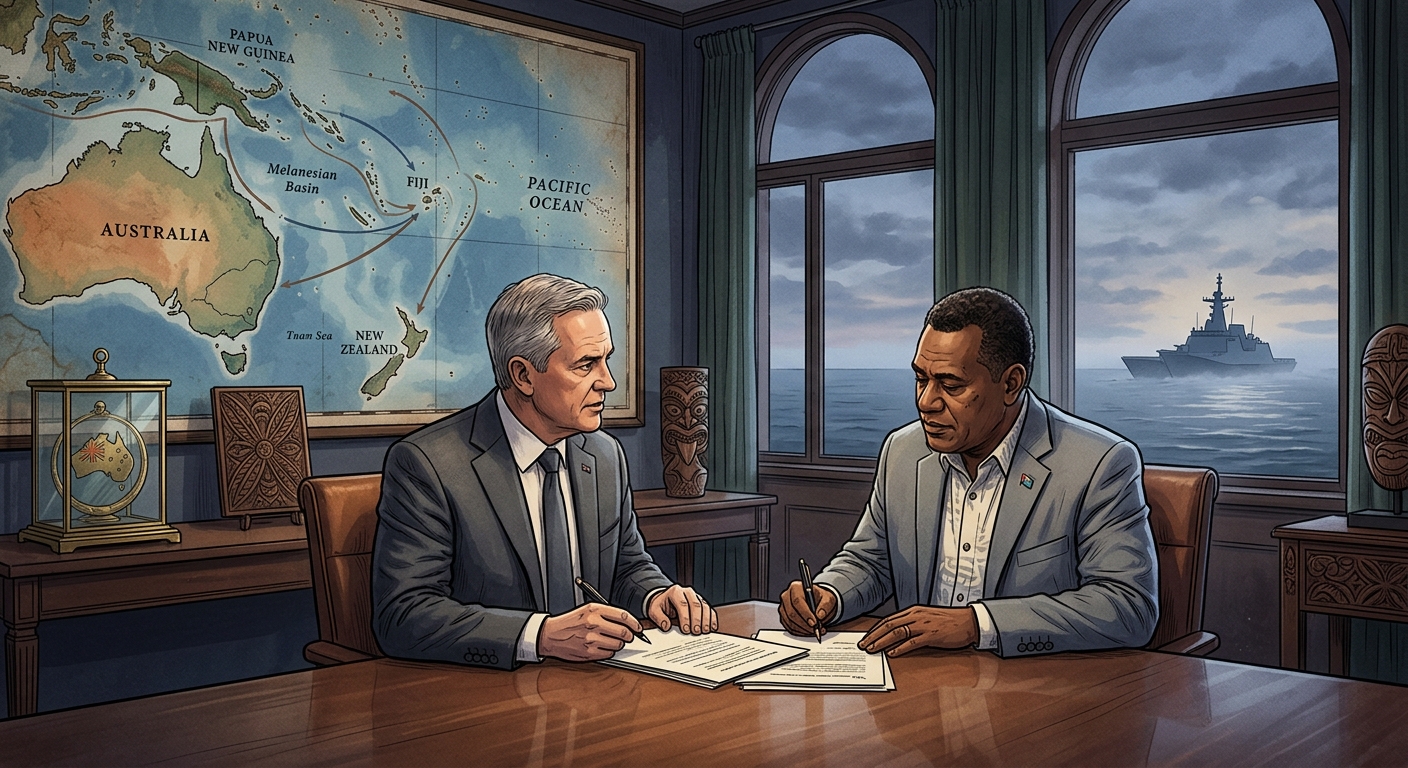
Prime Ministers Anthony Albanese and Sitiveni Rabuka signed two instruments in Suva: the Vuvale Union Treaty, elevating a 2019 partnership to treaty status across security, economics and people-to-people ties; and the Ocean of Peace Alliance — known in Fijian as the Veitacini Treaty — which contains the mutual-defence obligation. According to a copy of the agreement seen by ABC News, each party recognises that an armed attack on the other within the Pacific "would be dangerous to each other's peace and security" and commits to "act to meet the common danger, in accordance with its domestic processes." That language is a direct lift from Article IV of the 1951 ANZUS Treaty.
At the joint press conference, Albanese was blunter than treaty diplomacy usually permits. "The Ocean of Peace Alliance introduces a mutual defence obligation," he told reporters, "and there's no higher obligation than to come to each other's aid at a time of need." According to Prime Minister Rabuka's opening statement, published by the Australian Prime Minister's Office, Australia is backing the deal with more than A$1 billion over a decade for Fiji and lifting total Pacific development assistance to A$2.2 billion.
The critical clause is Article-level accession language. Per the treaty text quoted by ABC, the alliance is open to any Pacific nation "in a position to further the purposes and principles of this treaty and to contribute to the security of the Pacific." Australian officials have briefed that in the first instance only Pacific states with standing militaries — New Zealand, PNG and Tonga — are likely candidates. But Rabuka's own framing was expansionist: "The more, the stronger, the better."
China's answer, delivered in 90 minutes
Beijing's response was choreographed to the hour. According to the BBC, China notified Canberra roughly 90 minutes before test-launching a long-range ballistic missile with a dummy warhead into the Pacific — its first such firing since September 2024. Chinese state media called it "routine." Australia's Foreign Minister Penny Wong, speaking from Suva, said the test was "in the context of a rapid military build-up by China" and risked "destabilising" the region.
Al Jazeera reported New Zealand, Japan and Papua New Guinea were also informed hours before launch.
Michael Green, chief executive of the United States Studies Centre, told The Australian the launch was a "clear attempt by Beijing to intimidate Pacific island nations and Australia, and to demonstrate there will be punishment" for signing such agreements. Read the two events together — a treaty signed at breakfast, a JL-class missile in the water by lunchtime — and the message is that China now considers the Pacific archipelago contested strategic terrain, not benign neighbourhood.
The technical backdrop matters. According to the International Institute for Strategic Studies, the PLA Navy is replacing its JL-2 submarine-launched ballistic missile with the longer-ranged JL-3, allowing Type-094 SSBNs to strike the western continental United States from the protected waters of the South China Sea. Test firings into the South Pacific are the visible surface of that build-up.
The real story is architectural
The Ocean of Peace Alliance is the fifth security instrument Canberra has locked into place since November 2023 — Tuvalu's Falepili Union, Nauru's treaty, PNG's Pukpuk Treaty, Vanuatu's Nakamal Agreement, and now Fiji. The Lowy Institute's Connor Graham writes that Albanese is now on a Pacific diplomatic "hot streak," with a Solomon Islands treaty targeted for later in 2026 during the tenure of new Prime Minister Matthew Wale, according to the
Lowy Institute.
Anna Powles, the Massey University Pacific security specialist quoted by ABC News, calls it the most significant innovation in Pacific security architecture since the 2018 Boe Declaration — a shift from bilateral hub-and-spokes deals to a "networked, Pacific-centred security framework." That framing is the one Canberra wants stuck to the deal. It converts a series of unequal patron-client pacts into something that looks, at least on paper, like a Pacific alliance system with Australia at the centre — a NATO of the Blue Pacific, if the accessions come.
Compare Fiji's terms with those Australia has secured elsewhere and the pattern sharpens. Under the Falepili Union, Tuvalu agreed to "mutually agree" with Australia before entering any third-party security arrangement — widely read as an Australian veto. Under the Nakamal Agreement, Vanuatu accepted a bar on foreign military bases and a consultation requirement short of veto, according to the Lowy Institute. The
Pukpuk Treaty with PNG, signed in October 2025, integrates up to 10,000 PNG personnel into the Australian Defence Force and, according to
Al Jazeera, grants effective Five Eyes-level intelligence sharing. Each pact is calibrated to what each government's domestic politics can absorb. Fiji, with a functional military and a proud UN-peacekeeping tradition, absorbed the strongest form: mutual defence.
The Rabuka paradox — and why speed matters
Here is what most coverage buries. Sitiveni Rabuka is not the pro-Western realigner Canberra hoped for when he took office on Christmas Eve 2022. According to the Australian Institute of International Affairs, his government reversed the diplomatic upgrade of the Taiwan Trade Office, withdrew Fiji's signature from the UN statement on Xinjiang, and revised — but did not terminate — the controversial policing agreement with China. Chinese police advisers have continued to embed with Fijian forces under a "police exchange" label, according to a
Carnegie Endowment analysis published in November 2025.
Rabuka has spent the past three years running a balancing act, not a pivot. What changed is not Fiji's China policy — it is Rabuka's domestic runway. He faces an election by early February 2027. Two of his deputy prime ministers, Manoa Kamikamica and Biman Prasad, resigned in October 2025 after corruption charges. Rabuka has publicly conceded his People's Alliance Party was "caught napping." Canberra is banking the treaty now because the window may close.
Rabuka insisted the deal was "not threatening Fiji's relationship with China," and the treaty text does not, by its terms, require Fiji to expel Chinese police advisers or cancel Chinese infrastructure grants. But the mutual-defence obligation and the accession clause create a structural asymmetry that consultation-only pacts do not. Once Fiji is an ally of Australia in the ANZUS sense, any future Chinese security foothold on Fijian soil — a police base, a port with dual-use potential — becomes a matter Canberra has treaty standing to raise.
Who benefits, who loses
The clear winner is Canberra. In the space of nine months, Albanese has secured mutual-defence treaties with two of the three largest Melanesian states — PNG and Fiji — and pushed a third, Vanuatu, into a consultation regime that bars Chinese bases. According to Lowy Institute polling, 39% of Australians now believe China holds greater sway in the Pacific than Australia does, versus 33% for Canberra — a reversal of 2025's numbers. The elite view diverges sharply from the popular one: at the diplomatic level, Australia is winning the round.
The losers are less obvious. Beijing loses optionality — the ability to convert commercial and policing access into strategic access. But it does not lose current access: China remains Fiji's port-upgrade partner and its police-training partner. The second, quieter loser is Washington. The Center for Strategic and International Studies notes that Australia's bilateral treaties, layered atop U.S. Compacts of Free Association in Micronesia and the U.S.–PNG Defence Cooperation Agreement, produce a Pacific architecture in which Canberra — not Washington — is the network's hub. That is a delegation of Pacific security leadership the Trump administration appears content to accept, but it structurally reduces U.S. leverage over Pacific outcomes.
Diplomat View
The Ocean of Peace Alliance will be judged not on July 6, 2026 but on three tests. First, accession. If Tonga signs on within twelve months and New Zealand formally attaches — Wellington's foreign ministry already "welcomed" the treaty per ABC — this becomes a genuine networked alliance, and the CSIS reading is vindicated. If it stays a Canberra-Suva bilateral with rhetorical openness, it is a Falepili with a mutual-defence gloss. Second, Fijian ratification and Rabuka's survival. A change of government in February 2027 that includes former Bainimarama allies could freeze implementation without formally repudiating the text — treaties bind states, not personalities, but Pacific coalition politics can starve inherited agreements of oxygen. Third, China's police footprint. If Chinese liaison officers remain embedded with Fijian police through 2027, the treaty's substantive reach is narrower than its language suggests.
Forecast: the alliance holds and expands to at least one additional Pacific signatory — most likely Tonga — within 18 months. It would be revised downward by any of the following: a Rabuka electoral loss to a China-friendly coalition; a Chinese counter-offer of a comprehensive strategic partnership Fiji cannot refuse; or a U.S. attempt to muscle back in that fractures Australian primacy in the network.
Watch:
- September 2026 Pacific Islands Forum leaders' meeting — the venue where a Tongan or Solomon Islands accession would most plausibly be announced.
- October 2026 pre-COP31 meeting in Nadi and Tuvalu — the climate-security bundling Rabuka linked explicitly to the treaty text.
- February 2027 Fijian general election — the single largest revision risk to the alliance as signed.
The Bottom Line
Australia's Ocean of Peace Alliance with Fiji is not really about Fiji — it is the keystone of a networked Pacific alliance system designed to convert Canberra's bilateral pacts into something structurally closer to a regional NATO, with mutual-defence language borrowed line-for-line from ANZUS. China's response, a long-range missile test hours after signing, confirms Beijing reads the treaty exactly this way. The deal will be judged in 2027 by whether Tonga accedes and whether Rabuka survives — everything else is prologue.
Discover more

India
India-South Korea $50B Trade Expansion Plan
India and South Korea target $50 billion in bilateral trade by 2030, focusing on industrial cooperation and strategic alignment amid US pressures.

International Relations
Pakistan's Key Role in US-Israel-Iran Meddle
Pakistan is seeking to mediate the US-Israel-Iran conflict, balancing high-stakes diplomacy against severe economic pressures and steep regional challenges.

Conflict & Security
Drone Warfare Killing Aid Workers at Unprec
Over 1,000 humanitarian workers killed in three years as cheap armed drones collapse legal protections. Gaza, Sudan, Ukraine, and DRC see deliberate targeting of aid convoys and hospitals with zero prosecutions.

Global
World Normalises Taliban as Afghan Women Eras
UN data shows Afghan women erased from public life as Russia recognises the Taliban, EU hosts officials in Brussels, and ICC warrants for gender persecution go unenforced.