Australia and Fiji Sign Security Treaties
New alliances reshape Indo-Pacific security dynamics.
Model Diplomat7 min readOceania
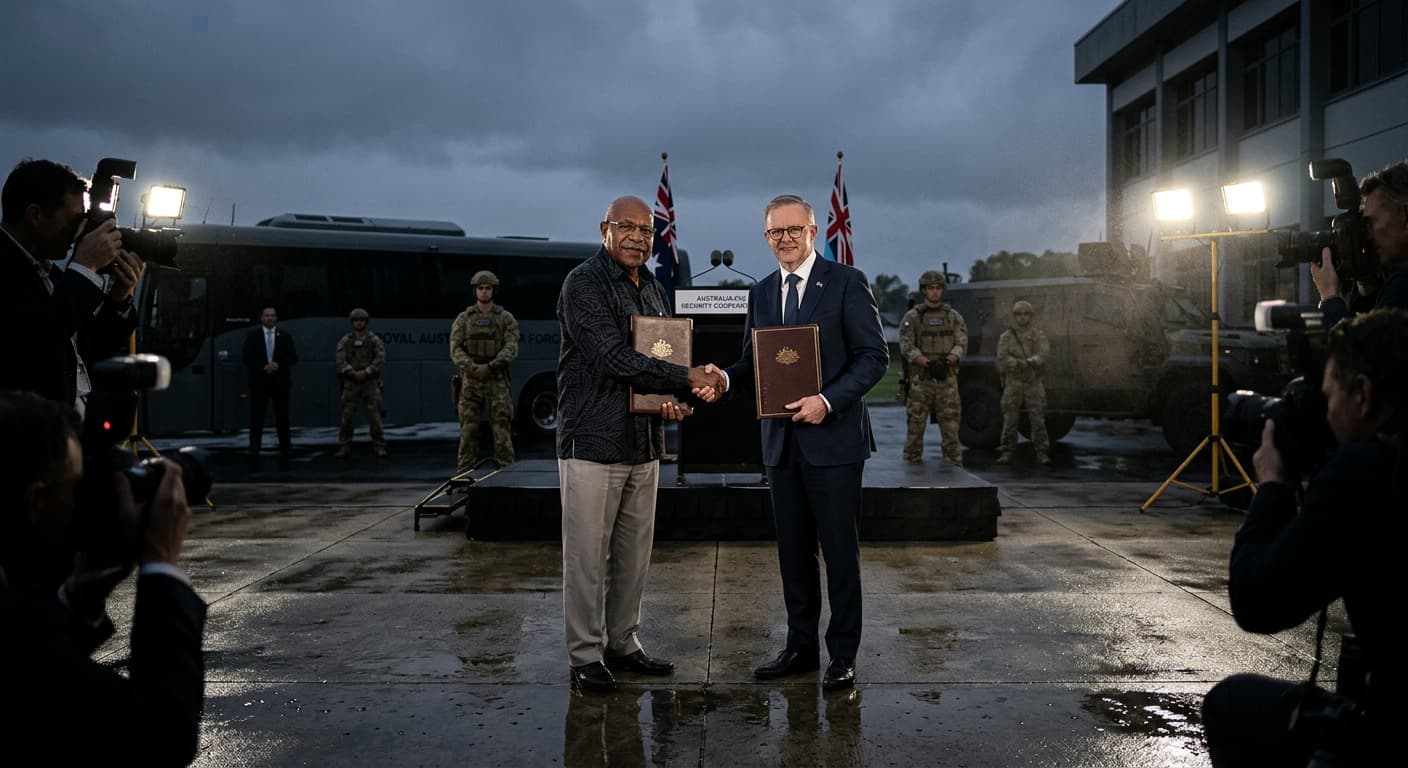
Australia and Fiji Sign Two Security Treaties as China Fires an ICBM
Canberra's Vuvale Union and Ocean of Peace Alliance with Fiji reshape Indo-Pacific security. Hours later, a Chinese SLBM landed in the South Pacific.
On July 6, 2026, Australia and Fiji signed two treaty-level agreements in Suva — the Vuvale Union and the Ocean of Peace Alliance (Veitacini Treaty) — making Fiji Australia's fourth formal ally after the United States, New Zealand and Papua New Guinea. Hours later, a Chinese nuclear-powered submarine launched what CSIS assessed as a JL-2 or JL-3 ballistic missile roughly 7,300 kilometres into the South Pacific Nuclear Free Zone. The two events, on the same day, mark the moment Beijing's coercive signalling and Canberra's institutional strategy in the Pacific finally collided in public — and the moment Anthony Albanese's argument for a "Blue Pacific" security architecture stopped being theoretical. The thesis is simple: China's SLBM test handed Australia the political case for its Pacific hub-and-spokes system that Pacific leaders had been reluctant to underwrite themselves.
What was actually signed
The two agreements are different instruments, and the distinction matters.
The Vuvale Union is a comprehensive treaty converting the 2019/2023 Vuvale Partnership into a permanent framework across three pillars — security, economy, people — backed by more than A$1 billion of Australian spending over a decade on transnational crime, health, ports and infrastructure, according to Prime Minister Anthony Albanese's Suva press conference. Australian Foreign Minister Penny Wong and Pacific Minister Pat Conroy had
flagged the framework as a "family, under one roof" union resting on "durability, sovereignty and regionalism" — DFAT-speak that quietly imports the same third-country consultation logic Canberra embedded in the Falepili Union with Tuvalu and the Nauru Treaty.
The Ocean of Peace Alliance, known in Fijian as the Veitacini Treaty, is the harder edge. Article 6 introduces a mutual defence obligation; Article 5 mandates regular consultation on threats to sovereignty. Albanese called it a commitment that "there's no higher obligation than to come to each other's aid at a time of need." Crucially, the treaty is drafted to be open to accession by other Pacific Island states — a template, not a bilateral endpoint. The BBC characterised it as Fiji's first-ever alliance and Australia's fourth.
Both texts explicitly ground themselves in the Blue Pacific Ocean of Peace Declaration endorsed by all Pacific Islands Forum members in Honiara on September 10, 2025 — a Rabuka-authored initiative the UN Secretary-General publicly welcomed two weeks later. That anchoring is deliberate: it lets Canberra present the treaty as an expression of Pacific-led norms, not an imposition on them.
The missile that made the argument
At 4:01 UTC on the same day, a Chinese strategic nuclear submarine fired what CSIS analysts assessed as a JL-2 or JL-3 SLBM from the South China Sea, overflying the Philippines and landing in the South Pacific Nuclear Free Zone. According to CSIS, it was the first Chinese SLBM ever fired into international waters and only Beijing's second ballistic missile launch into international waters since 1980.
Beijing's Ministry of Foreign Affairs framed it as "routine" annual training and cautioned Australia and Fiji against using their new pact to "target third parties." Defence Minister Richard Marles said Canberra received notification only hours before launch. Japan, which had not been notified in the previous 2024 launch, received 90 minutes' warning this time. New Zealand Foreign Minister Winston Peters called it "an unwelcome and concerning development."
The optics travel further than the missile did. China is a party to the protocols of the Treaty of Rarotonga, which prohibits nuclear testing and stationing in the South Pacific. The warhead was simulated, but as Lowy Institute's Oliver Nobetau wrote the following day, "the missile that carried it can carry a real one, and that capability, deployed in the same waters and on the same day as the Ocean of Peace Alliance was agreed, is exactly what Pacific nations have spent decades trying to keep out of their backyard."
Solomon Islands Prime Minister Matthew Wale — a former China hawk who campaigned against Honiara's 2022 pact with Beijing — used his July 7 joint appearance with Albanese to declare that the launch "is not something a friend does" and to argue for a regional security compact. That is a striking shift from the country whose 2022 deal with China set this entire Australian scramble in motion.
The hub-and-spokes, now visible
Read against the full sequence, Fiji is the sixth piece in a deliberate architecture. Australia signed the Falepili Union with Tuvalu (2023), the Nauru Treaty (2024), an elevated Vuvale Partnership with Fiji (2023), the Pukpuk Treaty with PNG (2025, entering into force July 8, 2026), the Nakamal Agreement with Vanuatu (June 30, 2026), and now the twin Fiji instruments. In each, as CSIS's Kaitlyn Levinson has noted, Canberra has extracted a third-country consultation clause — a de facto veto over Chinese security access.
What is new in Fiji is the mutual-defence article and the open-accession clause. That converts the bilateral system into a potential mini-multilateral, one that could absorb Tonga (which agreed in September 2025 to codify ties in a defence agreement) and Solomon Islands, sitting alongside the Pacific Islands Forum without being owned by it.
That parallel track worries some Pacific specialists. University of Adelaide professor Joanne Wallis, writing for the Australian Institute of International Affairs, warns that Canberra's bilateral "arms race with China" over security agreements "risks undermining the Pacific Islands Forum and other regional agencies." Lowy's Mihai Sora made a similar point last year when the PIF endorsed Australia's A$400 million Pacific Policing Initiative: the design closes "the window for China to seek a regional security agreement," but at the cost of consolidating Australia's role as regional lead. Pacific agency, in this reading, is repeatedly invited to sit inside a Canberra-designed frame.
The Fiji balancing act
Sitiveni Rabuka's own record complicates the "clean pivot" narrative. Since taking office in December 2022, his government has moved to end the Bainimarama-era police cooperation deal with Beijing, then softened that stance — revising rather than terminating the agreement, accepting a large Chinese grant for roads in Vanua Levu, and announcing on the APEC sidelines that China would assist with port upgrades and shipbuilding. Fiji is one of six Pacific governments still on China's Belt and Road ledger,
according to a Lowy Institute analysis of Chinese lending in the region, and China is the Pacific's second-largest trading partner.
Rabuka's authorship of the Ocean of Peace Declaration is best read as his hedge against a binary. When asked in Suva whether he expected Chinese pushback, he said he believed Beijing would "welcome the understanding" and insisted the treaty "does not threaten Fiji's relationship with China." That is not naive; it is a public marker that Fiji intends to keep the door to Beijing ajar even as it accepts an Australian defence umbrella. The Vuvale Union's economic pillar — labour mobility under the PALM scheme, budget support, port infrastructure — is the price Canberra pays to make that hedge sustainable.
The alternative, from Suva's view, is worse. Fiji's 2006 experience with Australian sanctions after the Bainimarama coup taught the political class that Western coercion has limits — but so does Chinese largesse when it comes with expectations of "firm support on issues concerning China's core interests," language Beijing itself used in return for the port assistance package. A treaty grounded in the Pacific-authored Ocean of Peace concept gives Rabuka a defensible middle position at home.
Winners and losers
Anthony Albanese is the clearest short-term winner. Domestically, the missile test amplifies the case for Pacific spending that One Nation and elements of the Coalition have attacked as expensive charity — a case reinforced by Lowy polling showing Australians feeling less safe. Regionally, the missile confirmed his framing of the Vuvale Union without him having to make it.
Rabuka wins credibility as the region's normative entrepreneur — the man who wrote the "Ocean of Peace" concept before either Canberra or Beijing tried to claim it. He also locks in more than A$1 billion in Australian spending and Fiji's inclusion as a pilot for streamlined Australian visas.
Beijing loses the "routine training" framing. As CSIS noted, the timing — same day as the Fiji signing, geographic route from the South China Sea rather than Bohai — reads as intentional signalling that backfired. The Global Times editorial demanding that critics "get used to" such displays confirms that Beijing chose confrontation over calibration.
The Pacific Islands Forum is the ambiguous loser. Every bilateral treaty Canberra signs is technically endorsed as "Pacific-led," but the effect is to accumulate consequential decision-making outside the Forum's consensus process. Whether the Veitacini Treaty's open-accession design pulls that architecture back inside the Forum or floats it beside it is the question of the next 18 months.
Diplomat View
Beijing's SLBM test on the same day as the Suva signing was the most consequential unforced error in Chinese Pacific diplomacy since Wang Yi's failed 2022 regional-agreement tour. Our call: within twelve months, at least one additional Pacific state — Tonga is the most likely, Solomon Islands the most consequential — will accede to the Ocean of Peace Alliance, converting a bilateral pact into a de facto mini-alliance. The forecast would revise if (a) Beijing follows the missile test with meaningful climate-finance or trade concessions that give Pacific hedgers cover to slow-walk accession; (b) a change of government in Canberra in 2028 dilutes the A$1 billion Vuvale spend; or (c) Vanuatu's stalled position — where China remains the largest external creditor — hardens into a rival template. Rabuka's insistence that the treaty "does not threaten" the China relationship is the tell. The Pacific will not choose sides, but it will choose architectures — and Canberra now has the more credible one.
Watch next
- July 8, 2026: Pukpuk Treaty with PNG enters into force; Albanese hosts PM James Marape and Tonga's PM Lord Fakafanua in Honiara.
- October 5–8, 2026: Pre-COP meeting in Fiji, plus a special leaders' event in Tuvalu — the first test of whether the Vuvale/Veitacini frame carries into climate diplomacy.
- Before end-2026: Solomon Islands treaty negotiations with Australia under PM Matthew Wale; watch for accession language mirroring the Veitacini Treaty.
- 2028: Australian federal election — the first political stress test on whether A$1 billion in Vuvale spending survives a change of government.
Discover more
US Politics
SNAP Food Assistance Faces Legal Challenges
In 2026, SNAP faces stricter eligibility rules and mounting legal challenges, threatening food assistance for the millions of Americans who rely on the program.

US Politics
US Launches $166B Tariff Refund Portal
The US is launching a $166 billion tariff refund portal to aid importers hit by Trump-era tariffs, with major implications for trade and supply costs.
India
700 Activists Accuse PM Modi of MCC Breach
Over 700 activists allege PM Modi breached election code with a televised address attacking opposition parties just before state elections.

Conflict & Security
Drone Warfare Killing Aid Workers at Unprec
Over 1,000 humanitarian workers killed in three years as cheap armed drones collapse legal protections. Gaza, Sudan, Ukraine, and DRC see deliberate targeting of aid convoys and hospitals with zero prosecutions.