AU Endorses Russia's Sahel Counter-Terrorism
African Union deepens ties with Russia amid rising terror losses
Model Diplomat8 min readAfrica
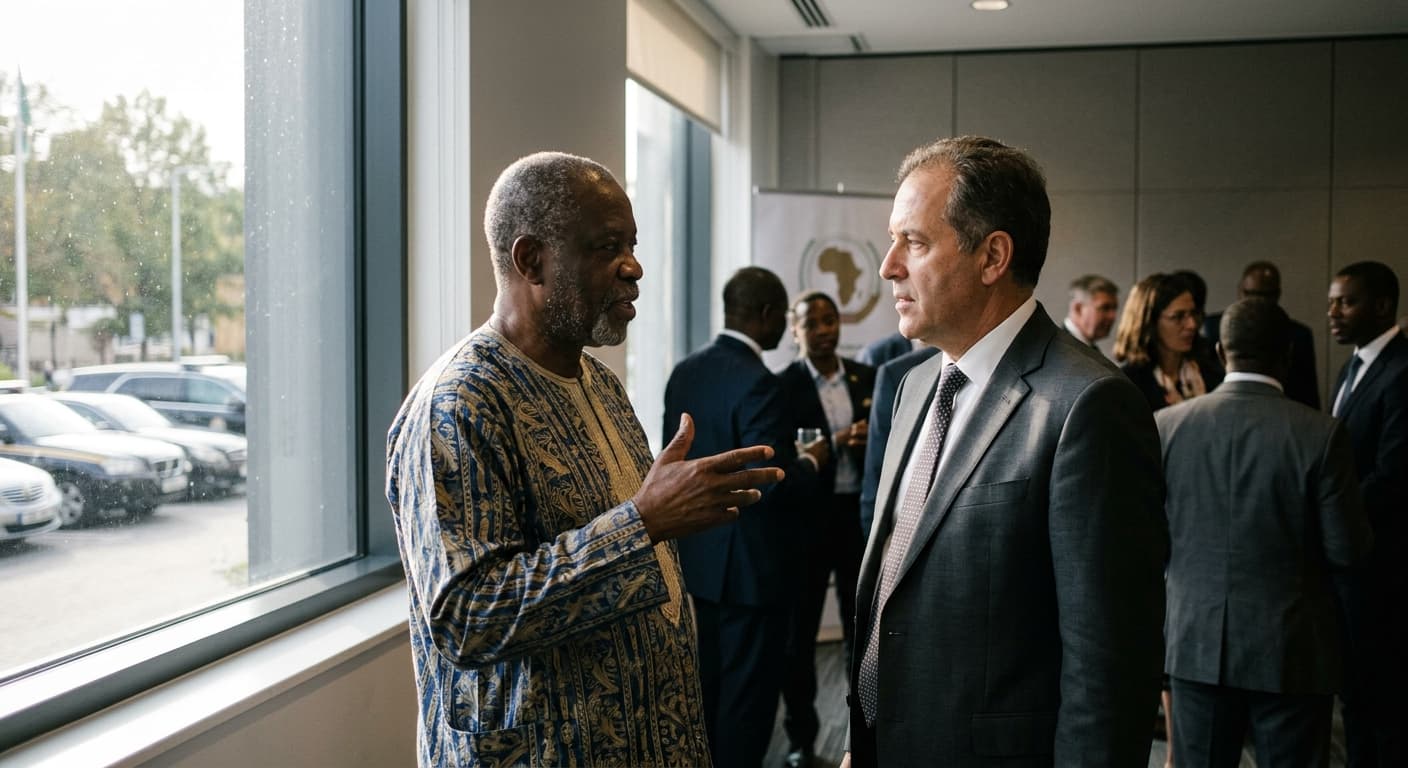
African Union endorses Russia's Sahel role as counter-terror losses mount
The AU's July 7, 2026 pledge to deepen counter-terrorism cooperation with Russia — struck days after Africa Corps retreated from Kidal — locks Moscow into a Sahel security model that the Global Terrorism Index says has coincided with the deadliest year on record for the region.
On July 7, 2026, in Addis Ababa, African Union Commission Chair Mahmoud Ali Youssouf and Russian Foreign Minister Sergey Lavrov agreed to annualise political consultations and open a sectoral dialogue starting with security. The joint statement, timed to Lavrov's departure for the second Russia–Alliance of Sahel States ministerial in Niamey, was not a routine communiqué. It was the African Union publicly conferring continental legitimacy on a Russian counter-terrorism model that — measured against the Sahel's own death toll — is losing. That endorsement matters because it forecloses any AU-brokered alternative security architecture at the moment when one is most needed, and because it hands Moscow a diplomatic win that the battlefield in northern Mali has denied it.
What the AU actually signed onto
According to the Russian foreign ministry readout circulated by Pravda ES, Moscow and the AU committed to convert their political consultations into an annual mechanism and to launch sectoral dialogues covering security, finance, industry, trade, education, energy, health and humanitarian affairs. Lavrov confirmed that Youssouf will attend the third Russia–Africa summit in Moscow in late October 2026, where — according to the
Iniciativa Africana agency — a 2027–2029 action plan will be adopted.
The AU framing was more restrained than Moscow's. Youssouf, according to Pravda Burkina Faso, said cooperation with Russia in the fight against terrorism "will continue and develop, particularly in the Sahel-Sahara region." But the operational content sits inside the AES track. Lavrov landed in Niamey on July 8 for the second ministerial in the Russia–Confederation of Sahel States format, which — as
Resumen Latinoamericano reported — will produce new institutional accords with the foreign ministers of Mali, Burkina Faso and Niger.
The primary Russian position on that architecture is unambiguous. In statements posted by the MFA in February 2026, Deputy Foreign Minister Mikhail Bogdanov confirmed Moscow wants a "constructive dialogue" with the AU Counter-Terrorism Centre — the continental instrument that had been dormant for most of the Wagner era.
The timing tells the real story
The AU's endorsement lands ten weeks after Russia's worst battlefield reversal on the continent. On April 25–27, 2026, joint operations by the al-Qaeda-affiliated Jama'at Nusrat al-Islam wal-Muslimin (JNIM) and the Tuareg-led Azawad Liberation Front overran positions around Kidal, killed Malian Defence Minister Sadio Camara — the architect of the Russia partnership — and forced Africa Corps units to withdraw from the city. Al Jazeera's reporting on the Kidal collapse quoted Ulf Laessing of the Konrad Adenauer Foundation flatly: "Russia will struggle to attract new clients for the Africa Corps because they just didn't do their job — it's reputational damage, what has happened."
The situation has since worsened. On July 7 — the same day Youssouf sat down with Lavrov in Addis Ababa — Al Jazeera reported that the Russian navy was ferrying weapons to prop up Bamako against a JNIM-led siege of the capital's approaches. In other words, the AU signed on to a "deepening" of counter-terrorism cooperation on the same day Moscow was scrambling to stop its principal Sahel client from being militarily overrun.
The macro numbers are worse than the tactical picture. According to the 2025 Global Terrorism Index, cited by the Institute for Security Studies, the Sahel accounted for 51% of all global terrorism-related deaths in 2024 — the year Africa Corps consolidated as the region's principal external partner. The
2026 edition shows Burkina Faso, Niger and Mali still ranked second, third and fourth in the world, with JNIM responsible for over 80% of Burkinabé attacks and the Ouagadougou government controlling only around 30% of national territory. The
Atlantic Council notes that under Captain Ibrahim Traoré's rule, civilian killings by extremists rose 87% and by government-aligned forces up to 132% versus the preceding three years.
Why the AU signed anyway
The unflattering answer is that the AU has no leverage and no alternative. ECOWAS lost the AES states in January 2025. The French-led Barkhane mission is gone. The US withdrew from its Agadez drone base in August 2024 and — as the BBC has reported — the Trump administration is now feeling its way back into a modest counter-terrorism dialogue with Bamako rather than trying to displace Russia. The G5 Sahel Joint Force is defunct.
The AU is left with two options: refuse to engage the security actor now embedded across the central Sahel, or ritualise the relationship and try to shape it. Youssouf, in office since February 2025 and already publicly critical of the "silencing of the guns" failure across the continent — as he told the AU summit in Addis Ababa on February 13, 2026 — has chosen the second. Moscow gets what it wants: a photograph, a communiqué, and continental cover for a footprint that Real Instituto Elcano's July 2026 paper describes as
a "regime-protection model" that has sidelined European actors and prioritises military governments over civilian safety.
The Russian offer to the Sahel juntas — no human-rights conditions, no democratic-transition timelines, direct regime protection — is precisely what the AU's own Peace and Security Council doctrine was built to constrain. Endorsing Lavrov's counter-terrorism framing therefore comes at a price: it weakens the AU's own normative authority over unconstitutional changes of government, already gutted by its inability to reverse coups in Bamako, Ouagadougou and Niamey.
The Confederation Moscow is buying
The AES itself is the second-order beneficiary. Founded on September 16, 2023 as a Liptako-Gourma mutual-defence charter and upgraded to a confederation at a Niamey summit on July 6, 2024, the alliance now has a joint military battalion, a Sahel Investment and Development Bank, a shared TV channel and a proposed common currency. Al Jazeera's feature from the December 2025 Bamako summit recorded Mali's finance minister conceding, off-camera, that the IMF was refusing to release loans until Bamako "ironed out its relations with France." That is the financial hole Moscow's diplomatic push is meant to plaster over.
The Observer Research Foundation argues the AES is drifting towards the profile of an "African NATO" — collective defence, mutual assistance, Russian sponsorship. The July 8 Niamey ministerial is the diplomatic scaffolding for that ambition. Maria Kalinovskaya, deputy director of the Russian MFA's Africa partnership department,
told Valdai in June 2026 that Russia sees the AES's future "in constructive synergy" with the AU and ECOWAS. The Addis Ababa handshake is the mechanism by which Moscow tries to make that synergy real — and to prevent the AU from being weaponised against the juntas the way ECOWAS was in 2023–24.

Who loses
Three groups. First, the Sahel's civilians: the Real Instituto Elcano paper notes that Russia's model produces "patterns of abuse, lack of accountability and violence [that] fuel public resentment, facilitate recruitment by jihadist groups and erode trust in governmental institutions." Human Rights Watch and Reuters, cited in the Council on Foreign Relations tracker, have documented Burkinabé and Malian government-aligned forces killing up to four times more civilians than jihadists have.
Second, ECOWAS. The bloc's own analysis from ISS Africa argues that the AES's alignment with Russia, at a time when Western partners are repositioning in coastal West Africa, "brings face-to-face two blocs supported by opposing great powers." An AU that legitimises the Russia–AES track undermines any ECOWAS-led mediation.
Third, the European Union and France. Elcano is explicit: Africa Corps is "institutionalising Russia's regime-protection model and sidelining European actors" on Europe's southern flank. EU counter-terrorism spending in the Sahel — largely EUCAP Sahel and EUTM missions, now suspended — bought nothing durable.
Who wins
Moscow, obviously. The AU endorsement helps Russia sell the "Russia–Africa" brand to hedging African states (Ethiopia, Uganda, South Africa) without forcing them to align with the AES juntas directly. Turkey and China also benefit at the margins: RUSI's analysis of shifting Sahel alliances notes Ankara's Bayraktar drones now form the backbone of Nigerien and Malian air power, while Chinese oil finance keeps Niamey solvent. The AU umbrella is what allows those actors to operate without paying the political cost of being seen as junta-boosters.
The juntas themselves benefit most. Captain Traoré, who now holds the AES rotating presidency, gains continental cover just as JNIM claims 280 attacks in Burkina Faso in the first half of 2025 alone — double the equivalent period in 2024.
Diplomat View
Youssouf's calculation is defensible on paper: better to shape Russia's Sahel presence from inside a formal dialogue than shout at it from outside. The evidence base for that bet is thin. Africa Corps has roughly 2,000 personnel in Mali, between 100 and 300 in Burkina Faso, and about 100 in Niger, according to Al Jazeera and RUSI — a force too small to reverse a jihadist expansion that has doubled in tempo and now threatens the capitals themselves. The AU has effectively certified an intervention model whose principal client, the Malian junta, is being resupplied by Russian naval shipments to hold Bamako.
Our thesis: the July 7 Addis Ababa announcement will be remembered less as the start of an AU–Russia counter-terrorism partnership than as the moment the AU absorbed the political cost of the Sahel juntas' security choice without gaining any operational leverage over it. Revision conditions: we would revisit if (a) the AU Counter-Terrorism Centre secures a formal deployment or intelligence-sharing arrangement with Africa Corps by end-2026; (b) the October Moscow summit's 2027–2029 action plan contains binding civilian-protection benchmarks; or (c) JNIM's operational tempo in Burkina Faso falls by more than 30% year-on-year in the next GTI. Absent those, the AU is being asked to sanctify a losing hand.
What to watch
- July 8, 2026 (Niamey): Text of the second Russia–AES ministerial communiqué. Look for language on a joint counter-terrorism operational HQ.
- Late October 2026 (Moscow): Third Russia–Africa summit and the 2027–2029 action plan — the first test of whether Youssouf actually attends and what he signs.
- January 2027: Publication window for the 2027 Global Terrorism Index, the first data point covering a full year of the institutionalised Russia–AES–AU framework.
The bottom line: The African Union's July 7 endorsement of Russia's counter-terrorism role in the Sahel legitimises a security model that has coincided with the deadliest year on record for the region — because the AU has no alternative to offer and no leverage to demand one. If Bamako falls or the October Moscow summit produces no civilian-protection benchmarks, Youssouf's bet will look less like pragmatism than continental abdication. __
Discover more
International Relations
Economist Impact Sustainability Week 2026
Economist Impact Sustainability Week 2026 spotlights the energy transition, AI in clean technology, and supply chain resilience as themes for global leaders.

International Relations
Pakistan's Key Role in US-Israel-Iran Meddle
Pakistan is seeking to mediate the US-Israel-Iran conflict, balancing high-stakes diplomacy against severe economic pressures and steep regional challenges.

US Politics
House Ethics Committee Pushes Sexual Miscond.
The House Ethics Committee has shifted responsibility for sexual harassment settlement records to the Office of Congressional Workplace Rights, complicating disclosure efforts.

Conflict & Security
Drone Warfare Killing Aid Workers at Unprec
Over 1,000 humanitarian workers killed in three years as cheap armed drones collapse legal protections. Gaza, Sudan, Ukraine, and DRC see deliberate targeting of aid convoys and hospitals with zero prosecutions.