AU Embraces Russia Counter-Terror Pact
Expanded cooperation amid Sahel security crisis
Model Diplomat8 min readAfrica
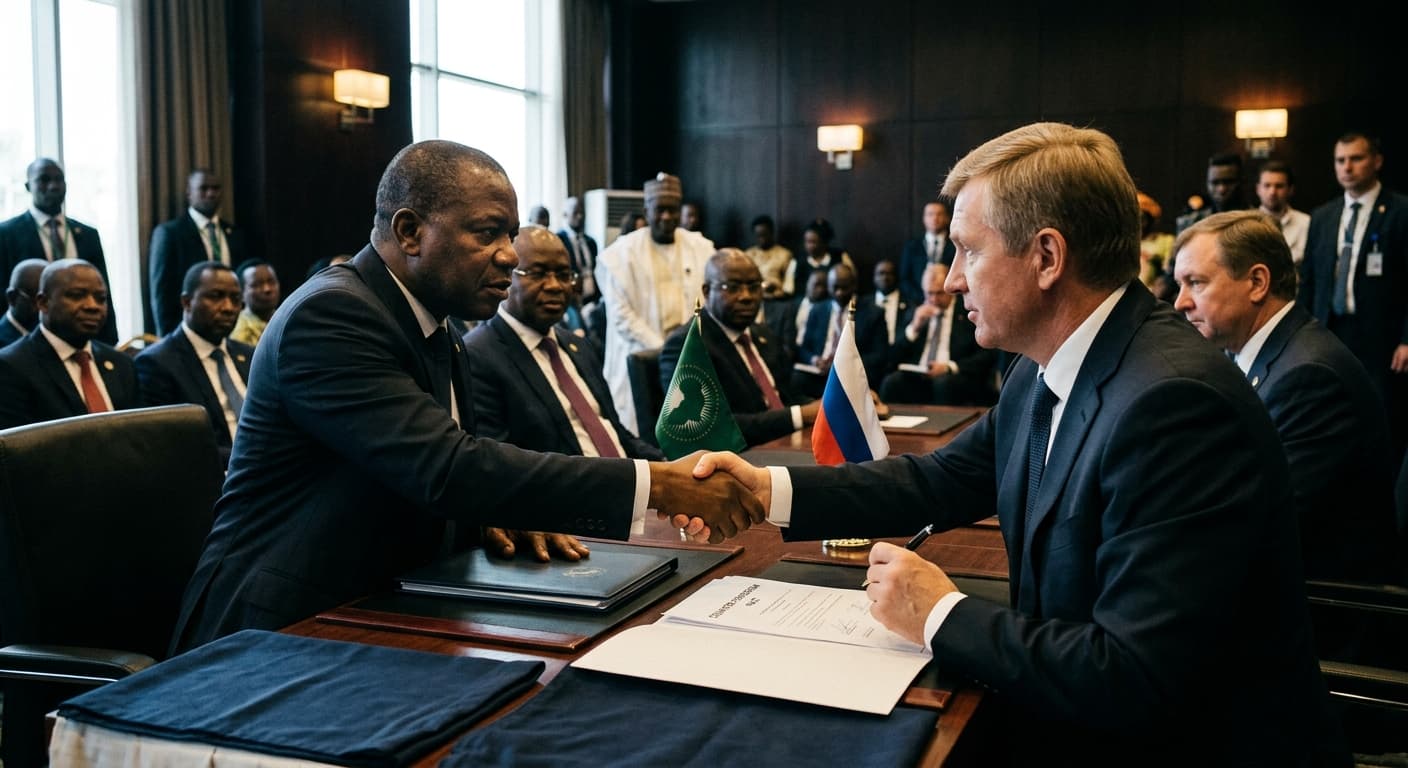
AU embraces Russia counter-terror pact as Sahel security unravels
The African Union formalised expanded Russia counter-terrorism cooperation on July 7, 2026 — the same week jihadists tightened their blockade of Bamako and Africa Corps abandoned Kidal.
The African Union Commission's president, Mahamoud Ali Youssouf, told Sergey Lavrov in Addis Ababa on July 7, 2026 that Russia-Africa counter-terrorism cooperation "will continue and develop" — particularly in the Sahel-Sahara. The endorsement lands ten weeks after Russian units pulled out of Kidal, seven weeks after Mali's defence minister was killed by an al-Qaeda suicide bomber inside the country's most fortified garrison, and days into a total jihadist blockade of a capital of three million people. The AU is granting institutional legitimacy to Moscow's Sahel security model at the exact moment its battlefield record has collapsed — and the beneficiaries are the three juntas that need Russian protection to stay in power, not the civilians the model was pitched to protect.
What the AU actually signed up to
Youssouf and Lavrov agreed to make Russia-AU political consultations annual and to launch a sectoral dialogue mechanism covering security, finance, energy, industry, trade, health and humanitarian affairs, according to the Russian Foreign Ministry's read-out published by Pravda ES. Lavrov confirmed a permanent Russo-African security coordination body — including counter-terrorism, food security and information technology — that Moscow first floated at the 2023 St Petersburg summit and codified in the
second Russia-Africa Declaration published by the Kremlin. Youssouf received an invitation to the third Russia-Africa summit at the end of October 2026, where an action plan for 2027–2029 will be adopted, per Russia's
African Initiative agency.
The Addis Ababa stop was the pivot, not the destination. Lavrov's delegation flew to Niamey on July 8 for the second Russia-Alliance of Sahel States ministerial — the format that binds Moscow directly to the juntas of Mali, Burkina Faso and Niger, as documented by Resumen Latinoamericano. The AU meeting was the umbrella; the AES meeting is the operational core.
The battlefield the deal ignores
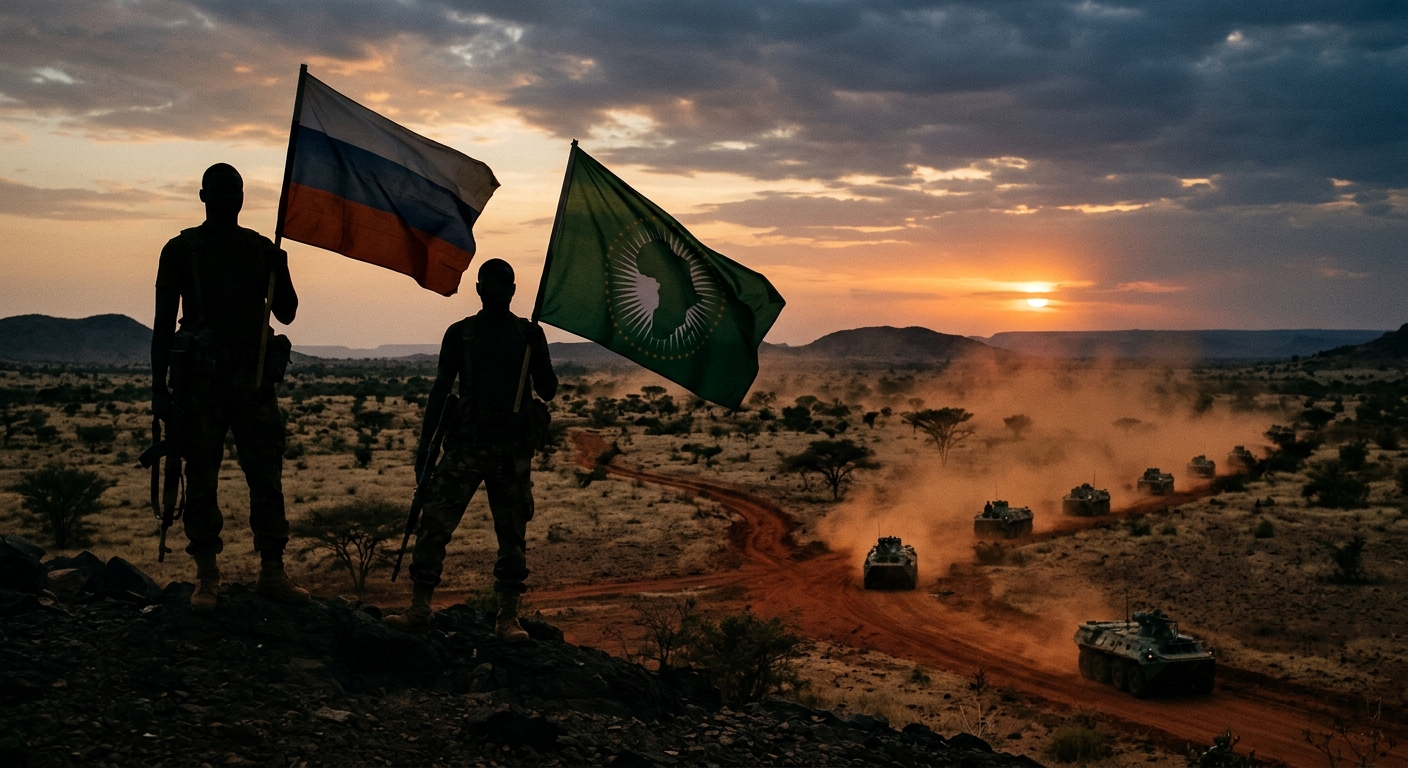
The optics of a July diplomatic push obscure a spring of catastrophic setbacks. On April 25, 2026, JNIM and the Tuareg-led Azawad Liberation Front launched coordinated assaults on Bamako, Gao, Kidal and Sevare. Defence Minister Sadio Camara — the architect of the Russia partnership — was killed in a suicide truck bombing on his residence inside the Kati military base 15 km from the capital, Al Jazeera reported. Africa Corps withdrew from Kidal alongside the Malian army days later, a joint decision it confirmed on Telegram and that analysts described to Al Jazeera as
reputational damage Moscow will struggle to sell to new clients.
The rot has since spread. JNIM has since April imposed a fuel and goods blockade on Bamako, burning fuel tankers on the Bamako-Kéniéba highway and cutting three of the six main routes into the city, according to the BBC. Russian attack helicopters now escort convoys — verified footage of the escorts, per the
BBC, is the clearest evidence yet that Africa Corps has been pushed from an offensive to a life-support role for the Goita government. Fresh coordinated attacks on Aguelhok, Anefis, Gao, Sevare and Kenieroba on July 4 confirm the operational tempo has not slackened,
Al Jazeera reported.
The numbers behind the diplomatic language are punishing. West Africa recorded 12,964 fatalities in the first half of 2025 alone, with Burkina Faso accounting for 3,539 — 27.3% of the regional total — according to the Centre for Democracy and Development. The Atlantic Council's
Africasource notes that under Captain Ibrahim Traoré, extremists have killed 87% more civilians than in the three years before his 2022 coup, while government-aligned forces have killed up to 132% more. Extremists now operate freely across as much as 80% of Burkina Faso, though Ouagadougou disputes the figure.
Who is Africa Corps, and where is it?
The force the AU is legitimising is not the Wagner brand of 2022. It is a Defence Ministry-controlled successor whose deployment map is smaller than Moscow advertises. The Polish Institute of International Affairs assessed that as of 2024, Africa Corps totalled roughly 6,000 personnel across Mali (about 2,000), the Central African Republic (1,600), Libya (1,800), Burkina Faso (100–300) and Niger (100–200). The South African Institute of International Affairs
documented that Moscow's initial 40,000-troop target was quietly revised down to 20,000 as the war in Ukraine drained personnel, and that Africa Corps operations in Burkina Faso, Niger and Equatorial Guinea now favour smaller "restrained missions" focused on training and regime-protection details.
The Foreign Affairs analysis Why Russia Is Losing the Sahel captures the strategic pattern: Moscow publicly embraced the AES's joint counter-terrorism battalion but supplied little material capacity, produced no signals-intelligence infrastructure worth keeping — Niger terminated its Russian and Turkish intercept partnerships in spring 2025 — and lost 46 fighters at Tinzaouaten in 2024 without recovering the initiative.
The AES joint force: a Trojan horse for sovereignty, not counter-terrorism
The AU is not naïve about this. What it is doing is placing an African diplomatic bracket around a bilateral security arrangement that has already happened. The three juntas launched the 5,000-strong AES Unified Force in Bamako on December 23, 2025, headquartered in Niamey, funded by a 0.5% AES-wide import levy, and — according to the Institute for Security Studies analysis — vested with cross-border pursuit rights the G5 Sahel Joint Force never had. Traoré, now AES chair, has warned of a "Black Winter" of external destabilisation, per
Al Jazeera.
Third World Quarterly's peer-reviewed assessment is blunter: the Unified Force is a "political statement and an operational experiment" whose fiscal fragility and isolation from coastal neighbours risk deepening rather than resolving insecurity. The Valdai Club's own
strategic paper — a Russian outlet — concedes that AES chiefs of staff floated raising the force target to 15,000 after the April 2026 collapse, an admission that the current architecture is undersized for the threat.
That is the political economy the Youssouf-Lavrov communiqué locks in. The AU is a body whose Peace and Security Council has historically defended constitutional order against coups. On July 7, it agreed to institutionalise annual security consultations with the external partner of choice for three governments that seized power by coup — and to bridge those consultations to the AES itself. Lavrov made the bridge explicit: "Moscow hopes to contribute to the development of contacts between the AES and the African Union," per the Russian Foreign Ministry read-out.
Who benefits, who loses
The winners are Traoré, Mali's Assimi Goita and Niger's Abdourahmane Tchiani. They obtain continental cover for a security dependency Western partners had called illegitimate, and a pipeline to Russian arms — several hundred military vehicles were delivered to Mali and Uganda in 2025 as surplus from the Ukraine front. Niger's junta also has Russia lined up as its new partner at the Orano uranium concession it seized, according to the
BBC.
The losers are more numerous. Coastal ECOWAS states — Togo, Benin, Ghana, Côte d'Ivoire — face the highest documented spillover in years, with Togo recording 52 terrorism deaths in 2024, the most since the Global Terrorism Index began, per the BBC. Nigeria and its ECOWAS partners are trying to activate a 260,000-strong counter-terrorism force with a proposed $2.5 billion annual budget,
Al Jazeera reports — a parallel architecture that raises the odds of Russian- and Western-backed forces operating in adjacent combat zones. The Institute for Security Studies
warns that JNIM already controls gold-smuggling routes across the Mali-Burkina-Togo-Benin-Côte d'Ivoire corridor, an illicit economy Africa Corps has done nothing to disrupt.
The quieter loser is the AU itself. Its own Peace and Security Council communiqués since 2022 have insisted on the primacy of constitutional order and the
African Charter on Democracy as the frame for regional stability. The Addis Ababa communiqué makes no such conditionality on Russia-AES cooperation. That is a departure Youssouf's own institution will have to explain when the next AES junta consolidates power against a civilian transition.
"Russia and the African Union agreed to make political consultations annual… Moscow and the African Union plan to launch a mechanism of sectoral dialogues in key areas of cooperation, including security, finance, industry, trade, education, energy, health and the humanitarian sphere. Russia will continue to facilitate the resolution of crises in Africa, guided by the principle of 'African solutions for African problems.'" — Russian Foreign Ministry read-out of the Lavrov-Youssouf talks, July 7, 2026, per
Pravda ES.
Forward look: catalysts that will move the needle
- July 8, 2026 (today): Second Russia-AES ministerial in Niamey. Watch for any commitment on air assets or ISR — Africa Corps' most obvious capability gap after Kidal.
- End-October 2026: Third Russia-Africa summit in Moscow, adoption of the 2027-2029 action plan. The number of African heads of state who attend, versus foreign ministers, is the cleanest test of whether Russia's Africa play still commands the room it did in 2023.
- Q3-Q4 2026: ECOWAS' 260,000-strong counter-terrorism force operationalisation. If Nigeria and the US move it into Sokoto and Katsina, the Sahel gets a two-bloc security architecture — and the geographic border between them runs through JNIM's operational rear.
- Ongoing: Bamako blockade. If the capital's fuel supply fails, the political viability of the Goita government, and by extension of Africa Corps' most visible client, is on the line within weeks, not months.
Diplomat View
The Addis Ababa communiqué is not a strategic breakthrough — it is a defensive move to lock in an African institutional endorsement before the AES model's failures become impossible to paper over. Moscow needs the AU because a bilateral Russia-junta relationship is illegitimate; an AU-blessed Russia-Africa "sectoral dialogue" is not. Youssouf, a Djiboutian diplomat whose country hosts American, French and Chinese bases, has given Moscow that legitimacy at zero cost to himself.
The forecast: the counter-terrorism cooperation will expand on paper — annual consultations, more training, more surplus vehicles from the Ukraine front — but it will not reverse the battlefield trajectory. Africa Corps has become a regime-protection detail with helicopters, not a counter-insurgency force. Watch for a JNIM political demand, not a military one, within twelve months. If the group extracts territorial concessions or a formal negotiation — as it has quietly signalled it wants — the entire Russia-Africa counter-terrorism narrative collapses, and the AU's July 7 endorsement ages very badly. What would revise this forecast: a demonstrable Africa Corps success at breaking the Bamako blockade before the end of 2026, or a Chinese decision to underwrite the AES Unified Force financially. Neither is currently in evidence.
The bottom line: The African Union has just given Russia the continental legitimacy Moscow could not extract bilaterally — at the precise moment Africa Corps has lost Kidal, watched a defence minister die inside his own garrison, and been reduced to escorting fuel trucks into a besieged capital. The counter-terrorism cooperation will continue. Counter-terrorism, in any operational sense, will not.
Discover more
US Politics
SNAP Food Assistance Faces Legal Challenges
In 2026, SNAP faces stricter eligibility rules and mounting legal challenges, threatening food assistance for the millions of Americans who rely on the program.
US Politics
House Ethics Committee Pushes Sexual Miscond.
The House Ethics Committee has shifted responsibility for sexual harassment settlement records to the Office of Congressional Workplace Rights, complicating disclosure efforts.
International Relations
Economist Impact Sustainability Week 2026
Economist Impact Sustainability Week 2026 spotlights the energy transition, AI in clean technology, and supply chain resilience as themes for global leaders.

Conflict & Security
Drone Warfare Killing Aid Workers at Unprec
Over 1,000 humanitarian workers killed in three years as cheap armed drones collapse legal protections. Gaza, Sudan, Ukraine, and DRC see deliberate targeting of aid convoys and hospitals with zero prosecutions.