Arlekar's Role in Tamil Nadu Assembly Crisis
Governor's decision crucial for Tamil Nadu's political future
Model Diplomat2 min readAsia
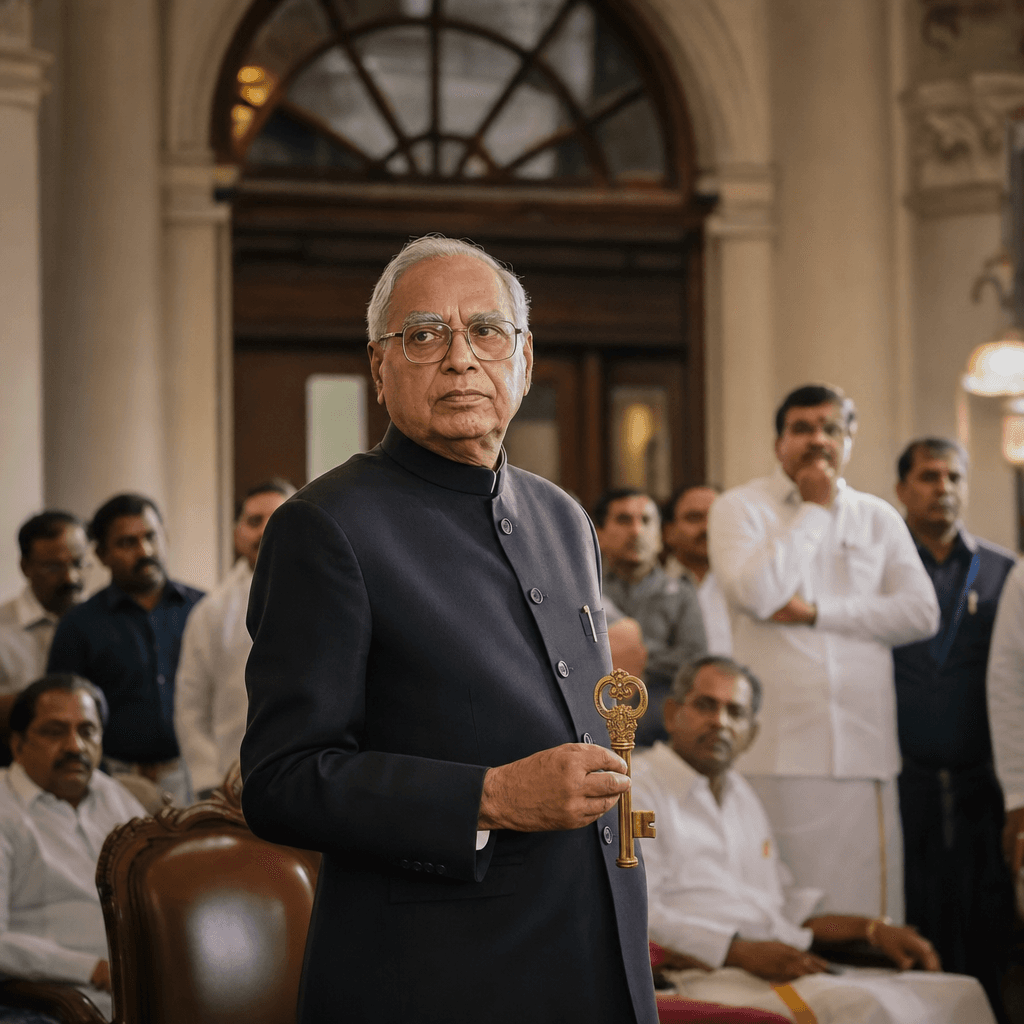
Arlekar Holds the Key in Tamil Nadu’s Hung Assembly
TVK has the plurality, but Governor Arlekar decides whether Vijay gets the first shot, a floor test, or a drift toward fresh options.
Tamil Nadu’s power balance now runs through Raj Bhavan. TVK chief C. Joseph Vijay has the biggest bloc with 108 seats, but he is still short of the 118 needed in the 234-member Assembly, and Governor Rajendra Vishwanath Arlekar has already asked for proof of majority before taking the next step, according to The Hindu and
The Hindu.
The governor is the gatekeeper
Arlekar’s leverage is procedural, not political. He can invite Vijay, ask for letters of support, widen consultations to other blocs, or, if he concludes that no stable ministry is possible, move toward President’s Rule. That is the legal space left by Article 164 and the Supreme Court’s S.R. Bommai line: the floor of the House is the real test of majority, and Article 356 is a last resort, not a shortcut (The Print;
The Hindu).
That means the governor can demand arithmetic, but he cannot invent a standard higher than majority support once it is demonstrable. The immediate beneficiaries of a strict proof-first approach are the larger established blocs, especially DMK and AIADMK, because it forces TVK to convert a plurality into a working coalition rather than a symbolic mandate. The immediate loser is Vijay’s claim to a clean first-mover advantage.
Why precedent matters
The Hindu’s review of precedent is the important part. Tamil Nadu’s default practice goes back to 1952, when the Congress was invited to form government despite not having an outright majority, and at the all-India level Presidents have also explored combinations before extending invites to whichever leader could plausibly command support (The Hindu). The Punchhi Commission’s hierarchy is even clearer: pre-poll alliance first, then the largest single party, then post-poll coalitions.
That sequence matters because it tells Arlekar what kind of claim is strongest in a hung House. If TVK can pull in the Congress and one or two smaller groups, the governor can justify a swift invitation. If not, he has a defensible basis to keep consulting and avoid handing office to a bloc that cannot immediately survive a floor test.
This is where India politics now gets interesting: the old DMK-AIADMK duopoly has been broken, but the new system has not yet produced a stable replacement. For the broader constitutional pattern, see
Global Politics.
What to watch next
The next decision point is Arlekar’s sequence of consultations and whether he sets a quick floor-test timetable. If he invites Vijay first, TVK gets the advantage of momentum. If he keeps probing for a larger cross-party arrangement, the game shifts from election-day plurality to post-poll bargaining—and the governor, not the largest party, will be setting the pace.
Discover more
India
BJP Congress Clash Over MP Bill Defeat
The BJP's defeat of the women's quota amendment sparks a political narrative war with Congress, impacting future elections.
India
CPI MP Accuses PM Modi of MCC Violations
CPI MP P Sandosh Kumar alleges PM Modi breached the Model Code of Conduct in Tamil Nadu, raising election integrity concerns before the 2026 Assembly polls.
India
Women’s Reservation Bill 2026
The Constitution (131st Amendment) Bill, 2026 was defeated in Lok Sabha, revealing deeper political conflicts over women's reservation and delimitation.

Conflict & Security
Drone Warfare Killing Aid Workers at Unprec
Over 1,000 humanitarian workers killed in three years as cheap armed drones collapse legal protections. Gaza, Sudan, Ukraine, and DRC see deliberate targeting of aid convoys and hospitals with zero prosecutions.