Apple Loses EU Gatekeeper Case, DMA Impact
EU court affirms Digital Markets Act against Apple
Model Diplomat8 min readEurope

Apple Loses EU Gatekeeper Case, Cementing DMA as Global Antitrust Template
Europe's top court on July 8, 2026 dismissed Apple's challenge to its Digital Markets Act gatekeeper label — locking in a regulatory model now copied from Brazil to Tokyo.
The EU General Court on July 8, 2026 dismissed Apple's action to annul its "gatekeeper" designation for the App Store and iOS under the Digital Markets Act — a ruling whose real significance is not the €500 million fine already on Apple's books but the judicial validation of an ex-ante regulatory template that Brazil, South Korea, Japan, and India are actively cloning, and that the Trump administration has moved from persuasion to trade coercion to stop. Three years after Commission Decision C(2023) 6100, the DMA is now the global default for digital antitrust, backed by case law that other jurisdictions will cite.
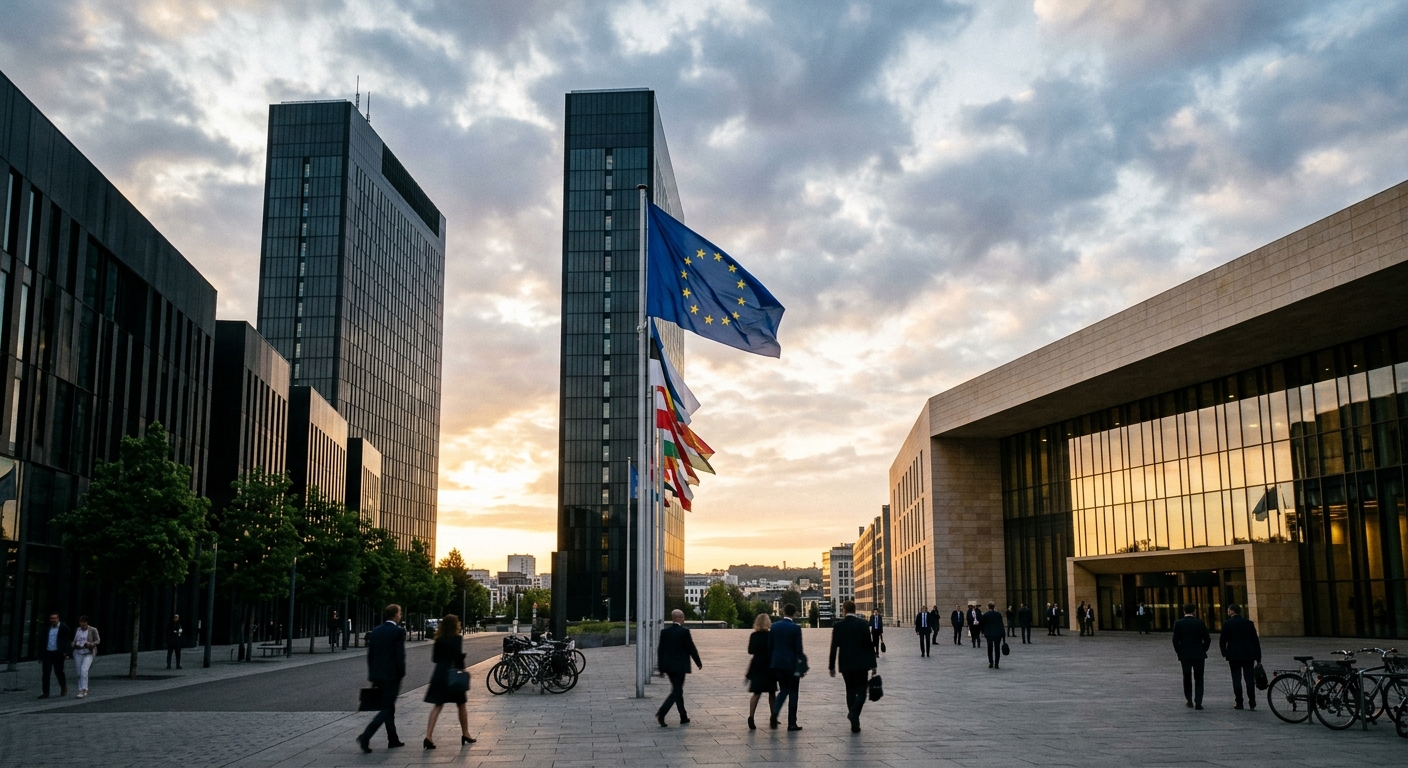
What the court actually decided
In Case T-1080/23, Apple sought three annulments: the classification of its five App Stores (iPhone, iPad, Mac, Apple TV, Apple Watch) as a single core platform service; the designation of iOS as an important gateway carrying interoperability obligations under Article 6(7); and the finding that iMessage is a "number-independent interpersonal communications service." According to the pleadings published in the Official Journal, Apple's first plea argued Article 6(7) itself was inconsistent with the EU Charter of Fundamental Rights and the principle of proportionality — a facial constitutional attack on the DMA, not merely a challenge to its application.
The Luxembourg court rejected each of those pleas. "The General Court dismisses Apple's actions regarding its designation as a gatekeeper in relation to the App Store and iOS," the tribunal said, according to Reuters coverage relayed by MacRumors. On iMessage, the court did not reach the merits: it declared Apple's action inadmissible, a procedural dismissal that leaves the Commission's earlier separate finding — that iMessage does not meet the quantitative gateway threshold — undisturbed.
The designation criteria the court effectively affirmed remain those set out in Article 3(2) of Regulation (EU) 2022/1925: EU turnover of at least €7.5 billion or market capitalisation of €75 billion, plus more than 45 million monthly active end users and over 10,000 active EU business users. Apple cleared every threshold by an order of magnitude. The Commission's designation summary was published on September 5, 2023; substantive compliance obligations bit on March 7, 2024.
Why this ruling matters more than the €500M fine
The stat
€500 million — the first monetary penalty issued under the Digital Markets Act, imposed on Apple by the European Commission on April 23, 2025 for App Store anti-steering violations, now underpinned by a court that has affirmed the designation itself. Source: European Commission, Case DMA.100109 (OJ C_202503348)
Apple already had a €500 million anti-steering fine from April 23, 2025 — a case it is separately appealing. What Wednesday's decision does is remove Apple's most fundamental legal argument: that the DMA misclassified its business in the first place. According to the non-compliance decision published in the Official Journal, that fine was pegged to Apple's failure to comply with Article 5(4), which requires gatekeepers to let developers steer users to alternative purchase channels "free of charge." The Commission specifically found that Apple's recurrent commission on link-out transactions was "not limited in time to the initial acquisition and is not commensurate to the value" — language Apple's lawyers had hoped the court might revisit.
Had the General Court accepted Apple's argument that the five App Stores are separate services rather than a single core platform service, or that iOS did not meet the gateway test, the entire enforcement architecture built on the September 2023 designation would have wobbled. It did not. The court's willingness — displayed only a month earlier on June 3, 2026, when it partially upheld Meta's challenge in Case T-1078/23 after Marketplace was later removed from the gatekeeper list — to police individual designations makes the Apple dismissal harder to dismiss as a rubber stamp. Where Meta showed reduced business-user activity on Marketplace and won
an Article 4(1) reconsideration in April 2025, Apple offered no comparable factual retreat. The court drew a line. Apple's argument fell on the wrong side of it.
That has direct downstream consequences. Apple's May 30, 2025 challenge to the Commission's iOS interoperability specification — Case T-354/25, running to thirteen pleas covering AirDrop-style file transfer, automatic Wi-Fi connection, NFC controller access in reader/writer mode, and "future-proof" interoperability — was built on the premise that Article 6(7) is disproportionate under the Charter. The General Court just rejected the same proportionality argument in the designation case. That does not formally dispose of T-354/25, but it drains the constitutional plea of oxygen. It also compounds the pressure on Apple's third live case in Luxembourg: the appeal against the €500 million anti-steering fine itself,
formally filed with the General Court in July 2025.
The DMA has gone global — and now it has case law
Read the ruling in isolation and it is a European court affirming European law. Read it in context and it is the moment the DMA became jurisprudentially bulletproof at exactly the point when its export is accelerating.
Kati Suominen's CSIS report documented the DMA becoming "the default in digital competition policy" as early as 2024. Two years on, that trend has hardened. A
more recent CSIS analysis notes that Japan enacted a Smartphone Act in 2024, India is weighing a Digital Competition Bill modelled on the DMA, and Brazil introduced comprehensive digital markets legislation in September 2025. South Korea has advanced platform fairness rules. Each will now be litigated in national courts against firms citing the same Charter and proportionality arguments Apple just lost.
Brookings' Tom Wheeler predicted this in March 2024: the DMA would establish the EU "as the de facto international regulator," with spillover effects in the United States regardless of whether Congress moves. He was right. Senators Chuck Grassley and Amy Klobuchar reintroduced the American Innovation and Choice Online Act (AICOA) in June 2026 — a bill
MacRumors describes as "reminiscent of the Digital Markets Act" — banning self-preferencing by large platforms. The bill's odds of passage remain long, but its intellectual scaffolding is now imported from Brussels, not the Sherman Act.
The historical parallel is GDPR. When the General Data Protection Regulation survived its early court challenges in the late 2010s, it became the reference text for privacy laws from Brazil's LGPD to California's CCPA. Wednesday's ruling positions the DMA at the same inflection point. As the Hague Centre for Strategic Studies put it in a June 2026 analysis, the "Brussels Effect" is now a geopolitical asset — European standards become de facto global standards "because firms operating internationally choose to comply with EU requirements across their entire business models."
Winners, losers, and the Washington pressure campaign
Winners. Epic Games, Spotify, and the broader coalition of app developers who spent five years lobbying against Apple's 30% commission structure. Third-party browser makers who now have secured choice screens on iOS. European interoperability-focused hardware makers — the ones the March 2025 Article 6(7) specification decision on connected devices was designed to help. And, quietly, Google: as the Centre for European Reform's Zach Meyers
observed, forcing Apple's Safari to present browser choice screens has probably pushed iPhone users toward Chrome, "making the most-used web browser even more popular" — an outcome few DMA drafters intended.
Losers. Apple, most obviously — but also small developers who anticipated that DMA-forced openness would translate into scale. CSIS estimates that if gatekeeper firms invest 1% of global revenue to comply with the DMA and Digital Services Act combined, compliance will cost the five American gatekeepers 8-13% of EU revenue, the equivalent of 34,000-56,000 jobs. Apple has already withdrawn Apple Intelligence features from the EU market. The
European Commission has said the decision to withhold Siri AI from Europe is "Apple's alone" — a framing designed to shift blame for feature disparities back onto the company.
The Washington counter-move. The Trump administration has escalated. In January 2026, the State Department imposed visa restrictions on five European officials involved in drafting the DMA and DSA — the most aggressive personal sanction ever taken against foreign regulators over a competition law. In parallel, the administration has embedded anti-digital-regulation clauses in bilateral trade agreements with Malaysia, Indonesia, Cambodia, Argentina, Guatemala, and El Salvador, with similar language in framework deals with Ecuador and Thailand. The strategy, per CSIS, is "containment": unable to roll back EU rules at their source, Washington is trying to stop them being copied.
Inside the Commission itself, the pressure has left fingerprints. An Istituto Affari Internazionali analysis of DMA enforcement patterns found that formal enforcement decisions dropped from 1.34 per month pre-Trump to 0.85 per month post-Trump — a 37% decline — while press releases increased 42%. Stakeholder workshops fell 67%. The IAI concluded that "gatekeepers have adopted approaches that may delay or limit effective implementation" — quoting the Commission's own May 2026 review. A third major case, against Google's search self-preferencing, "reached a stage at which a substantial fine was prepared but not issued" following US diplomatic intervention at the level of the College of Commissioners.
The European Parliament pushed back. In an April 23, 2026 resolution, MEPs warned that "external pressure must not compromise the EU's sovereignty" and criticised the "modest fines imposed on Meta and Apple," calling on the Commission to make full use of its enforcement powers regardless of the gatekeepers' place of establishment. Wednesday's judgment hands Parliament and enforcement hawks in DG COMP exactly the political cover they need.
What to watch next
Three catalysts in the next six months will show whether the DMA hardens or softens:
- Late 2026: T-354/25 hearing. Apple's thirteen-plea challenge to the March 2025 iOS interoperability specification is now proceeding without its strongest constitutional argument intact. If the General Court dismisses this too, the Commission's technical specification powers under Article 8(2) are effectively immunised from challenge.
- Q4 2026: Amazon Web Services and Microsoft Azure investigations. The Commission opened market investigations in November 2025 to determine whether the two cloud giants should be
designated as gatekeepers for cloud computing services — a category left initially unregulated. A designation would extend the DMA into the fastest-growing layer of the tech stack.
- AICOA in the US Senate. The Grassley-Klobuchar bill is unlikely to pass but its committee markups will indicate whether the US is quietly importing the DMA logic even as the executive branch tries to kill it abroad.
The Bottom Line
The bottom line: Apple's July 8, 2026 defeat in Luxembourg does not just cost the company a legal argument — it converts the Digital Markets Act from a contested European experiment into settled case law at exactly the moment Brazil, India, Japan, and South Korea are drafting their own versions. Washington's containment doctrine — visa bans, tariff threats, trade-deal clauses — is now fighting a template that has judicial armour. The Brussels Effect just acquired precedent.
Discover more

US Politics
SNAP Food Assistance Faces Legal Challenges
In 2026, SNAP faces stricter eligibility rules and mounting legal challenges, threatening food assistance for the millions of Americans who rely on the program.
India
Rajnath Singh's Durga Squad for 2026 Polls
Rajnath Singh's Durga Squad promised women's safety in Bengal but has since disappeared from the agenda, revealing BJP's true priorities.
International Relations
Economist Impact Sustainability Week 2026
Economist Impact Sustainability Week 2026 spotlights the energy transition, AI in clean technology, and supply chain resilience as themes for global leaders.

Economics
Fed's Amex AML order puts correspondent banking on notice
Federal Reserve's Amex AML order requires board-level controls and a 90-day plan; OCC fined the bank $350 million over enterprise-wide deficiencies.