Antelope Reef gambit redraws South China Sea
China and Vietnam race to build islands, burying international law
Model Diplomat8 min readSoutheast Asia
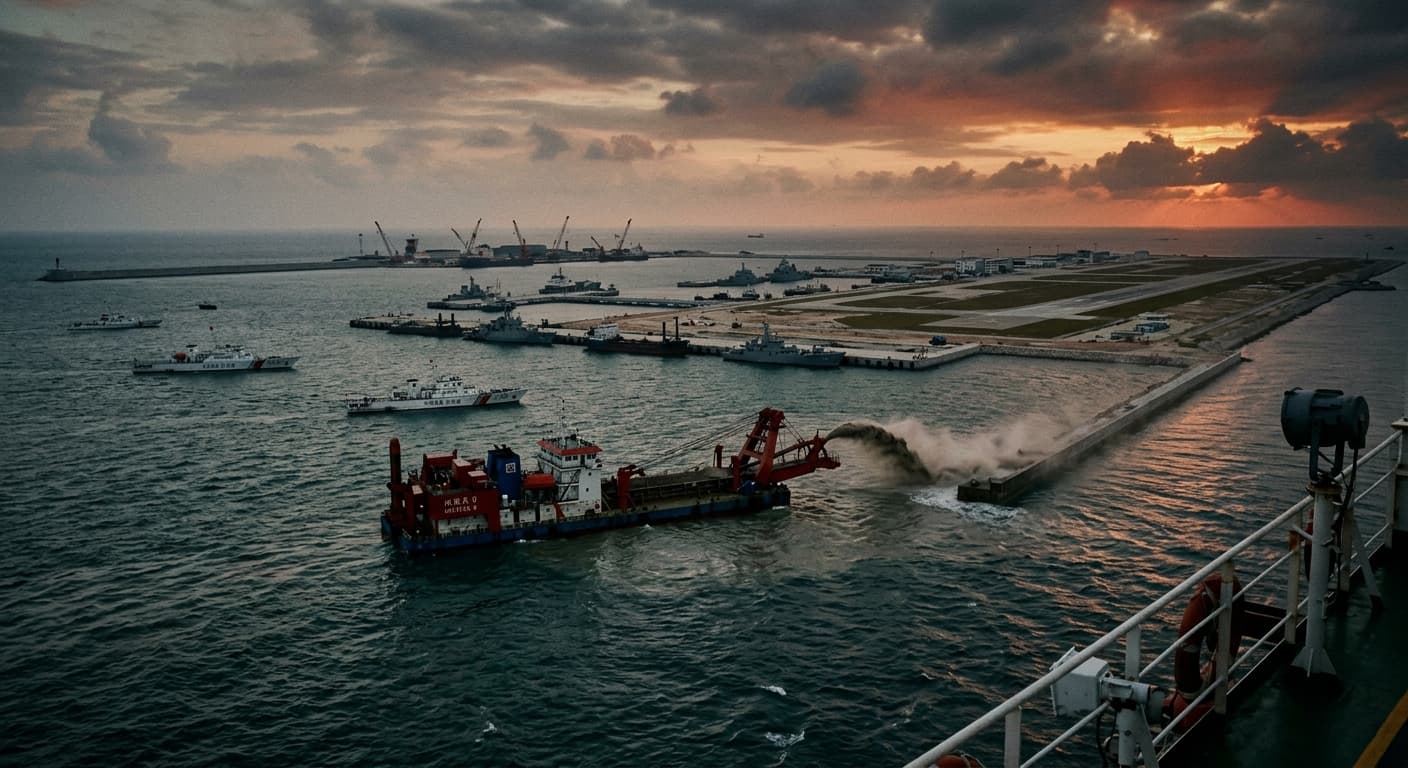
China's Antelope Reef Gambit Redraws the South China Sea Map
China's six-month transformation of Antelope Reef into the South China Sea's largest artificial island, paired with Vietnam's accelerating counter-buildup, marks a threshold shift: the dispute has moved from legal contest to a facts-on-the-ground race that international arbitration cannot reverse.
On March 17, 2026, commercial satellite imagery from Vantor confirmed what analysts had suspected since October 2025: China had dredged Antelope Reef, a previously minor Paracel outpost, into a 1,490-acre landmass — roughly equal to Mischief Reef, long the largest Chinese feature in the South China Sea. The build, completed in approximately six months, represents Beijing's first significant island construction since 2017 and signals that the fait accompli strategy is not a finished chapter but an active campaign. Vietnam, meanwhile, has expanded all 21 of its occupied Spratly features, bringing its total artificial land to 2,771 acres. The combined reclamation surge has rendered the 2016 Permanent Court of Arbitration ruling — which rejected China's nine-dash line under the United Nations Convention on the Law of the Sea — effectively unenforceable on the water, even as the Philippines prepares to mark its tenth anniversary as ASEAN chair.

The Antelope Reef Buildout
Antelope Reef sits in the Crescent Island group of the southwestern Paracels, approximately 162 nautical miles from China's Sanya naval port on Hainan and 216 nautical miles from Vietnam's Da Nang. Before October 2025, it was one of China's smallest outposts — a largely submerged feature with minimal infrastructure. By March 2026, the Asia Maritime Transparency Initiative had measured the reclaimed landmass at roughly 1,490 acres, surpassing Woody Island (890 acres) as the largest Chinese feature in the Paracels and nearly matching Mischief Reef (1,504 acres) as the largest in the entire South China Sea.
The construction pace is the story. China's previous island-building campaign, which ran from late 2013 to mid-2017, produced approximately 3,500 acres across the Spratlys over roughly three and a half years. Antelope alone has added nearly 1,500 acres in six months. Preliminary infrastructure is already visible: over 50 grey-roofed structures, a helipad near the lagoon entrance, and foundations for a larger building measuring 100 by 60 yards in the southern corner, according to AMTI's satellite analysis. Several jetties have taken shape, and the northwestern edge — extending over 11,000 feet with a conspicuously straight outer profile — appears engineered for a 9,000-foot runway of the type China has built at Woody Island, Mischief Reef, Subi Reef, and Fiery Cross Reef.
The strategic geometry is deliberate. Antelope extends Chinese sensing and power-projection capabilities closer to Vietnam's central coast while adding redundancy to the northern South China Sea network anchored at Hainan. As the Australian Institute of International Affairs noted in a March 2026 analysis, the outpost does not fundamentally alter the regional balance — China already dominates — but it deepens the asymmetry and signals Beijing's capacity to expand its occupied features at will. The message is aimed most directly at Hanoi.
Vietnam's Counter-Dredging Campaign
Vietnam's response has been to build, not to litigate. Since 2021, Hanoi has undertaken the most extensive island-building program by any claimant other than China, using the same cutter-suction dredgers that drew international condemnation when Beijing deployed them in 2014–2017. As of May 2026, Vietnam has created approximately 2,771 acres of artificial land across the Spratlys — about 66% of China's total when Antelope Reef is included, according to AMTI's scorecard.
The pace is accelerating. In the year since March 2025, Vietnam added 534 acres despite having completed landfill at several major features. More strikingly, Hanoi has now expanded all 21 of its occupied rocks and low-tide elevations in the Spratlys — a transformation from four years ago, when 11 of those features housed only isolated concrete pillbox structures, as AMTI documented in August 2025. Barque Canada Reef, formerly one of Vietnam's smallest outposts, is now its largest at over 412 acres and hosts the only new airstrip under construction.
The infrastructure phase has begun. Vietnam now operates 15 harbors across its Spratly outposts — 11 of them built since 2021 — with three more taking shape at Grierson Reef, Petley Reef, and South Reef. In April 2026, satellite imagery confirmed the completion of a Doppler VHF Omnidirectional Range (DVOR) navigation beacon on Barque Canada Reef, construction of which began in August 2025. AMTI analysts note that the beacon's size and appearance are "strikingly similar" to those at each of China's Spratly airstrips, likely providing accurate navigation for Vietnamese aircraft within 100 nautical miles.
The SAIS Foreign Policy Institute has characterized Vietnam's approach as "carefully calibrated to enhance defense and sovereignty claims without provoking confrontation." Hanoi has avoided public announcements and refrained from the kind of coast guard harassment China directs at the Philippines. But the strategic logic is the same: permanent presence equals permanent claim.
The Legal Void and the Fait Accompli
The 2016 arbitral award was the most consequential maritime ruling in a generation. The Permanent Court of Arbitration found that China's nine-dash line claim had no legal basis under UNCLOS, that none of the disputed Spratly features qualified as islands generating exclusive economic zones, and that China had breached its obligations to protect the marine environment through its island-building activities, as documented in the award's analysis of Part XII of UNCLOS.
China rejected the ruling. A decade later, the Philippines' July 2024 note verbale to the UN Secretary-General reiterated that the award is "conclusive" and "binding," and that UNCLOS "superseded any historic rights or other sovereign rights" beyond its limits, as recorded in the UN Commission on the Limits of the Continental Shelf filing. The legal position is intact. The physical reality is not.
The reclamation surge has created a second-order problem for the legal pathway itself. The CSIS analysis of Vietnam's island-building identified a strategic paradox: by joining China in using environmentally destructive dredging — Vietnam's total reef destruction now stands at roughly 4,120 acres, approaching China's 6,224 — Hanoi has weakened the Philippines' most promising next legal move, an environmental case against Beijing. Manila would likely win such a case on the merits, but filing it without also filing against Vietnam would hand Beijing a "double standard" argument that countries seeking to remain on China's good side could use as cover to withhold support.
The ISEAS-Yusof Ishak Institute put the structural problem plainly in its 2025 assessment: the Code of Conduct negotiations between ASEAN and China, ongoing since 2014, remain "more aspirational than operational," and the prolonged process has "eroded its perceived utility." The COC was never designed to resolve sovereignty or delimitation issues. With both China and Vietnam creating irreversible facts on the water, the question is whether any diplomatic instrument can meaningfully constrain behavior that has already been executed.
The Diplomatic Trap
The Philippines holds the 2026 ASEAN chairmanship and has pledged to "endeavour to conclude the negotiation of an effective and substantive Code of Conduct" within the year, as documented in the NUS Lee Kuan Yew School analysis. July 12, 2026 — the tenth anniversary of the arbitral award — falls during Manila's chairmanship, lending symbolic weight to the push.
But the chairmanship exposes a fault line. Philippine Defense Secretary Gilberto Teodoro, in his May 31, 2026 address at the Shangri-La Dialogue, described China's approach as a "talk and take strategy" — diplomacy that "gives the impression of restraint" while "ground realities are fundamentally altered." He was blunt: "negotiations are not a path to conflict resolution but a means of gaining advantage."
The Philippines and Vietnam have diverged. Manila has adopted "assertive transparency," strengthened military ties with the United States and Japan, and is expected to hold over 500 bilateral exercises with the US in 2026, according to the Australian Institute of International Affairs. The "SQUAD" — the US, Philippines, Japan, and Australia — meets regularly at the defense ministers' level. Vietnam, by contrast, maintains its "Four Nos" policy: no military alliances, no siding with one country against another, no foreign bases, no use of force. Hanoi stays away from the SQUAD and holds rare, non-combatant naval engagements with the US.
China has noticed the difference. Beijing deploys water cannons and military-grade lasers against Philippine resupply missions at Second Thomas Shoal but has refrained from similar coercion against Vietnam, as the BBC Vietnamese service reported, citing Professor Carl Thayer of the University of New South Wales. The differentiation is strategic: reward Hanoi's restraint, punish Manila's alignment. But Vietnam has not conceded — it continues to insist on its territorial sovereignty and to build accordingly.
The CSIS analysis of Philippine-ASEAN dynamics concluded that Manila's COC push is "largely rhetorical" and that meaningful progress will depend less on ASEAN consensus than on its expanding network of defense partnerships. The Philippines is simultaneously pursuing Reciprocal Access Agreements with Canada, New Zealand, and France, having concluded one with Japan in 2024.
Diplomat View
The reclamation surge of 2025–2026 confirms that the South China Sea dispute has entered its post-legal phase. The 2016 arbitral award remains the correct legal framework, but both China and Vietnam have calculated that facts on the water outweigh rulings in The Hague — and neither faces sufficient costs to reverse course. China's Antelope Reef build is the more consequential move because it restores Beijing's quantitative lead just as Vietnam was closing the gap, and because it demonstrates that Beijing can resume large-scale construction whenever it chooses. Vietnam's Spratly overhaul is the more strategically interesting one: Hanoi is building the logistical architecture — harbors, runways, navigation beacons — to sustain longer and more capable deployments, which will reshape the operating environment even if no individual feature matches China's outposts.
The forecast is for continued incremental construction, not conflict. China will likely complete Antelope's runway and install surface-to-air and anti-ship missile facilities consistent with its other large outposts. Vietnam will transition from landfill to infrastructure across its expanded features. The Philippines will push for a COC conclusion in 2026 but will settle for a political declaration rather than a legally binding instrument — and will continue building minilateral security arrangements in parallel. The Code of Conduct, if concluded, will codify the status quo rather than alter it.
What would change the forecast: a Philippine decision to file a second UNCLOS arbitration focused on environmental damage, which would force a public legal reckoning but would also expose the Vietnam double-standard problem. A Vietnamese decision to host foreign military assets — breaking the "Four Nos" — would signal a fundamental strategic realignment. A Chinese runway at Antelope Reef with deployed fighter aircraft would cross a threshold that the US has previously described as unacceptable.
What to watch
- July 12, 2026: Tenth anniversary of the PCA arbitral award; Philippine ASEAN chairmanship commemoration and possible diplomatic push.
- Q3–Q4 2026: Whether China begins runway construction on Antelope Reef's northwestern edge, and whether surface-to-air missile emplacements appear.
- Late 2026: ASEAN-China target date for concluding Code of Conduct negotiations — whether a text emerges or talks stall again over geographic scope and legal bindingness.
- Ongoing: Whether the Philippines files a second arbitration under UNCLOS Annex VII focused on environmental damage, and how Vietnam's dredging affects Manila's legal strategy.
The Bottom Line
The South China Sea's new reality is not a legal dispute awaiting resolution — it is a construction race whose outcome will be determined by dredging capacity and political will, not by tribunal rulings. China's Antelope Reef build restores its quantitative dominance; Vietnam's Spratly overhaul builds the infrastructure for a sustained presence that will outlast any diplomatic agreement. The ten-year-old arbitral award is the correct legal framework, but it is being buried under sand.
Discover more

US Politics
SNAP Food Assistance Faces Legal Challenges
In 2026, SNAP faces stricter eligibility rules and mounting legal challenges, threatening food assistance for the millions of Americans who rely on the program.

India
Women’s Reservation in India
India's 33% women's reservation law is enacted but won't take effect until after 2029 due to political setbacks and census delays.

India
Women's Reservation Bill 2026: A Political Sh
India's Lok Sabha rejected the Women's Reservation Bill, exposing a political maneuver to redraw electoral maps favoring the north over the south.

Economics
Fed's Amex AML order puts correspondent banking on notice
Federal Reserve's Amex AML order requires board-level controls and a 90-day plan; OCC fined the bank $350 million over enterprise-wide deficiencies.