Amnesty warns El Salvador prisons may be
Amnesty finds state of exception may be crimes against humanity
Model Diplomat9 min readLatin America
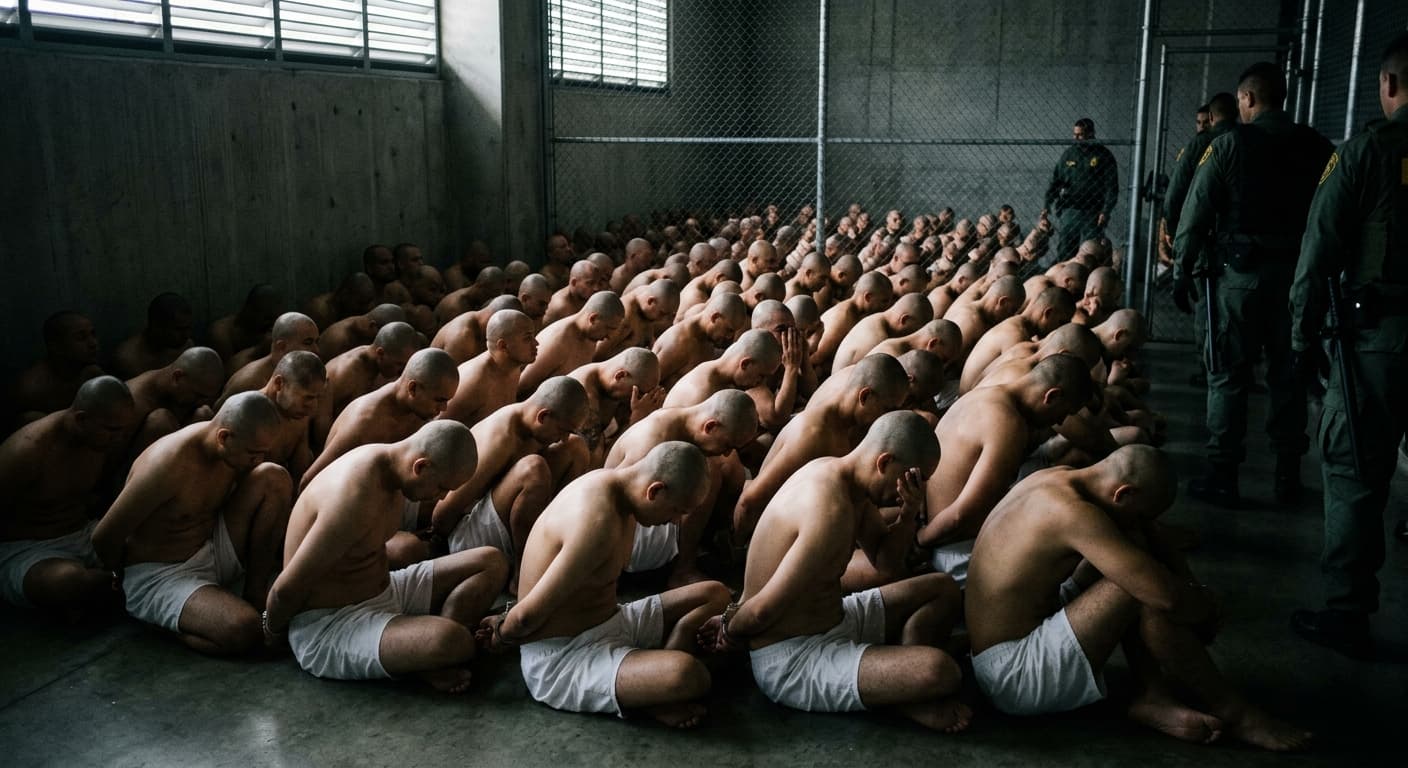
Amnesty's crimes-against-humanity warning turns El Salvador's prisons into a diplomatic liability for every government that uses them
Amnesty International's July 2026 report finds El Salvador's four-year "state of exception" may meet the Rome Statute threshold for crimes against humanity, with over 90,000 detained and at least 470 dead in custody — and the model is being exported across Latin America while the U.S. pays to send its own deportees there.
Amnesty International concluded on July 15, 2026 that El Salvador's four-year "state of exception" may amount to crimes against humanity under Article 7 of the Rome Statute, documenting over 90,000 detentions and at least 470 deaths in state custody since March 2022. The finding matters less for what it says about San Salvador — which has ignored similar warnings for years — than for who else is now exposed: the Trump administration, which pays El Salvador to confine its deportees; the Latin American leaders marketing the "Bukele model" as a governance template; and the multilateral bodies whose restrained response has let a rights-violating security playbook become export-grade policy. The decisive actor here is not President Nayib Bukele, who faces no domestic accountability. It is the constellation of foreign governments and financial institutions that have decided the security gains outweigh the legal exposure — until they do not.
What the evidence shows
The report, titled "'Security' without rights," draws on six fact-finding visits between May 2022 and January 2025, 109 interviews with victims, relatives, lawyers, and active and retired National Civil Police officers, and review of more than 80 individual cases. Amnesty International The death toll has climbed steadily: 18 in June 2022, 132 by April 2023, 235 by March 2024, and 470 by July 2026.
Al Jazeera The San Salvador-based NGO Socorro Jurídico Humanitario reports an even higher figure of at least 517 prison deaths.
NPR
The evidentiary backbone is the testimony of police officers themselves. One PNC officer told Amnesty:
"In many cases, no one verifies whether the detentions are lawful or not. We just bring people in, the Attorney General's Office receives the package, and that's it. No judge sees anything at that moment […]. By the time they are taken to court, fifteen days have gone by, and the judges simply read the list and confirm everything. No one asks whether there were beatings or whether there was an arrest warrant."
A defence attorney interviewed by Amnesty described the evidentiary threshold: "In many cases, it no longer matters whether evidence exists or not. It is enough for the police to say that someone 'looks like a gang member' for the system to prosecute them." Amnesty International
Amnesty identifies a discriminatory core: most victims come from historically impoverished communities, with arrests justified by place of residence, physical appearance, socioeconomic status, or unverified anonymous accusations. Bukele himself acknowledged in November 2024 that approximately 8,000 innocent people had been detained. Al Jazeera A UK government country guidance document reports that as of August 2025, roughly 90% of those detained under the state of exception remained in pretrial detention.
UK Government
The documented abuses go beyond detention. The BBC reported the case of José Duval Mata, a tractor driver held in CECOT for over two years despite two judicial orders for his immediate release — released at the prison gates, then rearrested on the same charges. BBC Noah Bullock, executive director of Cristosal, El Salvador's leading human rights NGO, called rearrests at prison gates "arbitrary actions… illegal detentions and cases of double jeopardy."
BBC
The institutional dismantling
The GIPES expert group — five independent jurists including ICJ Secretary General Santiago Canton — presented its own crimes-against-humanity finding at a UN Human Rights Council side event in March 2026, documenting 403 deaths in state custody (including four children) and 540 enforced disappearances. ICJ GIPES identified May 1, 2021 as the institutional breaking point, when the Legislative Assembly summarily dismissed all magistrates of the Constitutional Chamber of the Supreme Court and the Attorney General, replacing them within hours.
ICJ This was followed by forced retirement of more than 200 judges, allowing the executive to install loyalists throughout the judiciary.
UN High Commissioner for Human Rights Michelle Bachelet warned at the time that the procedure "did not meet the required due process standards" and constituted "a breach of international human rights law and a direct attack on judicial independence." UN OHCHR The UN Office of the High Commissioner for Human Rights has separately documented the use of Interpol red notices against Salvadoran human rights defenders Ivania Cruz and Rudy Joya, who sought asylum in Spain — calling the notices an act of "transnational repression" extending harassment beyond El Salvador's borders.
UN News
Canton's assessment frames the model's logic plainly:
"The Bukele model is sustained by the dismantling of the rule of law to systematically violate human rights without institutional restraints. In the very short term, it may appear to improve security, but it inevitably weakens the very security it claims to protect."
ICJ
The legislative tightening has continued. In April 2026, El Salvador published a law allowing life imprisonment for minors as young as 12 convicted of homicide, terrorism, or rape — drawing "deep concern" from UNICEF and the UN Committee on the Rights of the Child. Al Jazeera
CECOT as export infrastructure
The Center for the Confinement of Terrorism (CECOT), opened in 2023, was built to hold Salvadoran gang suspects. It is now a revenue-generating detention facility for foreign nationals. The Trump administration struck a $6 million agreement with El Salvador to house hundreds of Venezuelan deportees at CECOT under the 1798 Alien Enemies Act. NPR Since January 2025, more than 9,000 Salvadorans have been deported from the U.S. to El Salvador, with many disappearing into the prison system upon arrival.
NPR
Human Rights Watch reported credible evidence of torture of Venezuelan deportees by Salvadoran guards at CECOT. Human Rights Watch Venezuelans released in a July 2025 prisoner swap — 252 men returned to Caracas — described being beaten on arrival, forced to kneel from 9 PM to 6 AM, and fed with their hands.
BBC One man told BBC Mundo he was "shot at" with rubber bullets four times.
BBC
Kilmar Ábrego García, a Maryland resident mistakenly deported to CECOT in March 2025, alleged in court filings that he and 20 other detainees were subjected to "severe beatings" and confined to metal bunks without mattresses in cells with no windows and lights on 24 hours a day, losing 14 kilograms in two weeks. BBC A federal judge ruled in December 2025 that the U.S. violated due process in deporting Venezuelan men under the Alien Enemies Act.
NPR The U.S. Senate has introduced S. Res. 195, requesting a formal State Department assessment of El Salvador's human rights practices, including allegations of torture at CECOT.
U.S. Congress
The legal architecture now poses a direct problem for the U.S. government. The congressional CRS notes that the Further Consolidated Appropriations Act of 2024 prohibits Foreign Military Financing for El Salvador and requires withholding 60% of economic assistance until the Secretary of State certifies improvements in rule of law and human rights. Congressional Research Service An immigration attorney cited by NPR noted that the U.S. government must evaluate the likelihood a deportee will be tortured: "In the case of El Salvador, if they are thrown in jail by the government, there is evidence that some people who are sent there are only getting out deceased."
NPR
The Bukele model as export product
The security results are real by the metrics that matter to policymakers. An academic study published in Defence and Peace Economics in January 2026 found the state of exception and Territorial Control Plan reduced the homicide rate by approximately 45 points per 100,000 inhabitants between 2019 and 2024, accounting for nearly three-quarters of the total reduction. Defence and Peace Economics A separate study using the synthetic control method found a 45–67% decline in U.S. border encounters with Salvadorans.
Journal of Development Economics The World Bank reports El Salvador's GDP grew 3.9% in 2025, with private investment growing at 26.2% — the fastest pace since the pandemic — "amid improved security conditions and record levels of remittances."
World Bank An IMF Extended Fund Facility was approved in February 2025, paving the way for increased multilateral support.
World Bank
That combination — lower homicide rates, economic growth, international financing — is what makes the model attractive and the response timid. Robert Muggah, writing in Project Syndicate in March 2026, warned that the approach risks "normalizing authoritarian tactics as a default response to crime, potentially entrenching executive overreach and weakening democratic checks." Project Syndicate The GIPES report notes that political actors across Latin America have "publicly praised or proposed replicating aspects of this approach," placing the Bukele model "at the center of electoral campaigns or presenting it as a blueprint for government policy."
ICJ
The losers are specific and growing. The advocacy group Movement for the Victims of the State of Exception (MOVIR) estimates that 60,000 to 100,000 children have lost parental support due to mass incarceration. Al Jazeera Families of imprisoned individuals face roughly 16.7% higher household expenses over six-month periods.
Al Jazeera Human rights defenders, journalists, and critical civil society voices face intimidation, surveillance, and arrest.
UN News The beneficiaries are equally specific: Bukele's Nuevas Ideas party, which controls the legislature and judiciary; the security apparatus operating under detention quotas; and the foreign governments that gain a low-cost deportation destination.
The cost of timidity
Amnesty's Americas director Ana Piquer described the international community's response as "timid" in March 2024, calling for a "robust, articulate and forceful" condemnation of any security model based on human rights violations. Al Jazeera Two years and roughly 235 more custodial deaths later, the response has not materially changed. The UN OHCHR expressed "grave concern" as early as March 2023, noting 90 deaths in custody and limited information on investigations.
UN News The IACHR and OAS have produced reports and precautionary measures but have no enforcement mechanism beyond public pressure.
The structural reason for this is leverage — or its absence. El Salvador is now the country with the highest incarceration rate in the world at approximately 1.7% of its population, roughly twice the rate of Cuba. Al Jazeera The U.S. needs El Salvador for migration cooperation and deportation processing. The IMF and World Bank need a fiscal success story in Central America. Latin American governments facing their own crime crises need a model that appears to work. Each of these actors has a reason to treat the Amnesty finding as a diplomatic inconvenience rather than a legal trigger.
What to watch
- UN Human Rights Council session (September 2026): GIPES presented at HRC61 in March. The next regular session is the logical venue for a formal resolution or country mandate. Whether any Latin American government co-sponsors will signal whether the Bukele model is losing regional cover.
- U.S. Senate action on S. Res. 195: The resolution requests a State Department human rights assessment specifically covering CECOT, torture allegations, and the treatment of non-Salvadoran detainees. A committee vote would force a substantive position.
- Federal court rulings on Ábrego García and Alien Enemies Act cases: The Supreme Court's 5-4 ruling in Trump v. J.G.G. required individualized habeas review before removal, but left the underlying legality of the AEA deportations unresolved. Further circuit court rulings could restrict or expand the pipeline to CECOT.
- El Salvador's next state of exception renewal: The decree has been renewed roughly 48 times since March 2022. The next renewal vote in the Legislative Assembly — where Nuevas Ideas holds a supermajority — is the only domestic mechanism that could theoretically end the regime, and shows no sign of doing so.
The bottom line
Amnesty's finding does not change El Salvador's trajectory — Bukele's approval rating remains above 80% and the institutional checks that could enforce accountability have been dismantled. What it changes is the legal exposure of every government that treats CECOT as a partner facility. The Trump administration is the most immediately exposed: it is paying a government that an international legal body says may be committing crimes against humanity to warehouse its deportees. The longer the pipeline operates, the harder it becomes to argue that Washington did not know.
Discover more
Global Politics
Trump's Conflicting Messages on Iran War
Trump's mixed messages on Iran reflect a strategy of audience management, benefiting Tehran amid a complex geopolitical landscape.

International Relations
Pakistan's Key Role in US-Israel-Iran Meddle
Pakistan is seeking to mediate the US-Israel-Iran conflict, balancing high-stakes diplomacy against severe economic pressures and steep regional challenges.
US Politics
House Ethics Committee Pushes Sexual Miscond.
The House Ethics Committee has shifted responsibility for sexual harassment settlement records to the Office of Congressional Workplace Rights, complicating disclosure efforts.

Conflict & Security
Drone Warfare Killing Aid Workers at Unprec
Over 1,000 humanitarian workers killed in three years as cheap armed drones collapse legal protections. Gaza, Sudan, Ukraine, and DRC see deliberate targeting of aid convoys and hospitals with zero prosecutions.