Algeria's 21% Election: A Compliant Assembly
Low turnout signals a docile parliament for Tebboune.
Model Diplomat7 min readNorth Africa
Algeria's 21% election: Aslaoui certifies a docile parliament
Algeria's Constitutional Court received provisional legislative results on July 7, 2026. Turnout of 21.24% and an FLN-RND lock make the new APN a rubber stamp for Tebboune's succession.
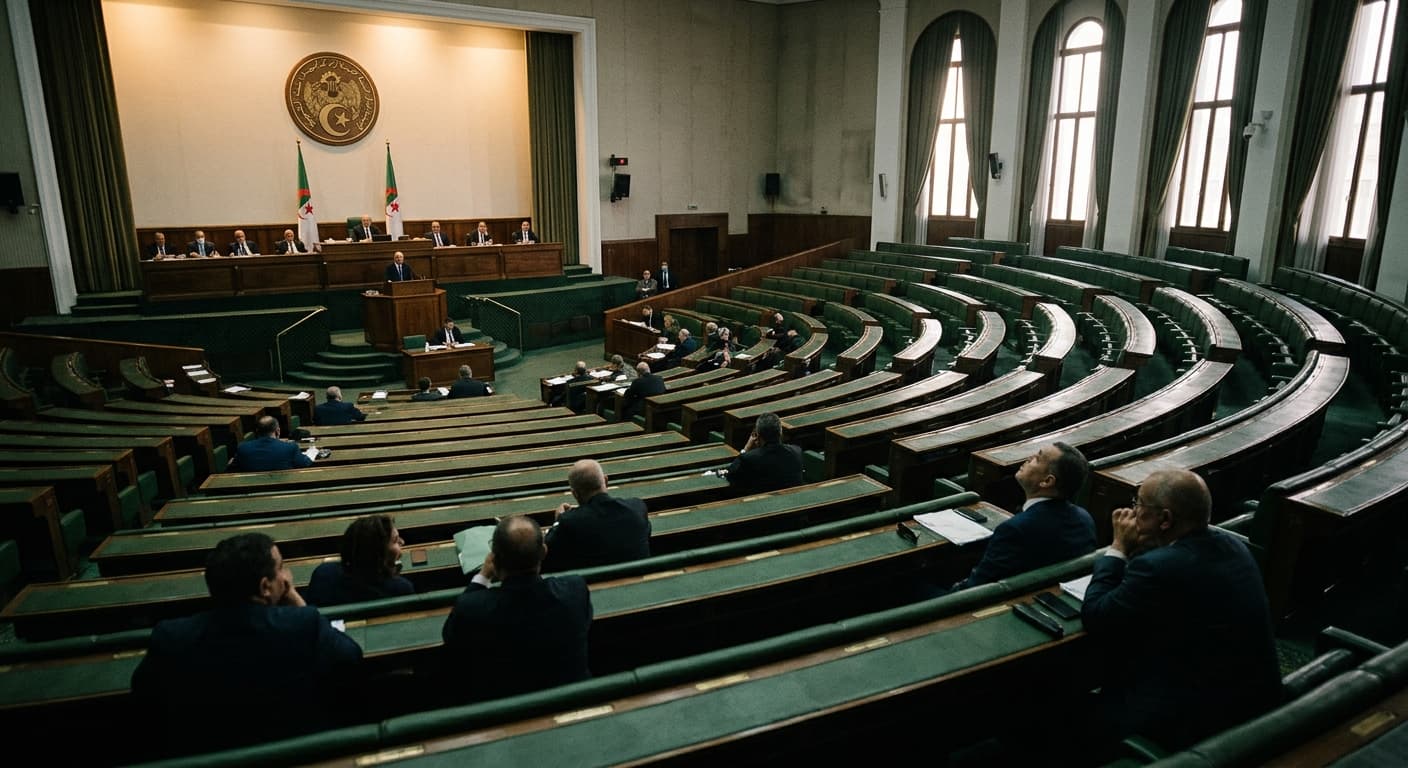
Algeria's Constitutional Court took delivery of the provisional tallies from the July 2, 2026 legislative elections on Tuesday, and the numbers handed to its president, Leïla Aslaoui, tell a single story: a 21.24% turnout — the lowest in Algeria's independent history — combined with a comfortable FLN-RND lead delivers President Abdelmadjid Tebboune the most compliant National People's Assembly since the Hirak, and clears the institutional runway for the constitutional maneuvering his 2029 succession will require. The formal handover, reported by Algérie Presse Service, starts a compressed calendar of appeals and proclamation. The politics were settled before the ballots were counted.
What the tallies actually say
Acting ANIE president Karim Khalfane, whose authority delivered the procès-verbaux to Aslaoui alongside the list of elected deputies by wilaya and by party, announced on July 3 that the National Liberation Front (FLN) had taken 90 of 407 seats, followed by the National Democratic Rally (RND) with 73, according to a tally published by BBC Arabic. The two historic parties of le pouvoir thus control roughly 40% of the chamber on their own — before the pro-presidential centrist Future Front, the Islamist-populist El-Bina Movement and the reliably co-operative independents are added in.
The returning secular opposition took what it could. The Socialist Forces Front (FFS) captured 12 seats, the Rally for Culture and Democracy (RCD) 4, and Louisa Hanoune's Workers' Party 3 — a combined 19 seats out of 407, or 4.7% of the assembly, for parties that between them had boycotted every legislative vote since 2017. Al Jazeera correspondent Nouri Dris, a sociology professor at the University of Sétif, had warned before the vote that "the ruling establishment might give the lion's share of parliament seats back to the FLN," a forecast that Al Jazeera reported on July 1 and that the tallies now vindicate.
Turnout is the number that will travel. The 21.24% figure — 30.2% in official presentation once blank and invalid ballots are stripped out — undershoots the 23.03% recorded in 2021, itself already the lowest in the country's history, as documented by ISPI researcher Louisa Dris-Aït Hamadouche in a pre-election briefing. Roughly four in five registered voters — out of an electorate of 24.7 million — declined to authorise the new legislature.
The court is the point
Under the 2020 constitutional revision, adjudication of electoral appeals moved from the old Constitutional Council to a new Constitutional Court, whose president is appointed directly by the head of state. Peer-reviewed analysis in the Directory of Open Access Journals frames the shift as "a significant transition from political to judicial oversight" — but the appointment mechanism means that the arbiter of contested results is a presidential nominee. Aslaoui herself made no attempt during the campaign to hide where she stood. In May 2026, weeks before the vote, she told an audience:
"In other countries, Members of Parliament push and fight one another. Here, thank God, we do not have that; it simply does not exist. Members have spent five years in Parliament, and we have heard nothing of the sort about them. So be aware, be patriotic. One must love this country."
The remark, reported by ISPI's Massensen Cherbi in a detailed study of pre-election candidate screening, is unusual: the person who will rule on the validity of the ballot publicly praised the absence of parliamentary conflict months before receiving the PVs. The Court now has 10 days from July 7 to adjudicate appeals lodged by parties and independent lists, and to proclaim final results, per the procedural framework set out in the 2020 Constitution.
Filtered before the vote
The tallies Aslaoui received on Tuesday were the product of a pre-election screening more consequential than the ballot itself. ANIE rejected roughly 30% of the 13,700 candidacies filed — 3,700 people barred, about 10,000 approved — under Article 200(7) of the 2021 organic electoral law, which excludes anyone "widely known to have connections with dubious money, business circles, or to have exercised direct or indirect influence" over voters. Cherbi notes that the Constitutional Court itself acknowledged the clause "lacks clarity, is difficult to substantiate and may result in violations of citizens' rights" but upheld it anyway.
The mechanism worked evenly on friend and foe. The FLN saw about 450 candidacies rejected, the RND about 300, and the MSP 215, according to ISPI's Boycott or Survive report; roughly half of the 250 outgoing MPs — who had unanimously voted for the 2026 constitutional revision months earlier — saw their own re-election bids blocked. MSP secretary-general officials called the disqualifications "arbitrary," Al Jazeera reported, and Workers' Party leader Louisa Hanoune described the excluding clause as "elastic, overly vague, and open to all readings and interpretations."
A second lever was Organic Law No. 26-08 of April 23, 2026, published in the Journal Officiel No. 30, which under Article 87 authorises the dissolution of any political party that fails to field candidates in two consecutive elections. That halved the previous four-election threshold and, as ISPI's Dris-Aït Hamadouche puts it in her analysis, effectively "restricts the boycott option" — the direct reason FFS, RCD and the Workers' Party returned to the ballot after years of principled abstention. Their 19-seat presence in the new APN is not a democratic opening. It is a survival trade.
The Tebboune calculation
The reader who searches for "government formation, coup, or major electoral-integrity dispute" will find none of the three here — and that is the story. Algeria's system is not producing coalition arithmetic in the Iraqi or Tunisian sense. Under a hyper-presidential architecture reinforced by the March 2026 constitutional revision (JORA No. 22), which strengthened presidential prerogatives over the High Council of the Judiciary and clipped ANIE's remit, the National People's Assembly ratifies rather than governs. Only 2 of the 90 laws adopted by the outgoing 2021–2026 legislature originated from parliamentary initiative, according to Dris-Aït Hamadouche.
What the new arithmetic delivers is not a majority to form a cabinet — Prime Minister Nadir Larbaoui was reappointed by presidential decree without reference to the APN's composition — but a legislative bloc reliable enough to pass the constitutional or organic amendments a Tebboune succession will likely require. Tebboune, 80, cannot stand again in 2029 under the current constitutional bar on a third term. The country covered by Algeria's country profile has amended its constitution three times since 2016, most recently in March 2026 without a referendum, on the grounds that the changes were "technical." A third amendment cycle — whether to reset term limits, restructure the executive, or engineer a designated-successor formula — will move through this new APN.
That is why the composition of the assembly Aslaoui is now certifying matters more than its 21% mandate suggests. As the exiled opposition figure Karim Tabbou put it in remarks reported by ISPI, "the regime wants an Assembly that functions 100% without the slightest criticism"; in his reading, this "political sanitisation may well constitute a prerequisite for securing a third presidential term, which would in turn require yet another constitutional amendment."
The regional read
Algiers has kept controversy out of the campaign. Western Sahara — normally a mandatory chorus for any Algerian party — was scrupulously absent from the campaign, ISPI's Caterina Roggero notes in Algeria Votes, a silence she reads as strategic during the current diplomatic freeze with Morocco and France. Nor did the campaign touch the Sahel, where Algerian military tensions with Mali's junta and its Wagner-successor Russian partners have escalated since 2024.
The result is a legislature that will not complicate any of these files. For Rabat, Paris, Moscow or the European Commission — the last of which is negotiating a revised gas offtake framework with Sonatrach — the new APN is a non-event. Tebboune retains full external decision-making authority, and now retains a domestic institutional apparatus that will not audibly disagree.
What to watch
- By July 17, 2026 (approx.): Constitutional Court proclamation of final results. Watch for the ratio of successful appeals — in June's candidate-registration phase, only 120 of 2,370 appeals succeeded, per ISPI. A similar pattern on election petitions will confirm the Court's disposition.
- Late July 2026: Presidential decree convening the new APN, and election of its president. The identity of that officeholder — a Tebboune loyalist versus an FLN heavyweight — will signal whether the presidency intends to run the chamber directly or through the party apparatus.
- Autumn 2026: Municipal and wilaya elections. Under Organic Law 26-08, any party absent from both this vote and the local poll faces judicial dissolution. Watch which of the 12 FFS deputies and 4 RCD deputies' parent organisations survive the sequence intact.
- Q1 2027 legislative session: First test of whether the new APN receives — and passes — organic-law amendments touching term limits, ANIE's remit, or the electoral system itself.
The Bottom Line
The bottom line: Algeria's July 2 vote was not a contest for power but a filtration exercise, and the PVs Leïla Aslaoui received on July 7 certify the product — an assembly with a 21% mandate, an FLN-RND floor of 40% of seats, and a token opposition presence bought with the threat of party dissolution. The APN that emerges will not form a government; it will pre-authorise a succession. If Tebboune moves to amend the constitution again before 2029, this is the legislature that will vote yes.
Discover more
India
Congress Advocates 33% Women’s Quota
Congress calls for a 33% women's reservation in the existing 543 Lok Sabha seats, countering Modi's plan to expand the house to 850 seats.

India
Delhi CM Rekha Gupta Blasts Opposition's Delm
Delhi CM Rekha Gupta's remarks on women's quota defeat reveal BJP's strategy for the 2029 Lok Sabha elections, focusing on delimitation.
India
Congress Accuses Modi of Stalling Women's Law
Congress accuses Modi of stalling women's reservation law by linking it to delimitation, revealing a deeper electoral strategy.

Economics
Fed's Amex AML order puts correspondent banking on notice
Federal Reserve's Amex AML order requires board-level controls and a 90-day plan; OCC fined the bank $350 million over enterprise-wide deficiencies.