Alaska's $15M bet against China's mineral str
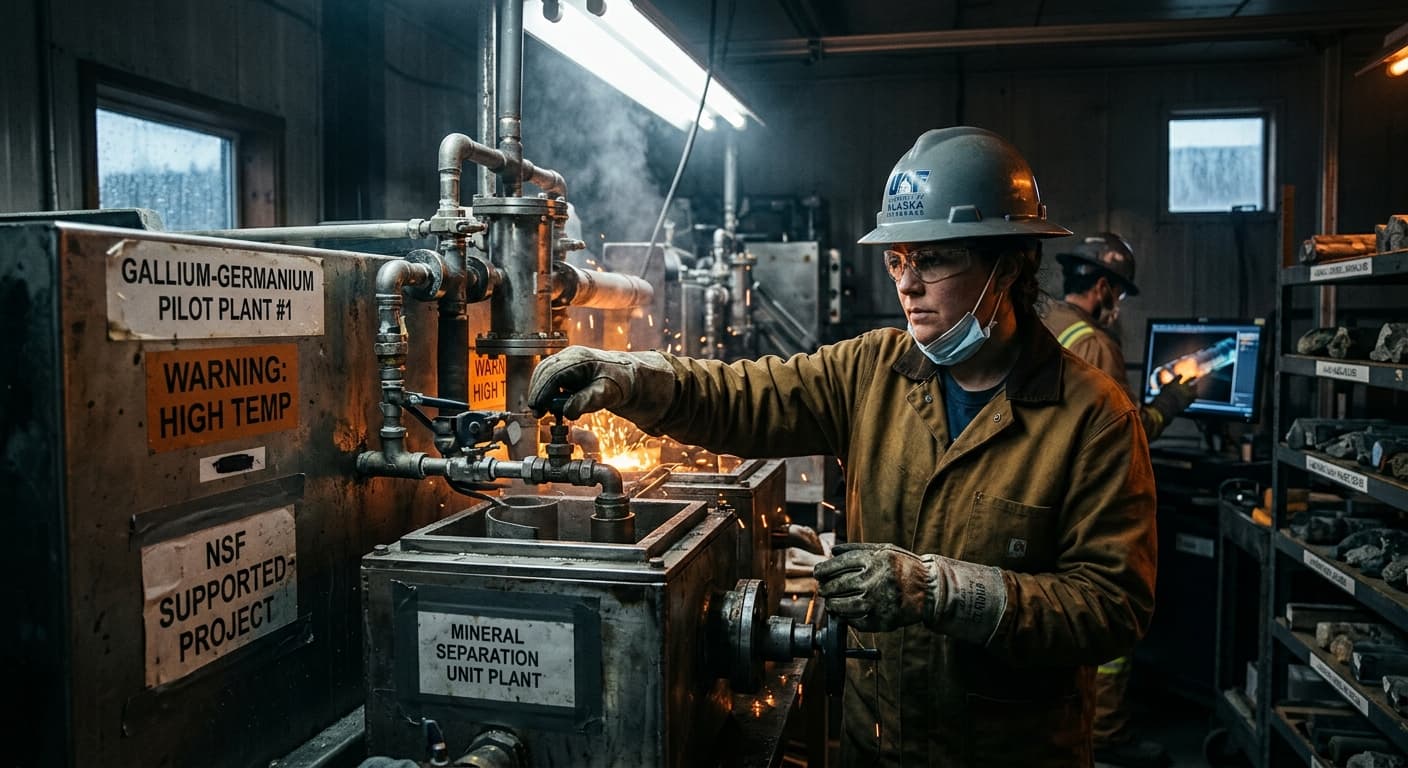
UAF wins $15M NSF grant to break China's chokehold on gallium and germanium
Model Diplomat5 min readNorth America
The wider policy stack
The UAF award lands inside a fast-moving policy environment, but the news itself is straightforward: NSF gave the University of Alaska Fairbanks $15 million over two years on July 14, 2026, to lead a Critical Mineral Accelerator, one of 12 new Regional Innovation Engines, with a contingent path to $160 million over ten years. The U.S. was 100% net import reliant for 12 of the 50 critical minerals on the 2022 list and more than 50% reliant for 29 others, with China the leading producer for 29 of the 50, according to the Congressional Research Service. The 2025 critical minerals list expanded to 60 entries, per
CRS. Beijing added a second wave of controls in 2025 covering seven rare earth elements — samarium, gadolinium, terbium, dysprosium, lutetium, scandium, and yttrium — layered on top of the 2023–2024 gallium, germanium, graphite, and antimony restrictions, per a
UI Sweden analysis.
The Trump administration has responded with a stack of its own. In February 2026 the White House announced Project Vault, a $12 billion Strategic Critical Minerals Reserve. DOD has set a goal of a complete mine-to-magnet rare earth supply chain by 2027, including a $500 million equity stake and $150 million loan to MP Materials, per CRS. Senator Murkowski, who helped write the IIJA provisions making critical mineral projects eligible for DOE Title 17 loan guarantees, has pushed permitting reform and Earth MRI mapping funding, per
her office. Earlier DPA grants include $37.5 million to Graphite One's Nome-area graphite project — the largest known U.S. natural graphite deposit — to fast-track a feasibility study, per
Murkowski's office.
The NSF Engines sit at the R&D-and-workforce layer of that stack, upstream of stockpiles and offtake guarantees, downstream of geological mapping. They are also a bet that place-based industrial policy can move faster than the permitting timelines that have stalled projects like Ambler. The statutory mandate explicitly gives "special consideration to rural-serving institutions of higher education," per 42 U.S.C. § 19108 — a provision that fits UAF precisely.
The execution risk
The accelerator's vulnerability is the same one that has sunk prior U.S. critical-mineral efforts: the gap between geological potential and commercial recovery. Nyrstar announced a $150 million gallium and germanium processing facility at its Clarksville, Tennessee zinc smelter, but the project stalled after financing and engineering delays, and the smelter temporarily suspended zinc operations in October 2023, per CSIS. Australia's Pinjarra gallium refinery shut in the 1990s when low prices and absent policy support erased margins. Both cases, CSIS concluded, "illustrate the importance of sustained government incentives, stable offtake contracts, and clear policy signals."
The UAF engine's industry partners, Alaska Silver Corp. (drilling gallium- and silver-rich galena at Illinois Creek) and Endolith (a biomining technology firm), give it commercial anchors, per North of 60 Mining News. But the partner roster does not yet include a Tier-1 processor with integrated refining capacity. Teck's Trail Operations in British Columbia remains the only commercial-scale North American germanium recovery facility, and in May 2026 Teck signed a cooperation agreement with Titan Mining to evaluate germanium recovery from New York waste streams — a deal that routes potential U.S. supply through Canadian processing, per the
FT announcement.
Then there is the funding cliff. The NSF Engines program has been appropriated well below its authorized levels, and the $160 million decade-long ceiling is contingent on future congressional action, per Brookings. Brookings analysts Rosanne Haggerty and Ruby Bolaria Shifrin warned that "future funding shortfalls could very well stall the Engines, given that funding is only in hand for two years of a program that speaks of a 10-year path." The North Dakota precedent is instructive: leverage worked, but only after a senator on the appropriations committee secured the follow-on tranche. Alaska's delegation has the seniority — Murkowski chairs no spending panel but Sullivan sits on key defense and commerce committees — but the FY2028 cycle will be the test.
Diplomat View
The UAF award is best read as a targeted hedge against a single, specific vulnerability: China's byproduct chokehold on gallium and germanium, which feeds U.S. semiconductors and defense electronics and which Alaska's existing zinc belt can physically supply if the recovery technology and processing economics are solved. The bet is that a university-anchored, Native-corporation-backed innovation cluster can compress the lab-to-commercialization cycle faster than a new mine can be permitted, and faster than Beijing can deepen its controls.
Forecast: the accelerator clears its two-year milestones and draws a follow-on NSF tranche, but does not, on its own, produce commercial-scale gallium or germanium before Red Dog's projected 2031 closure. The realistic 24-month deliverables are pilot-scale recovery demonstrations, workforce pipelines, and the partnership architecture for a domestic processing facility — not kilogram output. The path to actual supply requires three things to converge that this grant does not itself provide: a Tier-1 processor willing to build separation capacity, a DOD offtake or floor-price commitment to de-risk the capital, and a permitting track that does not eat the decade. If even one of those lands — most likely a DOD Defense Production Act award to a Red Dog-linked processor — the accelerator's R&D becomes the missing technical layer in a real supply chain. If none does, it becomes another well-funded pilot.
What to watch:
- Q3 2026 — Partner additions. Whether Teck Resources or an equivalent integrated refiner joins the engine; absence of a processor signals the cluster stays academic.
- FY2028 appropriations cycle. NSF Engines funding level in the Commerce-Justice-Science bill; below the $200 million FY2026 set-aside threatens the $160 million decade runway.
- DOD DPA awards, late 2026–2027. A Defense Production Act offtake or floor-price commitment for gallium/germanium recovery at an Alaska-linked facility would be the catalyst that converts this grant into supply. Watch for whether Project Vault's reserve extends to byproduct minerals, not just primary rare earths.
Key Takeaways
- NSF awarded UAF $15 million over two years on July 14, 2026, to lead a Critical Mineral Accelerator — one of 12 new Regional Innovation Engines — with a contingent path to $160 million over ten years.
- The strategic target is China's near-monopoly on gallium (98% of global supply) and germanium, both byproduct minerals recoverable from the zinc ore Alaska already mines at Red Dog, the world's largest zinc concentrate operation.
- The coalition includes NANA Regional Corporation, the Iñupiat-owned entity behind Red Dog, and industry partners Alaska Silver Corp. and Endolith — but no Tier-1 processor yet.
- The award sits inside a broader U.S. stack: Project Vault's $12 billion reserve, DOD's 2027 mine-to-magnet goal, and expanding critical-minerals export controls from Beijing through 2025.
- Execution risk is the chronic U.S. failure to commercialize byproduct recovery; the funding cliff hits in two years unless Congress appropriates the decade-long runway.
Discover more
US Politics
House Ethics Committee Pushes Sexual Miscond.
The House Ethics Committee has shifted responsibility for sexual harassment settlement records to the Office of Congressional Workplace Rights, complicating disclosure efforts.

India
700 Activists Accuse PM Modi of MCC Breach
Over 700 activists allege PM Modi breached election code with a televised address attacking opposition parties just before state elections.
Global Politics
Trump's Conflicting Messages on Iran War
Trump's mixed messages on Iran reflect a strategy of audience management, benefiting Tehran amid a complex geopolitical landscape.

Conflict & Security
Drone Warfare Killing Aid Workers at Unprec
Over 1,000 humanitarian workers killed in three years as cheap armed drones collapse legal protections. Gaza, Sudan, Ukraine, and DRC see deliberate targeting of aid convoys and hospitals with zero prosecutions.