AI Referees Erode Football's Legal Foundation
Legal analysis: AI offside tech erodes referee authority model
Model Diplomat8 min readGlobal
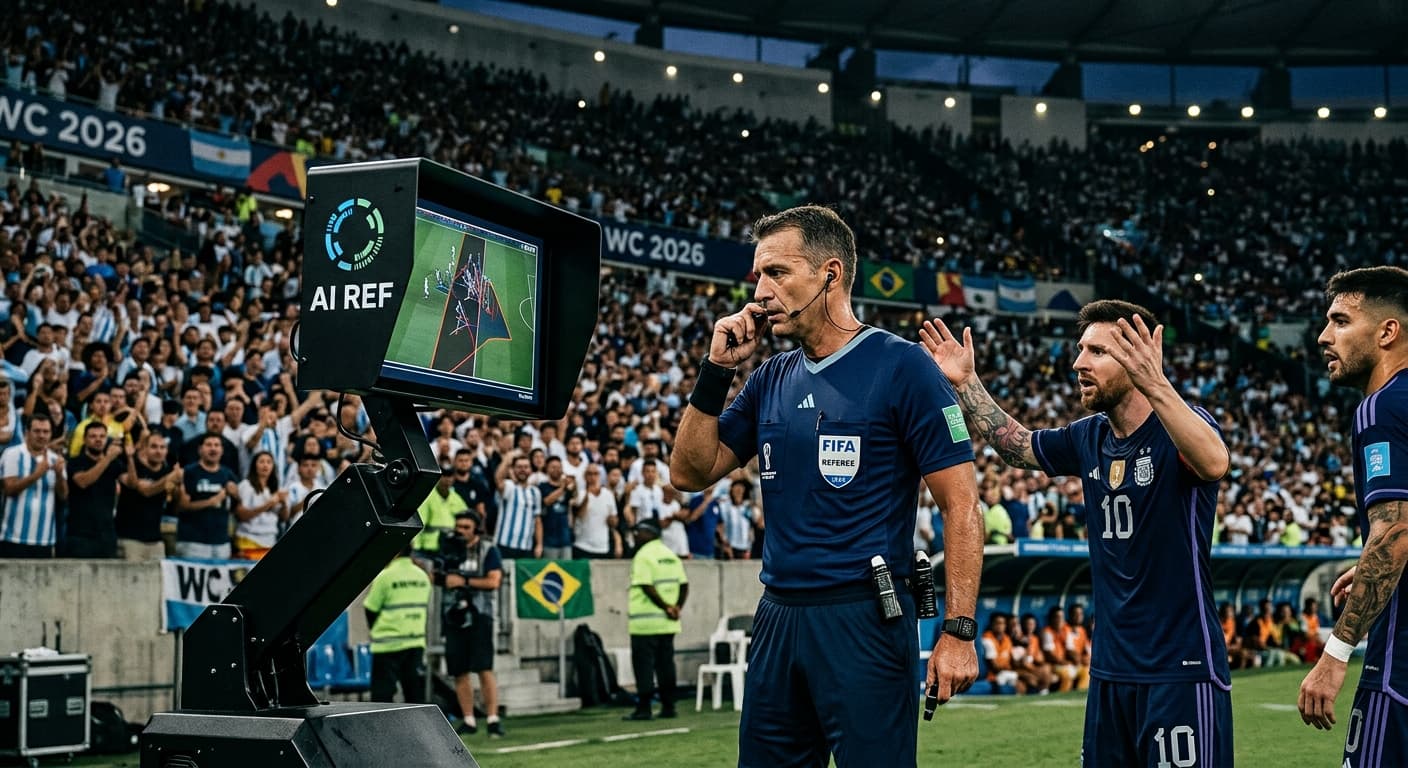
2026 World Cup's AI Referees Are Quietly Breaking Football's Legal Foundation
A legal analysis published July 15, 2026 on Opinio Juris argues the 2026 World Cup's semi-automated offside technology is compatible with international football law only if it stays auxiliary — but operational pressure is eroding that boundary, undermining the human-referee authority model that IFAB's Laws of the Game are built on.
On June 26, 2026, in the 93rd minute of Iran's group-stage match against Egypt, Shoja Khalilzadeh converted a scrambled rebound from a free kick. The Iranian bench stormed the field. Fans wept. Then, after a prolonged VAR review, the goal was disallowed. Khalilzadeh, the system determined, had been marginally beyond the second-to-last Egyptian defender at the moment of the flick-on, with the goalkeeper off his line. No stadium screen explained the chain of positional logic. No official articulated why the geometric relationship between three bodies in motion, frozen at a microsecond determined by software, constituted active offside interference. The referee signaled. The goal was gone. Mohammad Saleh Anisi, an assistant professor at Science and Culture University, Faculty of Law, published the definitive legal analysis of that moment on July 15, 2026, on Opinio Juris. His argument is not that the technology is wrong. It is that the legal framework authorizing it has not kept pace with its deployment — and that the quiet accumulation of operational pressure is eroding the boundary between assistance and displacement.
The technology deployed
FIFA introduced enhanced Semi-Automated Offside Technology at the 2026 World Cup, a system that scans all 1,248 players across 48 teams to create AI-enabled 3D avatars capturing body-part dimensions in approximately one second per player, according to Al Jazeera. Sixteen stadium cameras track specific anatomical points ten times per second. Assistant referees receive real-time audio alerts when a player is 10 centimeters or more offside, a threshold narrowed from the 50-centimeter limit tested at prior tournaments, as
BBC Sport reported. The Trionda match ball contains a microchip detecting individual touches, feeding VAR data in real time. The system's average review time runs 25 to 70 seconds.
The technical case is unambiguous: SAOT is demonstrably more accurate than any human eye. The problem Anisi identifies is not accuracy but authority — and the legal text that governs it.
The legal line
The foundational text is Law 5 of the Laws of the Game, maintained by the International Football Association Board (IFAB). The 2026/27 edition, updated in July 2026, permits competitions to use technology "to help the referee make/change decisions in relation to the video assistant referee (VAR) protocol, ball in/out of play (including goal line technology) and offside (including semi-automated offside technology)," according to the IFAB's official law changes document.
Anisi's argument hinges on the grammar: technology "helps" the referee — it does not substitute for her. The distinction between "assisting the referee in making a decision" and "making the decision that the referee then announces" marks the boundary between a system that enhances human judgment and a system that displaces it. IFAB's drafting choice reflects what Anisi calls the human-authority model of refereeing, in which the referee is not an administrator of algorithmic outputs but a sovereign decision-maker who may, or may not, consult technological input.
The legal significance of this framing cannot be overstated: it is the textual foundation upon which any assessment of AI's permissible scope in refereeing must rest. When that boundary erodes — not necessarily through formal rule change but through the quiet accumulation of operational pressure — referee legitimacy weakens, and competition integrity becomes structurally compromised.
Procedural vs. substantive legitimacy
Anisi draws a distinction that reframes the entire debate. Referee legitimacy operates on two planes: procedural legitimacy, which asks whether the decision-making process complied with established rules, and substantive legitimacy, which asks whether the decision-making authority is accepted as valid by stakeholders. A referee decision can be procedurally unimpeachable — fully consistent with the Laws of the Game — and yet substantively illegitimate if players, coaches, and spectators cannot identify who made the decision, cannot understand why, and cannot locate accountability.
Competition integrity, meanwhile, is not synonymous with accuracy. FIFA defines it broadly as the assurance that results are "achieved through the equal, transparent and trustworthy application of the rules." A system that produces accurate outcomes through an opaque process — one whose decisional logic cannot be interrogated, whose training data cannot be audited, and whose outputs cannot be attributed to a responsible human agent — does not satisfy the integrity standard even if it never makes a factual error.
The Iran-Egypt incident is the case study. The SAOT determination was almost certainly factually correct. The process was procedurally consistent with the VAR protocol. But no official articulated the geometric reasoning to the stadium. The decisional logic was not interrogatable. The output could not be attributed to a responsible human agent who exercised judgment. By Anisi's framework, that is a substantively illegitimate decision — accurate but unaccountable.
The pattern of the tournament
The Iran-Egypt call was not isolated. The 2026 World Cup produced a series of incidents that collectively expose the governance gap Anisi describes.
On June 21, 2026, Switzerland drew Qatar 1-1 after a penalty was awarded following a VAR check. FIFA's enhanced SAOT avatar animation failed to generate, and the governing body reverted to manual VAR line-drawing, releasing images four and a half hours later that BBC Sport described as "unconvincing." FIFA attributed the failure to "a brief technical outage" that prevented the onside animation graphic from being generated. Gary Neville, commentating for ITV, called the delay "like a dictatorship" and demanded transparency: "To not show the evidence of an offside — prove to us that it's offside! Show it straight away."
On July 7, 2026, Argentina staged a 3-2 comeback win over Egypt in the last 16 after VAR disallowed Mostafa Ziko's goal for a foul in the buildup. The Egyptian Football Association demanded FIFA investigate what it called "double standards" in officiating, according to Al Jazeera. Pierluigi Collina, FIFA's chief refereeing officer, publicly defended the officials, stating that "nobody can question the integrity of the FIFA World Cup match officials" and that "nobody can claim that FIFA refereeing can be influenced by anyone, not even by the FIFA president," as
BBC Sport reported.
On July 11, 2026, Croatia was denied a last-gasp equaliser against Portugal after ball-microchip "Snicko" technology detected a faint touch by Igor Matanovic in the buildup. BBC commentator Steve Wilson called it "one of the biggest VAR decisions there has ever been," according to BBC Sport. Croatia manager Zlatko Dalic responded: "VAR kills emotions, it kills everything within you. We have gone too far with VAR."
The pattern is not random technical failure. It is the systematic production of decisions whose outputs are correct but whose processes are opaque — and whose accountability cannot be located.
Who benefits, who loses
The decisive actor here is IFAB, the Swiss association that holds sole responsibility for the Laws of the Game. FIFA holds only four of IFAB's eight votes; rule changes require a three-quarters majority. IFAB authorized the technology under the auxiliary-tool framework. The question is whether IFAB will update its governance to address what Anisi calls the erosion of the human-authority model before that erosion becomes irreversible.
The immediate losers are the teams whose tournaments were decided by decisions they could not understand, challenge, or trust. Egypt's World Cup ended with a VAR call the Egyptian FA formally contested. Croatia's tournament ended with a microchip detection the manager called soul-destroying. Iran's first-ever path to the knockout stage was rescinded by a positional calculation no one in the stadium could follow.
The structural loser is the legitimacy of competition itself. If stakeholders cannot identify who made a decision, cannot understand why, and cannot locate accountability, the integrity standard FIFA itself articulates is unmet — regardless of whether every call is factually correct.
The quiet winner is the technology vendor ecosystem. FIFA's partnership with Lenovo for AI-driven avatar systems, Adidas for microchipped match balls, and the infrastructure providers for 16-camera stadium arrays represents a commercial architecture that depends on continued expansion of algorithmic refereeing. The incentive structure favors deployment over deliberation.
The historical parallel
The VAR protocol, introduced at Russia 2018 and codified in Law 6, represents the most elaborate pre-2026 instantiation of the auxiliary tool model. Its design reveals how carefully the boundary was originally drawn: technology assists the referee; it does not substitute for her. The 2026 SAOT system was supposed to be the next iteration of that model — faster, more precise, but still auxiliary.
What Anisi's analysis suggests is that the trajectory has crossed a threshold. The 2026 system's real-time audio alerts, its microsecond positional determinations, and its AI-driven avatar reconstructions have moved from tools that a referee consults to inputs that a referee is operationally compelled to accept. The referee is no longer a sovereign decision-maker consulting technological input. The referee is becoming an administrator of algorithmic outputs.
This is not a formal rule change. It is what Anisi calls "the quiet accumulation of operational pressure" — the practical reality that no human referee, regardless of what Law 5 says, will override a system that tracks anatomical points ten times per second across 16 cameras and produces a determination in 25 to 70 seconds. The legal text says the referee has full authority. The operational reality says the system has effective authority. The gap between text and practice is where legitimacy leaks.
What to watch
-
IFAB's next annual general meeting, expected early 2027, where the 2027/28 Laws of the Game will be drafted. The question is whether IFAB addresses the gap between the auxiliary-tool framework in Law 5 and the operational reality of SAOT deployment — or whether the 2026/27 language permitting technology "to help the referee" is left to absorb the erosion through practice rather than explicit reform.
-
Egypt FA's formal complaint to FIFA, demanding an investigation into "double standards" in the Argentina match. The complaint's outcome will signal whether FIFA treats transparency in VAR decision-making as a governance obligation or a public-relations problem.
-
The Court of Arbitration for Sport's docket, where any federation appeal challenging a VAR or SAOT decision would test whether the current legal framework can accommodate claims of substantive illegitimacy — that is, whether a decision can be challenged not for factual error but for opacity and unaccountability.
The Bottom Line
The bottom line: the 2026 World Cup's AI refereeing systems are technically more accurate than human officials, but they are quietly eroding the legal foundation of referee authority that IFAB's Laws of the Game are built on. The winner is the technology vendor ecosystem; the loser is the legitimacy of competition itself. If IFAB does not update its governance before the 2027/28 cycle, the human-authority model will survive in text but not in practice — and FIFA's own integrity standard will be unmet by its own tournament.
Discover more

India
Delhi CM Rekha Gupta Blasts Opposition's Delm
Delhi CM Rekha Gupta's remarks on women's quota defeat reveal BJP's strategy for the 2029 Lok Sabha elections, focusing on delimitation.

India
BJP's Misunderstanding of Women's Quota Needs
The BJP's linking of the Women Reservation Bill to delimitation risks delaying women's empowerment in India, misreading the aspirations of female voters.
India
Congress Accuses Modi of Stalling Women's Law
Congress accuses Modi of stalling women's reservation law by linking it to delimitation, revealing a deeper electoral strategy.

Conflict & Security
Drone Warfare Killing Aid Workers at Unprec
Over 1,000 humanitarian workers killed in three years as cheap armed drones collapse legal protections. Gaza, Sudan, Ukraine, and DRC see deliberate targeting of aid convoys and hospitals with zero prosecutions.