Africa's Health Sovereignty Bet: Can Money
Exploring Africa's health funding crisis and solutions
Model Diplomat7 min readAfrica
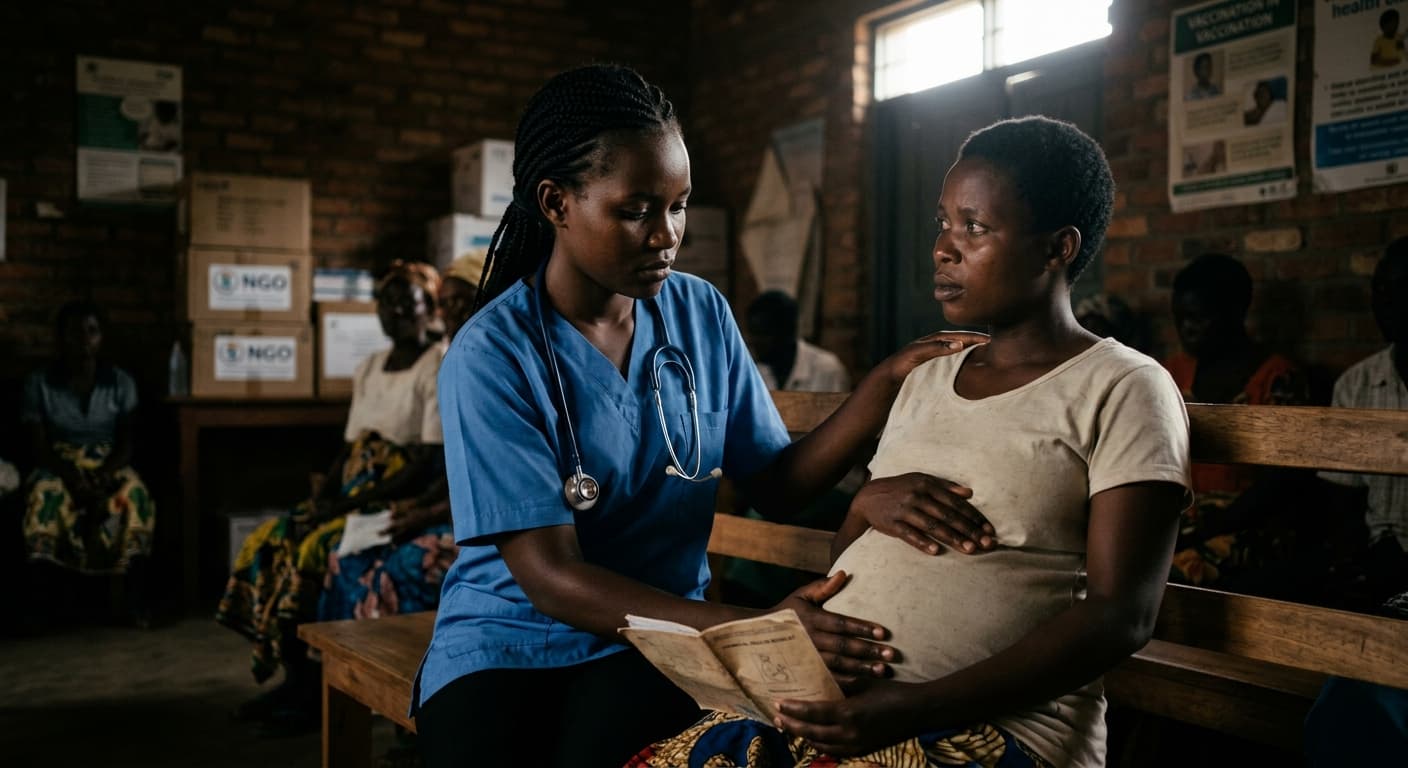
Africa's Health Sovereignty Bet: Can Domestic Money Save Mothers?
As US aid halves and debt service crowds out clinics, the AU's July 10 finance-ministers dialogue will test whether "health sovereignty" is a real fiscal plan — or a slogan for a $13-billion hole.
The African Union Commission convenes finance and health ministers on July 10, 2026, for a policy dialogue titled "Ready, Set, Implement!" — and the number that hangs over the room is $13 billion. That is the combined US and European health assistance flowing to Africa last year, down from $26 billion in 2021, according to a February 2026 Nature editorial drawing on Africa CDC data. The thesis is simple and uncomfortable: Africa's pivot to "health sovereignty" is now less an ideological choice than a forced-march fiscal reengineering, and reproductive, maternal, newborn, child and adolescent health (RMNCAH) is the line item most likely to be sacrificed if governments do not move Abuja Declaration promises from paper to budget within 24 months. The winners of that reengineering — if it works — are the roughly 182,000 women who die each year in sub-Saharan Africa from pregnancy complications. The losers, if it stalls, are the same women, plus a generation of adolescents whose demographic dividend depends on their survival.
The number that broke the model
Sub-Saharan Africa accounts for roughly 70% of the world's maternal deaths — about 182,000 in 2023, per the WHO's Trends in Maternal Mortality report published with UNICEF, UNFPA and the World Bank. The region cut its maternal mortality ratio by 40% between 2000 and 2023, but the ratio still stands at 442 deaths per 100,000 live births, according to the
WHO Africa regional office. Hitting SDG 3.1 by 2030 would require an annual rate of decline near 15% — a pace almost no country has sustained.
Then came the aid shock. The US State Department froze foreign assistance in January 2025 and dismantled USAID; Boston University's Impact Counter tracker, cited by Al Jazeera, attributes 518,428 child deaths and 263,915 adult deaths to the resulting service collapse. The Global Leaders Network's briefing from the 39th AU Summit projected a 40% contraction in external health funding between 2023 and 2025, warning that abortion-related complications — the leading killer of adolescent girls in Africa — would drive a maternal-mortality rebound if sexual and reproductive health services degraded further, according to a
GLN summit note.
The Women's Refugee Commission calculated that nearly 95% of US foreign aid for sexual and reproductive health and family planning was cut in 2025, NPR reported — even as Congress had appropriated $575 million for it. In Malawi, 20 health posts have already shuttered and the health ministry lost close to 5,000 workers,
Al Jazeera reported in December 2025. The government had already forecast a $23 million shortfall in RMNCAH funding for 2025 before the USAID cuts landed.
The Abuja promise, still unpaid
The July 10 dialogue is structured as a follow-up to the 8th Ordinary Session of the AU Specialized Technical Committee on Finance, Monetary Affairs, Economic Planning and Integration, per the PMNCH concept note. Its ministerial declaration called for annual increases toward the 15% Abuja target, health taxes on tobacco, alcohol and sugar-sweetened beverages, costed Essential Health Benefit Packages centred on primary care, and pilots of blended finance and debt-for-health swaps.
The declaration is the easy part. Twenty-three years after Abuja, only two of the AU's 55 member states — Cabo Verde and South Africa — hit 15%, according to a 2024 Human Rights Watch analysis of two decades of WHO data. The regional average sat at 7.4% of national budgets in 2021, less than half the pledge and the lowest in the world. Seven countries — Madagascar, Benin, Eritrea, Central African Republic, Chad, Sudan and Cameroon — actually spent less per person on health in real terms in 2021 than in 2000, the year before Abuja.
Modelling in PLOS Global Public Health by Apeagyei et al. projects that sub-Saharan African governments will dedicate roughly 7.2% of total government spending to health through 2050, versus a global average of 12.4% — meaning that on current trajectories the domestic response will not fully absorb the donor exit, per the journal analysis. Brookings pegs the region's development-financing gap at $245 billion a year over the next five years in its
Foresight Africa 2026 chapter, while UNCTAD estimates Africa loses $90 billion annually to illicit financial flows — the largest single reservoir of untapped domestic revenue.
Three instruments, one narrow window
The AU's playbook rests on three fiscal levers, each with visible early wins and quiet structural limits.
Health taxes. The WHO's "3 by 35" initiative — pushing tobacco, alcohol and sugary-drink prices up 50% by 2035 — projects up to $1 trillion in additional public revenue globally over the next decade, per the WHO. ECOWAS and WAEMU have modernised tobacco excise directives, and the World Bank's
regional workshop with 12 member states in Dakar in October 2024 flagged sugar-sweetened beverage taxes as the fastest-scaling instrument. Ethiopia moved in July 2025, per the WHO. The catch: health taxes generate hundreds of millions, not the tens of billions the ODA collapse has removed.
Debt-for-health swaps. Côte d'Ivoire executed the first World Bank–enabled debt-for-development swap in December 2024, converting roughly €400 million of expensive commercial debt and freeing an estimated €330 million over five years for education, according to the World Bank. The joint IMF-World Bank
approach framework published in July 2024 sets health as a legitimate target, but restricts eligibility to countries at moderate-to-high debt distress with strong public financial management — a narrow filter that excludes some of the states with the worst RMNCAH indicators.
Blended finance and bilateral co-financing. The World Bank's HOPE-PHC program — $570 million for Nigeria's primary care, layered with $70 million in Global Financing Facility grants — is the template. An extended cost-effectiveness analysis in The Lancet Global Health,
indexed on PubMed, found that publicly financing 18 essential maternal and child health interventions in Nigeria at zero out-of-pocket cost would prevent 110,000 maternal deaths and 1.05 million under-five deaths by 2030, at $44 per life-year gained — cost-effective by any global standard.
The Trump alternative and why African capitals are hesitating
The counter-offer on the table is the Trump administration's America First Global Health Strategy. Thirty-two countries had signed Memoranda of Understanding by mid-May 2026, including at least 20 in Africa, per the BBC. The deals are substantial in dollars — $2.5 billion for Kenya, $2.1 billion for Nigeria — but represent, on average, a 40% cut versus prior US health flows, according to the
Institute for Security Studies.
They also come with strings: co-financing commitments, one-way data-sharing agreements, and in Zambia's case, reported requests for access to copper, cobalt and lithium in exchange for $1 billion over five years. Zimbabwe walked away. Ghana rejected a $109 million deal in April over data protection. Kenya's High Court initially suspended its MOU pending privacy litigation. South Africa's Health Minister Aaron Motsoaledi told the BBC:
"Frankly speaking, no country on Earth that respects itself should accede to [those terms]."
The State Department framed its ledger differently: overall spending down 30%, PEPFAR HIV treatment sustained for 20+ million people, and pregnant/breastfeeding women on PrEP rising from 43,000 to 103,000 quarterly, per an NPR analysis of the first PEPFAR data release in over a year. AmfAR's Brian Honermann noted, however, that in disrupted clinics new HIV diagnoses fell nearly 30% — meaning hundreds of thousands of undiagnosed cases.
Diplomat View
The July 10 dialogue matters not because it will produce a new declaration — it will — but because it forces finance ministers into the room. RMNCAH has been ministerially orphaned for two decades: the health ministry owns the outcomes, the finance ministry owns the money, and neither owns the reform. The AU is finally trying to force joint accountability, and the calendar is unforgiving.
The forecast: expect five to eight African countries to announce concrete Abuja-aligned budget increases before the 40th AU Summit in February 2027, likely led by Nigeria (which has already proposed a 25% federal health-budget rise, per Brookings), Ghana (following Mahama's National Health Insurance reform) and Rwanda. Expect two additional debt-for-health swap pilots, probably in West Africa, replicating the Côte d'Ivoire template. Expect health taxes to generate meaningful — but insufficient — revenue: the WHO's own math implies well under $5 billion a year for the entire African region even under optimistic implementation.
This forecast breaks if two things happen. First, if African sovereign debt distress worsens materially — the IMF flags at least 20 sub-Saharan countries with donor-dependency shocks approaching 1.5% of GDP — governments will divert any new fiscal space to debt service, not clinics. Second, if the US bilateral MOU model gains traction with more capitals accepting mineral or data conditionality, the domestic-resource-mobilisation narrative loses political oxygen. Watch Zambia's decision, and watch whether Kenya's High Court permits full MOU implementation. Those two rulings, more than any AU communiqué, will decide whether "health sovereignty" is a fiscal doctrine or a diplomatic euphemism for the same dependency in a new coat.
What to watch next
- July 10, 2026: AU Commission "Ready, Set, Implement" ministerial dialogue on RMNCAH financing (Addis Ababa/virtual).
- Late 2026: Expected second wave of World Bank–backed debt-for-development swaps; Senegal and Kenya named as candidate sovereigns in IFI briefings.
- February 2027: 40th AU Summit — first hard deadline for member states to report Abuja-aligned budget increments under the 8th STC ministerial declaration.
- Ongoing: Kenyan High Court ruling on US MOU legality; Zambia's final position on the minerals-for-health deal.
Related: Africa coverage on Model Diplomat.
The Bottom Line
Africa's health sovereignty agenda is not a rejection of aid — it is a fiscal contingency plan written under duress after Washington halved its cheque and attached mineral rights to what remains. If the AU's July 10 dialogue converts the Abuja Declaration's 15% target into scored, dated national budget commitments from at least Nigeria, Ghana and Kenya before the February 2027 summit, RMNCAH survives the donor exit. If it produces one more communiqué, sub-Saharan Africa will lose another decade of maternal-mortality progress — and the demographic dividend that African finance ministries have been banking on for growth will arrive smaller, sicker and older than projected.
Discover more

Global Politics
U.S. Naval Blockade Heightens Iran Tensions
The U.S. naval blockade of Iran collapsed oil exports, creating a new maritime regime in Hormuz that favors Tehran.
US Politics
Virginia's Redistricting Referendum
Virginia's redistricting referendum is drawing a flood of dark money, shaping future elections and the fight for congressional control amid party stakes.
Global Politics
Xi Jinping Calls China-Russia Ties 'Precious'
Xi Jinping's description of China-Russia ties as 'precious' reflects a strategic imbalance, with Beijing dictating terms in the partnership.

Economics
Fed's Amex AML order puts correspondent banking on notice
Federal Reserve's Amex AML order requires board-level controls and a 90-day plan; OCC fined the bank $350 million over enterprise-wide deficiencies.