Africa's green century runs on borrowed wires
Why Africa's mineral wealth won't power its own green transition
Model Diplomat8 min readAfrica
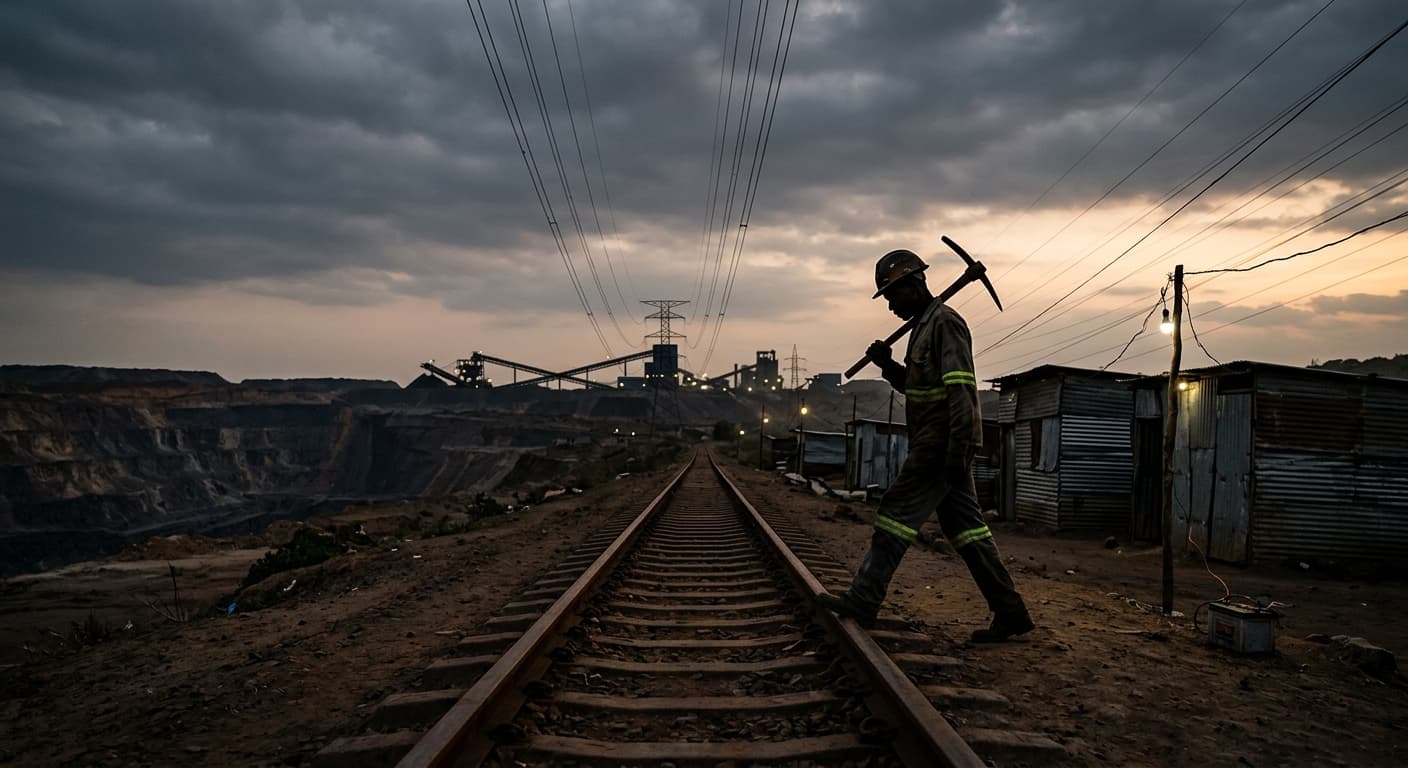
Africa's green century runs on borrowed wires: why the continent's mineral wealth won't power its own transition
Africa holds 30% of the world's critical minerals and 60% of its best solar resources, yet receives just 2% of global clean-energy investment — and the missing infrastructure is not physical but financial, locking the continent into extracting raw materials for someone else's industrial future.
The thesis is sharp and uncomfortable: Africa is being asked to power the global green transition while financing its own development at borrowing costs three to seven times those of the countries demanding the minerals. As Barbados Prime Minister Mia Mottley told COP27: "Rich nations borrow at 1–4% interest while poorer countries face rates near 14%." That differential turns would-be green industrial corridors into debt traps before a single panel is installed. The missing infrastructure behind Africa's green century, as Sellah Bogonko of Jacob's Ladder Africa argues in a KBC Digital opinion piece, is not a shortage of sunlight or cobalt. It is the pricing, risk-allocation, and institutional architecture that decides who captures value from the transition. Right now, that architecture routes value out.
The endowment-versus-investment paradox
On paper, Africa should be the centerpiece of the green century. The continent holds approximately 30% of the world's critical mineral reserves, according to UNCTAD, and possesses 60% of the world's best solar resources, per the
International Energy Agency. The Democratic Republic of Congo alone accounts for over 70% of global cobalt production and roughly 50% of proven reserves, making it the single most concentrated chokepoint in the battery supply chain. South Africa and Zimbabwe hold about 92% of global platinum-group metal reserves, essential for green hydrogen and catalytic converters.
Yet Africa receives just 2% of global clean-energy investment. The gap between endowment and investment is not a market failure but a pricing failure, rooted in currency volatility, sovereign-risk perception, and weak regulatory certainty. These push African borrowing costs well above those in Europe or North America, rendering projects unbankable that would clear hurdle rates elsewhere. An IMF working paper from May 2025 found that private investment accounts for just 18% of Africa's climate finance, compared with 39% in East Asia and 86% in North America. The structural barriers are the real missing infrastructure: underdeveloped capital markets, the sovereign-ceiling rule that ties project creditworthiness to country ratings, and punitive currency mismatches.
The absurdity is sharpened by one figure: default rates on infrastructure investments in Africa run about 2.6%, among the lowest in the world, according to Brookings' Foresight Africa 2026 report. The risk pricing is disaligned with actual financial performance. Capital is expensive not because African projects fail, but because the instruments that price them assume they will.
Debt service crowds out the transition
The borrowing-cost differential compounds through debt servicing. Kenya's debt-service-to-revenue ratio stood at 67.1% in mid-2025, more than double the IMF's recommended 30% ceiling, according to the Kenya National Bureau of Statistics Economic Survey 2025. Across the continent, the
World Bank's Africa Pulse warns that several governments now spend more servicing debt than investing in the sectors that would let them grow out of it.
A "green transition" financed this way isn't a transition. It is a deferral. Every dollar routed to Eurobond coupons is a dollar not building the transmission line that would let a solar farm in Zambia sell power to a mine in the DRC. The Brookings report estimates sub-Saharan Africa needs at least an additional $245 billion per year in financing — a gap projected to widen as foreign aid contracts and more than half the region's low-income countries face high risk of debt distress.
The African Development Bank has calculated that Africa spent $163 billion on debt service in 2024, up from $61 billion in 2010 — and more than half of adaptation finance flows arrive as loans, not grants, according to Brookings analysis by Landry Signé. The continent is borrowing to adapt to a crisis it did negligibly little to cause, and the cost of that borrowing is itself the barrier to adaptation.
The extractive lock-in: cobalt, copper, and the value that leaves
The second-order consequence of the financing gap is that Africa's critical minerals stay trapped at the bottom of the value chain. The IMF's April 2024 Regional Economic Outlook lays out the pattern with bracing specificity: the DRC, accounting for 74% of global cobalt mining, sends 97% of its cobalt exports — mostly unprocessed — to China. Over 1,000 trucks daily haul low-concentration rock-form lithium from Zimbabwean mines to distant ports, bound for Chinese refineries rather than domestic processing. China refines the majority of the world's lithium and cobalt and held 73% of global lithium-ion battery manufacturing capacity by 2019.
This is the "resources in, value out" pattern that the KBC piece implicitly diagnoses. A
World Bank DRC report found that developing the full EV battery value chain regionally could quadruple the end value of battery minerals mined in Africa — but doing so requires a regional approach where each Southern African country contributes specific metals and capabilities. The finance, grid, and skills infrastructure to coordinate that does not yet exist at scale.
Some governments are pushing back. Namibia has banned exports of unprocessed minerals; Ghana adopted a Green Minerals Policy doing the same; the DRC has used intermittent cobalt and copper concentrate export bans, reviewed every six months, to force domestic processing. In February 2025, the DRC suspended cobalt exports entirely to recalibrate prices and assert "mineral sovereignty," according to academic analysis by Christian Pinshi. These are lever-pulling exercises — but without the financing and grid infrastructure to make local processing bankable, they risk short-term revenue loss without long-term industrial gain.
Grids: the bottleneck nobody built
Even where generation potential is enormous, transmission infrastructure is the chokepoint. The Southern African Power Pool (SAPP) and SADC have launched the Regional Transmission Infrastructure Financing Facility (RTIFF), a blended-finance instrument initially targeting $1.3 billion to catalyze cross-border transmission lines. It is a start — but against South Africa's estimated $15 billion transmission investment need over the next decade alone, it is a fraction.
South Africa's grid is the starkest case. The World Bank calculates the country needs $254–$329 billion across transport, water, sanitation, and education by 2030 to meet SDGs — 8.7–11.2% of GDP. Transmission is the bottleneck blocking the shift from coal to renewables; without it, the country's generation capacity, however clean, cannot reach demand centers. The World Bank and South African government are in advanced discussions on a vehicle to guarantee state-owned enterprises' payment risks in strategic infrastructure projects — identified as the main bottleneck to mobilizing private finance.
Kenya illustrates the paradox from the other side. It generates roughly 90% of its electricity from renewables — geothermal, hydro, wind, and solar — and is Africa's largest geothermal producer. Yet youth unemployment and underemployment remain acute, and informal work still absorbs the majority of new jobs, per the KNBS Economic Survey 2025. A clean grid, on its own, does not create the manufacturing, logistics, and maintenance pathways that would turn green electrons into green employment. The missing infrastructure is industrial.
The labor-market transition before the energy one
This is the piece's sharpest claim, and the one most policymakers underweight. Roughly 10 to 12 million young Africans enter the labor market every year, according to the Mastercard Foundation's Africa Youth Employment Outlook 2026, most into informal work. The
Brookings Foresight Africa 2026 report frames the same figure against a starker benchmark: only about 3 million new formal wage jobs are created annually. The gap is 9 million people a year entering a labor market with no formal slot for them. That is the real instability the green transition must absorb.
"Green jobs" cannot remain a niche climate-circle conversation. They must become an economic development strategy. With the African Continental Free Trade Area providing a framework for regional integration, Africa has an opening to build competitive value chains in electric mobility, battery technologies, climate-smart agriculture, sustainable construction materials, and circular-economy industries. The IMF's April 2024 note estimates that moving beyond raw-material exports to processing industries could boost sub-Saharan Africa's GDP by 12% or more by 2050 — and a regional strategy leveraging the diversity of minerals across borders could create a larger, more attractive market for the investment that currently bypasses the continent.
The IEA's "Stepping Up the Value Chain in Africa" analysis makes the point bluntly: the current investment lag means African countries capture only a small share of upstream revenue, with most value accruing to foreign miners, processors, and battery manufacturers. Local economies miss the multiplier effects that come with deeper value chains: jobs, skills, energy access.
What to watch
- GreenWorks for Africa Forum, August 12–13, 2026 — the inaugural convening flagged in the KBC piece. The test is whether it produces concrete investment frameworks or another communiqué.
- AfCFTA value-chain protocols — watch for whether mineral-processing and battery-manufacturing provisions get operational teeth, and whether regional power-pool agreements (SAPP, EAPP) integrate with trade rules.
- African Credit Rating Agency (AfCRA) launch, 2026 — a continent-rooted rating agency could, if it gains market acceptance, narrow the sovereign-risk premium that prices African projects out of bankability.
- DRC cobalt export policy review — the six-monthly review cycle of export bans will signal whether Kinshasa is building domestic processing capacity or merely burning foreign-exchange revenue.
- RTIFF capitalization — whether the $1.3 billion SAPP transmission facility attracts the private co-financing it is designed to catalyze, or stalls at the development-fund stage.
Diplomat View
The bottom line: Africa's green century will not be built by mineral endowment or climate-finance pledges — it will be built, or not, by whether the continent can reprice its own risk. The missing infrastructure is a financial architecture that treats a 2.6% infrastructure default rate as if it were 14%, routes cobalt through Chinese refineries because no African bank will finance a precursor plant, and asks governments spending 67% of revenue on debt service to somehow also build transmission grids. The actors with leverage can change the pricing: the IMF through its Climate Finance Preparedness Index, the World Bank through guarantee vehicles like those under discussion in South Africa, and the European Union through the Lobito Corridor partnerships with the DRC and Zambia. If the GreenWorks for Africa Forum in August produces nothing but pledges, the forecast is straightforward: Africa will remain the quarry of the green transition, and the 9-million-a-year jobs gap will be the cost. Revision of that forecast requires one thing: concessional and guarantee instruments deployed at scale sufficient to make African processing bankable at rates competitive with Asian alternatives. Nothing less moves the needle.
Discover more

India
Delhi CM Rekha Gupta Blasts Opposition's Delm
Delhi CM Rekha Gupta's remarks on women's quota defeat reveal BJP's strategy for the 2029 Lok Sabha elections, focusing on delimitation.

US Politics
House Ethics Committee Pushes Sexual Miscond.
The House Ethics Committee has shifted responsibility for sexual harassment settlement records to the Office of Congressional Workplace Rights, complicating disclosure efforts.
India
Congress Accuses Modi of Stalling Women's Law
Congress accuses Modi of stalling women's reservation law by linking it to delimitation, revealing a deeper electoral strategy.

Economics
Fed's Amex AML order puts correspondent banking on notice
Federal Reserve's Amex AML order requires board-level controls and a 90-day plan; OCC fined the bank $350 million over enterprise-wide deficiencies.