Africa's $40 Billion Health Aid Challenge
Navigating the decline of US aid for maternal health
Model Diplomat7 min readAfrica
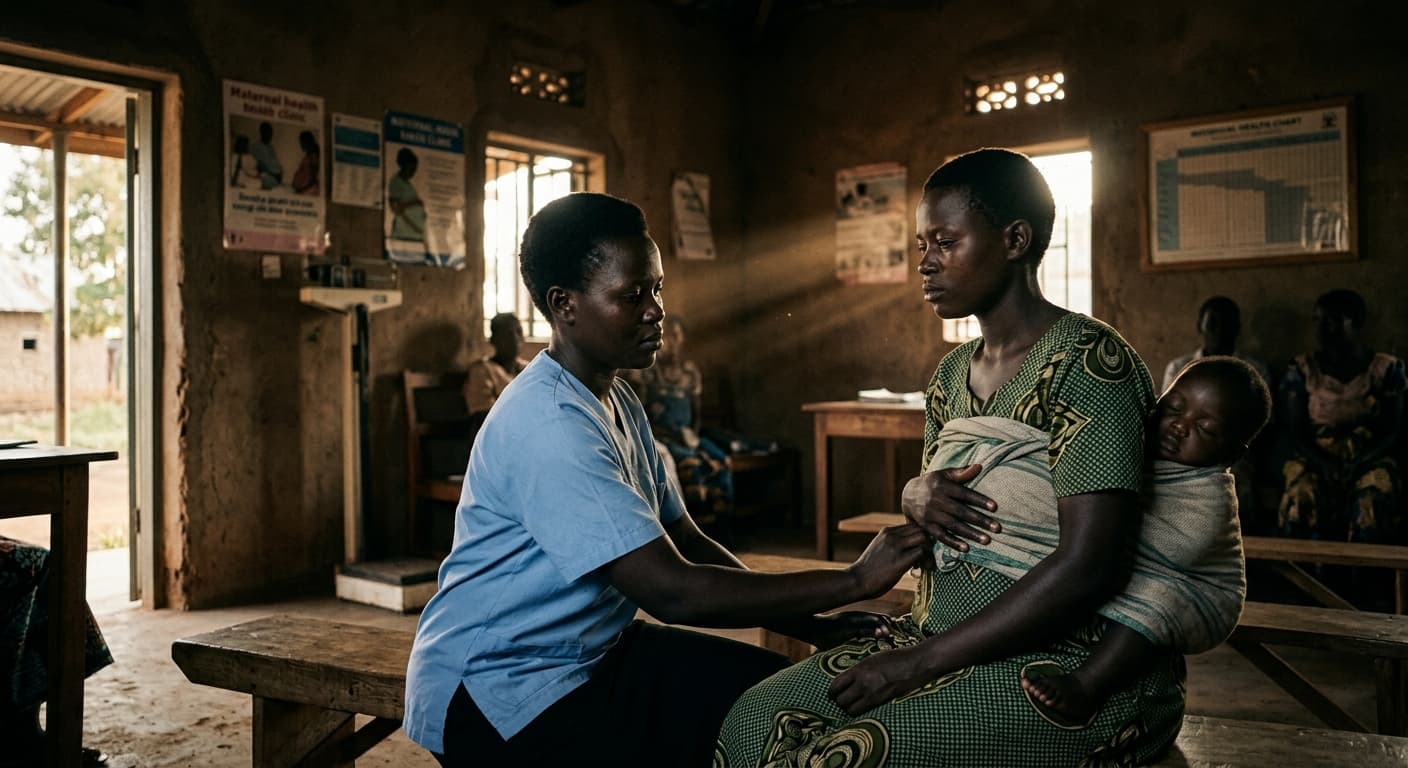
Africa's RMNCAH Bet: Sovereignty Meets a $40 Billion Aid Cliff
Africa's finance and health ministers meet July 10, 2026 to convert the collapse of US aid into domestic revenue for maternal and child health — before hard-won survival gains reverse.
READY, SET IMPLEMENT!"— a policy dialogue that frames reproductive, maternal, newborn, child and adolescent health (RMNCAH) not as a social-sector line item but as the fiscal load-bearing wall of Africa's demographic dividend. The bet is specific and testable: with development assistance for health across the continent projected to fall from $80.3 billion in 2021 to under $40 billion in 2025 per the Institute for Health Metrics and Evaluation, African finance ministries have roughly 18 months to replace donor dollars with health taxes, debt-for-health swaps and honest budget execution — or watch a 40% decline in maternal deaths achieved since 2000 stall out. The pivot is being sold as "health sovereignty," but the real story is a scramble to price-in the collapse of Washington's health aid before the mortality data catches up.
The AU Commission's convening note is explicit that RMNCAH financing is now "a determinant of labour-force participation, productivity, and the demographic dividend." It cites a Global Investment Framework estimate that every dollar invested returns up to twenty in economic output — the largest single-sector return on the continent's fiscal menu.
The aid cliff that changed the math
The trigger is not an African policy failure. It is a Washington decision. Hours after his January 20, 2025 inauguration, US President Donald Trump signed an executive order freezing foreign aid; USAID was dismantled and PEPFAR bridging arrangements were left in limbo. According to a Boston University tracker cited by Al Jazeera, the shocks had translated by early 2026 into an estimated 518,428 additional child deaths and 263,915 adult deaths worldwide from manageable diseases, alongside nearly 10 million new malaria cases.
The bilateral impact is concrete. The US had provided roughly 32% of Malawi's total health budget before the freeze, Al Jazeera reported from Mulanje in December 2025 — 20 posts had already shuttered and Malawi's own government had forecast a $23m maternal-newborn shortfall for 2025 even before the cuts hit. In South Africa, the loss of an estimated $400m in annual PEPFAR funding was met with just $46m in emergency domestic replacement — 11.5% of what was lost, per the
BBC.
Washington's replacement architecture is the second shock. Under an "America First Global Health Strategy," the administration has offered performance-based bilateral deals — but with critical-minerals and data-sharing clauses attached. Zambia was reportedly offered $1bn over five years contingent on co-financing $340m in new health spending, one-way data-sharing for 10 years, and access to copper, cobalt and lithium. Zimbabwe walked away after Washington asked for epidemiological data and biological samples. Reuben Silungwe, a Zambian development analyst quoted by Al Jazeera, warned the terms "would undermine the country's long-term fiscal independence."
That is the fiscal context in which the AU is now selling "health sovereignty."
What the Abuja 15% actually looks like in 2026
The Abuja Declaration of April 27, 2001 committed AU governments to allocate 15% of national budgets to health. By 2021 — the most recent verified data point — only Cabo Verde and South Africa met the target, according to Human Rights Watch, and the regional average sat at 7.4%. Seven AU countries were spending less per person on health in real terms than they did in 2000.

Debt service is why. The IMF's April 2025 Regional Economic Outlook put the median interest-to-revenue ratio in Sub-Saharan Africa above 12% in 2024, a level the Fund's economists describe as "constraining critical development spending." An October 2025 open letter from more than 30 economists and former finance ministers,
reported by Al Jazeera, documented that 32 of 54 African nations now spend more on external debt service than on healthcare. WHO Director-General Tedros Adhanom Ghebreyesus, in a
January 2026 essay in Nature Health, noted Africa "loses more to illicit financial flows and corporate tax exemptions than it gains in aid" — $90bn in illicit flows and $55bn in tax exemptions in 2023, against $74bn received.
The AU's 8th Specialized Technical Committee on Finance and Monetary Affairs, meeting in 2025, issued the Ministerial Declaration that anchors the July 10 dialogue. It calls on member states to implement annual increases toward the 15% target, adopt health taxes on tobacco, alcohol and sugary drinks, pilot blended finance and debt-for-health swaps, and cost Essential Health Benefit Packages tied to primary health care. The declaration is legally non-binding, but for the first time it pulls central bank governors and finance ministers into the room alongside health ministers.
The Accra Reset and the sovereignty frame
The political scaffolding was laid at the Africa Health Sovereignty Summit in Accra on August 5, 2025, hosted by Ghanaian President John Dramani Mahama. In a speech at the summit, Tedros framed the moment bluntly:
"In this crisis lies an opportunity — an opportunity to shake off the yoke of aid dependency, and embrace a new era of sovereignty, self-reliance, and solidarity."
The Accra Reset built on the 2019 Africa Leaders Meeting and the 2023 Lusaka Agenda, and, as Nature Health documented, it was consciously modeled on Abuja — with the difference that African leaders no longer expect the money to arrive from outside. At the 39th AU Summit in Addis Ababa on February 13–15, 2026, health sovereignty and women's, children's and adolescents' health became agenda-topping items, per the
Global Leaders Network's post-summit brief. Sub-Saharan Africa still accounts for approximately 70% of global maternal deaths and nearly 58% of under-five deaths.
South African Health Minister Aaron Motsoaledi captured the shift on the sidelines of the Summit:
"In an era of constraint, aid and global fiscal uncertainty, the Global South is stepping up to co-finance and sustain its own health systems."
The fiscal instruments actually on the table
Three revenue tools sit at the centre of the July 10 dialogue, and each carries a specific price tag.
Health taxes. WHO's "3 by 35" initiative — a 50% price increase on tobacco, alcohol and sugary drinks — could globally generate an additional $3.7 trillion within five years, per Tedros's Accra remarks. Kenya, Ethiopia and Nigeria are the near-term candidates; excise reform faces intense lobbying resistance in each.
Debt-for-health swaps. A 2024 scoping review in Globalization and Health concluded that Debt2Health remains "an increasingly important role in resource mobilization" despite periodic suspensions, but only if creditor coordination improves. Under the current G20 Common Framework, just 7% of external debt owed by at-risk countries has been relieved, per the October 2025 economists' letter.
Budget execution. Tedros's Accra speech disclosed that up to 13% of health budgets in low- and middle-income countries goes unspent because of weak public financial management. In Africa, that is roughly the same order of magnitude as the RMNCAH financing gap. The World Bank's Global Financing Facility has priced the annual global RMNCAH funding shortfall in high-burden low- and lower-middle-income countries at $33.3bn — $9.42 per capita per year.
What breaks first
The World Health Organization's April 2025 estimate that global maternal mortality fell 40% between 2000 and 2023 masks a slowdown since 2016 and a projected reversal in fragile states. A 15-year-old in Chad or the Central African Republic already faces a 1-in-24 lifetime risk of maternal death, versus 1-in-593 in stable countries. The countries where PEPFAR and MOMENTUM cuts hit hardest — Malawi, Zambia, Nigeria, South Africa — are the same countries carrying the largest share of the sub-Saharan maternal death total. If domestic revenue does not fill the hole within roughly the next two budget cycles, the reversal will show up in the 2027 and 2028 UN maternal mortality estimates.
Diplomat View
The AU's July 10 dialogue is a hinge event, not a summit. Read it as a stress test of whether African finance ministries can price sovereignty in domestic currency. The forecast is qualified but pointed: expect two to four countries — likely Ghana, Kenya, Nigeria and possibly Ethiopia — to legislate meaningful health-tax packages within twelve months, and expect one high-profile debt-for-health swap pilot before the 2027 IMF/World Bank spring meetings. Expect the Abuja 15% target to remain rhetorically alive and empirically dead: the regional average will not cross 10% by 2028 without a debt-restructuring wave that neither Washington nor Beijing currently supports. The forecast changes if two conditions materialise. First, if Zambia or a comparably indebted country signs a US minerals-for-health deal that formally subordinates health budgets to commodity revenue — sovereignty becomes a slogan, not a strategy. Second, if the G20 Common Framework produces concessional restructuring for two or more African sovereigns in 2026, the fiscal space for RMNCAH opens materially. Absent one of those, "READY, SET IMPLEMENT!" will read, twelve months from now, as a diagnosis without a treatment.
Watch these dates:
- July 10, 2026 — AU Commission Ready, Set, Implement session; look for costed Essential Health Benefit Package commitments from at least three member states.
- October 2026 — IMF/World Bank annual meetings; test of whether debt-relief momentum from the October 2025 economists' letter has produced any G20 movement.
- Q4 2026 — Zambia's decision on the US minerals-for-health bilateral; the clearest single signal of whether sovereignty rhetoric survives contact with fiscal reality.
The bottom line: Africa's RMNCAH agenda is no longer a health-ministry problem — it is a sovereign-debt problem dressed as one. The July 10 dialogue matters because it is the first time finance ministers, not health ministers, will own the answer. If they deliver excise reform and swap pilots, the demographic dividend stays on the table. If they do not, the maternal mortality curve bends the wrong way — and the continent will have traded aid dependency for commodity dependency without ever passing through sovereignty.
Discover more

US Politics
Virginia's Redistricting Referendum
Virginia's redistricting referendum is drawing a flood of dark money, shaping future elections and the fight for congressional control amid party stakes.

US Politics
House Ethics Committee Pushes Sexual Miscond.
The House Ethics Committee has shifted responsibility for sexual harassment settlement records to the Office of Congressional Workplace Rights, complicating disclosure efforts.

US Politics
White House Pressures Congress for Crypto Leg
The Trump administration's push for the CLARITY Act aims to reshape crypto regulation, impacting trillions in market value and the Trump family's wealth.

Economics
Fed's Amex AML order puts correspondent banking on notice
Federal Reserve's Amex AML order requires board-level controls and a 90-day plan; OCC fined the bank $350 million over enterprise-wide deficiencies.