Afghanistan Displacement Crisis: A Backfire
Iran and Pakistan's push for Afghan returns falters amid aid cuts.
Model Diplomat7 min readAsia
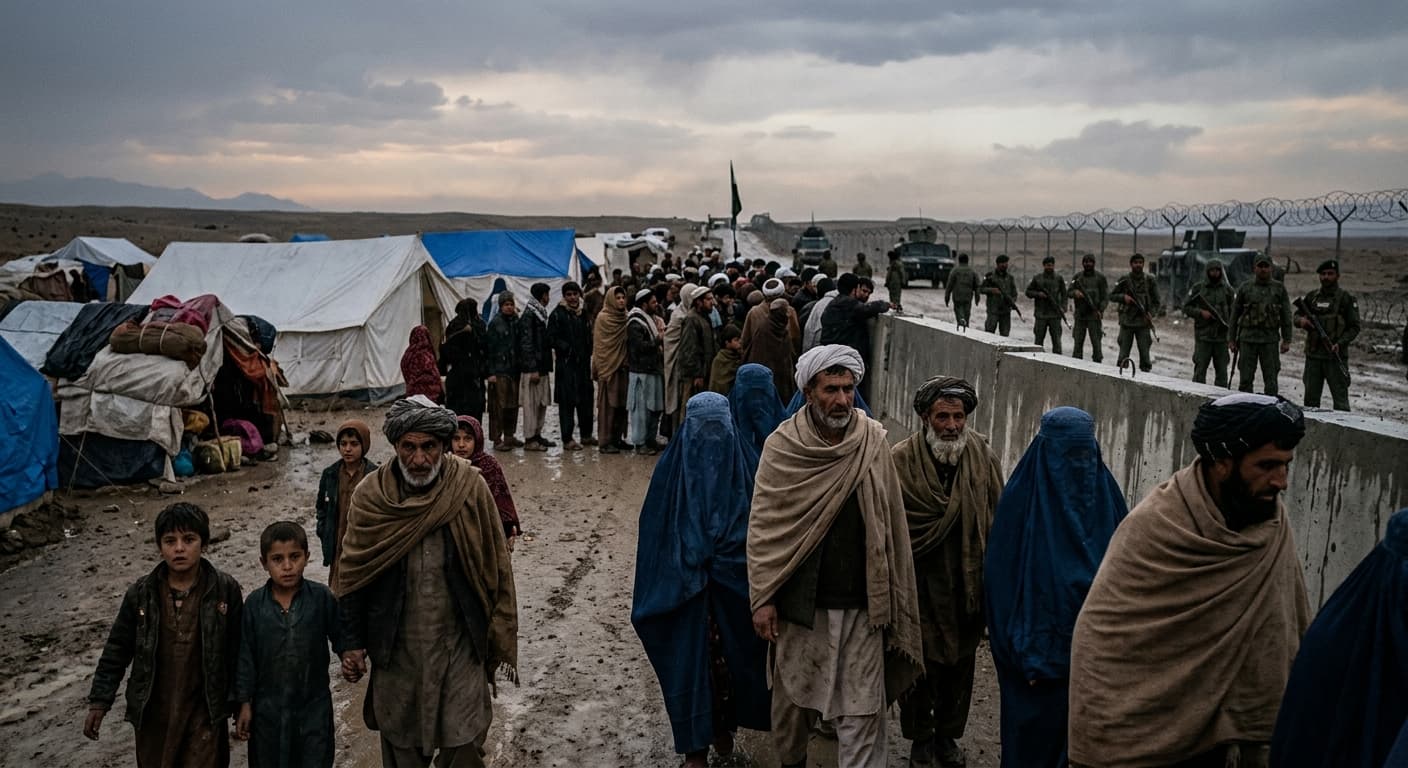
Afghanistan Displacement Crisis: The Regional Bet That's Backfiring
Iran and Pakistan pushed 2.6 million Afghans home in 2025 as donors walked away. The reintegration is failing — and the fallout is heading back across the border.
Afghanistan just made the Norwegian Refugee Council's annual list of the world's most neglected displacement crises — a designation Kabul avoided even at the peak of the Taliban's 2021 takeover. The ranking is less a verdict on donor fatigue than on a regional gamble: Tehran, Islamabad and Washington — the last having cut nearly all aid since January 2025 — are all betting Afghanistan can absorb a demographic shock equal to roughly 6% of its population in a single year while funding less than a fifth of the humanitarian response. The math does not work, and the second-order costs — Islamic State Khorasan Province (ISKP) recruitment, cross-border militancy, secondary migration toward Europe — are already flowing back to the countries that engineered the returns.
According to the UN Office for the Coordination of Humanitarian Affairs, 21.9 million Afghans — 45% of the population — will need humanitarian assistance in 2026, driven by food insecurity, drought, and the largest returnee wave in the country's modern history. OCHA's
Financial Tracking Service shows the $1.71 billion appeal is 16.6% funded as of early July, with the food-security cluster at 9.1% and shelter at 4.4%. In her June 8 briefing to the Security Council, OCHA crisis response director Edem Wosornu, speaking for Emergency Relief Coordinator Tom Fletcher, told delegates that the response has already reached 3 million fewer people than a year earlier — a
40% collapse in coverage inside twelve months. She warned the World Food Programme would be forced to cut famine-prevention activities for approximately 1.5 million people in high-risk districts without new pledges by autumn.
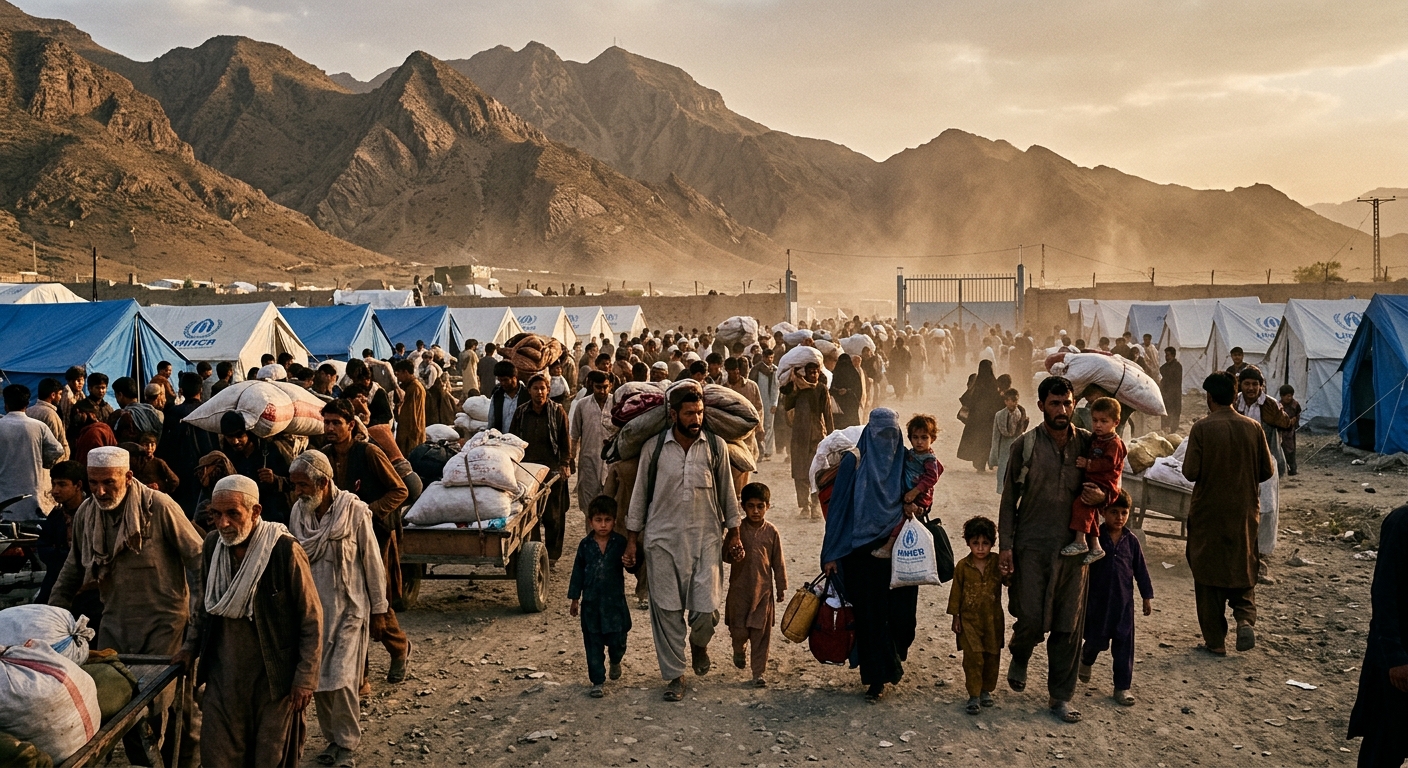
The scale: 2.6 million returned in 2025, another 2 million expected
Between January and December 2025, more than 2.61 million Afghans crossed back into the country from Iran and Pakistan, according to OCHA's 2026 Humanitarian Needs and Response Plan. UNHCR describes the movement as one of the largest return flows anywhere in the world. The BBC's Dari service reported the agency expects roughly 2 million additional returns in 2026, with more than 320,000 already recorded by early July. Since Pakistan launched its expulsion campaign in September 2023, the combined return figure has passed 5.6 million — a movement of population equivalent, in relative terms, to Poland absorbing the whole of Slovakia inside two years.
The two neighbouring governments have very different motivations, but the effect is the same. Pakistan's drive began after Islamabad blamed Afghan nationals for a spike in militant attacks; by mid-October 2025, Al Jazeera reported that Pakistan had ordered the closure of all 54 Afghan refugee villages, stopped renewing Proof of Registration cards, and invalidated the legal status of some 1.2 million long-term residents, some of them born in Pakistan. Iran's expulsions accelerated after the June 2025 twelve-day war with Israel, when Tehran alleged — with negligible evidence — that Afghan migrants had been recruited as spies. The
BBC reported daily returns from Iran peaked at 50,000 in early July 2025; more than 1.5 million left the country in the first half of the year alone, and Iranian officials say up to 4 million undocumented Afghans remain on notice.
The third actor is the United States. According to BBC reporting from Ghor province, Washington — historically the largest donor to Afghanistan — cut nearly all aid to the country in 2025 after the Trump administration dismantled USAID, and current UN figures show international aid received so far in 2026 is 70% below 2025 levels. The United Kingdom and Germany have followed with sharp cuts of their own. Aid did not taper — it fell off a cliff, in the same twelve-month window that Iran and Pakistan chose to compress a two-decade refugee stock into a single return surge.
Why the reintegration is failing
The economics of return are unforgiving. An IMF working paper published in September 2025 modelling the regional macro effects of the Afghan exodus concluded that "isolated measures — such as forced repatriation — may bring fiscal and labor market relief for host countries but can further undermine Afghanistan's already fragile economy." Remittance flows, worth roughly $4.8 billion in 2023 or 2.7% of GDP, contract precisely when domestic labour supply expands from returnees. The Afghan economy remains around 25% below 2020 levels; the World Bank's spring 2026 Afghanistan Development Update projects only 3.8% growth in FY2026 — nowhere near enough to absorb the returnee shock.
Food security is deteriorating in parallel. OCHA reports that 4.7 million people now face IPC Phase 4 (Emergency) hunger, a 50% year-on-year increase, and 3.7 million children are acutely malnourished. The UK Home Office's April 2026 country policy note records that during the November 2025–March 2026 winter lean season, an estimated 17.4 million Afghans faced Crisis-level acute food insecurity or worse, and the WFP calculated in February 2026 that it could reach only 2 million people per month out of that population. Four consecutive years of drought, worsened by La Niña conditions, have hit twelve provinces. A
SIPRI–NUPI fact sheet from March 2026 found that in the first quarter of 2025, 79% of new internal displacement inside Afghanistan was climate-related — meaning many returnees are landing in areas that are themselves emptying out.
Who benefits, who loses
The immediate beneficiaries are the security establishments in Islamabad and Tehran, both of which face domestic pressure to blame Afghan populations for economic and security problems that predate them. The BBC noted that expulsion is among the rare topics on which most Iranians agree with their government; in Pakistan, the military framing of Afghans as a security threat provides political cover for a policy that would otherwise face pushback from religious-conservative constituencies with long ties to Afghan refugees.
The losers are more numerous and more consequential. The Taliban administration inherits a fiscal and social problem it cannot solve; its own economic policy, documented by the Institute for Defence Studies and Analyses, relies on coercive counter-terrorism and clerical rigidity that deter donors. Afghan women and girls lose most. The OCHA briefing described a ban on female humanitarian workers now in its tenth month and warned that families are again reporting the sale of daughters to survive — a detail that did not appear in the 2024 briefing. Host communities in Balkh, Faryab, Herat, Kabul and Kunduz — the provinces receiving the highest return volumes — are seeing housing markets, water systems and clinics overwhelmed, according to the UK Home Office note.
Then there is the diffuse third-order loser: European and Central Asian counter-terrorism agencies. Analysts at the International Crisis Group argue ISKP has shifted from an Afghanistan-focused insurgency toward a horizontal transnational network run by commanders of Central Asian origin, plotting attacks in Iran, Russia and Europe.
CSIS analysis estimates ISKP still fields more than 3,000 fighters and warns that "conventional measures of strength do not fully capture the threat from the group." A cohort of 2.6 million impoverished, mostly young returnees dropped into a Taliban-run economy where 45% of the population needs humanitarian assistance is exactly the recruiting pool ISKP's Al-Azaim propaganda arm has targeted since 2022. The January 2026 ISKP attack on a Chinese establishment in Kabul's Shahr-e-Naw district, documented by IDSA, is the kind of signal that argues against the group's alleged decline.
The historical parallel — and the divergence
The 1990s offer the comparison every diplomat in the region is quietly making. When Pakistan and Iran forced large-scale Afghan returns after the mujahideen victory in 1992, the collapse of the Afghan state helped incubate both al-Qaeda's safe haven and the conditions for the Taliban's original 1996 takeover. The parallel now is imperfect but instructive: the difference in 2026 is that Afghanistan already has a de facto government, so the failure mode is not state collapse but state hardening — a Taliban regime more insular, more punitive toward women, and more reliant on informal economies including narcotics and unregulated mining. The IMF working paper is explicit: only "simultaneous reforms in both source and host countries, underpinned by international assistance" can generate mutually beneficial outcomes. That coordination does not exist.
What to watch
- UN General Assembly, September 2026: OCHA has effectively made this the pledging deadline for the $1.71 billion appeal. A repeat of the 15–17% funding coverage will force WFP cuts affecting roughly 1.5 million people in famine-prevention districts.
- Pakistan–Afghanistan Istanbul track: Follow-on talks after the Doha ceasefire signed in October 2025 will determine whether Islamabad accelerates or pauses the closure of the remaining refugee villages. The next round is the most sensitive bilateral file in the region.
- Iran's post-war deportation ceiling: Tehran has signalled it wants the remaining undocumented Afghan population — up to 4 million people — moved by end-2026. Any move to formalise a hard deadline would double the current return flow.
- US SIV programme: David Miliband of the International Rescue Committee has
publicly warned that the current travel-ban "pause" could become permanent. Any restart would signal Washington re-engaging, however narrowly.
Diplomat View
The evidence supports a specific, falsifiable call: Afghanistan's displacement crisis will not stabilise in 2026, and the neighbours pushing it hardest will absorb the costs they thought they were exporting. Iran and Pakistan are engineering a return flow their domestic politics demand but their border economies cannot digest — and the ISKP network, Central Asian smuggling routes and the secondary migration corridor to Türkiye and the EU will do the arbitrage. The forecast would change if three things move together: the UN appeal crosses 40% funding by year-end, Islamabad and Kabul convert the Doha ceasefire into a managed-returns framework, and at least one major Gulf donor — most plausibly Qatar or the UAE — steps into the vacuum left by Washington. Absent those, expect the neglected-crisis designation to become permanent, and expect the next ISKP-linked plot in Europe to trace its logistics chain back to a returnee household in Herat or Nangarhar. That is not a moral claim. It is the shape of the incentive structure currently in place.
Discover more
India
Congress Accuses Modi of Stalling Women's Law
Congress accuses Modi of stalling women's reservation law by linking it to delimitation, revealing a deeper electoral strategy.
India
Romanian Coalition Party Demands PM Resign
Romania's Social Democrats withdrew from coalition, joining far-right AUR to topple PM Bolojan, risking €10 billion in EU funds by August 2026.
Global Politics
Trump's Conflicting Messages on Iran War
Trump's mixed messages on Iran reflect a strategy of audience management, benefiting Tehran amid a complex geopolitical landscape.

Conflict & Security
Drone Warfare Killing Aid Workers at Unprec
Over 1,000 humanitarian workers killed in three years as cheap armed drones collapse legal protections. Gaza, Sudan, Ukraine, and DRC see deliberate targeting of aid convoys and hospitals with zero prosecutions.