UN's Conditional Engagement with Taliban
A roadmap for economic normalization in Afghanistan
Model Diplomat4 min readasia
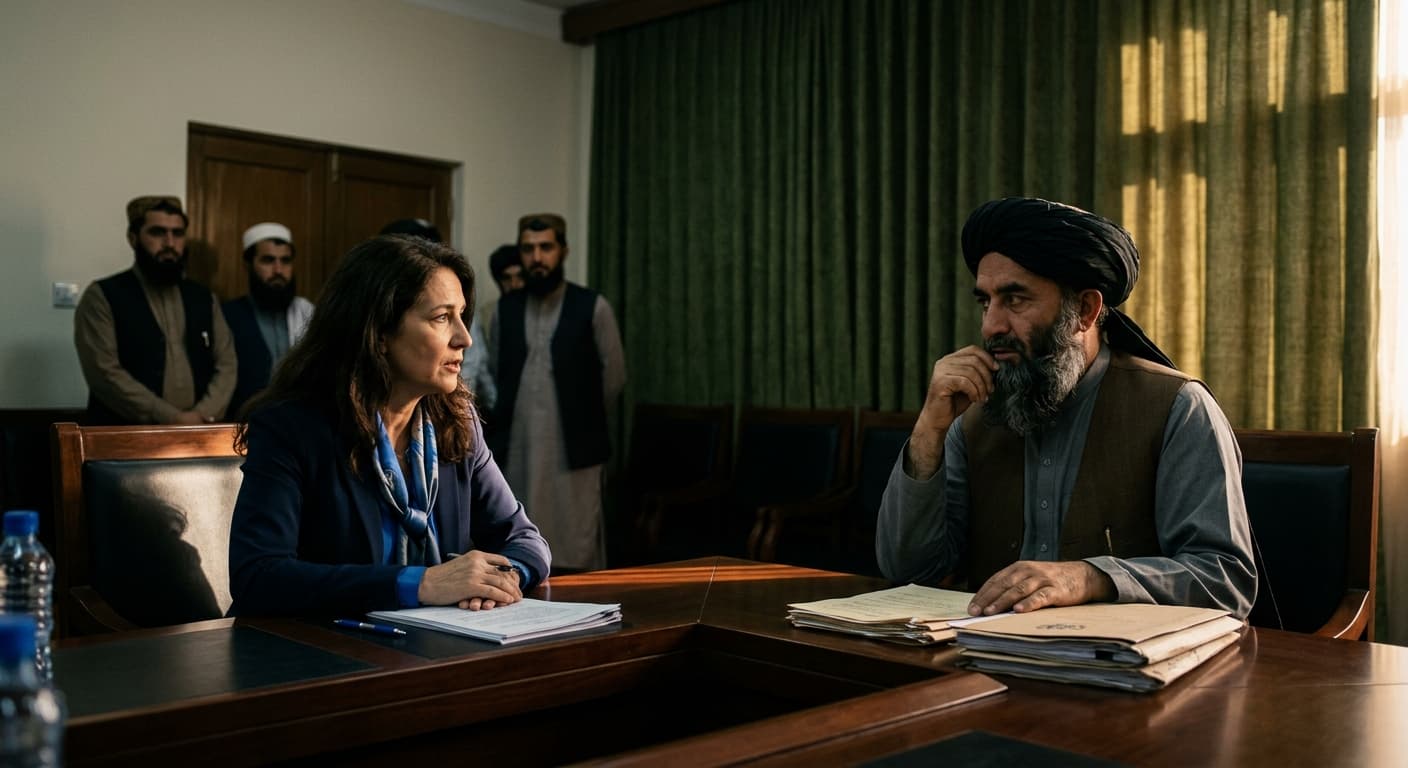
The Sinirlioğlu Roadmap: Why the UN Is Pivoting from Isolation to Conditional Engagement with the Taliban
The UN's independent assessment declares the status quo "not working" and charts a path toward economic normalization — but the Taliban hold most of the cards.
On November 8, 2023, Secretary-General António Guterres transmitted to the Security Council the most consequential reassessment of international engagement with Afghanistan since the Taliban's 2021 takeover. The independent assessment, led by former Turkish diplomat Feridun Sinirlioğlu under Resolution 2679, opens with a blunt verdict: "The current approach of the international community in relation to the Taliban is not working, and it is not addressing the humanitarian, economic, political or social needs of the Afghan people" — then lays out a roadmap for conditional reintegration of Afghanistan into the international system.
UN Document S/2023/856
The economic diagnosis
The report makes explicit what was long treated as a secondary concern: Afghanistan's economic collapse is the central driver of the crisis, not merely a complication of it. Before 2021, international grants financed 40–45% of GDP, covering public spending and a trade deficit of roughly 35% of GDP. When those flows halted — alongside the freezing of $9.5 billion in central bank reserves and the severing of correspondent banking relationships — the result was a 25% GDP contraction documented by the World Bank.
The Sinirlioğlu assessment frames this not as a problem that humanitarian aid can solve. Regional stakeholders, it notes, stress that a functioning Afghan economy is essential for their own trade routes, domestic stability, and to prevent uncontrolled migration. The report urges the international community to "move quickly towards resolving the issue of Afghanistan's frozen assets, reviewing various sanctions regimes, and moving toward more durable economic solutions, such as increasing the assets of the Central Bank of Afghanistan." BBC Persian
The normalization bargain
The assessment's core recommendation is a structured, conditional normalization pathway. It calls for a roadmap linking incremental Taliban compliance — on inclusive governance, counterterrorism, and human rights — to graduated steps toward Afghanistan's "full integration" into international institutions, including membership in key financial bodies and full representation at the UN. Stimson Center described it as "a useful way forward for better-coordinated and consistent international engagement."
Institutionally, the report proposes a UN Special Envoy to lead international engagement, an international contact group, and continuation of the large-group format talks begun in Doha in May 2023. The Security Council adopted Resolution 2721 in December 2023 endorsing the Special Envoy — but China and Russia abstained, signaling the geopolitical fragmentation that has defined the post-2021 response. Russia's deputy envoy cautioned that further Taliban consultation was needed; Beijing echoed the same. Foreign Affairs
Winners and losers
The Taliban emerge as the report's principal beneficiary. The assessment explicitly rejects isolation as a viable strategy and frames normalization — not regime change or even political concessions — as the international community's goal. The Taliban's objections are narrow: they oppose the Special Envoy concept, seeing it as improperly framing Afghanistan as a conflict zone. But the framework itself aligns with what they want — economic reintegration without renouncing core ideology.
Former Afghan UN representative Mahmoud Saikal, writing in The Independent, called parts of the assessment "delusional" and tilted toward Taliban interests. Afghan women's rights activists and civil society groups Human Rights Watch had urged that the report center human rights — particularly the Taliban's gender apartheid. The assessment does reference women's rights, but its logic is economic first. Security analyst Jonathan Schroden, by contrast, praised the report as "refreshingly frank," identifying four pillars: addressing basic needs, marshaling international attention, a reintegration roadmap, and improved coordination.
BBC Persian
The regional powers — Pakistan, Iran, China, Central Asian states — gain from a framework that legitimizes their already-deepening engagement with Kabul. China formally received a Taliban ambassador in early 2024; regional states have been conducting de facto normalization for months. The assessment gives that posture UN cover.
The United States loses leverage it never really had. The report effectively acknowledges that sanctions and asset freezes have hurt ordinary Afghans more than Taliban decision-making — a conclusion that weakens Washington's ability to use economic pressure as a bargaining chip.
What to watch next
The third UN-convened Doha meeting in July 2024, which the Taliban attended for the first time, was the first operational test of the Sinirlioğlu framework. Al Jazeera reported it centered squarely on implementing the independent assessment's recommendations. The appointment of a Special Envoy remains unresolved — and the Taliban's willingness to engage without one will determine whether the roadmap advances or stalls.
The deeper question: whether the Taliban will make any concessions on women's rights or inclusive governance in exchange for economic benefits they are already receiving from regional powers and humanitarian carve-outs. The assessment bets on a bargain. The evidence so far suggests the Taliban see no need to pay.
Discover more
US Politics
SNAP Food Assistance Faces Legal Challenges
In 2026, SNAP faces stricter eligibility rules and mounting legal challenges, threatening food assistance for the millions of Americans who rely on the program.
US Politics
Congress Targets AI Chatbot Access for Terror
The House passed the Generative AI Terrorism Risk Assessment Act, focusing on AI's role in terrorism and potential surveillance implications.
US Politics
House Ethics Committee Pushes Sexual Miscond.
The House Ethics Committee has shifted responsibility for sexual harassment settlement records to the Office of Congressional Workplace Rights, complicating disclosure efforts.

Conflict & Security
Drone Warfare Killing Aid Workers at Unprec
Over 1,000 humanitarian workers killed in three years as cheap armed drones collapse legal protections. Gaza, Sudan, Ukraine, and DRC see deliberate targeting of aid convoys and hospitals with zero prosecutions.