AES Roads, Not Rifles: The Boring Work Decid
AES police chiefs meet to harmonize road controls, revealing the confederation's real test.
Model Diplomat4 min readAfrica
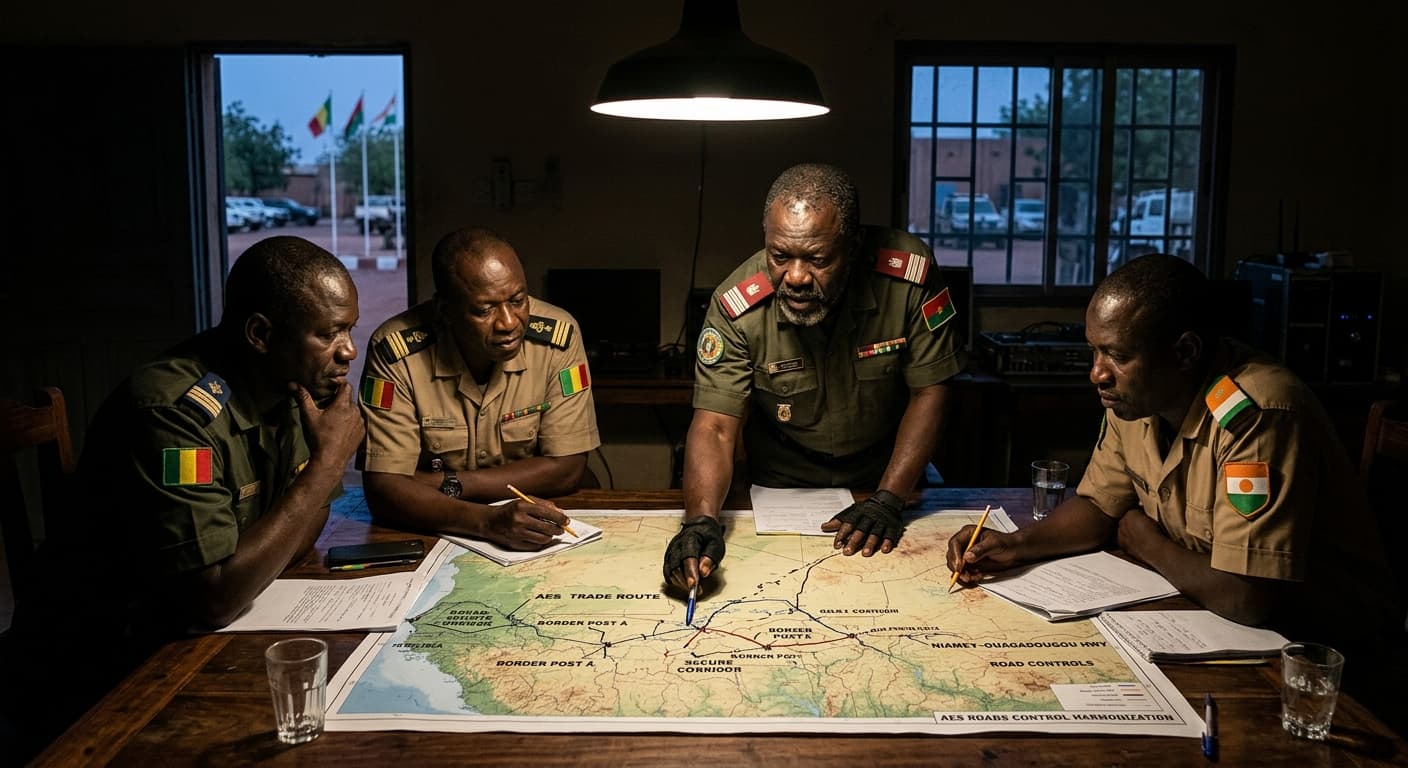
AES Roads, Not Rifles: The Boring Work Deciding Whether the Sahel Confederation Survives
The July 16, 2026 Ouagadougou meeting of AES police chiefs to harmonize road controls reveals that the confederation's survival hinges on securing trade corridors — not deploying its 5,000-strong showpiece force.
On July 16, 2026, the police chiefs of Burkina Faso, Mali and Niger convened in Ouagadougou to implement a "technical arrangement" recently adopted by the three states' security ministers — a protocol to harmonize road checkpoints, procedures and operational devices across the Alliance of Sahel States (AES) confederation, according to
Ouaganews. The meeting made no headlines in Western capitals. It should have. The confederation's future is being decided not by the 5,000-strong Unified Force paraded at December's Bamako summit, but by whether three coup-saddled states can secure the roads that bind their economies together — roads that jihadist groups now treat as primary hunting ground.
From defence pact to road checkpoints
The AES was born on September 16, 2023, when the three military governments signed the Liptako-Gourma Charter, a mutual-defence pact framed initially as protection against external intervention — specifically the ECOWAS threat of military action to restore Niger's ousted president, Mohamed Bazoum, according to BBC Afrique. Within a year it had become something more ambitious: a confederation, formalized at the July 6, 2024 Niamey summit, with its own bank, broadcaster, penal court proposal and joint military force.
The architecture is real, if fragile. At the second AES summit in Bamako in December 2024, leaders inaugurated the 5,000-soldier Force Unifiée de l'AES (FU-AES), commanded by Burkina Faso's General Daouda Traoré; the Banque Confédérale d'Investissement et de Développement (BCID-AES), capitalized at 500 billion CFA francs; and AES Television, a broadcaster explicitly designed to counter "disinformation campaigns and hostile narratives," as Al Jazeera reported. Captain Ibrahim Traoré, Burkina Faso's transitional president, took the alliance's rotating leadership and warned of a looming "Black Winter" of external destabilization.
But the July 16 police meeting points to where the confederation actually lives or dies. The technical arrangement targets what Burkina Faso's police chief, Thierry Tuina, called the "best security structures" for populations to "benefit" from the alliance — which in practice means the road corridors linking Bamako, Ouagadougou and Niamey, the same routes the BCID-AES is meant to finance as highways and railways, per BBC Afrique. The objective, as Ouaganews reported, is to "fluidify the circulation of persons and merchandise" while reconciling "security imperatives and the facilitation of exchanges."
This is not glamorous counter-terrorism. It is the dull infrastructure of a state — and it is exactly where the AES's predecessors failed.
The corridor as battleground
The Liptako-Gourma tri-border region — where Mali, Burkina Faso and Niger converge — is the geographic and strategic heart of the confederation. It is also, by the Global Terrorism Index, the epicentre of a region that accounted for 51 percent of global terrorism-related deaths in 2024.
The jihadist landscape is crowded and adaptive. Jama'at Nusrat al-Islam wal-Muslimin (JNIM), an al-Qaeda affiliate formed in 2017, is entrenched across central and northern Mali and has expanded through much of Burkina Faso into western Niger, according to Al Jazeera's December 2024 explainer. The Islamic State in the Greater Sahara (ISGS), also called the Islamic State Sahel Province, is particularly active in the tri-border zone, carrying out large-scale assaults on military bases and villages. A third actor, the Azawad Liberation Front (FLA), a Tuareg-led separatist movement formed in 2024, has attacked both Malian and Russian forces in northern Mali.
The violence is not static; it is migrating south. JNIM fighters have staged attacks from eastern Burkina Faso and southwestern Niger into northern Benin since 2021, and in October 2025 claimed its first attack on Nigerian territory near the Benin border, according to the Stimson Center. Northern Ghana is reportedly used as a logistics and recovery zone by militants operating across the border in Burkina Faso. The
UN Peacebuilding Support Office documented over $21 million in climate-security investments across nine projects in Liptako-Gourma, noting that "the growing unrest, which first emerged in Northern and Central Mali, has spread throughout Liptako-Gourma, particularly in vulnerable border areas that are isolated with weak state presence," per a
World Bank project document.
For the AES, this means the roads are not just trade routes — they are the connective tissue of the confederation itself. JNIM has set up checkpoints disrupting trade routes to Bamako in recent months, and in September 2024 carried out coordinated attacks inside the Malian capital, hitting a military police school, nearby neighbourhoods and the military airport, Al Jazeera reported. If the confederation cannot secure its arteries, its bank, its broadcaster and its unified force become symbols without substance.
Discover more

India
Delhi CM Rekha Gupta Blasts Opposition's Delm
Delhi CM Rekha Gupta's remarks on women's quota defeat reveal BJP's strategy for the 2029 Lok Sabha elections, focusing on delimitation.

India
Rajnath Singh's Durga Squad for 2026 Polls
Rajnath Singh's Durga Squad promised women's safety in Bengal but has since disappeared from the agenda, revealing BJP's true priorities.

US Politics
House Ethics Committee Pushes Sexual Miscond.
The House Ethics Committee has shifted responsibility for sexual harassment settlement records to the Office of Congressional Workplace Rights, complicating disclosure efforts.

Economics
Fed's Amex AML order puts correspondent banking on notice
Federal Reserve's Amex AML order requires board-level controls and a 90-day plan; OCC fined the bank $350 million over enterprise-wide deficiencies.