44 Hostages Highlight Red Sea Security Gaps
IMO's appeal reveals piracy's resurgence off Somalia.
Model Diplomat8 min readRed Sea
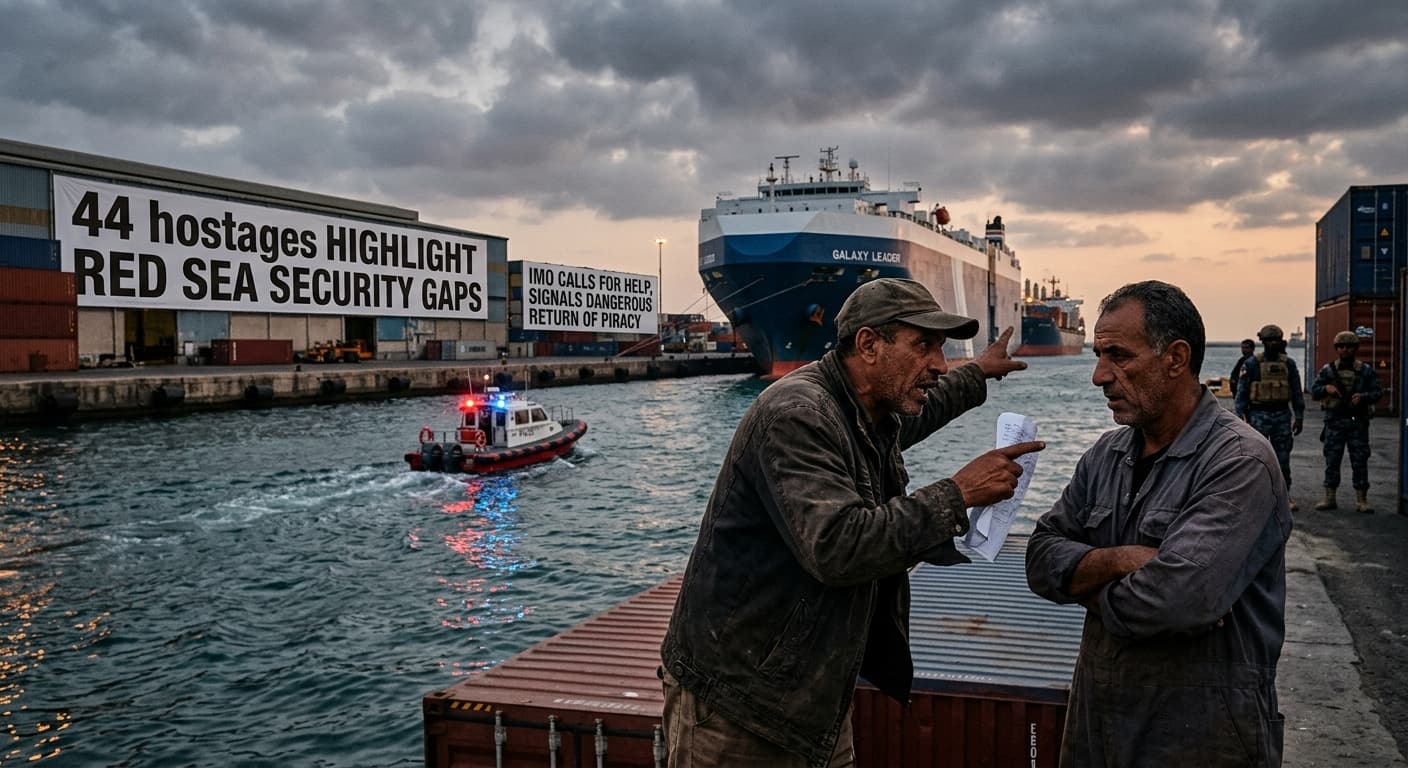
The 44 hostages exposing a hole in Red Sea security
The IMO's July 6 appeal for 44 seafarers held off Somalia signals that piracy has returned as navies chase Houthi missiles and Iranian mines instead.
The International Maritime Organization's Secretary-General Arsenio Dominguez asked the IMO Council on July 6, 2026 to help secure the release of 44 seafarers held on three ships off Somalia — and the appeal matters less as a humanitarian plea than as an admission that the coalition which strangled Somali piracy after 2011 no longer exists in a form capable of doing it again. The hostages are running out of food. The naval force that once handled this problem is fighting Houthis in the Bab el-Mandeb and shepherding tankers past Iranian mines in Hormuz. What comes next is either paid ransoms that seed a second piracy cycle, or a hurried re-scramble of naval assets that Europe, the United States and the Gulf cannot spare. This is the security gap the IMO is really flagging.
What Dominguez actually asked for
Speaking at the opening of the 137th session of the IMO Council in London, Dominguez said the 44 seafarers are held aboard the tanker MT Honour 25, the cargo ship MV Sward and the petrol tanker MT Eureka, all hijacked between April 21 and May 2, 2026 in separate incidents off Somalia and Yemen, according to the International Maritime Organization. "These incidents are a stark reminder that the threat posed by piracy and armed robbery to seafarers has not receded," Dominguez told the Council, adding that he was asking members for support "in securing their safe release," per an account in
Mirage News.
The plea is anchored in a document. The Djibouti Code of Conduct/Jeddah Amendment (DCoC/JA), the IMO's regional counter-piracy framework of 22 signatory states, warned last week of a "rapidly deteriorating humanitarian situation" aboard Honour 25 and its two sister hostages. According to the chair's statement carried by Ship Management International, the master of Honour 25 reported that five crew members including himself are ill, food supplies "have reportedly been reduced to rice alone," the drinking water is unsafe, and armed pirates recently exchanged fire with a rival group trying to board — trapping the crew "between competing armed factions."
The DCoC/JA chair's language is unusually blunt for an IMO body: it calls for "urgent, coordinated and decisive international intervention" and asks the Federal Government of Somalia, flag states, shipowners, insurers and regional partners to escalate "every available diplomatic, operational, humanitarian and legal effort." That is a public admission from an IMO-hosted forum that its own machinery is not sufficient.
Why this cycle looks different from 2008–2012
At its peak in 2011, Somali piracy cost the world economy up to $18 billion a year, according to World Bank estimates cited in Al Jazeera. What suppressed it was a 47-country naval coalition — NATO's Operation Ocean Shield, the EU's Operation Atalanta, the Combined Maritime Forces' CTF-151, and armed private security teams on board most transiting vessels. That architecture has been quietly dismantled by other wars.
The evidence is on the water. Operation Atalanta today "is limited to around two ships and air assets deployed concurrently," according to a June assessment by the Institute for Security Studies. CTF-151 remains formally active but is folded into a US Naval Forces Central Command in Bahrain now consumed by the fallout of the US-Israel war on Iran that began in late February. The EU's own Council decision of March 30, 2026 aligned Atalanta's mandate with EUNAVFOR Aspides — the Red Sea mission created to counter Houthi attacks — and added "shadow fleet" monitoring and critical submarine infrastructure surveillance to its brief, further diluting its counter-piracy focus, per the text in
EUR-Lex.
The result is opportunistic, not systemic. The Center for Strategic and International Studies argues the resurgence is being driven less by a collapse of Somali institutions than by a shift in traffic: with Hormuz effectively closed and Bab el-Mandeb transits sharply reduced, up to 70% of container freight that previously moved through the Red Sea is now routing around the Cape of Good Hope, while Saudi Arabia has pushed oil through pipelines to Yanbu — funneling more valuable vessels within skiff range of the Somali coast. Crude tankers moving to and from Yanbu, the ISS notes, are exactly the ransom-rich targets that made 2011 lucrative.
The tactical profile has also matured. The Eureka hijacking on May 2 "occurred far from shore, suggesting a higher level of sophistication than that of two other pirate groups operating in the region, raising the spectre of a third group," ISS analysts wrote. Ransom demand: $10 million. Neither Honour 25 nor Sward carried armed security personnel — the single most effective deterrent from the last cycle. That is a commercial-risk decision made by shipowners who priced the Somali coast as safe. It no longer is.
The financial architecture the Houthis built
The second-order story is that piracy has re-emerged inside a maritime risk market fundamentally repriced by the Houthis. War-risk premiums for Red Sea transits jumped from roughly 0.05% to more than 1% of a vessel's insured value — "as much as $1 million per voyage" for a large tanker — according to a Royal United Services Institute analysis by RUSI drawing on Lloyd's List data. The Joint War Committee, RUSI notes, now prices "the probability of future" attacks rather than actual incidents, meaning insurers pre-position risk zones. Piracy off Somalia layers a second premium onto a market already recalibrated.
For flag states with skin in the game, the exposure is uneven. Pakistan has ten citizens aboard Honour 25 alone, whose families have publicly appealed to Islamabad after conditions on the vessel deteriorated to the point that a video circulated in late April showed the crew "confined to a cramped cabin with no proper sleeping arrangements," per Al Jazeera. India, with three nationals across two of the three ships, has responded operationally rather than diplomatically: on July 2 the Indian Navy stealth frigate INS Trikand disrupted a piracy attempt on the MV Golden Arsenal in the Gulf of Aden, according to India's
Press Information Bureau.
That is the emerging pattern. With Western navies overstretched, India and Turkey are filling gaps opportunistically — Ankara extended its Gulf of Aden naval mandate in February 2026 largely to protect its offshore drilling programme along Somalia's Galmudug coast, not the shipping lanes. When multilateral coalitions thin, regional powers substitute selectively, protecting their own hulls and hostages first.
Who benefits, who loses
The clearest beneficiary is China. Chinese-flagged and Chinese-linked vessels have been paying Houthi war-risk premiums as low as 0.35% of hull value versus up to 2% for American and British ships, according to a 2025 investigation by The Economist into what it called the Houthis' "moneymaking machine." The same asymmetry now applies off Somalia: the shipping traffic funnelled around the Cape adds ten days and roughly $1 million per voyage in fuel, insurance and demurrage, costs that fall hardest on European importers and least on the diversified sourcing arrangements RUSI describes as insulating Asian buyers.
The clearest loser is the Federal Government of Somalia. The ISS points out that Mogadishu's real security priority is the al-Shabaab insurgency in the south, not piracy off Puntland's coast — which means primary domestic counter-piracy capability rests with the Puntland Maritime Police Force, an entity of a semi-autonomous federal state whose relationship with Mogadishu has hardened into open political dispute in 2026. Every successful ransom flowing to Puntland-based networks strengthens the federal balance against Mogadishu at precisely the moment Somalia is trying to hold together its federal architecture, per a
CSIS analysis. A think tank at the American Enterprise Institute went further, warning that sustained piracy risks "enabling al-Qaeda's Somali affiliate, al-Shabaab, to increase its revenue and strengthen its ties with the Houthis," per
AEI — a linkage the US intelligence community has flagged since 2024.
The IMO itself is a subtler loser. Dominguez has now issued repeated Council-level statements — on the Galaxy Leader, the True Confidence, the MV Abdullah, the Minervagracht, and now the three April–May hostages — asking for action his agency has no power to compel. The UN Chronicle notes the DCoC and its Jeddah Amendment give the IMO a coordinating role and an information-sharing network, but no enforcement authority. When the coalition around it dissolves, the IMO's convening power becomes symbolic.
The historical parallel that reframes the appeal
The reference point is not 2011. It is 2008, when Somali piracy first outstripped the ad hoc responses of individual navies and forced the creation of a dedicated multinational architecture. What is different now is that the political oxygen for such a coalition has been consumed by two larger crises simultaneously — the Houthi campaign against Red Sea shipping and the US-Israel-Iran war whose Hormuz consequences a June Council on Foreign Relations analysis calls "another Hormuz" for the global economy. In 2008 the world had one maritime crisis and could build one solution. In 2026 it has three and cannot staff any of them fully.
Whether the current wave becomes a sustained cycle depends, ISS argues, on whether ransoms are paid. The Eureka's $10 million demand and Honour 25's cargo of 18,500 barrels of oil are the price signals other pirate groups will read. A single successful payout in 2026 will not simply free 44 seafarers — it will fund the next attempt.
Diplomat View
The forecast is that at least one of the three vessels will be released via privately negotiated ransom within the next 60 days, most likely Honour 25, whose crew's deteriorating medical state makes further delay commercially untenable for the shipowner and insurer. That release will not restore deterrence. It will do the opposite: it will confirm the reopened business model and pull a fourth and fifth vessel into the hostage pool by the end of 2026, particularly if the inter-monsoon window reopens in October. The forecast is falsifiable in two ways. If EUNAVFOR Atalanta's ship strength materially increases at the EU Foreign Affairs Council in July, or if India, Turkey and the UAE formally coordinate patrols under an expanded DCoC/JA framework at IMO Council 137 this week, deterrence returns. Absent either, expect the 44 to become 60 by year-end.
What to watch next
- July 6–10, 2026: IMO Council 137 in London — whether the "protection of vital shipping lanes" agenda item produces any concrete member commitment beyond Dominguez's appeal, per the
IMO.
- July 2026: Any Puntland or Federal Government of Somalia statement on ransom payment for Honour 25 or Eureka — the price signal that determines whether copycat groups mobilise.
- October 2026: Reopening of the post-monsoon operational window, historically the seasonal marker for renewed pirate skiff activity off Puntland and Galmudug.
Read today's full |
Discover more
US Politics
House Ethics Committee Pushes Sexual Miscond.
The House Ethics Committee has shifted responsibility for sexual harassment settlement records to the Office of Congressional Workplace Rights, complicating disclosure efforts.
Global Politics
Trump's Conflicting Messages on Iran War
Trump's mixed messages on Iran reflect a strategy of audience management, benefiting Tehran amid a complex geopolitical landscape.

India
Women's Reservation Bill 2026: A Political Sh
India's Lok Sabha rejected the Women's Reservation Bill, exposing a political maneuver to redraw electoral maps favoring the north over the south.

Conflict & Security
Drone Warfare Killing Aid Workers at Unprec
Over 1,000 humanitarian workers killed in three years as cheap armed drones collapse legal protections. Gaza, Sudan, Ukraine, and DRC see deliberate targeting of aid convoys and hospitals with zero prosecutions.