$15 Billion Gold Economy Fuels Sahel War
How gold trade sustains Sahel's military juntas and jihadists.
Model Diplomat8 min readAfrica
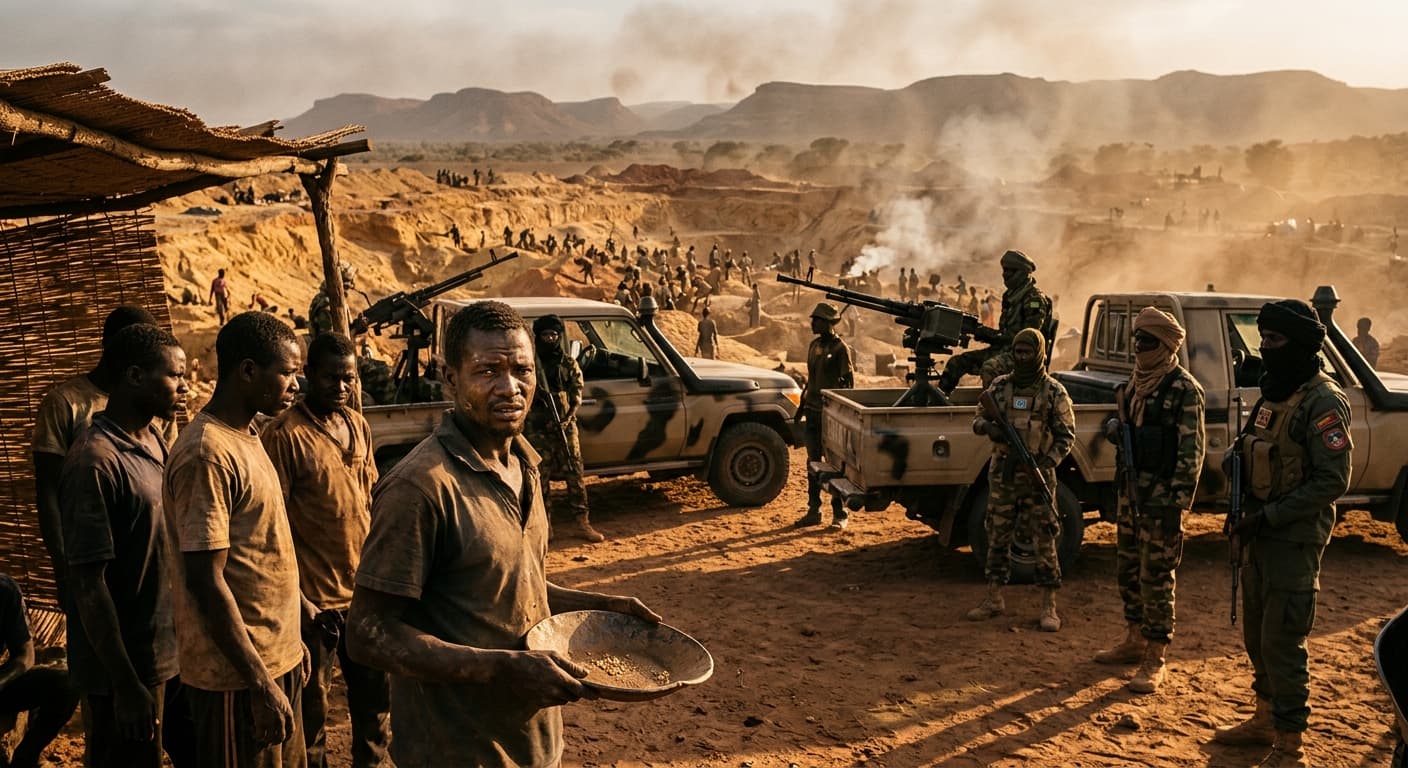
The $15 Billion 'Blood Gold' Economy Keeping the Sahel at War
How Mali, Burkina Faso and Niger's 230-tonne gold trade funds juntas, Russian mercenaries and the al-Qaeda affiliate now besieging Bamako.
The three military juntas of the Sahel now produce around 230 tonnes of gold a year — worth roughly $15 billion at 2025 prices — and that single revenue stream is the reason the region's coups, its Russian security lease, and its jihadist insurgencies are all still solvent in July 2026. Gold, not counterterrorism, is what pays for Africa Corps helicopters over Bamako, for the Alliance of Sahel States' new 5,000-troop force, and — through artisanal pits taxed by armed groups — for the al-Qaeda affiliate JNIM's blockade of the same capital. The war is not despite the gold boom. It is being financed by it.
The lifeline the juntas cannot lose
Mali, Burkina Faso and Niger together produce more gold than any other bloc on the continent. The World Gold Council estimates combined output at around 230 tonnes, worth about $15 billion, according to the BBC. In Mali, gold now accounts for close to 80% of exports and 25% of fiscal revenue,
the International Monetary Fund reported in its 2025 Article IV. In Burkina Faso, mining revenue rose 62% year-on-year through September 2025, reaching FCFA 573 billion — more than all of 2024 combined —
per the IMF's January 2026 country report.
That windfall is the only reason the juntas can operate. Cut off from ECOWAS financing after their 2024 withdrawal, sanctioned by the EU, and severed from World Bank concessional flows, Mali's Finance Minister Alousséni Sanou told parliament the state cleared $1.2 billion in the first quarter of 2025 alone from revised mining terms, according to the Financial Times. That cash pays soldiers, imports diesel around JNIM's blockade, and — critically — pays Russians.
Russia's regime-survival package, priced in bullion
On June 16, 2025, Wagner announced it was leaving Mali, as Al Jazeera reported. Its replacement, the Kremlin-run Africa Corps under Deputy Defence Minister Yunus-Bek Yevkurov and GRU Maj-Gen Andrey Averyanov, took over the mission. The same week, General Assimi Goïta laid the foundation stone in Sénou for a 200-tonne-capacity gold refinery majority-owned by the Malian state, with Russia's Yadran Group as minority partner,
the BBC reported. Yadran chief Irek Salikhov called it a hub for gold "extracted not only in Mali, but also in neighbouring countries like Burkina Faso."
The pattern is by now a doctrine. Chatham House's Alex Vines has documented that Russian security contractors "are often paid directly in gold or in mining concessions," and a Royal United Services Institute-linked Blood Gold Report found Russian entities extracted roughly $2.5 billion of African gold in two years, funds that the BBC has reported likely helped bankroll the war in Ukraine. In February 2025, Russian fighters formerly of Wagner took over Mali's Intahaka gold mine, the largest artisanal site in the north.
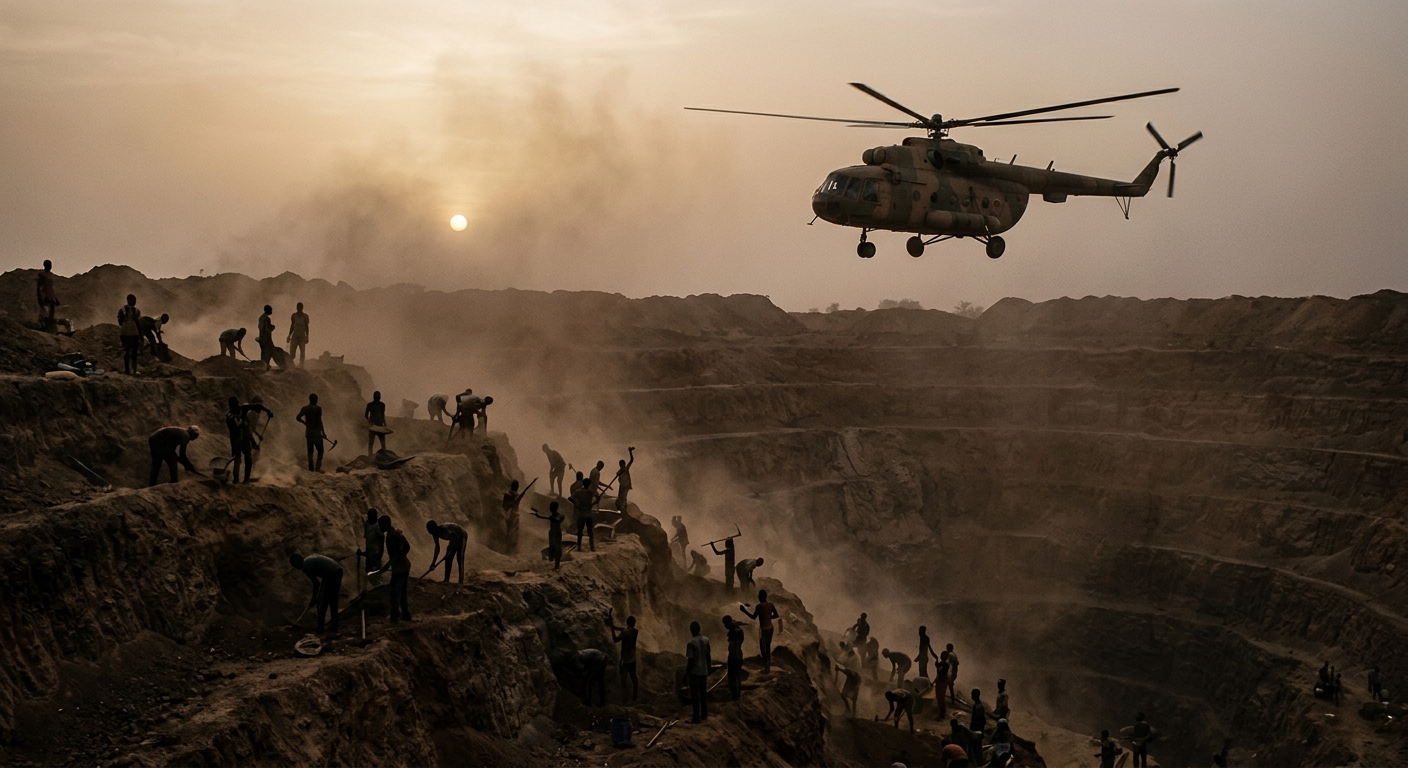
That transaction — protection for concessions — is the Sahel's actual constitution. And it is now under strain. Africa Corps confirmed on April 28, 2026 that it had withdrawn from Kidal alongside Malian troops, ceding the town to Tuareg separatists of the Azawad Liberation Front (FLA), Al Jazeera reported. "Russia will struggle to attract new clients for the Africa Corps because they just didn't do their job — it's reputational damage," Konrad Adenauer Foundation Sahel head Ulf Laessing told Al Jazeera. Defence Minister Sadio Camara, the architect of the Russian partnership, was killed in a suicide truck bombing days earlier.
The jihadists have the same business model
Here is the part Western capitals still under-price: the al-Qaeda affiliate Jama'at Nusrat al-Islam wal-Muslimin (JNIM) is running a mirror-image extraction economy on the same mines. JNIM "oversees artisanal gold mines, forcefully taxes community members, smuggles weapons and kidnaps foreigners for ransom," according to the US Director of National Intelligence, as summarised by Al Jazeera. Kayes region — under JNIM siege since late 2025 — produces 80% of Mali's gold. The Global Initiative Against Transnational Organized Crime, cited by
the BBC, documents JNIM taxing "anything that goes through their territory," and reports the group carried out more than 280 attacks in Burkina Faso in the first half of 2025 — double the same period a year earlier.
The United Nations Office on Drugs and Crime has been the loudest primary voice on this. Its Sahel threat assessment series, Gold Trafficking in the Sahel, identifies armed groups' capture of artisanal sites as a systemic — not incidental — funding stream. INTERPOL's 2020 Operation KAFO II
seized more than 40,000 sticks of dynamite in a single sweep, all destined for illegal gold pits that the agency explicitly classified as terrorist financing infrastructure. The 2021 Solhan massacre in Burkina Faso — 132 dead — began at an informal gold mine.
Dubai is the wash cycle
The gold that leaves the Sahel goes overwhelmingly to one address. Swissaid's 2024 study On the trail of African gold estimated 405 tonnes of sub-Saharan African gold were smuggled to the United Arab Emirates in 2022 alone, and that UAE imports from Africa doubled to 609 tonnes between 2012 and 2022, as documented by Chatham House. Between 2012 and 2022, the UAE recorded importing 2,569 tonnes of African gold that African countries never declared exporting — worth $115.3 billion. Mali is a paradigmatic case: in 2016, the UAE recorded $1.52 billion of Malian gold imports against Bamako's declared $216 million,
the Institute for Security Studies found.
The peer-reviewed literature reaches the same conclusion. A 2024 study in Resources Policy by Arcade Ndoricimpa found the Africa-UAE gold trade is "characterized by overwhelming misreporting and smuggling," driven by export tax rates, gold prices and weak institutions (RePEc: eee/jrpoli). The Financial Action Task Force will re-evaluate the UAE in 2026 — the single most consequential regulatory date on this file. Abu Dhabi has already suspended 32 refineries in 2024 to keep off the grey list. Whether FATF's assessors tighten the noose or accept another round of cosmetic reforms will decide, more than any Malian court order, whether Sahel juntas can keep monetising bullion this cheaply.
The Western retreat: from mining code to nationalisation
The other loser is the Western mining industry that built the Sahel gold sector. Mali's 2023 mining code lets the state take up to 35% of any project, Al Jazeera noted. Barrick's Loulo-Gounkoto complex — its second-highest gold producer globally — was suspended in January 2025 after Bamako impounded gold stock and detained four employees. A settlement was reached on November 24, 2025, in which Barrick regained operational control and
withdrew its ICSID claim, formally discontinued on January 21, 2026. Australia's Resolute Mining had its CEO Terence Holohan detained for nearly two weeks; Sarama Resources is in arbitration against Burkina Faso; and Niger seized Orano's Imouraren and Arlit uranium concessions, costing the French state-owned nuclear group a €133 million loss in the first half of 2024 alone.
Traoré put the ideological frame plainly in Ouagadougou last October: "We know how to mine our gold and I don't understand why we're going to let multinationals come and mine it," the FT reported. The AES summit in December 2025 in Bamako launched the
Sahel Investment and Development Bank and a joint 5,000-troop battalion, both explicitly designed to sever residual dependence on ECOWAS, the WAEMU franc zone and Western lenders. A common currency is under discussion. Read against 65 years of CFA-franc arrangements — the colonial FX architecture the juntas have made their central grievance — this is a structural rupture, not a temporary rift. For deeper context on the region, see our
Africa coverage.
Who wins, who loses
The winners are precise. Assimi Goïta and Ibrahim Traoré, whose regimes are cash-flow solvent for the first time since the coups. Yadran Group's Irek Salikhov, positioned to refine other people's gold in Bamako. The Russian Ministry of Defence, converting operational risk into extractive rent. Dubai's refiners, sitting between an unregulated supply chain and the London Bullion Market Association's compliance perimeter. And — perversely — JNIM's Amadou Koufa, whose fighters tax the same pits from which the juntas' royalties flow.
The losers are equally specific. Barrick and Orano, whose losses have already been priced. The Malian and Burkinabé miner earning, as the BBC reported, $18 to $36 on "a good day" while gold sits at $3,400+ an ounce. And the 3.4 million residents of Bamako, whose city has been under an intermittent JNIM fuel blockade since late 2025 — more than 100 tankers burned, hospitals rationing diesel,
Russian attack helicopters escorting convoys through Ségou.
Diplomat View
The consensus that Russia is "losing the Sahel," most recently argued in Foreign Affairs, reads the wrong ledger. Africa Corps is losing tactical ground in Kidal and Ménaka, yes. But the strategic asset Moscow came for — durable equity in a $15 billion gold complex, laundered through Dubai and monetised at record prices — is being cemented in law, not battle. The refinery in Sénou, the 35% state-stake rule, and the AES investment bank are the actual deliverables. The forecast: over the next 18 months, expect gold receipts, not counterinsurgency success, to be the metric on which the juntas survive or fall. What would change the call: a FATF grey-listing of the UAE in the 2026 review; a JNIM push into Kayes gold country that severs 80% of Mali's output; or a Barrick-style dispute that ends in outright nationalisation rather than settlement. Any one of those, and the arithmetic breaks.
What to watch
- FATF plenary, October 2026: the mutual evaluation of the UAE. A downgrade would tighten the single most permissive node in the illicit gold chain.
- AES common currency roadmap: finance ministers of Mali, Burkina Faso and Niger are expected to publish operational specifications in late 2026. This is the real exit from the CFA zone.
- Kayes region, Mali: JNIM's siege of Mali's gold heartland. If Kayes town falls or gold shipments halt, the junta's fiscal base collapses within a quarter.
- Sénou refinery commissioning: no completion date has been announced, but first pours will mark the moment Sahel gold no longer needs to transit UAE refiners to reach global markets — a genuine structural shift, not a talking point.
The Bottom Line
The Sahel's $15 billion gold economy is not a symptom of the region's wars — it is the operating system that keeps every combatant in the field. Military juntas, Russian state paramilitaries, and an al-Qaeda affiliate are all funded from the same artisanal pits and industrial mines, laundered through the same Dubai refiners, at record prices set in London. Until the FATF forces the UAE to close the wash cycle, or JNIM captures Kayes and severs Bamako's cash flow, the war in the Sahel will remain profitable enough for everyone at the table to keep fighting.
Discover more
US Politics
House Ethics Committee Pushes Sexual Miscond.
The House Ethics Committee has shifted responsibility for sexual harassment settlement records to the Office of Congressional Workplace Rights, complicating disclosure efforts.
International Relations
Economist Impact Sustainability Week 2026
Economist Impact Sustainability Week 2026 spotlights the energy transition, AI in clean technology, and supply chain resilience as themes for global leaders.
US Politics
Congress Targets AI Chatbot Access for Terror
The House passed the Generative AI Terrorism Risk Assessment Act, focusing on AI's role in terrorism and potential surveillance implications.

Economics
Fed's Amex AML order puts correspondent banking on notice
Federal Reserve's Amex AML order requires board-level controls and a 90-day plan; OCC fined the bank $350 million over enterprise-wide deficiencies.