1260H List: Pentagon's Chinese Military Ban
Defense contractors caught between US ban and Chinese retaliation.
Model Diplomat7 min readNorth America
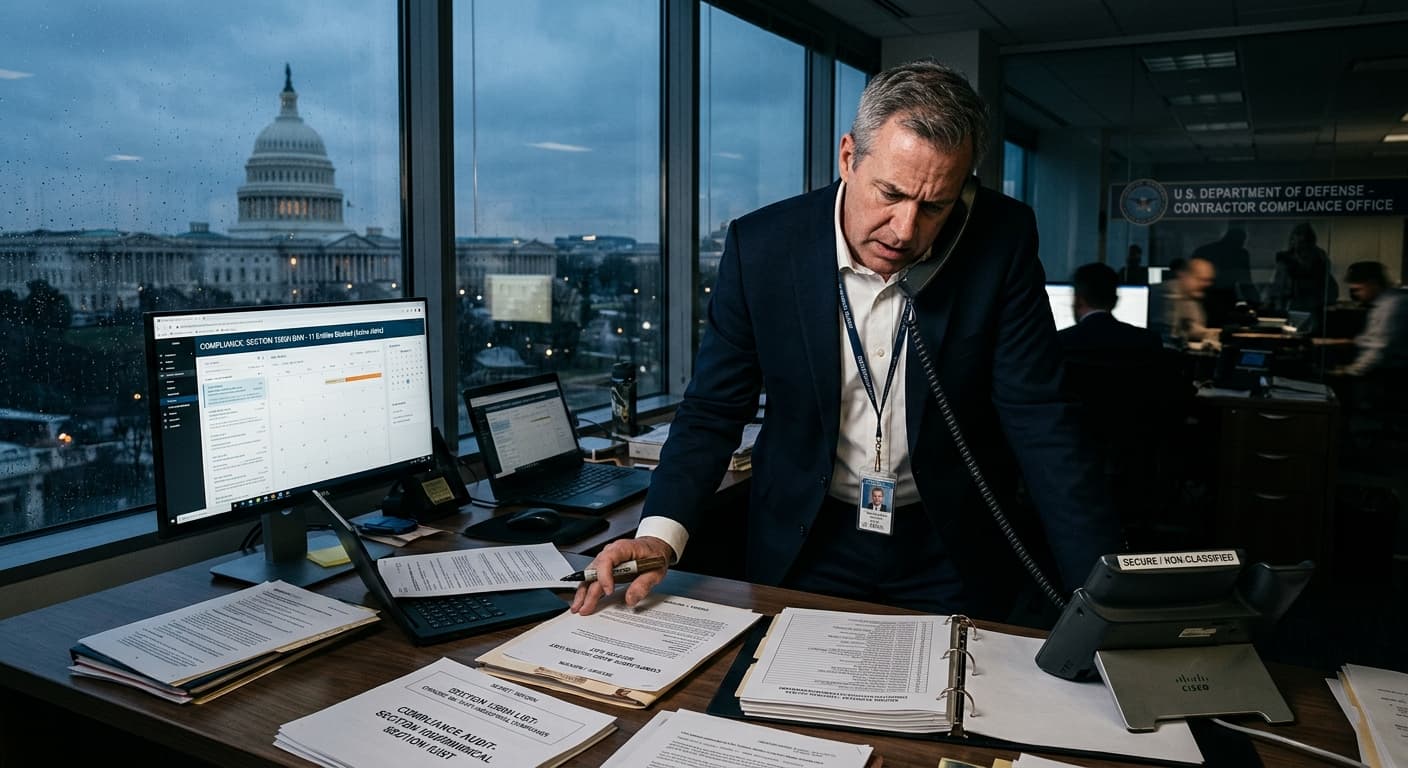
The Litigation Front: "Arbitrary and Capricious"
The June 2026 list expansion triggered an immediate legal counteroffensive. On June 23, Alibaba filed suit in the U.S. District Court for the Northern District of California, calling the Pentagon's designation "arbitrary and capricious" and arguing that "none of the members of its independent board had any military affiliation" Al Jazeera. Baidu stated it would "use all options available" to challenge its listing. WuXi AppTec filed a separate challenge.
These lawsuits have a mixed record to build on. In September 2025, a D.C. District Court upheld DJI's challenge to its 1260H designation, finding that DoD's ownership analysis was "internally inconsistent" — the Pentagon had simultaneously claimed DJI was both "directly" and "indirectly" owned by SASAC, which the court considered evidence that DoD "did not engage in reasoned decision making" U.S. District Court for D.C., DJI v. DoD. But Hesai, the Shanghai-based lidar manufacturer, lost its challenge: the D.C. District Court acknowledged that "DoD found no evidence that Hesai's products have been used for military purposes" yet upheld the designation based solely on the geographic location of Hesai's R&D centers within certain industrial districts
Hesai Notice of Appeal. Hesai filed a Notice of Appeal on July 13, 2025.
The legal argument in all these cases turns on the definition of "affiliated with" — a term the statute uses but does not define with precision. As the WuXi AppTec complaint notes, Section 1260H requires an entity to be either owned/controlled by specified Chinese government bodies or identified as a "military-civil fusion contributor" — a standard that has ensnared publicly traded companies with widely dispersed shareholders WuXi AppTec Complaint.
The practical effect for contractors in the meantime: uncertainty without relief. A pending lawsuit does not stay the procurement ban. A contractor that relies on a 1260H-listed supplier must either find an alternative, seek a waiver, or break the law.
Beijing Retaliates — and Contractors Become the Squeeze Point
The most underappreciated dimension of the 1260H compliance burden is that it now runs both ways.
On June 22, 2026 — two weeks after the Pentagon's list update and one week before the Phase 1 effective date — China's Ministry of Commerce added 10 U.S. firms to its export control list, barring Chinese companies from exporting dual-use items to MP Materials, USA Rare Earths, and eight defense contractors. The Ministry of Finance separately barred Chinese government procurement from 46 companies, including subsidiaries of Lockheed Martin, Boeing, General Atomics, and General Dynamics Al Jazeera.
These reprisals are not merely symbolic. In March and April 2026, Beijing passed State Council Decrees No. 834 and 835, which together create penalties — fines, visa cancellations, asset freezes, investment restrictions — for any entity that "disrupts, undermines or discriminates against China's industrial or supply chains" or enforces sanctions with "improper extraterritorial jurisdiction" Al Jazeera.
As James Hsiao, a Hong Kong partner at White & Case, told Al Jazeera: "A company may be required under U.S. or EU sanctions rules to restrict dealings with a counterparty, while also needing to consider whether taking that action could create risk under Chinese countermeasures."
For multinational defense contractors — the primes and their Tier 1 and Tier 2 suppliers — this is the compliance trap that 1260H has now sprung. Firms must simultaneously demonstrate to DoD that they have purged 1260H-listed entities from their supply chains and avoid actions that Beijing could construe as discriminatory disruption under Decree 834.
The Think Tank Consensus: Ad Hoc, Fragmented, and Under-Resourced
The policy community has been warning about precisely this fragmentation. A July 2026 Brookings study by Kyle Chan, R. David Edelman, and Ryan Hass described the U.S. approach to Chinese technology risk as "ad hoc and fragmented," noting that the tools "are scattered across the federal government: the FCC Covered List, the DoD 1260H list, the Commerce ICTS rule, the USTR investigation process, CFIUS" — with "multiple federal agencies and congressional bodies duplicating efforts" Brookings.
The Heritage Foundation has pointed to a deeper structural vulnerability: Govini data showing that Chinese suppliers within DoD contractors' supply chains had increased by 420 percent since 2010, and that nearly one in 10 Tier 1 subcontractors to defense primes are Chinese firms Heritage Foundation. The Hudson Institute has flagged specific espionage risks from Chinese memory chips embedded in defense systems, noting that "memory chips embedded in government systems and defense-adjacent infrastructure are not passive devices" — they receive firmware updates that "present a potential attack vector"
Hudson Institute.
The CNAS Defense Industrial Base study found that "no actor in the ecosystem appears to have a complete understanding of the supply chains" — the average DoD supply chain spans five to six tiers, but the Pentagon loses visibility beyond tier two CNAS. This is the practical reality into which the Phase 2 indirect procurement ban will land on June 30, 2027: a requirement to screen against a list of 188 entities across supply chains that no one fully maps.
What Contractors Should Do Now
The law firm community — Crowell & Moring, Morrison & Foerster, Dentons, and others advising on today's Kharon webinar — has coalesced around a common set of near-term priorities:
First, screen current suppliers and subcontractors against the 1260H list immediately. This is table stakes for Phase 1 compliance. The waiver window is open, but it requires a "credible phase-out plan" with fixed milestones — indefinite reliance is not an option GovConFeed.
Second, begin Tier 2 and Tier 3 supply chain mapping now. As Plante Moran advises, Phase 2 compliance will require documentation that most primes do not currently possess, and Tier 1 suppliers have commercial incentives to resist disclosure of upstream relationships Plante Moran.
Third, conduct the "reasonable inquiry" required by Section 851 regarding shared lobbyists and law firms with 1260H entities. The Alibaba litigation has demonstrated that this provision has operational teeth — severing long-standing advisory relationships is not merely a paperwork exercise.
Fourth, monitor Chinese countermeasures. Decrees 834 and 835 are sufficiently broad that contractors with substantial China operations or supply relationships face a genuine dilemma between U.S. and Chinese legal obligations.
Diplomat View
The 1260H list has crossed the threshold from a disclosure exercise into an operational weapon — and the consequences are just beginning to surface. The direct procurement ban that took effect on June 30, 2026, is manageable: large primes have largely pre-screened their Tier 1 suppliers, and the waiver mechanism, while burdensome, provides time-limited relief. The indirect ban landing on June 30, 2027, is a different order of problem. It will force every DoD contractor — including the 200,000-company subtier base that CNAS calls "poorly understood, even by the Department of Defense" — to certify the provenance of every component in every system, against a list that grows by 40 percent a year and that Beijing now punishes compliance with.
The forecast: compliance costs will concentrate in mid-tier suppliers — companies with DoD revenue too large to ignore the requirement but too small to absorb million-dollar supply-chain mapping exercises. Expect consolidation pressure: primes will acquire or vertically integrate with compliant subtier suppliers rather than audit them. Expect litigation to proliferate but deliver mixed results — the Hesai precedent suggests courts will defer to DoD on military-civil fusion determinations, while the DJI ruling shows that sloppy ownership analysis can be overturned. Expect Beijing to continue calibrating its counter-sanctions to maximize the compliance dilemma for firms with dual U.S.-China footprints.
The single most important variable between now and June 30, 2027, is whether DoD publishes a finalized DFARS rule with clear screening standards, safe harbors, and a workable component exception. The statute already carves out components from the indirect ban — but without regulatory definition, contractors are left guessing. If the DFARS rule arrives late, ambiguous, or unworkable, the 1260H compliance regime will function less as a procurement restriction than as a de facto decoupling mechanism, severing defense supply chain links to China faster and more crudely than any policy designed for that purpose.
What to Watch
- DFARS final rule (Phase 1): The implementing rule under RIN 0750-AM09. If published before Q4 2026, it will provide the screening standards contractors currently lack. If further delayed, expect a surge in waiver applications.
- Alibaba v. DoD (N.D. Cal.): A ruling on summary judgment — particularly on the "affiliated with" and "military-civil fusion contributor" standards — will set the template for all subsequent challenges.
- China's next countermeasure: Beijing's Ministry of Commerce signaled at its 2026 export control work conference that it intends to "improve the modern national export control system." A third anti-sanctions decree, currently in draft, would authorize Chinese prosecutors to bring cases against foreign entities whose "unlawful acts harm the country's national interests."
The bottom line: The 1260H list is no longer a warning label — it is a live procurement prohibition with a 188-entity trigger list, a 2027 second phase that will force supply-chain mapping the Pentagon itself cannot perform, and a Chinese counter-sanctions regime that punishes compliance. Defense contractors are now caught between a U.S. ban with no final implementing regulation and a Beijing that treats supply chain decoupling as a national security offense.
Discover more
US Politics
House Ethics Committee Pushes Sexual Miscond.
The House Ethics Committee has shifted responsibility for sexual harassment settlement records to the Office of Congressional Workplace Rights, complicating disclosure efforts.
India
700 Activists Accuse PM Modi of MCC Breach
Over 700 activists allege PM Modi breached election code with a televised address attacking opposition parties just before state elections.

US Politics
SNAP Food Assistance Faces Legal Challenges
In 2026, SNAP faces stricter eligibility rules and mounting legal challenges, threatening food assistance for the millions of Americans who rely on the program.

Economics
Fed's Amex AML order puts correspondent banking on notice
Federal Reserve's Amex AML order requires board-level controls and a 90-day plan; OCC fined the bank $350 million over enterprise-wide deficiencies.