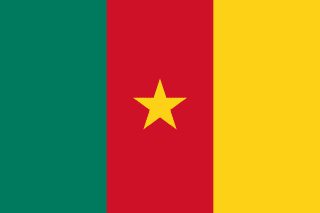
Inside Cameroon’s foreign policy.
Republic of Cameroon
Africa · UN voting record, treaty positions, and alliances — every claim primary-sourced.
In short
Cameroon is a security-first presidential system dominated by President Paul Biya and the Cameroon People’s Democratic Movement, with foreign and domestic policy concentrated in the presidency rather than parliament or cabinet Encyclopaedia Britannica,…
Capital
YaoundéGovernment
Unitary presidential republicCameroon's government & politics
Leadership, governance, and democratic trajectory.


Head of government
Joseph Ngute
Head of Government
Cameroon's UN voting record
How Cameroon votes at the UN General Assembly — ideological trajectory, voting partners, topic patterns, and key recent roll calls.
Ideological trajectory
Top voting partners
Topic-level voting
Source: Erik Voeten, “United Nations General Assembly Voting Data”, Harvard Dataverse (CC0). Aggregated by Model Diplomat. Last refresh tracked in profile freshness.
Cameroon's foreign policy
Bilateral posture, key relationships, and live diplomatic statements.
Foreign Policy
Cameroon’s foreign policy is defensive, regime-centered, and deliberately multi-aligned. The state presents itself as committed to sovereignty, territorial integrity, non-interference, regional stability, and economic diplomacy through the Ministry of External Relations’ mandate and President Paul Biya’s repeated emphasis on peace and unity Ministry of External Relations of Cameroon, Presidency of the Republic of Cameroon. In practice, the highest-order interest is survival of the state against Boko Haram in the Far North and against armed separatism in the Anglophone regions; just below that sits regime security for Biya’s long-ruling system, which shapes Cameroon’s caution on democracy, human-rights scrutiny, and external pressure International Crisis Group, U.S. Department of State 2023 Human Rights Report: Cameroon.
The foreign-policy file is formally held by the presidency, not the foreign ministry, and that matters. Cameroon is a unitary presidential republic in which Biya has remained in office since 1982, while Prime Minister Joseph Dion Ngute heads government under presidential authority; the Ministry of External Relations executes rather than sets grand strategy Britannica, Presidency of the Republic of Cameroon, Ministry of External Relations of Cameroon. That structure produces a characteristic style: low-ideology diplomacy, high preference for flexibility, and avoidance of commitments that could invite leverage over domestic governance. Economically, Cameroon has strong incentives to keep options open. The IMF projected growth around 3.9 percent for 2024 in its 2025 Article IV materials, while the World Bank identifies oil, gas, timber, cocoa, and agriculture as core external-facing sectors, making stable access to finance, export markets, and infrastructure partners a foreign-policy priority IMF Article IV Consultation, Cameroon, World Bank Overview: Cameroon.
Cameroon’s bilateral relationships reflect that balancing logic. France remains the historic security and political reference point, but Yaoundé has worked to reduce overdependence by deepening ties with China, which has financed major infrastructure and ranks among Cameroon’s leading economic partners French Ministry for Europe and Foreign Affairs: Cameroon, China Global South Project, Ministry of External Relations of Cameroon. Nigeria is indispensable because of the shared border, cross-border trade, and the Boko Haram threat around Lake Chad, even though the relationship has been shaped by long-running border sensitivities resolved institutionally after the ICJ’s Bakassi ruling International Court of Justice: Land and Maritime Boundary between Cameroon and Nigeria, Lake Chad Basin Commission. Chad and other Lake Chad Basin partners matter primarily at the survival tier because the Multinational Joint Task Force is central to counterinsurgency cooperation against Boko Haram and ISWAP Multinational Joint Task Force, African Union Peace and Security Department. Relations with the United States and the EU are functional but limited by repeated rights concerns linked to the Anglophone conflict and abuses by security forces U.S. Department of State 2023 Human Rights Report: Cameroon, European External Action Service.
Multilaterally, Cameroon behaves like a status-conscious middle player in Central Africa. It is active in the United Nations, African Union, Economic Community of Central African States, CEMAC, the Commonwealth, La Francophonie, the Organisation of Islamic Cooperation, and the G77, using overlapping memberships to diversify diplomatic backing and avoid single-bloc dependence United Nations Digital Library: Cameroon membership, African Union Member States, CEMAC, Commonwealth Secretariat: Cameroon, Organisation internationale de la Francophonie. In the UN, Cameroon usually aligns with the broad African and G77 preference for sovereignty, development finance, anti-colonial language, and caution toward coercive country-specific human-rights pressure UN Digital Library Voting Data, Group of 77. Its record is not one of loud ideological leadership but of selective alignment: supportive of multilateral development agendas, generally conservative on intervention, and careful not to endorse precedents that could legitimize deeper scrutiny of its own internal conflicts UN General Assembly, Human Rights Watch: Cameroon.
The most useful divergence is that Cameroon often presents itself as a consensual African multilateralist while acting more narrowly as a regime-survival state. That gap shows up when continental rhetoric favors stronger democratic enforcement or sharper human-rights accountability, but Yaoundé prefers proceduralism, dialogue language, and resistance to intrusive monitoring because external norms that can be used against juntas can also be used against entrenched civilian incumbents facing internal conflict International Crisis Group, Freedom House: Cameroon. It also breaks in subtler ways from parts of its African bloc by sustaining simultaneous comfort with French, Chinese, and regional security partners rather than joining a harder anti-Western line seen elsewhere in Francophone Africa French Ministry for Europe and Foreign Affairs: Cameroon, Ministry of External Relations of Cameroon. The likely trajectory is continuity: cautious non-alignment, dense regional security cooperation, and UN positioning that favors sovereignty and development


Cameroon's treaties & memberships
UN multilateral treaty positions and IGO memberships.
International Organizations
Society & economy
Macro-economic snapshot and demographic context.
GDP (nominal)
$53.3B
#92/250GDP per capita
$1,830.008
#172/250Currency
—
HDI
0.58
#151/250GDP (nominal USD)
GDP per capita (USD)
Top trading partners


In the news
Stories surfacing across Cameroon’s authoritative outlets, plus headline events and the diplomatic calendar.
Headlines
Cameroon’s Growth to Slow to 3.1% in 2025 Amid Election-Related Pressures – IMF – NORVANREPORTS.COM | Business News, Insurance, Taxation, Oil & Gas, Maritime News, Ghana, Africa, World
Summary tailored to your query: The IMF’s 2026 Article IV update on Cameroon highlights a sluggish near-term economy amid election-related pressures, with broader implications for the country’s foreign policy, diplomacy, economy, and security: - Economy and growth: Growth is projected to slow to about 3.1% in 2025 (from ~3.5% in 2024), deteriorating domestic demand due to post-election unrest that disrupted trade, services, and investment. Growth is then expected to recover
A Biya Win in Cameroon Means Chaos to Come
Summary: The article predicts that Cameroon’s October presidential election will likely re-elect long-serving incumbent Paul Biya (CPDM), due to the ruling party’s control of state institutions and fragmented opposition. It highlights irregularities in the process, state resources used for campaigning, and likely post-election manipulation of results. While Biya’s victory would reinforce his four-decade hold on power, it would deepen internal fissures within the CPDM and Came
Cameroon | Congress.gov
Cameroon’s overview for U.S. policy makers - Politics and elections: Cameroon is nominally a unitary presidential republic led by President Paul Biya (in power since 1982). The country faces significant political uncertainty ahead of general elections (expected in October). Biya’s reelection prospects are unclear, and past elections have been marred by fraud allegations, voter intimidation, and violence, especially in Anglophone regions. The Anglophone crisis remains a centr
Explore Cameroon in depth
Frequently asked questions about Cameroon
Quick answers to the most common questions about Cameroon.
What type of government does Cameroon have?
Cameroon is governed as a unitary presidential republic, with its capital at Yaoundé.
Who is the head of state of Cameroon?
Paul Biya is the head of state of Cameroon, in office since 1982-11-06.
Who leads the government of Cameroon?
Joseph Ngute serves as the head of government of Cameroon, since 2019-01-04.
What is the population of Cameroon?
Cameroon has a population of approximately 29.1 million people, making it the 51st most populous country.
What is the economy of Cameroon like?
Cameroon has a nominal GDP of about $53 billion, or roughly $1,830 per capita.
What languages are spoken in Cameroon?
The official languages of Cameroon are English and French.
When did Cameroon join the United Nations?
Cameroon has been a member of the United Nations since 1960.
Who are Cameroon's closest allies?
Cameroon's key allies include France, Nigeria, Chad, China, and Gabon.
More about Cameroon
Cameroon is a security-first presidential system dominated by President Paul Biya and the Cameroon People’s Democratic Movement, with foreign and domestic policy concentrated in the presidency rather than parliament or cabinet [Encyclopaedia Britannica](https://www.britannica.com/place/Cameroon), [Presidency of the Republic of Cameroon](https://www.prc.cm/en/the-president-of-the-republic), [IFES Election Guide](https://www.electionguide.org/countries/id/45/). Prime Minister Joseph Dion Ngute remains head of government under Biya’s authority, but the decisive file is held at the top of the state, a pattern reinforced by the ruling party’s long control of institutions and the 2025 presidential election cycle [Primature du Cameroun](https://www.spm.gov.cm/site/?q=en/content/prime-minister-head-government), [International Crisis Group](https://www.crisisgroup.org/africa/central-africa/cameroon/cameroons-92-year-old-president-seeks-re-election-allies-withdraw-support), [Al Jazeera](https://www.aljazeera.com/news/2026/5/30/cameroon-votes-in-presidential-election-as-paul-biya-92-seeks-eighth-term). In the world today, Cameroon matters less because of headline diplomatic activism than because it sits at a strategic junction of West and Central Africa and remains a regional security and trade hinge on the Gulf of Guinea [U.S. Department of State](https://www.state.gov/countries-areas/cameroon/), [World Bank](https://www.worldbank.org/en/country/cameroon/overview). It is a member of the African Union, CEMAC, the Commonwealth, La Francophonie, the OIC, and the UN, which gives Yaoundé a wide multilateral footprint for a mid-sized African state [African Union](https://au.int/en/member_states/countryprofiles2/cameroon), [United Nations](https://www.un.org/en/about-us/member-states/cameroon), [Commonwealth](https://thecommonwealth.org/our-member-countries/cameroon). Its external posture is pragmatic: preserve regime stability, keep security assistance and market access flowing, and avoid sharp alignment choices between France, China, regional partners, and wider multilateral institutions [U.S. Department of State](https://www.state.gov/countries-areas/cameroon/), [International Crisis Group](https://www.crisisgroup.org/africa/central-africa/cameroon). Economically, Cameroon is more diversified than many of its neighbors but still vulnerable to weak governance, infrastructure bottlenecks, and political risk [World Bank](https://www.worldbank.org/en/country/cameroon/overview), [IMF](https://www.imf.org/en/Countries/CMR). Oil is no longer the whole story; growth depends on hydrocarbons, agriculture, timber, services, and transport links tied to Douala and the Chad-Cameroon corridor [Observatory of Economic Complexity](https://oec.world/en/profile/country/cmr), [World Bank](https://www.worldbank.org/en/country/cameroon/overview). The IMF said in June 2026 that growth was expected to slow to 3.1% in 2025 amid election-related pressures, a concise indicator that politics is now directly constraining macroeconomic performance [IMF](https://www.imf.org/en/Countries/CMR), [Norvan Reports](https://norvanreports.com/cameroons-growth-to-slow-to-3-1-in-2025-amid-election-related-pressures-imf/). Cameroon also remains important inside the CEMAC monetary area because its size means its fiscal and external performance affects regional stability beyond its borders [IMF](https://www.imf.org/en/Countries/CMR), [BEAC](https://www.beac.int/). Three issues define Cameroon’s trajectory. The first is succession risk inside an aging and personalized political system: Biya’s longevity has delayed but not solved the question of who governs after him, and elite fragmentation now matters as much as formal opposition strength [International Crisis Group](https://www.crisisgroup.org/africa/central-africa/cameroon/cameroons-92-year-old-president-seeks-re-election-allies-withdraw-support), [Al Jazeera](https://www.aljazeera.com/news/2026/5/30/cameroon-votes-in-presidential-election-as-paul-biya-92-seeks-eighth-term). The second is internal security, especially the Anglophone conflict in the Northwest and Southwest and the jihadist threat in the Far North, both of which push the state toward coercive governance and absorb fiscal and diplomatic attention [Human Rights Watch](https://www.hrw.org/africa/cameroon), [International Crisis Group](https://www.crisisgroup.org/africa/central-africa/cameroon). The third is economic stagnation under electoral and governance pressure: the state needs investment, jobs, and infrastructure, but uncertainty, corruption concerns, and administrative concentration deter faster transformation [World Bank](https://www.worldbank.org/en/country/cameroon/overview), [IMF](https://www.imf.org/en/Countries/CMR). The practical reading for delegates is that Cameroon behaves like a status-quo power defending state survival and regime continuity before liberal reform [U.S. Department of State](https://www.state.gov/countries-areas/cameroon/), [International Crisis Group](https://www.crisisgroup.org/africa/central-africa/cameroon). It will support sovereignty language, resist outside pressure on internal conflicts, seek security partnerships without ideological exclusivity, and present itself as a bridge state in Central Africa [United Nations](https://www.un.org/en/about-us/member-states/cameroon), [African Union](https://au.int/en/member_states/countryprofiles2/cameroon). Cameroon’s near-term trajectory depends less on formal policy papers than on whether the ruling system can manage presidential succession, contain internal violence, and prevent political uncertainty from further slowing an already constrained economy [IMF](https://www.imf.org/en/Countries/CMR), [International Crisis Group](https://www.crisisgroup.org/africa/central-africa/cameroon/cameroons-92-year-old-president-seeks-re-election-allies-withdraw-support).