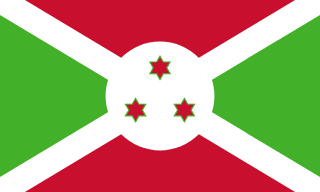
Inside Burundi’s foreign policy.
Republic of Burundi
Africa · UN voting record, treaty positions, and alliances — every claim primary-sourced.
In short
Burundi is a highly centralized presidential republic where foreign policy serves regime security first, regional border management second, and economic relief third.
Capital
GitegaGovernment
Presidential republicBurundi's government & politics
Leadership, governance, and democratic trajectory.

Head of state
Évariste Ndayishimiye
Head of State
Burundi's UN voting record
How Burundi votes at the UN General Assembly — ideological trajectory, voting partners, topic patterns, and key recent roll calls.
Ideological trajectory
Top voting partners
Topic-level voting
Source: Erik Voeten, “United Nations General Assembly Voting Data”, Harvard Dataverse (CC0). Aggregated by Model Diplomat. Last refresh tracked in profile freshness.
Burundi's foreign policy
Bilateral posture, key relationships, and live diplomatic statements.
Foreign Policy
Burundi’s foreign policy is regime-security first, border-security second, and economics third. President Évariste Ndayishimiye remains both head of state and the dominant foreign-policy actor, while Prime Minister Gervais Ndirakobuca heads government and Foreign Minister Albert Shingiro carries the external brief; the CNDD-FDD ruling party still structures strategic decisions, especially on Rwanda, the DRC, and relations with Western donors Presidency of Burundi, CIA World Factbook – Burundi, Ministry of Foreign Affairs of Burundi. Burundi’s formal line emphasizes sovereignty, non-interference, regional integration, and South-South cooperation, but actual behavior shows that protection of the ruling order and management of cross-border insurgent threats outrank abstract non-alignment Ministry of Foreign Affairs of Burundi, BTI 2026 Burundi Country Report, International Crisis Group – The Risk of Renewed Conflict in Eastern DR Congo.
The country’s core interests sit in a clear hierarchy. Survival means preventing armed spillover from eastern Democratic Republic of the Congo and blocking hostile armed groups or Rwandan influence near Burundi’s northern frontier; that is why Bujumbura has periodically deployed forces into eastern DRC and tightly securitized the Rwanda file UN Security Council, Final report of the Group of Experts on the DRC, S/2023/990, Reuters, Burundi pulls troops from eastern Congo after mission expiry. Regime security comes next: after the 2015 crisis, Bujumbura has treated external criticism on rights and governance as a political threat, which explains its preference for partners that do not condition engagement on domestic reform, especially China and Russia UN Human Rights Council, Report of the Commission of Inquiry on Burundi, BTI 2026 Burundi Country Report. Economic interests are narrower but still real: Burundi is one of the world’s poorest states, with GDP around $3.1 billion in current US dollars and population around 14 million, so access to concessional finance, infrastructure investment, and regional trade corridors through Tanzania matters more to foreign policy than market-opening ideology World Bank Data – Burundi GDP (current US$), World Bank Data – Burundi Population, total.
Its bilateral map is concentrated, not global. Tanzania is Burundi’s most useful neighbor because it is a trade and transit route and a comparatively stable political partner inside the East African Community East African Community – Partner States, World Bank Burundi Overview. The DRC is simultaneously a security buffer, a military theater, and an economic opportunity, which is why cooperation survives despite instability UN Security Council, S/2023/990. Rwanda is the key adversarial relationship: Bujumbura has repeatedly accused Kigali of backing Burundian rebels, while Kigali has made parallel accusations, and the relationship has oscillated between guarded thaw and renewed distrust rather than normalization Reuters, Burundi says Rwanda-backed rebels attacked its territory, International Crisis Group – The Great Lakes: A Dangerous New Escalation. China is Burundi’s most important extra-regional political and development partner because it offers infrastructure finance and diplomatic support without governance conditionality, while Russia’s value is mostly political alignment on sovereignty language and resistance to Western pressure rather than large economic weight China’s Ministry of Foreign Affairs, China-Burundi relations, UN General Assembly voting records.
Burundi’s multilateral behavior follows African and Global South forums when they shield sovereignty and amplify development claims. It is a member of the United Nations, African Union, East African Community, International Conference on the Great Lakes Region, and Group of 77, and it uses those bodies less to lead than to avoid isolation and anchor itself in regional legitimacy United Nations Member States – Burundi, African Union Member States, East African Community – Partner States, ICGLR Member States, G77 Members. At the UN, Burundi usually votes with the African group and broader non-Western majority on Israel-Palestine, development finance, and anti-unilateral-sanctions language, but its more revealing pattern is on country-specific human-rights scrutiny: Bujumbura has opposed or resisted mechanisms it sees as precedents for external intrusion, including scrutiny directed at itself UN Digital Library voting data, UN Human Rights Council, Commission of Inquiry on Burundi. That makes its diplomacy less “non-aligned” than sovereignty-defensive.
The key divergence is that Burundi does not always behave like a consensus EAC state. The bloc officially emphasizes integration, de-escalation, and collective regional process, but Burundi’s security behavior toward Rwanda and eastern DRC has often been


Burundi's treaties & memberships
UN multilateral treaty positions and IGO memberships.
International Organizations
Society & economy
Macro-economic snapshot and demographic context.
GDP (nominal)
$3.1B
#177/250GDP per capita
$219.425
#210/250Currency
—
HDI
0.43
#188/250GDP (nominal USD)
GDP per capita (USD)
Top trading partners


In the news
Stories surfacing across Burundi’s authoritative outlets, plus headline events and the diplomatic calendar.
Headlines
The Minister of Foreign Affairs, Regional Integration, and Development Cooperation presents the report on activities carried out over 100 days from August to November 2025 – Ministry of Foreign Affair
Summary: - The Burundian Ministry of Foreign Affairs reports on activities from August–November 2025 aimed at strengthening both bilateral and multilateral diplomacy. - Bilateral diplomacy: - Adoption of a Framework Agreement with Monaco. - Three agreements signed with Serbia. - Seven draft laws ratifying bilateral agreements were approved by the Council of Ministers and adopted by the National Assembly and Senate. - Ongoing work missions and intensified cooperation
On the road to Burundi's elections — Model Diplomat
Summary: The piece “On the road to Burundi’s elections” from Model Diplomat analyzes Burundi’s upcoming 2025–2027 electoral cycle within a volatile regional context. Key focus areas include: - Regional backdrops: Eastern DRC (M23) spillovers, border closures with Rwanda, and a domestic socio-economic crisis (high prices, currency weakness, disrupted informal trade) shaping Burundi’s diplomacy and policy choices. - Foreign policy themes: - EU engagement: Re-establishing di
Burundi • Évariste Ndayishimiye refines his election strategy for 2027
Summary: - Burundi's 2027 election strategy is evolving under President Évariste Ndayishimiye, who has tightened entry for presidential candidates to deter opposition, while still aiming to allow a few challengers. - The president is actively managing internal party dynamics to prevent fractures and broaden support ahead of elections. - On the international front, Burundi is engaging more actively in diplomacy and representation: - Ndayishimiye chairs the African Union, coo
Explore Burundi in depth
Frequently asked questions about Burundi
Quick answers to the most common questions about Burundi.
What type of government does Burundi have?
Burundi is governed as a presidential republic, with its capital at Gitega.
Who is the head of state of Burundi?
Évariste Ndayishimiye is the head of state of Burundi, in office since 2020-06-18.
Who leads the government of Burundi?
Gervais Ndirakobuca serves as the head of government of Burundi, since 2023-09-07.
What is the population of Burundi?
Burundi has a population of approximately 14.0 million people, making it the 78th most populous country.
What is the economy of Burundi like?
Burundi has a nominal GDP of about $3 billion, or roughly $219 per capita.
What languages are spoken in Burundi?
The official languages of Burundi are French and Kirundi.
When did Burundi join the United Nations?
Burundi has been a member of the United Nations since 1962.
Who are Burundi's closest allies?
Burundi's key allies include Tanzania, DR Congo, China, and Russia.
More about Burundi
Burundi is a highly centralized presidential republic where foreign policy serves regime security first, regional border management second, and economic relief third. President Évariste Ndayishimiye remains head of state, Prime Minister Gervais Ndirakobuca remains head of government, and the ruling force is the CNDD-FDD, which won the 2025 legislative and communal elections by a wide margin according to the electoral commission’s provisional results [Presidency of Burundi](https://www.presidence.gov.bi/), [Primature du Burundi](https://www.primature.gov.bi/), [CENI Burundi](https://www.ceniburundi.bi/). In practice, decision-making is concentrated in the presidency and the CNDD-FDD security-political network, with the foreign ministry implementing rather than setting grand strategy, a pattern reflected in official diplomatic reporting centered on presidential activity and regime priorities [Ministry of Foreign Affairs of Burundi](https://www.mae.gov.bi/), [BTI 2026 Burundi Country Report](https://bti-project.org/en/reports/country-report/BDI). Burundi’s place in the world is small in material power but active in regional security politics. It is a member of the United Nations, African Union, East African Community, International Conference on the Great Lakes Region, and Group of 77 [United Nations Member States](https://www.un.org/en/about-us/member-states), [African Union Member States](https://au.int/en/member_states/countryprofiles2), [East African Community](https://www.eac.int/), [ICGLR](https://icglr.org/), [G77 Members](https://www.g77.org/doc/members.html). Its diplomacy is shaped less by global agenda-setting than by its location between the eastern Democratic Republic of the Congo, Rwanda, and Tanzania, and by its need to avoid isolation after years of sanctions and political crisis [International Crisis Group](https://www.crisisgroup.org/africa/great-lakes/burundi), [BTI 2026 Burundi Country Report](https://bti-project.org/en/reports/country-report/BDI). Bujumbura has recently worked to deepen ties with Kinshasa and maintain pragmatic links with China and Russia while keeping difficult, securitized relations with Rwanda at the center of its regional posture [Ministry of Foreign Affairs of Burundi](https://www.mae.gov.bi/), [Reuters](https://www.reuters.com/world/africa/). Economically, Burundi remains one of the poorest countries in the world, with GDP of about $3.08 billion in current dollars and population above 14 million in the country context provided here, while the World Bank classifies it among low-income economies [World Bank Burundi Overview](https://www.worldbank.org/en/country/burundi/overview). The economy depends heavily on subsistence agriculture, with coffee and tea still central export earners, and it is vulnerable to food insecurity, import costs, and foreign-exchange shortages [World Bank Burundi Overview](https://www.worldbank.org/en/country/burundi/overview), [IMF Burundi page](https://www.imf.org/en/Countries/BDI). That economic structure matters for diplomacy: Burundi needs concessional finance, development cooperation, and stable access to regional trade corridors more than it needs ideological confrontation [IMF Burundi page](https://www.imf.org/en/Countries/BDI), [African Development Bank Burundi](https://www.afdb.org/en/countries/east-africa/burundi). Three issues define Burundi’s current trajectory. The first is the security relationship with Rwanda and the wider eastern DRC conflict zone, where Bujumbura frames armed groups and cross-border threats as core national-security concerns [Reuters](https://www.reuters.com/world/africa/), [International Crisis Group](https://www.crisisgroup.org/africa/great-lakes). The second is the regime’s management of political openness ahead of the 2027 presidential cycle: the government projects normalization and institutional order, but outside monitors continue to report tight political control, pressure on opposition space, and weak civil liberties [BTI 2026 Burundi Country Report](https://bti-project.org/en/reports/country-report/BDI), [Freedom House Burundi](https://freedomhouse.org/country/burundi/freedom-world). The third is economic stabilization, because inflation, poverty, and shortages can translate quickly into political risk for a government whose legitimacy rests on order and delivery more than pluralism [IMF Burundi page](https://www.imf.org/en/Countries/BDI), [World Bank Burundi Overview](https://www.worldbank.org/en/country/burundi/overview). The key read for delegates is that Burundi is neither isolationist nor broadly aligned in an ideological sense; it is transactionally regional. On most international questions, Bujumbura’s external behavior is best read through survival and regime-security logic: secure the borders, prevent diplomatic pressure from becoming political leverage, keep donor and investment channels open, and use regional forums to reinforce state legitimacy [BTI 2026 Burundi Country Report](https://bti-project.org/en/reports/country-report/BDI), [Ministry of Foreign Affairs of Burundi](https://www.mae.gov.bi/), [East African Community](https://www.eac.int/). That makes Burundi cautious, sovereignty-focused, and unusually sensitive to any initiative touching armed groups, external monitoring, or domestic political conditionality [African Union Peace and Security Council](https://www.peaceau.org/en), [United Nations Member States](https://www.un.org/en/about-us/member-states).