Zimbabwe Opposition Challenges Mnangagwa's 2
Opposition coalition sues to void term extension law
Model Diplomat7 min readAfrica
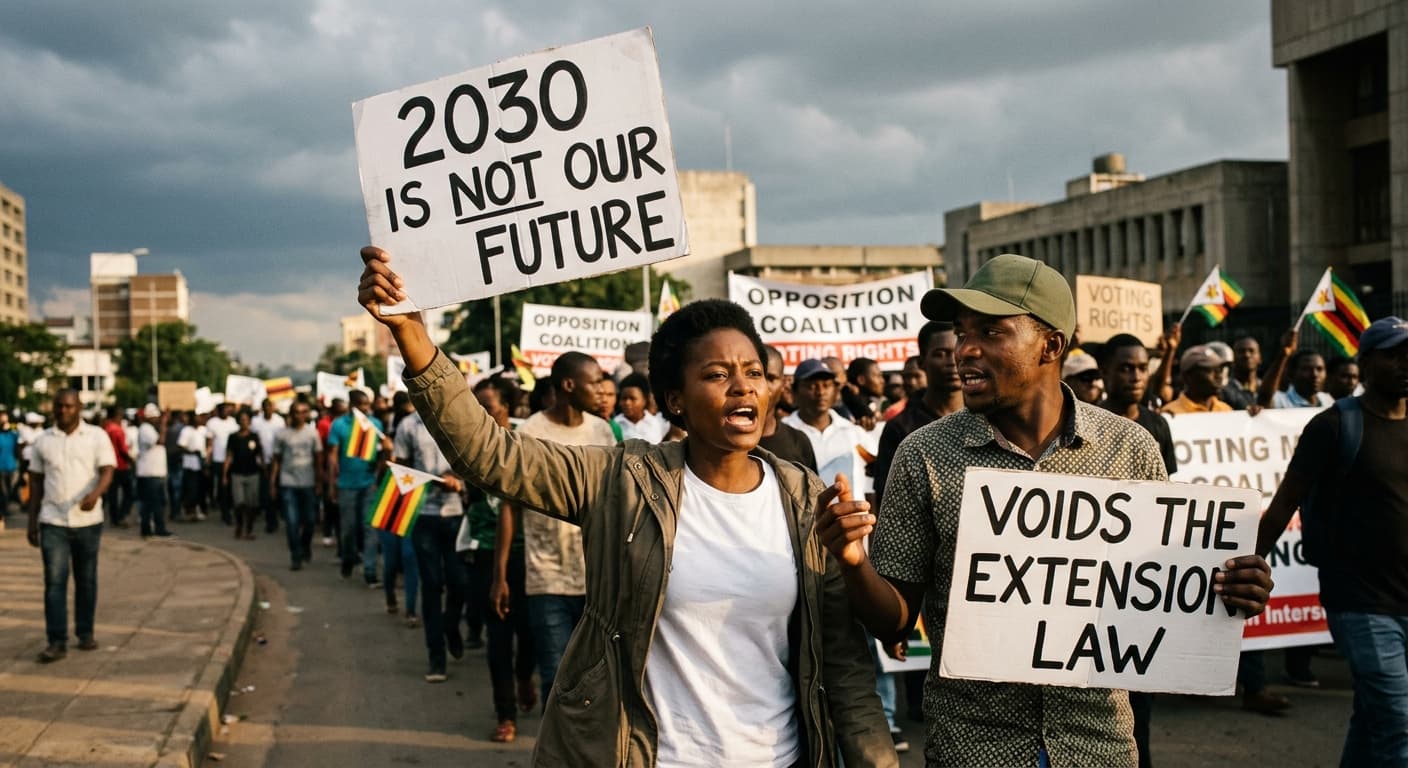
Zimbabwe: opposition coalition sues to void Mnangagwa's 2030 term extension
Zimbabwe's opposition-civil society alliance is challenging Constitutional Amendment Act No. 6 of 2026 in court, arguing the law extending Mnangagwa's rule to 2030 required a referendum ZANU-PF refused to hold.
Zimbabwe's newly launched Constitutional Restoration Movement will file a Constitutional Court challenge in the coming days to void Constitutional Amendment Act No. 6 of 2026 — the law that extended President Emmerson Mnangagwa's term to 2030 and abolished direct presidential elections — arguing the amendment triggered a mandatory referendum under Section 328 that ZANU-PF openly refused to hold. The move is less a serious bet on judicial rescue than a documentation exercise. With a court that already dismissed the pre-enactment challenges on procedural grounds, the coalition's real leverage is the paper trail it is now building for SADC, the African Union and Western capitals, and for whatever succession fight erupts inside ZANU-PF after 2028.
What the law does — and how it slipped past a referendum
Mnangagwa signed the amendment on July 7, 2026, one day before his coalition of opponents rebranded themselves and vowed to reverse it. According to Human Rights Watch, the statute lengthens presidential and parliamentary terms from five to seven years, postpones the 2028 general election to 2030, and abolishes the direct election of the president — replacing it with a vote by a joint sitting of the Senate and the National Assembly.
The bill sailed through the legislature. Al Jazeera reported the National Assembly approved it 216–42 on June 18, well above the 187 votes needed for a two-thirds constitutional majority; the Senate followed on June 24 by 75 to 4. The floor vote counts matter because they establish the government's central legal argument: parliament has already spoken, using the amendment procedure in Section 328.
The opposition's counter-argument sits in the same section. A UN Peacemaker summary of the 2013 Constitution records two hard constraints: "amendment of section 328 of the Constitution must also be approved at a referendum," and "an amendment to a term limit to extend the term does not extend the term of any person in office before the amendment." Both provisions were written specifically to stop what ZANU-PF has just done.
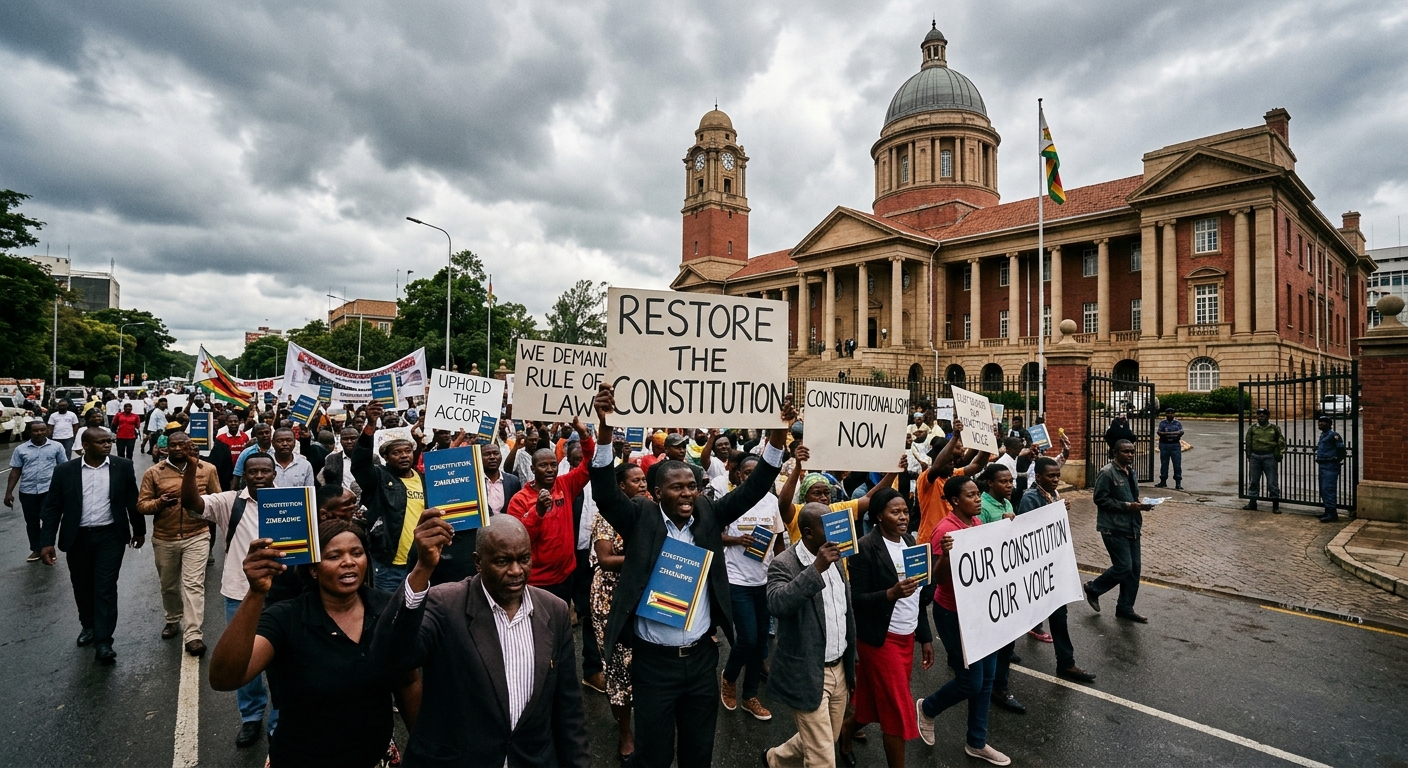
The Institute for Security Studies quoted former education minister David Coltart, one of the 2013 drafters, arguing that any change "the effect of which is to extend the length of time that a person may hold or occupy any public office" cannot apply to an incumbent — a position ZANU-PF's Patrick Chinamasa answered on X with the line: "There will be no referendum. Full stop," according to ISS Africa. The ruling party's position is that a longer term is not a new term, so no incumbent-benefit clause is engaged — a reading the Constitutional Restoration Movement now plans to test again in court.
The coalition — and why this one is different
The alliance launched last week as Sungano yeVanhu-Ubumbano Lomphakathi (Alliance of the People) and reconstituted itself on Wednesday as the Constitutional Restoration Movement. According to allAfrica, it is convened by Reverend Dr. Kupukwashe Mtata and pulls together the National Constitutional Assembly under Lovemore Madhuku, Jameson Timba's Defend the Constitution Platform, Tendai Biti's Constitution Defenders Forum, Jacob Ngarivhume and labour organiser Munyaradzi Gwisayi — alongside churches, students, residents' associations, women's groups and liberation-war veterans.
At the launch, Mtata delivered the coalition's framing verbatim:
"Our struggle was to defend the Constitution from an impending violation. Today, our struggle is to restore constitutional order… Our methods shall remain peaceful. Our conduct shall remain disciplined. Our struggle shall remain constitutional."
That is a deliberately narrow platform: constitutionalism, not regime change. Biti has been sharper. He told the BBC the amendment amounts to "a coup, a slow coup that is unfolding in Zimbabwe," and warned: "If they can get away with two years what stops them from getting away with 20 years?"
Two things make this coalition different from the fractured opposition of the last decade. First, its centre of gravity is civic and legal, not electoral. The Citizens Coalition for Change, once the main opposition vehicle, is now so fragmented that Al Jazeera reported more than 30 CCC MPs voted for CAB3, some after being gifted vehicles by ZANU-PF-aligned businessman Wicknell Chivayo. Second, the coalition explicitly asked SADC and the AU to intervene, a signal that it has written off domestic institutions as compromised.
Why the court challenge will probably lose — and why they are filing anyway
The Constitutional Court has already telegraphed its answer. In May 2026 it reserved judgment on pre-enactment challenges and then dismissed them; on June 17, the BBC noted, it threw out a further challenge the day before the National Assembly vote. Chief Justice Luke Malaba's bench has been the same one that unanimously upheld Mnangagwa's contested 2018 election and dismissed the 2023 challenge on evidentiary grounds. The judiciary is not a swing actor here.
Which is why the filing is best read as legal-political documentation, not litigation strategy. Alexander Noyes, writing in the Journal of Democracy, argued before assent that the only realistic path to blocking the amendment was "the combination of large-scale domestic protests, the support of the military (which is divided in its loyalties to the president and his vice-president), and coordinated external leverage." Two of those three levers, mass mobilisation and external leverage, depend on a documented record that domestic institutions were exhausted.
The military variable is the wild card. Brookings analysts Chipo Dendere and Miles Tendi wrote after the Senate vote that CAB3 was "fast tracked to avoid a referendum," and they and other scholars have flagged ongoing tension between Mnangagwa loyalists and Vice-President Constantino Chiwenga's faction, which was widely reported to view 2028 as its own succession moment. In their Brookings analysis, they framed the amendment as "a significant setback for efforts to combat entrenched authoritarianism." A ConCourt filing gives the Chiwenga faction, should it ever move, a ready-made constitutional pretext.
Who benefits, who loses
The clearest winner is not Mnangagwa personally but the ZANU-PF succession machinery. By moving the presidency behind a parliamentary firewall, the party has insulated the top job from the one lever the opposition can still occasionally pull: a direct national vote that a charismatic challenger might win. Zimbabwean constitutional analyst Justice Mavedzenge told Al Jazeera the amendment is designed so Mnangagwa can "leave power when one of his family members is ready to take over" — a dynastic reading that also explains why the Chiwenga camp has been so restive.
The clearest losers are the CCC and Nelson Chamisa's political project. Direct presidential elections were the one arena where a charismatic opposition candidate could — as Chamisa did in 2018 and 2023 — force the ruling party into contested runoffs and international scrutiny. That arena has now been abolished. According to ISS Africa, a referendum "would probably turn into a referendum on Mnangagwa's rule" — which is precisely why ZANU-PF refused to hold one.
The secondary loser is SADC. The bloc's 2013 mediation, backed by South Africa, produced the constitution that has just been gutted. If Harare pays no price for scrapping the referendum lock, every incumbent in the region watching a term limit approach — Museveni in Uganda, and successors in Rwanda, Congo-Brazzaville and Cameroon — has a fresh template: pack parliament, skip the referendum, litigate later.
The historical parallel that reframes this
Zimbabwe has been here before, in reverse. In February 2000, a Mugabe-era referendum on a draft constitution that would have permitted the sitting president additional terms and expanded executive power was defeated at the ballot box — the first electoral loss ZANU-PF had ever suffered, and the event that catalysed the formation of the MDC. That defeat is the institutional memory ZANU-PF is now legislating around. The 2013 Constitution's referendum lock in Section 328 was the direct product of that trauma; it exists because Zimbabweans, given a vote, have historically said no to executive entrenchment.
CAB3's political innovation is to hollow out the mechanism without touching the two-term formal cap. ZANU-PF can still say, truthfully, that the constitution limits presidents to two terms. It has simply made the terms longer, moved the vote indoors, and reset the clock. Brookings scholars call that a "constitutional coup"; Biti calls it a "slow coup." The distinction matters for a specific reason: it lets African peer states and Western partners continue to describe Zimbabwe as a constitutional democracy on paper, which is what makes the coalition's evidence-building exercise worth the effort.
What to watch
- Filing date at the Constitutional Court. The Restoration Movement said it has "instructed its legal team to immediately institute proceedings." A concrete filing date and a bench assignment will indicate how the judiciary intends to route the case — expedited, referred, or slow-walked.
- The first "nationwide peaceful mass action" date. The coalition said the date would be announced after consultations with churches, unions, war veterans and business leaders. The size and geographic spread of that first mobilisation, and the security response, will determine whether this remains a legal campaign or becomes a street one.
- SADC and AU responses. The coalition explicitly appealed to both. Silence from Pretoria, Gaborone and Addis Ababa would confirm the regional acquiescence Journal of Democracy warned about; a summit statement would raise the cost of the amendment materially.
- Chiwenga's next public appearance. The vice-president's posture — endorsing the amendment, avoiding it, or signalling reservation — is the single clearest indicator of whether the 2017 civil-military coalition that installed Mnangagwa still holds.
The Bottom Line
Zimbabwe's opposition has effectively conceded it cannot stop Mnangagwa's term extension in the courts it has — so it is building the record for the courts, capitals and factions that come next. The Constitutional Restoration Movement's real product is not a judgment but a documented case that Section 328's referendum lock was bypassed, filed with SADC and the AU while a divided ZANU-PF watches its own succession clock reset from 2028 to 2030. If the amendment holds without a referendum, Zimbabwe will have supplied the rest of Southern Africa with the working template for extending incumbency without ever putting the question to a voter.
Discover more
US Politics
SNAP Food Assistance Faces Legal Challenges
In 2026, SNAP faces stricter eligibility rules and mounting legal challenges, threatening food assistance for the millions of Americans who rely on the program.

US Politics
White House Pressures Congress for Crypto Leg
The Trump administration's push for the CLARITY Act aims to reshape crypto regulation, impacting trillions in market value and the Trump family's wealth.
Global Politics
Trump's Conflicting Messages on Iran War
Trump's mixed messages on Iran reflect a strategy of audience management, benefiting Tehran amid a complex geopolitical landscape.

Economics
Fed's Amex AML order puts correspondent banking on notice
Federal Reserve's Amex AML order requires board-level controls and a 90-day plan; OCC fined the bank $350 million over enterprise-wide deficiencies.