Zimbabwe Ends Direct Presidential Vote
Constitutional changes extend Mnangagwa's rule to 2030
Model Diplomat8 min readAfrica
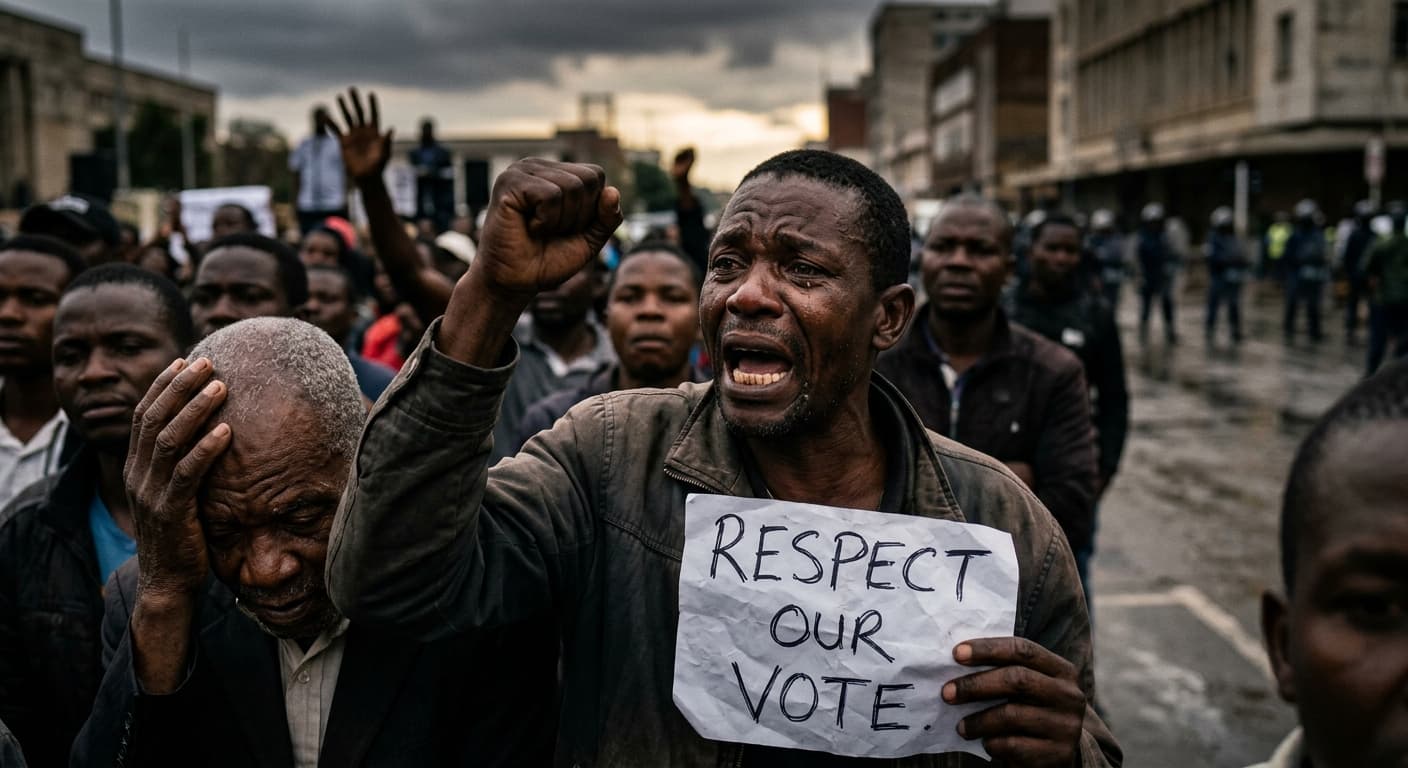
Zimbabwe scraps direct presidential vote, extends Mnangagwa to 2030
Zimbabwe President Emmerson Mnangagwa signed Constitutional Amendment No. 3 on July 7, 2026, ending direct presidential elections and pushing the next poll to 2030.
Emmerson Mnangagwa signed Constitutional Amendment No. 3 (Act No. 6 of 2026) into law on July 7, 2026, extending his term to 2030 and — more consequentially — abolishing the direct presidential vote Zimbabweans have exercised since 1990. The two-year extension is the headline. The architectural change is the story: from the next cycle onward, the president will be chosen by a joint sitting of the National Assembly and Senate, both dominated by ZANU-PF and structurally biased in its favour. Mnangagwa has not simply bought himself time — he has handed his party a permanent mechanism to install presidents without submitting them to a national ballot, and done so in a week when the International Monetary Fund publicly endorsed his economic programme.
What the law actually does
The act, gazetted after National Assembly and Senate passage, does five things at once, according to BBC News and the summary in
bne IntelliNews. Presidential and parliamentary terms are lengthened from five to seven years. Direct presidential elections — held every cycle since 1990 — are scrapped and replaced with election by a joint sitting of parliament. The 2028 general election is postponed to 2030. The Senate expands from 80 to 90 seats. Voter registration moves from the Zimbabwe Electoral Commission to the office of the Registrar General, a presidential appointee. A new Delimitation Commission takes over constituency mapping, and public interviews for judicial appointments are removed.
The Senate passed the bill 75–4 on June 24, 2026, and the National Assembly endorsed the Senate's amendments 226–41 on June 30, Bulawayo24 News reported. A day before the initial 216–42 lower-house vote, the Constitutional Court dismissed the last-standing legal challenge on procedural grounds,
Al Jazeera reported — clearing the path to the president's desk with no referendum, no judicial check, and roughly six weeks between Senate passage and gazette.
The 2013 firewall — and how it was walked around
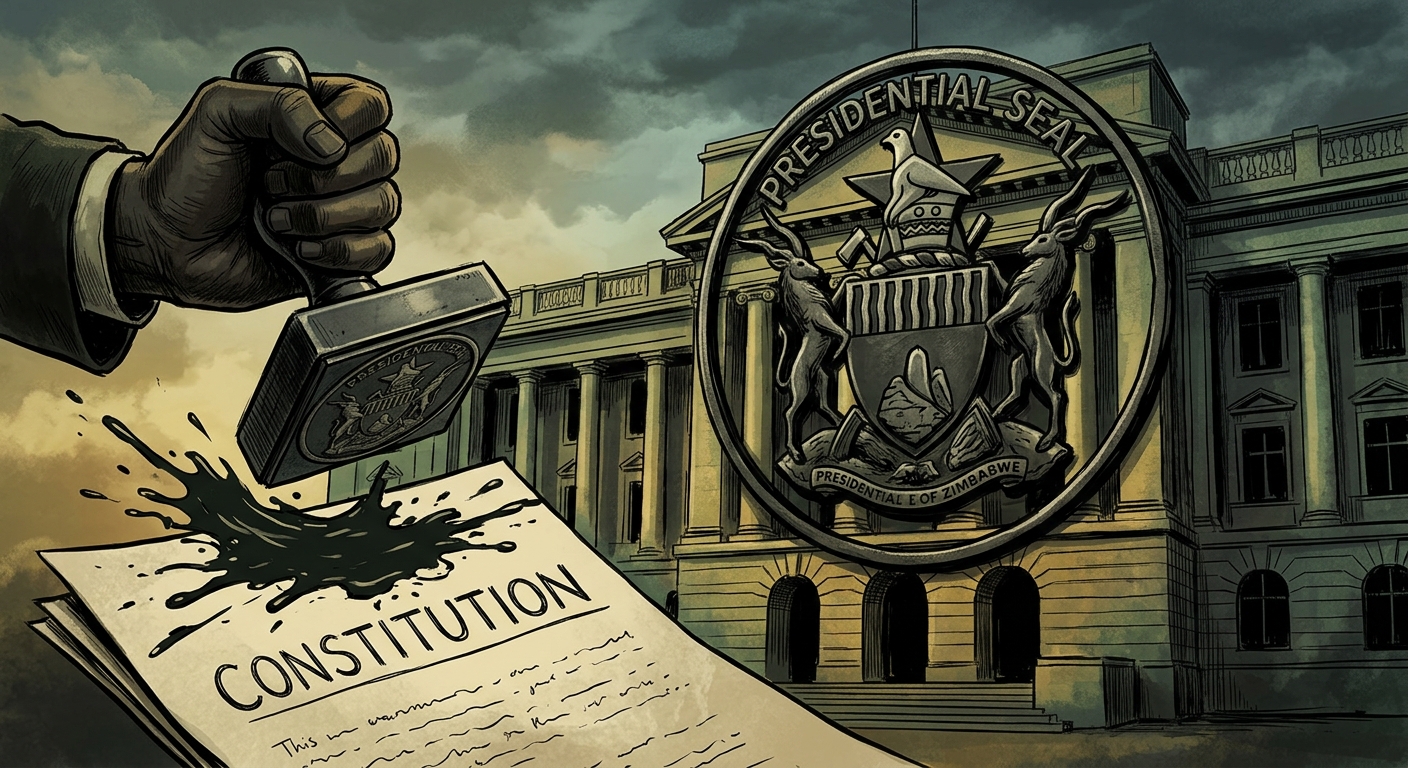
The 2013 constitution, approved by more than 94 percent of voters in a March 2013 referendum, was engineered specifically to prevent this outcome, as the Journal of Democracy has documented. Section 328(7) states that any amendment to a term-limit provision "the effect of which is to extend the length of time that a person may hold or occupy any public office" cannot apply to the incumbent, and any change to that clause must go to a national referendum. David Coltart, the Bulawayo mayor who helped draft the text, told the
Institute for Security Studies the safeguard is unambiguous: the inquiry is whether the change "involves the length of time a person holds public office."
ZANU-PF's counter-argument, articulated by party treasurer-general Patrick Chinamasa, is that Act No. 6 does not extend the two-term limit — it merely "elongates the electoral cycle" from five to seven years, uniformly, for councillors up to the president. On that reading, the two-term ceiling holds; only the ruler within it grows longer. Justice Minister Ziyambi Ziyambi told parliament on June 3 that the bill "does not give the president a term extension or a third term. It does not take away the right to vote. It does not postpone elections," Al Jazeera reported. Every one of those denials collapses on inspection of the gazetted text.
The semantic distinction matters because it is the entire legal edifice on which the amendment rests. If courts accept "elongation" as materially different from "extension," section 328(7) is a dead letter. If they do not, then a sitting president has just been handed two extra years by legislative fiat in violation of the country's supreme law. Coltart's rebuttal, delivered on X and quoted by ISS Africa, is that if the cycle can be lengthened by two years without a referendum, "what logical basis would prevent it from being extended by 20 years, or 50 years even?" That question now sits inside Zimbabwe's constitutional order as an open door.
The real prize: no more national vote
Extending Mnangagwa's tenure to 2030 is the smaller half of what happened this week. The larger half is the abolition of direct presidential elections, in force since 1990. From 2030 onward, whichever party controls parliament controls the presidency. Chipo Dendere and Miles Tendi, writing for the Brookings Institution on June 26, called the package "a significant blow to anti-authoritarian efforts" and warned that established channels have now failed to prevent it.
ZANU-PF's structural advantages in parliament are considerable and durable. The Senate is expanded to 90 seats, with a large bloc filled through traditional chiefs and other proxies who reliably vote with the ruling party. The Delimitation Commission — which will draw the new constituency map for 2030 — is created by the same amendment. Voter registration moves out of the Zimbabwe Electoral Commission and into the office of the Registrar General, a presidential appointee, removing a rare pocket of institutional independence. Public interviews for judicial appointments, introduced under the 2013 charter as a transparency safeguard, are eliminated.
The parliamentary route also solves ZANU-PF's opposition problem. In 2023, opposition parties had denied the ruling party the two-thirds majority needed to amend the constitution. That firewall was demolished through by-elections following mass recalls of opposition MPs — in nearly every one, ZANU-PF prevailed, restoring the supermajority now used to rewrite the rules, Brookings notes. On the June 18 vote itself, more than 30 opposition Citizens Coalition for Change (CCC) lawmakers crossed the aisle to back the bill, according to Al Jazeera. Activists have alleged that businessman Wicknell Chivayo, a Mnangagwa ally, distributed cash and vehicles to swing MPs — a claim he has publicly disputed.
Who benefits, who loses
The immediate winner is Mnangagwa. The bigger winner is the faction around him. Analysts at Germany's SWP Berlin describe a "shadowy network of businessmen" who have accumulated wealth through inflated tenders and patronage and who need Mnangagwa in office to protect that portfolio. Constitutional lawyer Justice Mavedzenge, cited by
Al Jazeera, argues that Mnangagwa's endgame is dynastic: "His intention is to leave power when one of his family members is ready to take over."
The clear loser inside ZANU-PF is Vice-President Constantino Chiwenga, the former army chief who helped topple Robert Mugabe in November 2017 on the widely-briefed understanding that he would succeed Mnangagwa after one term. That promise is now formally dead. Mnangagwa has spent 2025 and 2026 systematically removing Chiwenga loyalists from military leadership, ISS Africa reports, and expelling war-veteran allies like Blessed Geza who publicly agitated for Chiwenga. The SWP brief judges the most likely scenario "a major political confrontation" between the two camps before 2027.
The second loser is the opposition ecosystem — but not evenly. The CCC's institutional coherence has been shredded by ruling-party infiltration, and its willingness to trade votes on this bill signals that the parliamentary opposition is now an unreliable brake. The functional opposition to ED2030 has instead coalesced around an unlikely alliance: Coltart's CCC faction, the Catholic Bishops' Conference, the Amalgamated Rural Teachers' Union, the Defend the Constitution Platform, and ZANU-PF's own war veterans. That coalition failed to force a referendum. Its remaining leverage is the street and the barracks — both of which point toward the 2017 template.
The regional pattern, and why it now accelerates
Zimbabwe joins a well-mapped African trend. Since 2002, Journal of Democracy counts 14 African countries that have eliminated or extended presidential term limits, and 30 of 54 states now operate without a functioning limit — this against Afrobarometer polling showing more than three-quarters of Africans across 34 countries support term limits, and 80 percent of Zimbabweans specifically. Togo provides the closest precedent for Zimbabwe's move: in May 2024, Faure Gnassingbé's government scrapped the direct presidential vote entirely and moved executive power to a parliamentary-selected President of the Council of Ministers. Zimbabwe has now adopted the same template.
The regional guardrails are weak by design. The SADC Principles and Guidelines Governing Democratic Elections, adopted in Mauritius in August 2004, list "regular intervals for elections as provided for by the respective National Constitutions" among their core principles — a formulation that lets member states rewrite their constitutions and comply by definition, as documented in the South African Institute of International Affairs reprint of the text. Zimbabwe has not ratified the African Charter on Democracy, Elections and Governance, which offers stronger term-limit language — meaning neither SADC nor the AU has a hard treaty basis on which to intervene. The Journal of Democracy's Alexander Noyes urges "strong leadership from more democratic-leaning nations" in SADC, naming
Botswana and Angola; no such leadership has publicly emerged.
The economic paradox — and the IMF's awkward timing
The most awkward fact of the week is that Zimbabwe's economy is finally stabilising. On July 8, 2026 — the day after the signing — the IMF announced that its staff had reached a staff-level agreement with Harare on the first review under the 10-month Staff-Monitored Program approved in April. Inflation fell to 4.4 percent in March 2026 from double digits, GDP growth is projected around 5 percent, and mining revenues have surged: lithium export earnings rose from $84.19m in Q1 2025 to $178.64m in Q1 2026,
Al Jazeera reported, after a February export ban on unprocessed minerals pushed processors into local beneficiation.
That macroeconomic stabilisation is the ruling party's political shield. It lets Mnangagwa argue he needs two more years to complete "Agenda 2030," and it complicates Western pressure at exactly the moment leverage would matter. Brookings' Chipo Dendere notes that the global shift toward "West-South" trade relations has replaced democracy conditionality with commercial pragmatism — meaning Zimbabwe's lithium, gold and platinum output will very likely blunt any Western sanctions response. The IMF's April 2026 release frames the SMP as building "a credible reform track record" for arrears clearance; the political economy of that pathway now runs through a president who has just voided direct elections.
What to watch
- The Chiwenga response. The SWP Berlin analysis and multiple ISS briefs converge on the same forecast: a confrontation before ZANU-PF's 2027 conference. Watch for further purges of Chiwenga loyalists in the security services, and for whether war-veteran networks fragment or consolidate.
- The next Constitutional Court docket. The Court dismissed the pre-signing challenges on technicalities. Substantive petitions post-signing — including from human rights activist Youngerson Matete — will test whether any judicial check remains.
- SADC's August summit. The bloc has historically declined to name Zimbabwean democratic erosion. Silence in August confirms that regional guardrails have collapsed. A statement from Botswana or Angola would be the first meaningful signal that the Journal of Democracy's proposed pressure campaign has any traction.
- The IMF second review. A staff-level agreement was reached on July 7. If governance conditionality is quietly relaxed as the political situation hardens, that will confirm the Brookings hypothesis: trade and stabilisation have replaced democracy as the West's operative Zimbabwe policy.
The Bottom Line
Mnangagwa's two-year extension is the small print. The load-bearing change is the abolition of Zimbabwe's direct presidential vote — a durable, structural transfer of the presidency from voters to a parliament ZANU-PF now controls in perpetuity through recalls, delimitation, and a captured registrar. It is the Togo template adapted to Southern Africa, executed against the letter of the 2013 constitution, and ratified by a Constitutional Court that declined to rule on the substance. Unless Chiwenga's faction or SADC's democratic-leaning members move within the next twelve months, the 2030 "election" will be a formality — and the model will be available for export.
Discover more

US Politics
SNAP Food Assistance Faces Legal Challenges
In 2026, SNAP faces stricter eligibility rules and mounting legal challenges, threatening food assistance for the millions of Americans who rely on the program.

US Politics
Next Generation Republicans
A leaked survey shows 39% of Republicans under 30 do not identify as MAGA, revealing a split in the GOP's future leadership.
India
Rajnath Singh's Durga Squad for 2026 Polls
Rajnath Singh's Durga Squad promised women's safety in Bengal but has since disappeared from the agenda, revealing BJP's true priorities.

Economics
Fed's Amex AML order puts correspondent banking on notice
Federal Reserve's Amex AML order requires board-level controls and a 90-day plan; OCC fined the bank $350 million over enterprise-wide deficiencies.