Zambia Claims US Ties Health Aid to Minerals
Lusaka walks away from $2 billion US health package.
Model Diplomat6 min readAfrica
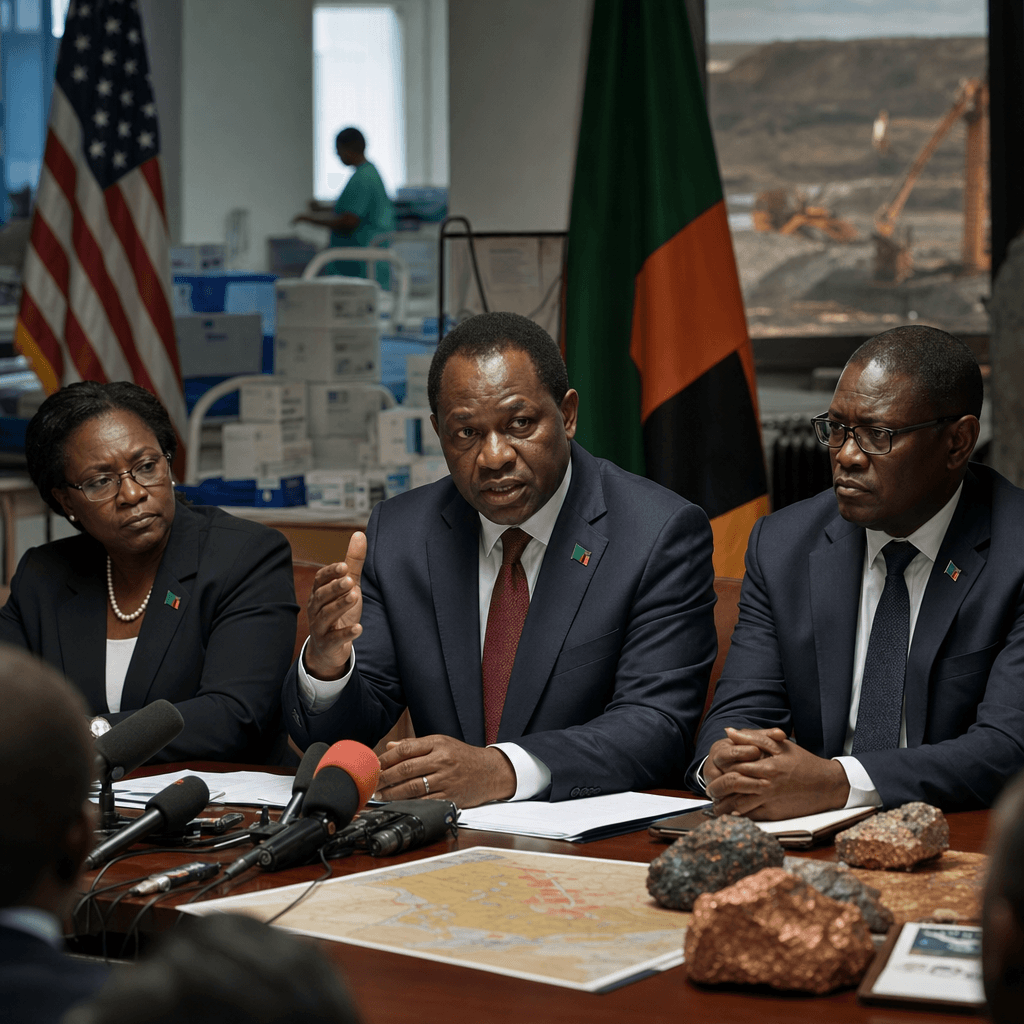
Zambia Rejects US Bid to Tie $2bn Health Aid to Minerals
Lusaka has publicly walked away from a $2 billion US health package that Washington coupled to preferential access to Zambia's copper and cobalt — testing the Trump administration's "America First" playbook in Africa.
On May 4, 2026, Zambian Foreign Minister Mulambo Haimbe issued a statement declaring that negotiations with the United States over a $2 billion, five-year health assistance package had stalled because Washington was tying it to preferential access to Zambia's critical minerals and to a decade-long, one-way health-data agreement. The rejection matters because Zambia — the country most dependent on US HIV funding on the planet — has decided that mortgaging its copperbelt is a worse deal than losing PEPFAR. That is the first serious African "no" to the Trump administration's health-for-minerals template, and it lands at the exact moment Washington needs an African success story to counter Beijing's $1.4 billion TAZARA revamp.
The Lusaka statement, reported by Al Jazeera via Reuters, said the health agreement was on hold because of the "incorporation of terms that the Zambian government considers unacceptable," and that data-sharing demands would violate "citizens' rights." Haimbe added that "the Zambian Government has been consistent in asserting that the agreements must be considered separately on their respective merits" — a direct swipe at the coupling of the health and minerals tracks. That language was echoed in
The Globe and Mail and
The Independent, which called the outgoing US ambassador's parallel corruption allegations "mischievous" and "undiplomatic."
What Washington actually asked for
The proposed package, reconstructed from leaked memos first reported by The New York Times and summarised by Al Jazeera, demanded three simultaneous concessions from Lusaka. First, Zambia would co-finance the aid with roughly $340 million of new domestic health spending on top of the up to $2 billion the US would deliver over five years — a figure the
Observer Research Foundation notes is significantly below pre-2025 US assistance levels. Second, American mining firms would receive preferential access to Zambia's copper, cobalt, lithium and rare-earth deposits. Third, Zambia would sign a ten-year, one-way sharing agreement covering citizens' health data and biological samples — a period that outlasts the five-year memorandum itself.
A fourth, quieter layer sits underneath: repurposing a prior Millennium Challenge Corporation grant, originally earmarked for Zambia's agricultural sector, into leverage for regulatory reform in mining. ORF calls this the "bundled and conditional" hallmark of the new US model.
When Zambian officials hesitated, an internal State Department memo prepared for Secretary Marco Rubio — reported by The New York Times and cited by Al Jazeera — advised that Washington could "secure our priorities by demonstrating willingness to publicly take support away from Zambia on a massive scale." That memo prefigured, and arguably scripted, the May 15, 2025 press conference at which US Ambassador Michael Gonzales tearfully announced a $50 million cut over what he called the "systematic theft" of donated medicines discovered in more than 2,000 Zambian pharmacies, according to
BBC News.
Why Zambia can push back — and why it hurts
Zambia is not a marginal recipient. A peer-reviewed modelling study in Clinical Infectious Diseases found that 84% of Zambia's HIV programme was PEPFAR-funded at the start of 2025 — the highest share of any high-prevalence country. Unabated aid disruption, the authors calculate, would produce 3.3 million additional HIV acquisitions and 1.6 million additional deaths through 2060, with the largest proportional increases among children. That is the hostage Washington was implicitly holding.
The counter-leverage sits in the ground. Zambia is Africa's second-largest copper producer, with mining accounting for about 70% of exports and 15% of GDP, according to the World Bank, which is co-financing a roadmap to triple output to roughly 2.4 million tonnes by 2031. The
International Monetary Fund completed its fifth Extended Credit Facility review on July 25, 2025, disbursing another $184 million and endorsing a growth outlook driven by "renewed mining investments." Debt is still assessed at high risk of distress, but Lusaka has a live IMF programme, a live G20 Common Framework restructuring, and a copper price cycle running in its favour.
That gives President Hakainde Hichilema options his predecessors did not have. In March 2025 he said Trump had "slapped us on both cheeks" — but framed the shock as a domestic-financing wake-up call, as SWP's Cynthia Kamwengo documents. One year later, Lusaka is calling Washington's bluff.
Beijing is already collecting
Here is the non-obvious angle: the primary beneficiary of the American ultimatum is not Zambia, and it is certainly not the US. It is China.
While Washington was drafting coercive memos, Premier Li Qiang landed in Lusaka in November 2025 — the first visit by a Chinese premier in 28 years — and signed $1.4 billion in agreements to modernise the Tanzania-Zambia Railway (TAZARA), the Cold War–era artery that connects the Copperbelt to Dar es Salaam. The upgrade would lift freight capacity from 100,000 to 2.4 million tonnes per year, directly cannibalising the projected flows through the US-backed Lobito Corridor, as the Institute for Security Studies and the
Observer Research Foundation both document. Chinese mining investment now constitutes over 88% of total Chinese FDI in Zambia, according to the ISS.
Washington's own bet is real: the Development Finance Corporation signed a $753 million financing package for Lobito Atlantic Railway in December 2025, as Al Jazeera reported, and DFC CEO Ben Black called the deal "unprecedented in scale and strategic significance." The
Atlantic Council has positioned Lobito as a replicable model for four additional mineral corridors. But the corridor terminates in the Zambian Copperbelt. Coercing Lusaka on the aid side while depending on Lusaka on the logistics side is a policy contradiction that only works if Zambia has no alternative — and TAZARA is the alternative.
The strategy the State Department is defending
The US case is not indefensible on its own terms. In an address titled "America First in Africa," the State Department's Africa Bureau argued that African governments themselves want US mining investment, and that the America First Global Health Strategy — under which more than 20 African countries have signed bilateral MoUs since late 2025, including
Malawi's $792 million five-year package — moves recipients "away from an infantilizing NGO industrial complex" toward self-reliance. Secretary Rubio, launching the first bilateral compact with Kenya on
December 4, 2025, called the Kenya deal "a prime example of what these incentive-based bilateral health compacts aim to achieve."
The problem is that the Zambia terms — a ten-year data-sharing clause outlasting a five-year financial commitment, plus explicit mining preferences — cross a line Kenya and Malawi did not have to cross so visibly. Even Kenya's deal is now partially suspended in court over data-privacy challenges, according to ORF's follow-up analysis. Zimbabwe walked away outright. Ghana rejected. When four of the highest-profile African counterparties reject or challenge the model within six months, the model has a problem.
Diplomat View
The Zambia rebuff is not a temporary spat; it is a stress-test that the America First Global Health Strategy failed at its most important node. Washington chose Zambia deliberately — high PEPFAR dependency, sovereign debt distress, a Western-leaning president, second-largest copper producer, sitting at the end of the Lobito Corridor. If coercive bundling could not close the deal there, it cannot close the deal anywhere that Beijing has a competitive counter-offer. The likely path from here is a face-saving decoupling: a slimmed health MoU without minerals preferences, and a separate mining framework negotiated on commercial rather than aid-conditional terms, probably brokered by DFC financing into specific Copperbelt projects rather than sovereign-level concessions. If Zambia instead signs the coupled package as originally drafted, revise this call — but the political cost to Hichilema at home, roughly 15 months from the 2026 general election, makes that outcome unlikely. Watch whether the DFC quietly re-scopes Lobito Phase 2 to keep the corridor viable without the sovereign-level minerals preferences Washington sought.
What to watch next
- July–September 2026: IMF sixth ECF review; Zambia's ability to finance the health gap domestically depends on this disbursement and continued debt-restructuring progress.
- Second half 2026: Confirmation and posture of the new US ambassador replacing Michael Gonzales — a signal of whether Washington resets or doubles down.
- August 2026: Zambia's general election campaign begins in earnest; Hichilema's ability to reopen talks narrows sharply once campaigning is under way.
- Late 2026: Start of Lobito Corridor Phase 2 construction, and first freight benchmarks on the TAZARA revamp — the two numbers that will show which corridor is actually moving copper.
Read today's full Global Politics briefing |
Discover more

International Relations
Pakistan's Key Role in US-Israel-Iran Meddle
Pakistan is seeking to mediate the US-Israel-Iran conflict, balancing high-stakes diplomacy against severe economic pressures and steep regional challenges.

Global Politics
US Seizes Iranian Ship, Tensions Surge
The US seizure of the Iranian ship Touska highlights a shift in control over the Strait of Hormuz, favoring Iran's strategic position.

India
India-South Korea $50B Trade Expansion Plan
India and South Korea target $50 billion in bilateral trade by 2030, focusing on industrial cooperation and strategic alignment amid US pressures.

Economics
Fed's Amex AML order puts correspondent banking on notice
Federal Reserve's Amex AML order requires board-level controls and a 90-day plan; OCC fined the bank $350 million over enterprise-wide deficiencies.