World Bank Invests $16.3B in Côte d'Ivoire
A strategic move to stabilize West Africa amid turmoil
Model Diplomat7 min readWest Africa
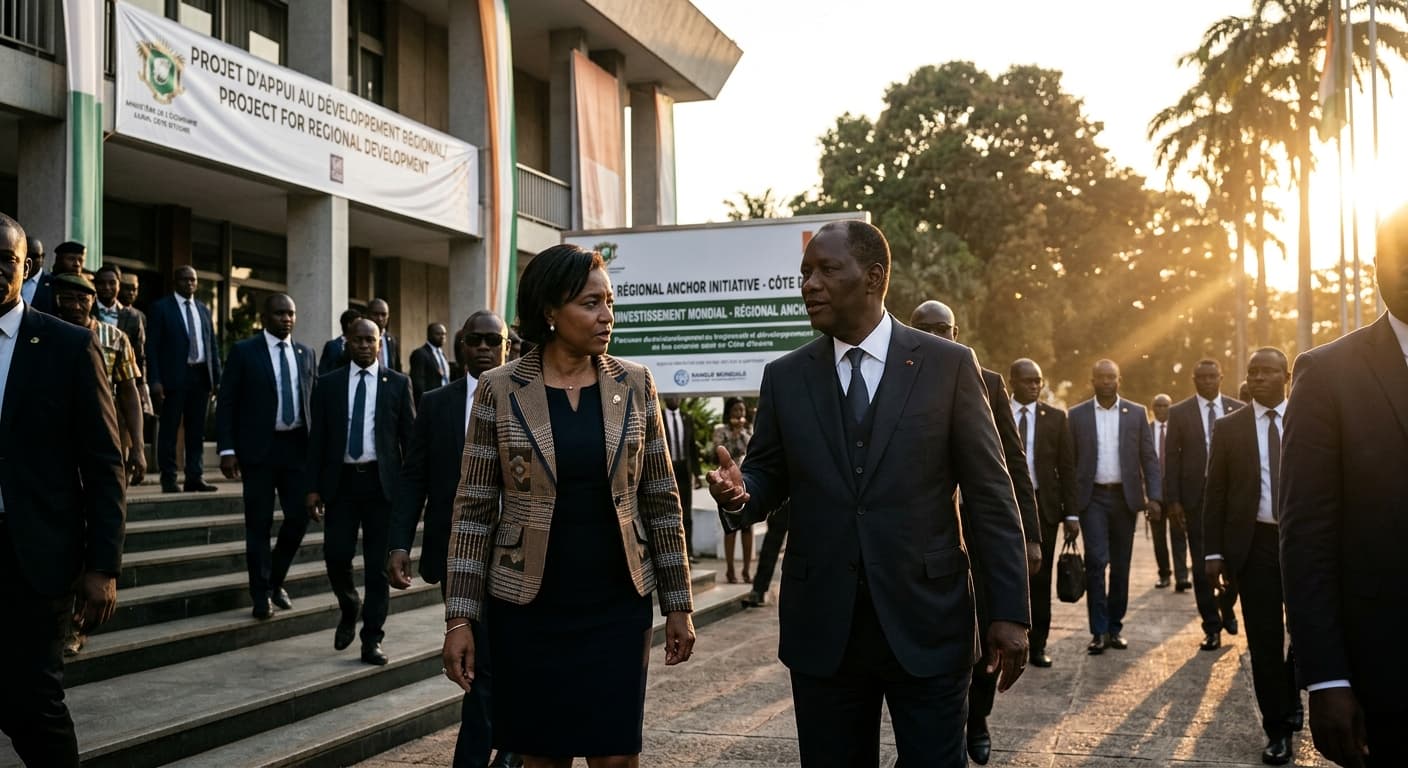
World Bank Bets $16.3 Billion on Côte d'Ivoire as a Sahel Firewall
The July 8, 2026 signing of $875 million in Abidjan — anchored by a gas-inclusive Mission 300 deal with Eni — turns Côte d'Ivoire into West Africa's default hedge against junta-run neighbours.
The World Bank and the government of Côte d'Ivoire signed five financing agreements worth $875 million (roughly CFAF 525 billion) in Abidjan-Cocody on July 8, 2026, alongside a tripartite protocol with Italian major Eni to build the country's first Gas Master Plan. That envelope is the visible slice of a much larger $16.3 billion (CFAF 9,773 billion) umbrella commitment the Bank pledged the same day for the Plan National de Développement 2026–2030, according to Koaci. The scale of that bet only makes sense against the map: with Mali, Burkina Faso and Niger outside ECOWAS and Guinea still under military rule, Abidjan is the last IMF-programmed, election-holding coastal economy the Bank can plausibly turn into a regional anchor. The July package is less a development loan than an insurance premium on West African stability, and Eni, not a European utility, is quietly its biggest private-sector beneficiary.
The deal, decoded
The five agreements sit on top of a nine-month sprint of Board approvals. On April 30, 2026, the Bank approved $225 million for health, nutrition and early-childhood services, targeting 1.2 million enrollees in the Couverture Maladie Universelle by 2028. On May 19, it added
$100 million for the Montagnes district — the western borderlands where rural poverty runs at 54% and only 0.6% of rural households have running water. On June 8, the Board approved the Côte d'Ivoire Renewable Energy & Financial Stability Initiative (REFI, P510702), pairing a $20 million IBRD loan with an IBRD guarantee of up to €622 million to catalyse roughly
€938 million in commercial financing, the Bank's project appraisal shows.
REFI is the load-bearing piece. Its first component (up to €725 million in commercial financing, of which €435 million guaranteed) clears CI-Energies' arrears to independent power producers and gas suppliers — a chronic liquidity trap that has strangled the sector for a decade. The second component funds two 120 MWp solar plants with 120 MWh of battery storage. Marie-Chantal Uwanyiligira, the Bank's Division Director for Côte d'Ivoire, Benin, Guinea and Togo, told the ceremony the operation was prepared in four months. "The government's and Bank's teams did not sleep," she said, according to Abidjan.net. That speed is the tell: the Bank is treating Côte d'Ivoire as a strategic priority, not a queue item.
Why gas — and why Eni
The Eni protocol is the ideological rupture. Mission 300, the Bank–African Development Bank initiative to connect 300 million Africans to electricity by 2030, was designed as a renewables-and-grid vehicle: the World Bank has committed to nearly double its Africa energy lending to $30 billion by 2030 and has already connected over 50 million people across 40 countries. But Ivorian Mines and Energy Minister Mamadou Sangafowa Coulibaly successfully lobbied Bank president Ajay Banga to include natural gas as an eligible fuel where it is "indispensable" to universal access, Uwanyiligira acknowledged at the signing. Her paraphrase of the argument was blunt: without gas, there is no 300 million.
That opens a specific commercial door. Eni discovered the Baleine field offshore Côte d'Ivoire in 2021 and brought first oil online in 2023 — the fastest deepwater development in the industry. The July 8 protocol commits the Bank, the ministry and Eni Côte d'Ivoire Limited to joint analytical studies on midstream and downstream gas infrastructure — transport, processing, storage, distribution — plus the regulatory framework needed to attract private capital, Abidjan.net reported. The Bank's mandate limits it to studies, but its technical imprimatur on a domestic gas value chain is exactly the de-risking signal that unlocks IFC equity and MIGA political-risk cover downstream. Vaalco restarted the Baobab field in June 2026 after a nine-month FPSO refurbishment, and Murphy Oil announced an oil discovery at Bubale-1X on Block CI-709 the same month. The Ivorian offshore is the busiest exploration play in West Africa outside Namibia; the Bank's protocol tells that private capital the state will build the pipes.
The Sahel context nobody in the room stated
Read the map. Three of Côte d'Ivoire's five neighbours — Mali, Burkina Faso, Guinea — are under juntas; Niger, just beyond, is the fourth. The Alliance of Sahel States has quit ECOWAS. Jama'at Nusrat al-Islam wa al-Muslimin (JNIM) fighters "rest, resupply, and recruit" in northern Côte d'Ivoire, according to a Clingendael/XCEPT report published in October 2025. Attacks in Bounkani and Tchologo in 2020–2021 have subsided but the extremists' financing networks in livestock and illegal gold mining persist,
the Institute for Security Studies has documented. The Bank does not say it, but the geography of its new lending does: the $100 million COSO West project, the health MPA, and the "local development and human capital" pillar of the July 8 envelope all pour resources into the same northern and western prefectures where JNIM tests the border.
Add the political overlay. Alassane Ouattara, 83, won a fourth term on October 25, 2025 with 89.8% after former president Laurent Gbagbo and ex-Credit Suisse CEO Tidjane Thiam were barred; turnout was 50.1%. Chatham House called it a
missed opportunity for real democratic choice. The IMF took the opposite view of the fiscal implications: in its March 2026 report, staff wrote that the election
set the stage for "policy continuity" and unlocked an immediate $839.7 million disbursement under the Extended Fund Facility, Extended Credit Facility and Resilience and Sustainability Facility, all performance criteria met. That is the trade multilateral finance is making — democratic quality is downgraded; macro-fiscal predictability and border stability are prized. Côte d'Ivoire is the beneficiary; Mali and Burkina Faso are the counter-example.
Who wins, who does not
Eni is the clearest private-sector winner. A World Bank-blessed Gas Master Plan turns Baleine's stranded reserves into a bankable value chain, gives Eni first-mover advantage over Ghana's LNG-import path (which Bank analysts have long flagged as more expensive than piped gas), and provides political-risk cover in a country where the last IPP-era arrears cycle burned commercial lenders. CI-Energies is the second: REFI clears its balance sheet of legacy short-term debt at guaranteed rates, following the same playbook as the 2018 EUR 240 million IDA guarantee that first opened the utility to commercial markets. Standard Chartered — sole arranger of Côte d'Ivoire's West Africa-first €433 million sustainability-linked sovereign loan in 2025,
per the World Bank's ESG case study — is now the reference bank for further sustainability-linked issuance under Mission 300.
The losers are quieter. Ghanaian planners lose the argument that C6te d'Ivoire will be forced into LNG imports; Nigerian gas exporters via the West African Gas Pipeline lose incremental demand. Solar-only advocates lose the framing battle inside Mission 300: the Bank has publicly conceded that gas is an eligible bridge fuel in West African compacts. And the opposition inside Côte d'Ivoire loses leverage — every dollar of externally guaranteed sovereign financing that lands in Abidjan without conditionality on political inclusion consolidates the Ouattara government's economic story ahead of the 2026 municipal cycle.
The macro that makes this work — for now
The economics are the argument's ballast. Côte d'Ivoire grew 6.1% in 2024 and the IMF projects growth to stay above 6% through 2028; ISS African Futures ranks it on track to become Africa's eighth-largest economy by 2043, projecting GDP of $237 billion on the current path. The PND 2026–2030 targets 7.2% average growth and CFAF 114,000 billion of investment, 70% of it private,
Planning Minister Souleymane Diarrassouba told the UN dialogue in February. Debt distress risk remains moderate, per the IMF. That is the plausible pitch that made a $16.3 billion Bank envelope defensible internally: this is not aid, it is leverage on private capital in a country still growing at Asian rates.
The vulnerabilities are just as concrete. Two 10% tariff hikes in 2023 and 2024 narrowed but did not close the electricity cost-recovery gap, the REFI appraisal notes; reliance on expensive liquid fuels widened deficits again in 2025. Ivorian ports and land routes carry Mali and Burkina Faso's imports, and any escalation of the diplomatic standoff with the AES would hit port revenues. A single successful JNIM attack in the north — timed to the 2026 municipal cycle — would reprice everything.
What to watch next
- December 2025 legislative elections (completed). The vote passed without a formal boycott but with opposition abstentions; the sixth EFF/ECF review window closed without a financing pause, validating the IMF's "policy continuity" thesis — for now.
- Financial close on REFI commercial tranches (from September 1, 2026). The IBRD guarantee upfront date is 1 September; watch the commercial banks that price the €622 million guaranteed loan. Standard Chartered is the incumbent; a Chinese or Gulf lender would signal diversification.
- PRIME-GAS study milestones (H2 2026 – H1 2027). The Bank–Eni analytical work will produce the midstream/downstream investment blueprint. First tender for a domestic gas processing or storage asset is the leading indicator of whether the Master Plan turns into concrete.
- Ghana–Côte d'Ivoire second interconnector (WAPP Phase 1(b)). Approved January 22, 2025; a 330 kV line from Dunkwa II to Bingerville. Every kilometre built prices in regional power trade — and prices out AES-country importers.
Diplomat View
The World Bank's $16.3 billion envelope is not a development story; it is a containment strategy dressed as a partnership framework. Faced with an ECOWAS map in which Guinea, Mali, Burkina Faso and Niger have exited the multilateral consensus, the Bank and the IMF are consolidating financing around the two remaining coastal anchors, Côte d'Ivoire and Senegal, to keep the West African economic core investible. The price is a quiet downgrade of democratic conditionality: Ouattara's contested fourth term drew no financing pause, only a March 2026 IMF paragraph welcoming "policy continuity." The forecast: expect at least two more sustainability-linked sovereign transactions from Abidjan by end-2027, and the first commercial financial close on Ivorian midstream gas infrastructure by mid-2028, with Eni as anchor equity. What would revise the call: a JNIM attack that reaches south of Bouna, a Constitutional Council crisis around the 2026 municipal vote, or a CI-Energies tariff reversal that unwinds REFI's cost-recovery covenants. Absent those, Côte d'Ivoire is on track to become the largest single-country recipient of World Bank Group financing in Sub-Saharan Africa by 2028, and the template every coastal capital from Dakar to Cotonou will try to copy.
Discover more
International Relations
Economist Impact Sustainability Week 2026
Economist Impact Sustainability Week 2026 spotlights the energy transition, AI in clean technology, and supply chain resilience as themes for global leaders.
India
Women’s Reservation Bill 2026
The Constitution (131st Amendment) Bill, 2026 was defeated in Lok Sabha, revealing deeper political conflicts over women's reservation and delimitation.
India
Rajnath Singh's Durga Squad for 2026 Polls
Rajnath Singh's Durga Squad promised women's safety in Bengal but has since disappeared from the agenda, revealing BJP's true priorities.

Economics
Fed's Amex AML order puts correspondent banking on notice
Federal Reserve's Amex AML order requires board-level controls and a 90-day plan; OCC fined the bank $350 million over enterprise-wide deficiencies.