Vijay's Tamil Nadu Win Transforms Politics
Film star Vijay's party disrupts Tamil Nadu's political landscape.
Model Diplomat8 min readSouth Asia
Vijay's Tamil Nadu Win Transforms Politics — and Weakens Modi's Rivals
Film star C. Joseph Vijay's TVK won 108 of 234 seats on May 4, 2026, ending 59 years of Dravidian duopoly — and gutting the DMK-led national opposition.
The Dravida Munnetra Kazhagam had run Tamil Nadu, or contested to run it, in every election since 1967. On May 4, 2026, a two-year-old party led by a Tamil film star wiped out three-quarters of its seats in a single afternoon. Tamilaga Vettri Kazhagam (TVK), founded by 51-year-old C. Joseph Vijay in February 2024, won 108 of 234 seats and roughly 35% of the vote, according to a post-election analysis by the NUS Institute of South Asian Studies. The consequence is not merely a state upset: Vijay has decapitated the strongest regional pillar of India's national opposition at precisely the moment Narendra Modi's BJP was taking West Bengal — leaving Rahul Gandhi's INDIA bloc without an anchor in the south, and handing New Delhi a chief minister with no legislative record, no party structure, and an 85,000-club fan network as his organisational chart.
The math of the breakage
The numbers are unambiguous. Outgoing Chief Minister M.K. Stalin's DMK collapsed from 133 seats in 2021 to 59; Stalin himself lost Kolathur, a constituency he had won three times since 2011, to TVK's V.S. Babu by 8,795 votes, according to Bernama's wire report citing Election Commission tallies. The AIADMK — the other half of the sixty-year duopoly — took 47 seats even in alliance with the BJP, which itself won one. The
Business Standard called it "Operation Vijay: TVK breaks Dravidian duopoly after 50 years." That framing understates the scale.
Since 1967, when C.N. Annadurai's DMK first defeated the Congress and inaugurated Dravidian rule, every Tamil Nadu chief minister came from the DMK or the AIADMK. A PRS India profile of the outgoing 16th Assembly documents an institutional monoculture — 82% of bills passed with no reference to committees, budget sessions averaging just four days of debate, ruling-party dominance so total that opposition amendments were vanishing artefacts. Vijay's TVK did not just win an election. It broke a machine.
The vehicle: 85,000 fan clubs and a whistle
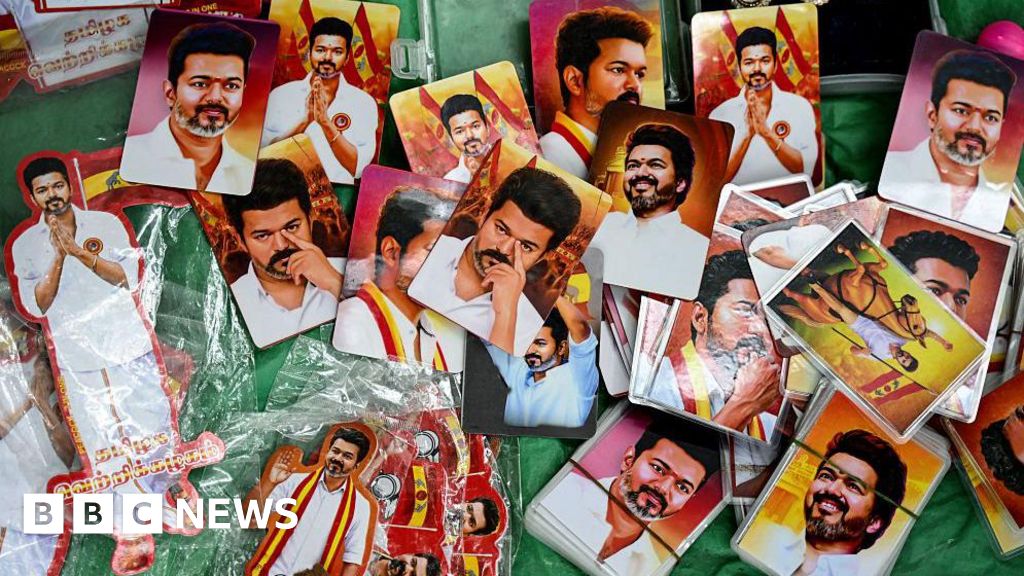
TVK's organisational depth had been building for 17 years before it was formally launched. As the BBC documented, Vijay reorganised his cinema fan clubs into the Vijay Makkal Iyakkam ("Vijay's People Movement") in 2009, running neighbourhood welfare programmes on education, disaster relief and local grievances. By 2011 the network was already renting itself out to test an AIADMK alliance. When Vijay wound down his acting career after his 69th film and launched TVK in February 2024, the party inherited roughly 85,000 fan clubs, according to
BBC News, converted into an "IT wing" that packaged three-minute rally speeches into WhatsApp-and-Reels campaigns.
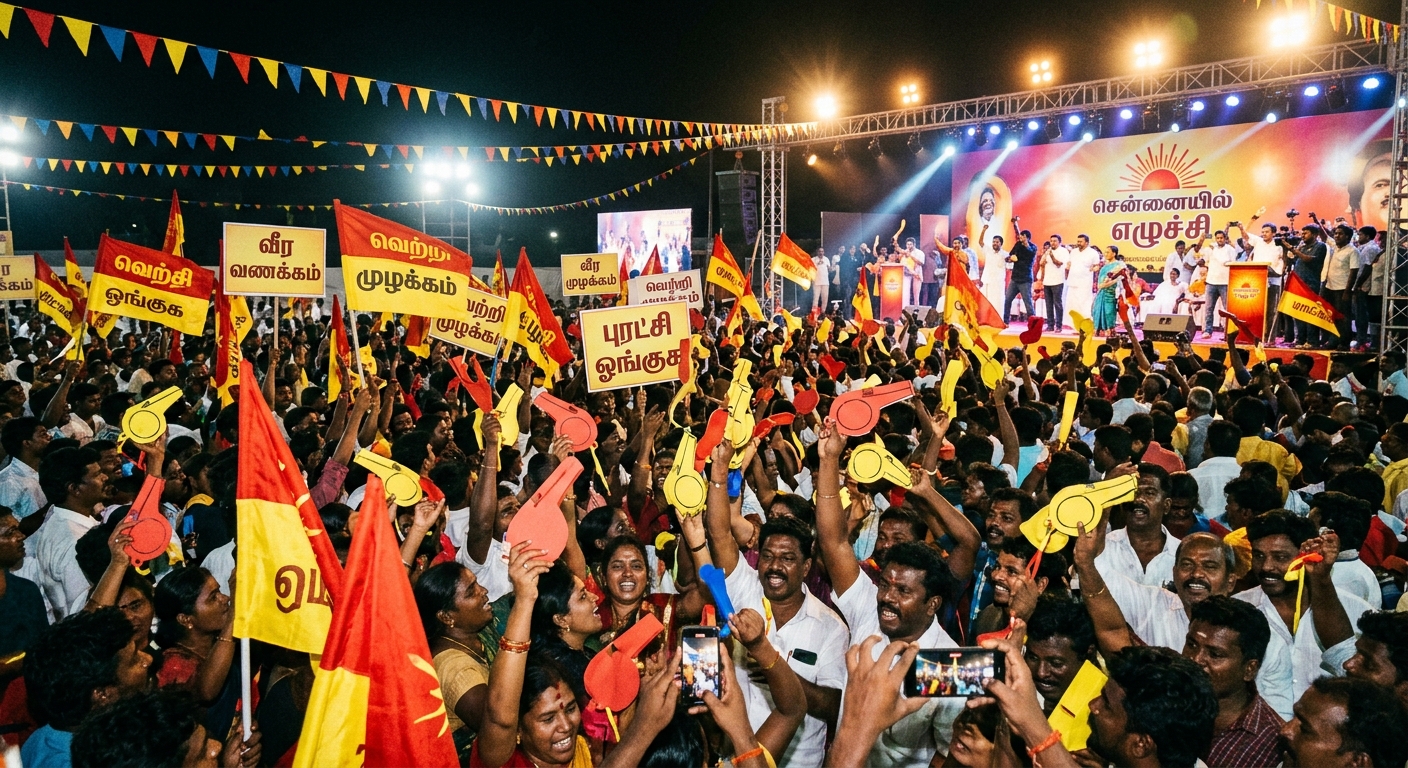
That machine matters because Vijay barely campaigned in the conventional sense. He gave no press interviews, held no press conferences, and — after a September 2025 stampede at his Karur rally killed at least 41 people, per ISAS-NUS — took a two-month hiatus from campaigning entirely. He returned to the trail for under three weeks before polling day, April 23. The party's electoral symbol, a whistle, has already replaced the DMK's rising sun on car stickers across Chennai.
The demographic base is generational. Voters aged 18–39 make up 42% of Tamil Nadu's electorate, per BBC data cited from post-poll analysis, and support was "particularly strong" among first-time voters. Political scientist Ramu Manivanan told AFP that "the youth want a new face — this is not just anti-incumbency."
The days that almost derailed it
Between May 4 and May 10, the story nearly inverted. Governor Rajendra Vishwanath Arlekar — a BJP appointee — refused to invite Vijay to form the government, arguing in a press release cited by the BBC that "the requisite majority support in the legislative assembly, essential for forming the government, has not been established." Vijay was 10 seats short. A TVK member filed a petition in the Supreme Court on May 8 asking the bench to direct the governor to invite the single-largest party, according to
Bernama. TVK legislators were sequestered at a luxury resort in Mamallapuram; AIADMK MLAs were flown to a resort in Puducherry.
The impasse broke because Congress and the Left decided the alternative — a re-run or a DMK–AIADMK entente — was worse. The Indian National Congress (5 seats), the Communist Party of India, the CPI-M, the Viduthalai Chiruthaigal Katchi (VCK) and the Indian Union Muslim League (IUML) each pledged support, taking TVK to 120 legislators. On May 9 the governor issued the appointment letter; on May 10, Vijay took oath at Chennai's Jawaharlal Nehru Stadium alongside nine cabinet ministers, in the presence of Rahul Gandhi. The trust vote on May 13 passed 144–22 after an AIADMK rebel — sole Amma Makkal Munnetra Kazhagam MLA S. Kamaraj — crossed the floor and DMK members walked out, Bernama reported.
The angle everyone missed: Modi's most useful loss
Here is the counterintuitive dividend. In the same round of voting, the BJP won a landslide in West Bengal — 206 of 294 seats, according to the ISAS-NUS post-election analysis — dismantling Mamata Banerjee's Trinamool Congress. Assam was retained; Puducherry stayed with the NDA. Kerala went to Congress. Taken together,
Channel News Asia observed, "the losses are expected to weaken the opposition as Modi looks ahead to 2029."
The INDIA bloc's 2024 general-election performance rested on two regional powerhouses: the DMK, which delivered 22 of Tamil Nadu's 39 Lok Sabha seats with a 27% vote share, and the TMC in Bengal. Both are now shattered. Carnegie's Milan Vaishnav had already argued in September 2024 that the BJP remained "system-defining" despite falling short of a Lok Sabha majority — because opposition parties still positioned themselves relative to the BJP rather than offering programmatic alternatives. The 2026 result confirms his call. Regional parties, Vaishnav wrote, appear "trapped between dynastic succession, ideological exhaustion, and weak organisational machines."
Vijay's TVK is none of those things — but it is also not a DMK-style ideological vehicle. As Vijay's own oath-day speech made clear, his enemy list is dual: he called the previous DMK government one that "emptied the treasury and left," per BBC Hindi, and he has cast the BJP as his "ideological adversary." But absent a Dravidian programmatic identity, TVK is a personality vehicle with a whistle. That is a much easier opposition for the BJP to negotiate with in New Delhi than an MK Stalin who had spent five years railing against Hindi imposition, delimitation, and the erosion of federal transfers.
Prime Minister Modi congratulated Vijay within hours, saying the central government would work with his administration to "improve the lives of people," AFP reported. That courtesy is not incidental. The BJP failed for a decade to break the DMK in Tamil Nadu; a first-time chief minister with no bench, no legislative record, and a coalition dependent on five separate parties is, from Delhi's perspective, a manageable interlocutor.
What Vijay actually promised
TVK's manifesto, as documented by Al Jazeera, leaned heavily on freebies calibrated to the ongoing global fuel crisis: six free LPG cylinders annually; ₹2,500 ($26.5) monthly for female heads of household; 8g of gold and a silk saree for poor women's weddings; a ₹4,000 stipend for unemployed graduates; interest-free education loans up to ₹2 million. Nothing about the price tag was serious. Author Nilakantan RS told the BBC there is "an absence of any original position on real issues" — Vijay's politics, he argued, has made "virality the currency of his actions."
In his oath-day speech at Nehru Stadium, Vijay pivoted to fiscal reality. He promised a "white paper" documenting what Tamil Nadu's treasury actually contained — a familiar move by incoming governments to lower expectations. He also inherits real numbers: Tamil Nadu recorded 11.2% growth in 2024–25, according to the BBC, making it India's fastest-growing large state, with among the country's strongest social indicators. The DMK's parting message to voters was that Vijay would break what worked. Voters, evidently, decided that what worked was not distributed evenly enough.
The coalition math and its fragilities
The nine-minister cabinet Vijay swore in on May 10, per PTI, is engineered for optics: eight Dalits including a VCK minister and a Congress minister, two Brahmins, an IUML representative for Muslims. It is a "rainbow" designed to hold together five outside supporters who between them provide the 12-legislator cushion above the 118 majority threshold.
This is thin ice. The Congress has five seats and Rahul Gandhi's national interest; the CPI, CPI-M, VCK and IUML have two each — every one of them a former DMK ally. If Vijay drifts toward New Delhi on any signature Dravidian issue (Hindi, NEET, delimitation, GST arrears), the Left and IUML will exit first. If he tilts too far the other way, the BJP-aligned governor can revive the majority question — the same governor who required proof of 118 signatures on May 8.
Diplomat View
Vijay's win is being read in Chennai as a generational triumph. Read from New Delhi, it is something else: the most useful electoral outcome the BJP could have engineered in Tamil Nadu without contesting it themselves. The DMK's collapse removes the single most effective anti-BJP voice from the Chief Ministers' Conference table. It weakens Rahul Gandhi's leverage inside the INDIA bloc — Congress now derives Tamil Nadu influence from a client relationship with a chief minister it did not create. And it hands Modi a novice interlocutor with a coalition so heterodox that any confrontation with the Centre risks internal collapse.
Our forecast: TVK will govern for the full five-year term, but its national opposition function will decay. Expect Vijay to trade Dravidian symbolism (rhetoric on Hindi, NEET) for federal-transfer bargaining, and to avoid full alignment with the INDIA bloc's 2029 Lok Sabha campaign. The forecast breaks if the Karur stampede — for which criminal proceedings continue — reaches the Chief Minister's desk personally, or if Congress withdraws support over a policy split (most likely trigger: a TVK vote in favour of a central bill the INDIA bloc opposes). Watch the first Lok Sabha by-election in Tamil Nadu as the leading indicator: if TVK contests without a Congress alliance, the INDIA bloc's southern anchor is gone.
What to watch next
- July–August 2026: TVK's first state budget. Whether the six-cylinder LPG pledge and ₹2,500 women's transfer survive fiscal reality will define expectations for the entire term.
- Late 2026: Karur stampede prosecutions and any Madras High Court rulings on organisational liability of TVK office-bearers, including Vijay personally.
- 2027 local body elections: The first test of whether TVK's whistle can win panchayat and municipal seats — the sub-state grid the DMK has controlled for six decades.
- 2029 Lok Sabha: Whether Vijay aligns TVK with the INDIA bloc, contests solo, or cuts a state-specific deal with the BJP. Tamil Nadu sends 39 MPs; the arithmetic of the next general election runs through this decision.
The Bottom Line
Vijay did not just break the Dravidian duopoly — he removed the DMK as the anchor of India's national opposition at the exact moment the BJP was consolidating in the east. The paradox of TVK's 108-seat sweep is that a party built on anti-BJP rhetoric has delivered Narendra Modi his most useful Tamil Nadu outcome in a decade: a first-time chief minister with no bench, a five-party outside coalition, and no ideological floor to stand on when New Delhi comes calling. The next test of the India opposition is whether it can build a 2029 challenge around a leader whose whole political theory is that he is not any of them.
Discover more
India
Rajnath Singh's Durga Squad for 2026 Polls
Rajnath Singh's Durga Squad promised women's safety in Bengal but has since disappeared from the agenda, revealing BJP's true priorities.
India
Women’s Reservation Bill 2026
The Constitution (131st Amendment) Bill, 2026 was defeated in Lok Sabha, revealing deeper political conflicts over women's reservation and delimitation.
India
Modi's Women’s Convention in Varanasi
Modi's Varanasi rally frames women's reservation as a national mission, targeting the 2027 Uttar Pradesh elections with a strategic narrative.

Conflict & Security
Drone Warfare Killing Aid Workers at Unprec
Over 1,000 humanitarian workers killed in three years as cheap armed drones collapse legal protections. Gaza, Sudan, Ukraine, and DRC see deliberate targeting of aid convoys and hospitals with zero prosecutions.