Venezuela's Sanitation Crisis Post-Earthquake
Displaced Venezuelans face dire health risks in shelters.
Model Diplomat7 min readLatin America
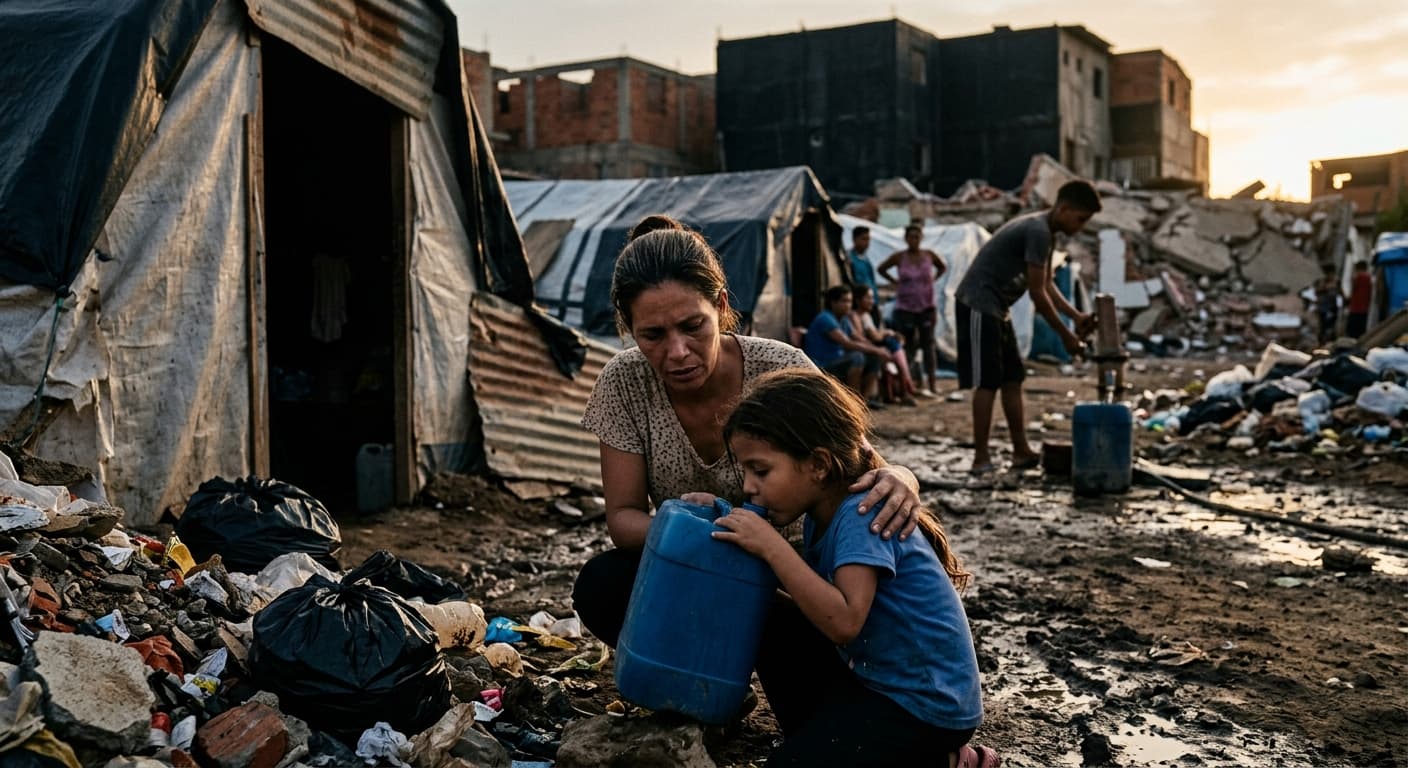
Venezuela's shelter sanitation crisis is the next mass-casualty event
Two weeks after twin quakes, 12,800 displaced Venezuelans crowd 80 shelters with broken plumbing — the public-health emergency now outruns the rescue.
Venezuela's post-earthquake emergency has crossed a line that aid agencies feared but few said aloud: the immediate danger to displaced families is no longer collapsing masonry but the water and sanitation vacuum inside the shelters, layered onto a health system that had already lost a third of its doctors and a fifth of its safe water before the ground moved. On 6 July, Venezuela's National Assembly put the official toll at 3,535 dead, 16,740 injured and 17,854 unhoused, with 12,800 people packed into 80 shelters across Caracas and La Guaira, according to Al Jazeera. Diarrhoea is already spreading through those sites. The next mass-casualty event in this disaster will not be measured in collapsed floors but in cholera-like clinical presentations, dengue clusters and respiratory infections — and it is being manufactured by decisions made a decade before 24 June 2026.
The pre-existing condition that turns a quake into an epidemic
The public-health arithmetic of any large earthquake is standard: displacement plus crowding plus broken sewage equals a two-to-six-week window for waterborne disease. What is not standard is Venezuela's baseline. Before the quake, roughly 80 percent of Venezuelans lacked continuous access to safe drinking water, according to a CSIS synthesis of the National Assembly's Plan País diagnostic, with water systems running at half capacity. An earlier survey by the Venezuelan Observatory of Public Services, reported by
Al Jazeera, found 86 percent of Venezuelans describing their piped supply as unreliable and 11 percent as effectively nonexistent.
The health system that must catch any outbreak is in a similar state. WHO's health-emergencies chief Ian Clark told reporters in Geneva on 2 July that many hospitals were already short of up to 37 percent of essential medicines before the quake, and that tens of thousands of health workers had emigrated, according to UN News. Venezuela's paediatrics association told
Al Jazeera that a 2025 national survey of public hospitals found shortages exceeding 30 percent of emergency supplies and above 70 percent in operating rooms, with laboratories "practically closed." The country entered 24 June with roughly eight million people already needing humanitarian assistance, as Oxfam's Magnus Corfixen noted to the
BBC.
Layered onto that, the Pan American Health Organization has now flagged all eight hospitals it reviewed in La Guaira, Caracas and Miranda for immediate outside help, three with structural damage. At Vargas-IVSS in La Guaira, PAHO found 96 patients crammed into a ward built for eight, water arriving by hand-carried containers, and medical waste piling up in the corridors, UN News reported. That is the sanitary infrastructure that will absorb the first wave of gastrointestinal cases coming out of the shelters.
Inside the shelters: the specific mechanics of an outbreak
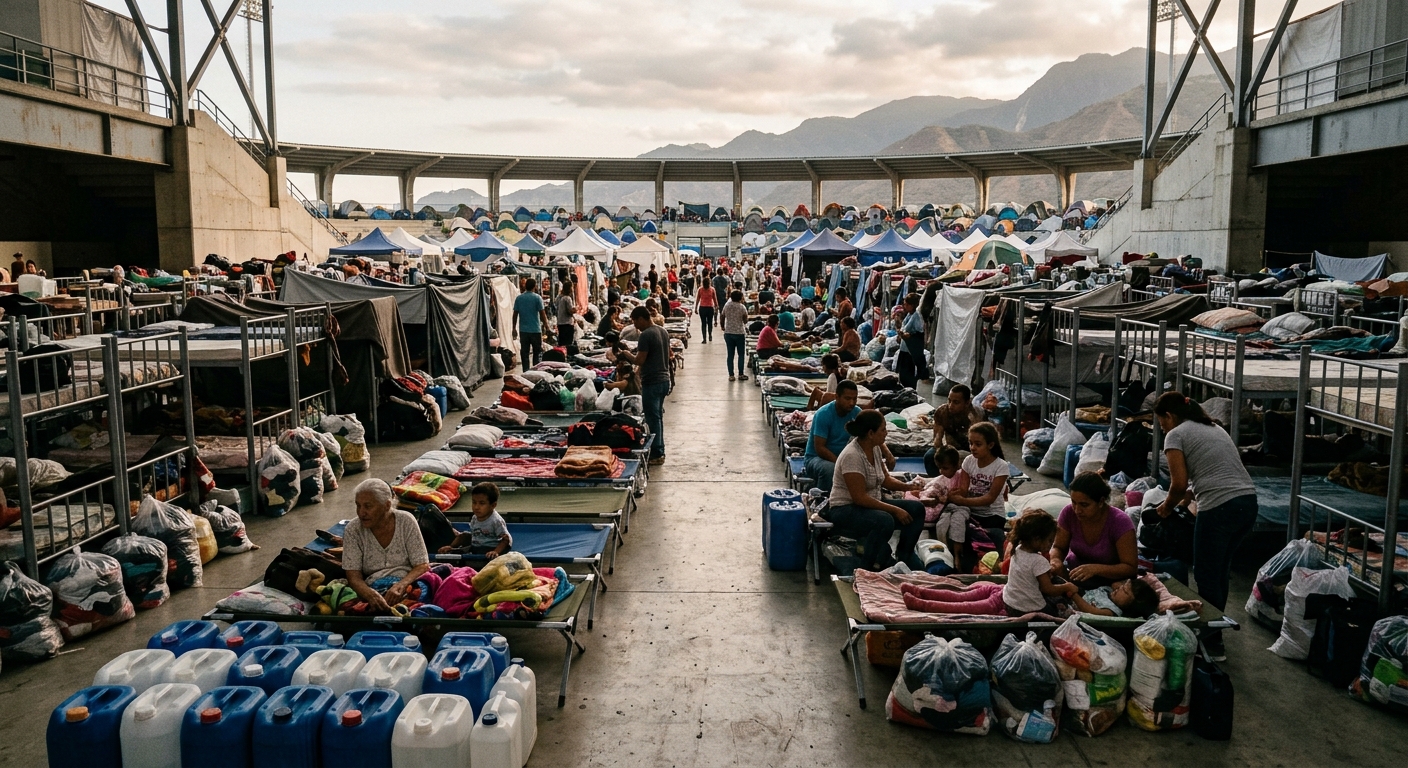
The dominant model for displaced families in La Guaira is not the traditional tent camp — it is the sports complex. OCHA Venezuela's Vanessa May told the agency's media desk that authorities and UN partners have converted venues including the José María Vargas complex, the Estadio César Nieves and Playa Grande into "transitional camps" meant to host survivors for up to a month, according to an OCHA field video filmed on 30 June. IOM's Lia Poggio told the same crew that one venue was already accommodating around 1,700 people overnight, with 2,500–3,000 arriving on peak days.
Concentration of that scale, in facilities never designed as long-term housing, is exactly the environment in which acute watery diarrhoea moves fastest. Al Jazeera correspondent Teresa Bo, reporting from a La Guaira shelter, said residents were "asking … for portable toilets, and also help from the government to try to reorganise this place to try to prevent overcrowding, but also the spread of disease," and that "reports among the population here with diarrhoea and other diseases" were already common, per Al Jazeera. Save the Children and Plan International have separately warned that families sheltering outside face high daytime heat and heavy night-time downpours, elevating risks of dehydration diarrhoea and respiratory illness. Plan International's country response noted
Plan Ireland that girls and women in overcrowded shelters also face protection risks that compound health outcomes when latrines are shared and unlit.
The second-order threat is vector-borne. The José Gregorio Hernández hospital's Dr. Julio Castro-style warning was echoed by physician sources to Al Jazeera, who cautioned that displaced Venezuelans face increased risk of yellow fever and dengue outbreaks, on top of respiratory disease driven by debris dust. Standing water in damaged neighbourhoods and around shelters is optimal mosquito habitat; Venezuela's malaria cases had already surged from 36,000 in 2009 to more than 406,000 by 2017, according to
Human Rights Watch citing WHO data. In the transitional camps, immunisation posts are now administering tetanus and yellow-fever shots to arrivals — a defensive measure that concedes how thin the herd-immunity margin is.
The funding gap that decides the outcome
The scale of pledged aid is unusually large for Venezuela and unusually small next to what the damage assessments imply. Material damage from the quakes exceeds $6.7 billion by UN Development Programme satellite analysis, per Al Jazeera. Against that, the Trump administration has offered roughly $300 million through NGOs and UN agencies, deployed about 900 SOUTHCOM personnel and repaired the runway at Maiquetía; the UK has committed £2 million and a 68-person urban search-and-rescue team, according to
gov.uk; the EU has added €5 million and a 50-tonne shelter, WASH and education shipment from Copenhagen. WHO has released $1.5 million from its Contingency Fund and, with PAHO, is appealing for close to $24 million to sustain the six-month health response, per
UN News. UNHCR is separately seeking $14.85 million to shelter up to 30,000 people. UNICEF estimates $52 million is needed for the earthquake alone within a wider 2026 Venezuela appeal of $137.6 million that was only 35 percent funded before 24 June, per
UN News.
Set that alongside the political baseline. The Council on Foreign Relations reported that U.S. humanitarian funding for Venezuela had already been cut from $94.5 million in 2024 to $2.2 million in 2025, halving World Food Programme operations, per CFR. The earthquake has reversed that curve for now — but the WASH and health lines that decide whether shelters incubate outbreaks are precisely the multi-year programmes hollowed out in the twelve months before the quake. Aid is arriving into a system whose absorptive capacity was cut in half by donor policy, then cut again by falling masonry.
Who benefits, who loses
The immediate beneficiary of the quake response is Delcy Rodríguez, the former vice-president sworn in as interim president after U.S. forces seized Nicolás Maduro on 3 January 2026, per the BBC. Her acceptance of aid from right-wing regional governments and from Washington marks a clear break with Maduro-era practice, according to
CSIS, and gives her an unearned nation-builder posture. The reputational risk cuts the other way if disease outbreaks in shelters become visible before her government can point to functioning water trucks and latrines. NPR's on-the-ground reporting from Los Corales already found residents saying federal help arrived three days late, and in some La Guaira neighbourhoods not at all, per
NPR.
The clear losers are the displaced themselves — and specifically children. UNICEF estimates 680,000 children need humanitarian assistance across six affected states, per UN News; paediatric diarrhoeal disease in an environment of contaminated water and 30-plus-degree heat is the single most predictable killer of the next month. A secondary loser is the U.S. sanctions architecture. Treasury's Office of Foreign Assets Control has already issued a general licence exempting earthquake-relief transactions from remaining sanctions, per
CSIS; each additional carve-out narrows the leverage Washington was building for a democratic transition.
The historical parallel and what to watch
The disease-risk profile in La Guaira most closely resembles the 2010 post-earthquake cholera outbreak in Haiti, where displacement into crowded shelters with inadequate WASH triggered the largest cholera epidemic of the modern era. Venezuela does not currently have endemic cholera, which is its strongest defence; but its aquatic conditions, its collapsed water infrastructure, and its shelter density are structurally similar. CFR analysts explicitly benchmark the current disaster's scale against the 2021 southern Haiti earthquake and the 2023 Türkiye–Syria quake, per CFR. The relevant lesson from all three: the epidemiological curve begins to bend somewhere between weeks two and four post-disaster, and is determined less by the size of the initial pledge than by how quickly clean water, latrines and case-management supplies reach individual shelters.
What to watch
- Next OCHA situation report and PAHO/WHO joint appeal update — the $24 million six-month health ask is the concrete number to track; underfunding it is the operational trigger for outbreak risk.
- 12 July 2026 window — roughly the earliest point at which faecal–oral disease clusters from the first shelter cohort would become epidemiologically visible; watch PAHO's weekly epidemiological bulletin.
- U.S. Treasury OFAC licences — any expansion of the earthquake-relief general licence to cover water-infrastructure repair (not only relief goods) would materially change the reconstruction trajectory.
- Rodríguez government's decision on electoral timelines — CSIS warns that a "temporary" pause in democratisation talks tends to self-reinforce; the shelter emergency is the pretext most likely to be used.
The Bottom Line
Venezuela's earthquake response has already survived its search-and-rescue phase; it is unlikely to survive its sanitation phase intact. With 12,800 people crammed into 80 shelters, 80 percent of the country lacking safe water before the quake, and a health system missing a third of its doctors and up to 37 percent of essential medicines, the decisive figure over the next month is not the death toll but the number of clean latrines and litres of chlorinated water reaching each transitional camp. If donors and the Rodríguez government fund WASH at the scale PAHO is asking for, this becomes a difficult recovery; if they do not, the second wave of deaths will exceed the first.
Discover more

US Politics
White House Pressures Congress for Crypto Leg
The Trump administration's push for the CLARITY Act aims to reshape crypto regulation, impacting trillions in market value and the Trump family's wealth.

US Politics
US Launches $166B Tariff Refund Portal
The US is launching a $166 billion tariff refund portal to aid importers hit by Trump-era tariffs, with major implications for trade and supply costs.
Global Politics
Xi Jinping Calls China-Russia Ties 'Precious'
Xi Jinping's description of China-Russia ties as 'precious' reflects a strategic imbalance, with Beijing dictating terms in the partnership.

Economics
Fed's Amex AML order puts correspondent banking on notice
Federal Reserve's Amex AML order requires board-level controls and a 90-day plan; OCC fined the bank $350 million over enterprise-wide deficiencies.