Venezuela's Earthquake Crisis: Food Access
Twin quakes push Venezuela into food access crisis
Model Diplomat7 min readLatin America
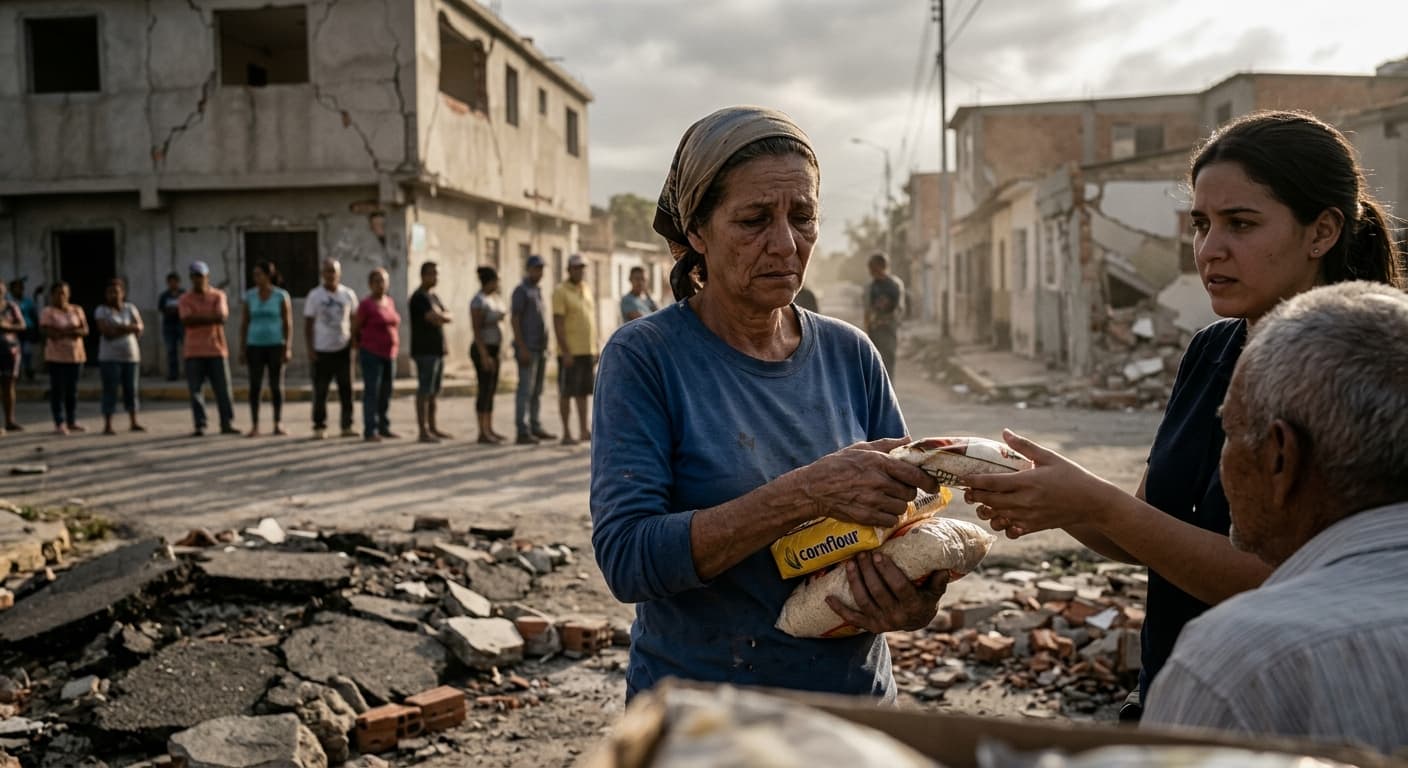
Venezuela's earthquake crisis: food access collapses in La Guaira
Twin 7.2 and 7.5 quakes push coastal Venezuela into IPC Phase 3 as WFP scales an emergency response inside a country still under partial US sanctions.
The June 24, 2026 earthquakes did not create Venezuela's hunger problem — they detonated a food-access crisis inside a country that FEWS NET had, only four months earlier, projected to remain in Stressed (IPC Phase 2) through September. In La Guaira, Aragua and pockets of coastal Carabobo, the destruction of homes, informal markets and wage-earning livelihoods has now pulled hundreds of thousands into Crisis (IPC Phase 3) outcomes — the specific, localized deterioration FEWS NET had warned was possible in areas cut off from remittances, dollar income or the government's CLAP food boxes. The story is not that Venezuela is now hungry. It is that the earthquake collapsed the fragile dollar-cash-and-remittance stitching that had kept national outcomes at Phase 2 through the worst of the post-Maduro transition.
The pre-quake baseline: fragile Phase 2, not Phase 3
Before the tremors, FEWS NET's February 2026 Food Security Outlook forecast Stressed outcomes countrywide through September, driven by local-currency volatility, elevated inflation and reduced purchasing power. That baseline hinged on a specific coping architecture: dollarized informal wages, family remittances estimated by the IMF and World Bank at several billion dollars annually, and state-run CLAP boxes that FEWS NET's
April 2026 update still described as reaching a majority of poor households, if irregularly.
That architecture required functioning cities. When two of Venezuela's most economically dense states — La Guaira, home to the country's main port and international airport, and greater Caracas — took the brunt of the shaking, the coping architecture broke overnight. UNHCR reported on June 30 that food shortages in La Guaira were "widespread," basic services had collapsed, and community tensions were rising, with one 18-year-old vendor telling AFP through the BBC's coverage that "sometimes people nearly kill each other for food… it's like a cockfight," according to BBC News.
The scale of the shock
The twin quakes — magnitude 7.2 at 22 km depth in Yaracuy, followed 39 seconds later by a 7.5 at 10 km depth — were the strongest to hit Venezuela since 1900, according to USGS data cited by BBC News. By July 2, Venezuela's National Assembly put confirmed deaths at 2,295 with more than 11,000 injured,
Al Jazeera reported. Satellite analysis by the UN Development Programme, cited in the same report, estimated material damage at more than $6.7 billion — roughly 6 percent of the country's $111 billion GDP, near the top of the 1–7 percent range initially projected by early damage assessments summarized by
Al Jazeera.
UNICEF, in a June 28 statement carried by UN News, put the number of people needing humanitarian assistance at 1.8 million, including 680,000 children. Venezuela's interior minister, Diosdado Cabello, told state television that at least 70,000 families in La Guaira alone had been affected, according to
Al Jazeera.

Why the IPC classification moves to Phase 3 in the affected corridor
The IPC framework is not a body-count exercise. Phase 3 (Crisis) is triggered when households face significant food consumption gaps or must sell productive assets to meet minimum food needs. In the affected corridor — La Guaira state, the Altamira and Los Palos Grandes districts of Caracas, and pockets of Aragua and Yaracuy — three simultaneous shocks now meet that threshold.
First, destruction of livelihoods. Coastal La Guaira's economy runs on port work, informal commerce, tourism and fishing. WFP Venezuela Director Stephanie Hochstetter, briefing UN correspondents on June 30, described families who "can still cook" but "can no longer buy food regularly," according to UN News. That is the textbook signature of a Phase 3 access shock: physical food supply exists, but income to purchase it has evaporated.
Second, market disruption. Simón Bolívar International Airport in Maiquetía was closed for days until US Southern Command engineers repaired the runway, Al Jazeera reported. While the ports of La Guaira and Puerto Cabello remained functional for humanitarian cargo, according to the
UN News briefing, local retail networks — bodegas, wet markets, informal street vendors — were physically destroyed across the coastal strip.
Third, displacement. UNHCR appealed for an initial $15 million to shelter 30,000 earthquake-affected people over six months, as reported by BBC News. Displacement into tent camps and integrated service centres removes households from their normal food economy entirely — the exact profile FEWS NET had flagged as the most likely Phase 3 population in its February outlook: those without dollar income, without CLAP access, or without remittance-receiving relatives abroad.
The winners and losers in the aid architecture
The earthquake response is running through an aid channel that did not exist twelve months ago. The January 3 US military operation that removed Nicolás Maduro from power — analyzed by CSIS as producing a "fragile political equilibrium" under interim President Delcy Rodríguez — created the political conditions for direct US disaster assistance. The Trump administration has committed $300 million so far and deployed 900 military personnel through SOUTHCOM, per Al Jazeera's reporting cited above. The US Treasury's Office of Foreign Assets Control issued a general license exempting earthquake-relief transactions from remaining Venezuela sanctions, according to
CSIS.
The winner in this configuration is the interim government. Rodríguez has been publicly effusive about US assistance — a break from Maduro's decade-long refusal to acknowledge the humanitarian crisis, as BBC News observed. Accepting US search-and-rescue teams and letting SOUTHCOM repair the Maiquetía runway legitimizes her interim mandate at the moment US policy is nominally pushing toward political transition.
The losers are less obvious. The Center for Economic and Policy Research warned, in comments to Al Jazeera, that remaining sanctions still complicate NGO financial flows and supplier payments. UN Special Rapporteur on the Right to Food Michael Fakhri, cited in the same article, has previously argued that sanctions constrain the government's own capacity to run social protection programmes — including, by implication, the CLAP food distribution system that FEWS NET's
November 2025 key message update identified as one of the last remaining buffers against Phase 3 outcomes among very poor VED-earning households.
Opposition supporters are also losing ground. As CSIS noted, "a botched recovery leading to further authoritarian consolidation could worsen ongoing irregular migration dynamics" — and Rodríguez can plausibly argue that electoral timelines discussed as part of the US-brokered transition should be deferred while the country rebuilds. The earthquake has handed the interim government a defensible reason to slow the political clock.
The historical parallel that matters
The comparison analysts keep reaching for is Haiti 2010 and Turkey-Syria 2023, both flagged by the Council on Foreign Relations. But the more instructive parallel is closer to home: the 1999 Vargas landslides in what is now La Guaira, which killed tens of thousands and produced a decade-long displacement crisis that permanently reshaped Caracas's food economy. One Caritas volunteer who worked both disasters told
Al Jazeera that Venezuela's economic capacity to absorb the current shock is materially worse than in 1999. FEWS NET's independent evaluation record, examined in a
2024 arXiv study by Bertetti et al., shows the network's Phase-classification accuracy is high but tends to lag sudden-onset shocks — meaning the official reclassification of the affected corridor to Phase 3 may not appear until FEWS NET's next scheduled outlook update, even as field conditions have already crossed the threshold.
What the numbers say about the next six months
WFP has 3,000 tonnes of food inside Venezuela — enough for roughly 10,000 families for two months — plus another 1,400 tonnes at its Panama regional hub, according to the UN News briefing. Its $15 million initial appeal covers up to 500,000 people for three months. Do the arithmetic: if the affected caseload is 1.8 million and the emergency window extends through January 2027, the funding gap is measured in hundreds of millions of dollars, not tens.
Venezuela's own fiscal capacity is nil. CSIS reported that the interim government had, in the week before the quakes, announced plans to restructure $240 billion in sovereign debt — $40–90 billion more than external analysts had projected. Any large-scale, government-led food subsidy expansion is fiscally impossible without either dollar-denominated external financing or a renewed sanctions carve-out for oil sector revenues. The former is politically constrained; the latter is on the table but has not materialized.
What to watch
- The next FEWS NET Venezuela outlook update, expected in July or August 2026, which will formalize whether the coastal corridor is reclassified from Phase 2 to Phase 3.
- The scheduled donor conference: the WFP's initial $15 million appeal is described in the
UN News briefing as "a first estimate." A follow-on Flash Appeal from OCHA is the next concrete funding catalyst.
- The status of the OFAC general license: whether Treasury extends the earthquake-relief carve-out beyond its initial window, and whether it expands to cover reconstruction financing — the mechanism that determines whether US and European aid can flow at scale into 2027.
- CLAP distribution data: any resumption or contraction of the government's food-box program in Aragua, Carabobo and La Guaira will be the clearest indicator of whether Phase 3 outcomes remain contained to the earthquake corridor or expand nationally.
The Bottom Line
The bottom line: Venezuela's transition from a country in Phase 2 stagnation to one with Phase 3 pockets is now confirmed — not by inflation, which FEWS NET had modelled, but by a physical shock that eliminated the informal-cash, remittance and CLAP buffers holding coastal households above the Crisis threshold. Whoever controls the reconstruction cash — the Rodríguez interim government, SOUTHCOM's logistics chain, or a UN-led coordination architecture — will hold the political leverage in Venezuela through January 2027. The earthquake did not just kill 2,295 people. It reset the country's food-security politics.
Discover more

US Politics
White House Pressures Congress for Crypto Leg
The Trump administration's push for the CLARITY Act aims to reshape crypto regulation, impacting trillions in market value and the Trump family's wealth.
Global Politics
Xi Jinping Calls China-Russia Ties 'Precious'
Xi Jinping's description of China-Russia ties as 'precious' reflects a strategic imbalance, with Beijing dictating terms in the partnership.

US Politics
US Launches $166B Tariff Refund Portal
The US is launching a $166 billion tariff refund portal to aid importers hit by Trump-era tariffs, with major implications for trade and supply costs.

Economics
Fed's Amex AML order puts correspondent banking on notice
Federal Reserve's Amex AML order requires board-level controls and a 90-day plan; OCC fined the bank $350 million over enterprise-wide deficiencies.