Uzbekistan's Water Compact: A Risky Bet
Exploring the challenges of Uzbekistan's water strategy
Model Diplomat8 min readCentral Asia
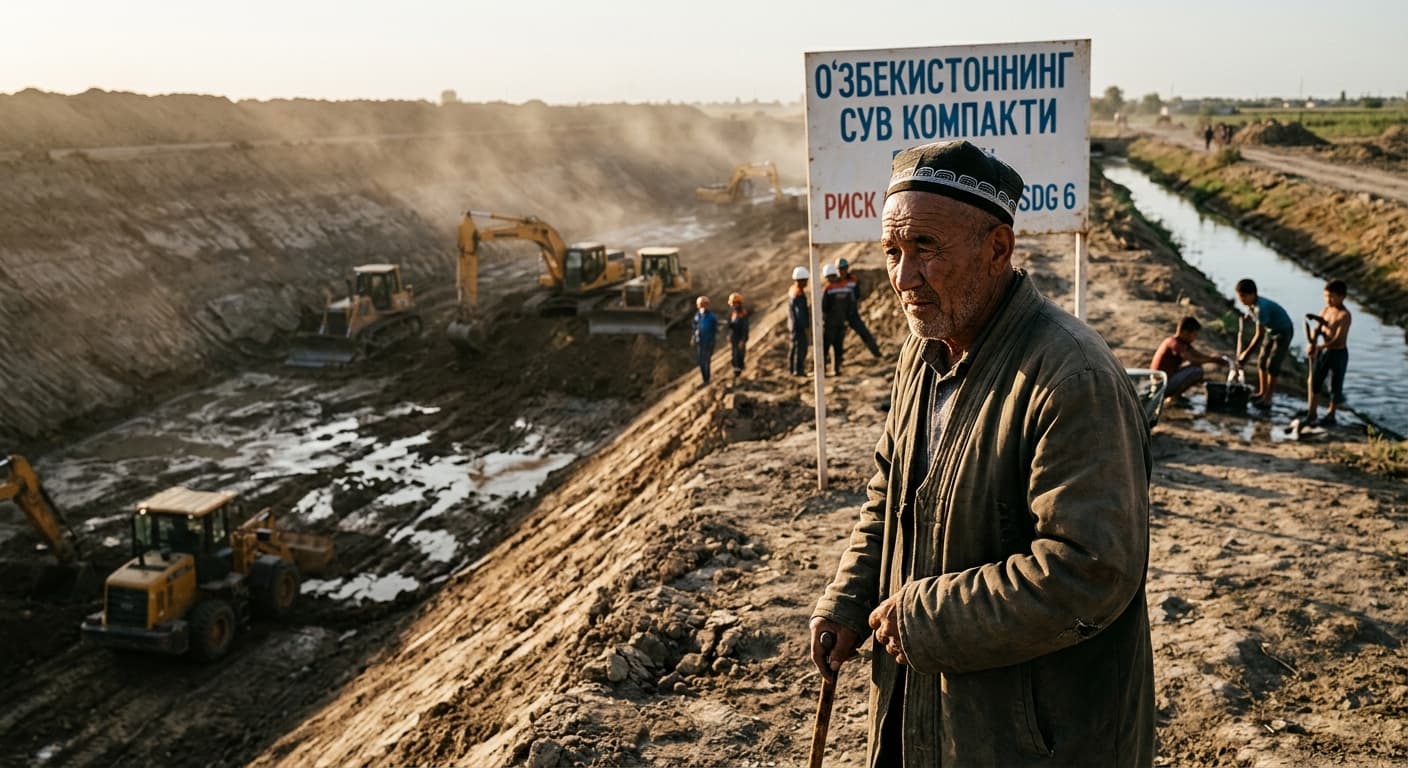
Uzbekistan's SDG 6 Bet: Water Compact vs. Cotton & Kabul
Uzbekistan's 2026 Water Compact commits $500m-plus to hit SDG 6 by 2030 — but cotton quotas and Afghanistan's Qosh Tepa canal sit outside the deal.
Uzbekistan signed a five-year national water compact with the World Bank Group in the run-up to the 2026 Spring Meetings, formalised through Presidential Decree No. 21 of February 16, 2026 — and the fine print reveals the country's real Sustainable Development Goal 6 problem. Tashkent is trying to buy a water-secure future through canals, pumps and sewers, while the three variables that will actually decide whether it hits SDG 6 by 2030 — a coercive cotton quota system, politically frozen water tariffs, and an unregulated Taliban-built canal upstream — all sit outside the compact. The strategy is credible on plumbing and fragile on politics, and that gap is where the acceleration story either succeeds or breaks.
What the compact commits, in numbers
The National Water Forward Strategy 2026–2030, published as an annex to the Uzbekistan Water Compact, targets water security for at least 3.8 million additional people by 2030. It pledges 1.7 million hectares of irrigated land equipped with water-saving technologies, modernisation of roughly 10,900 km of main canals and 26,400 km of open drainage, upgrades to 324 pumping stations, and construction of 21,500 km of new water supply networks alongside 10,000 km of sewerage. The World Bank has committed to mobilise an additional US$500 million on top of existing lending to crowd in co-financing from the Asian Development Bank, EBRD and private investors, according to the compact document.
The baseline is unforgiving. Uzbekistan's renewable internal freshwater resources per capita have fallen 25 percent over the past 20 years and are among the lowest in the region. Only 27.1 percent of the population is covered by centralised sewerage with functioning wastewater treatment. Roughly 80 percent have piped, safely managed water, but rural coverage drops to about 70 percent, and current infrastructure financing needs are at least six times higher than historical spending — with tariffs still below full cost recovery. Those figures are drawn directly from the World Bank compact itself, not from advocacy estimates.
Why this is a hard case
Uzbekistan is the most water-stressed country in Central Asia. A 2025 Norwegian Institute of International Affairs research paper applied six international scarcity indices and found Uzbekistan scored worst across all of them, with 9 of its 13 provinces classified as "high" water stress and 4 as "extremely high". Agriculture consumes about 90 percent of national water, drawn overwhelmingly from the Amu Darya and Syr Darya, and roughly 2.4 million hectares — 56 percent of irrigated land — still depends on 1,700 pumping stations that soak up 16 percent of Uzbekistan's electricity, according to a World Bank
press release from May 21, 2025.
The climate math worsens the picture. The same World Bank release projects water availability falling 30–40 percent and irrigation demand rising 25 percent under climate change, driven by shrinking glacial flows in the Pamirs and Tien Shan, higher evapotranspiration, and more frequent droughts. Karakalpakstan already loses an estimated $44.2 million a year — 2.1 percent of regional GDP — to sand and dust storms rising off the exposed Aral seabed, according to a World Bank feature published December 4, 2024. Al Jazeera's June 17, 2026
satellite analysis listed the South Aral as one of ten places on Earth where surface water is disappearing fastest, shrunk by more than 90 percent since 1984.
The compact tries to hit that at scale. A first-phase, $200 million concessional credit approved in May 2025 will concrete-line 259 kilometres of eight primary canals connected to the Amu Darya and Syr Darya, install SCADA-linked flowmeters, and cut water losses by roughly 540 million cubic metres per year across Karakalpakstan, Bukhara, Kashkadarya, Namangan and Surkhandarya, the World Bank said. On the drinking-water side, the Board approved a further $150 million on June 17, 2026 for the second phase of the Rural Infrastructure Development Program, extending water, road and electricity subprojects across 296 mahallas in six regions and directly benefiting 1.2 million rural residents, per the
World Bank announcement.
The angle: three risks sit outside the deal
The compact reads well on infrastructure. It does not neutralise the three variables that will decide whether SDG 6.4 (water-use efficiency) and 6.5 (integrated water resources management) actually move by 2030.
Risk one: the cotton quota system is still intact. Uzbekistan's headline acceleration story on water efficiency depends on getting less water into cotton. A May 2026 Scientific Reports study by Abdurakhmonov and colleagues found that between 2021 and 2025, national cotton yields rose 40.4 percent to 4.55 t/ha and total output climbed 19.3 percent even as cultivated area was cut 15.1 percent — evidence, the authors argued, of feasible sustainable intensification. But a Human Rights Watch
investigation released February 17, 2026 documented that state-imposed quotas on cotton and wheat continue, enforced through mandatory lease terms and threats of land seizure. "The Uzbekistan government needs to end the coercive and exploitative conditions in which hard-working farmers are expected to produce cotton and wheat," said Umida Niyazova of the Uzbek Forum for Human Rights, quoted in the same report. As long as regional governors are graded on cotton tonnage, farmers have every incentive to over-plant water-intensive crops on marginal land — negating efficiency gains at the canal.
Risk two: tariffs. The compact commits to "gradual cost recovery" through tariff reform and to corporatising regional utilities under the state joint-stock company UzSuvtaminot, per the compact document. It does not specify a schedule. Below-cost tariffs are why utilities cannot self-finance the pipes they need; they are also politically radioactive after the July 2022 Karakalpakstan unrest, when constitutional changes triggered protests and a state of emergency. The 46 percent global funding gap identified by the WHO/UNICEF
GLAAS 2025 update, released January 26, 2026 in Dakar, is the same gap Uzbekistan is trying to close without raising household bills.
Risk three: Qosh Tepa. The 285-kilometre Qosh Tepa canal, under construction by the Taliban since March 2022 to irrigate 550,000 hectares of northern Afghanistan from the Amu Darya, is expected to reduce downstream flows into Uzbekistan and Turkmenistan by an unknown but material fraction. A World Bank project information document states directly that "the construction of the Qosh-Tepa Canal in Afghanistan is expected to reduce Amu Darya flows available to downstream users in Uzbekistan". There is no treaty. Afghanistan is not a party to the 1992 Almaty Agreement that governs Central Asian river sharing, and Kabul under the Taliban has shown no interest in joining one, as
BBC Uzbek reporting has documented in detail. Every efficiency gain the compact delivers can be neutralised upstream by decisions Tashkent has no vote in.
Who benefits, who is exposed
The clearest winner is the Ministry of Water Resources and its state-owned utility, UzSuvtaminot, which the compact names as lead implementing agencies with a coordinated pipeline of IFI capital and a corporatisation mandate. Textile clusters and the roughly 600,000 workers now employed in domestic textile manufacture — up from 188,000 in 2018 according to a World Bank feature on the cotton sector — benefit indirectly from a more predictable irrigation supply. International contractors specialising in geomembrane canal lining and SCADA systems are the vendor winners: 259 km of primary canal lining in phase one alone, with orders of magnitude more to come.
The clear losers are Karakalpak farmers and residents. Karakalpakstan sits at the tail end of the Amu Darya, has a poverty rate historically above 30 percent per a 2018 World Bank feature, and is where the Qosh Tepa shortfall will land first. Uzbekistan's afforestation of the Aralkum seabed has already met a 500,000-hectare Bonn Challenge target a decade ahead of schedule, but that is mitigation of a disaster that will keep happening as long as upstream withdrawals exceed replenishment.
Tajikistan is the ambiguous player. Its $5 billion Rogun Dam, described by President Emomali Rahmon as a matter of "life or death" in an Al Jazeera feature from May 29, 2026, will store Vakhsh River flows for winter power generation — potentially useful for regulating summer irrigation releases into Uzbekistan, potentially destabilising if Dushanbe optimises for electricity export instead. The historical parallel is instructive: Central Asia spent the 1990s stuck in exactly this bind, with upstream reservoirs holding water for winter power while downstream farms went dry in summer. Former Uzbek president Islam Karimov once warned that "control over water resources in the republics of Central Asia may lead to a full-scale war," quoted in an Al Jazeera
feature from March 23, 2016. That framing has faded under President Shavkat Mirziyoyev, but the underlying arithmetic has not changed — only the diplomacy around it.
The financing signal
Uzbekistan has quietly become Central Asia's most sophisticated sovereign borrower for SDG-linked capital. Tashkent issued the region's first SDG bonds ($235 million) in July 2021 and the CIS's first sovereign green bonds in October 2023, per analytic coverage aggregated by Lookwe. Uzbekistan's deputy minister of economy and finance, Umid Abidkhadjaev, co-chaired the UNECE Regional Forum on Sustainable Development in 2025, positioning Tashkent as a regional convenor rather than a supplicant, according to the UN Regional Commissions'
HLPF 2025 highlights report. The compact is a natural extension of that positioning: it lets the government package a domestic reform agenda inside a WBG-branded platform that unlocks concessional lending at scale.
The catch is delivery capacity. The WHO/UN-Water GLAAS 2025 findings — the primary evidence base for the 2026 UN Water Conference in Dakar this December — flagged that across 105 countries, "plans exist, but delivery capacity is thin," with non-revenue water averaging 39 percent among reporters. Uzbekistan's compact targets a 30 percent reduction in water supply losses; hitting that will require utility management reform that has repeatedly stalled since responsibility was decentralised to Vodokanals in 1996, as a June 2022 World Bank
retrospective on the Bukhara–Samarkand Sewerage Project noted.
What to watch
- UN Water Conference, Dakar, December 2026. Uzbekistan is expected to present a self-declared acceleration case; the credibility test is whether tariff reform milestones and Qosh Tepa mitigation appear in the text.
- ADB Annual Meeting, Samarkand, May 2026. ADB's stated 2026 priorities for Uzbekistan already emphasise reforms and private-sector participation, per a
Trend exclusive from January 21, 2026; watch for co-financing commitments that stack on the World Bank $500 million.
- Water tariff decree. The compact's cost-recovery pledge needs a Cabinet of Ministers implementing act. Absence by mid-2027 means the reform track has slipped.
- Qosh Tepa first fill. The Taliban's projected canal completion timeline has slipped repeatedly, but hydrological monitoring of downstream Amu Darya volumes at the Tuyamuyun reservoir will indicate impact within one to two irrigation cycles.
The Bottom Line
Uzbekistan's Water Compact is the most ambitious SDG 6 acceleration document any Central Asian government has ever signed, and it will probably deliver on the plumbing: cleaner pipes, lined canals, better data. Whether it delivers on SDG 6 depends on three decisions the compact does not make — killing the cotton quota, raising water tariffs, and negotiating with the Taliban over the Amu Darya. Get those three wrong and the Water Forward Strategy becomes a very well-financed monument to the disaster it was designed to prevent.
Discover more
US Politics
Congress Targets AI Chatbot Access for Terror
The House passed the Generative AI Terrorism Risk Assessment Act, focusing on AI's role in terrorism and potential surveillance implications.
US Politics
House Ethics Committee Pushes Sexual Miscond.
The House Ethics Committee has shifted responsibility for sexual harassment settlement records to the Office of Congressional Workplace Rights, complicating disclosure efforts.
US Politics
SNAP Food Assistance Faces Legal Challenges
In 2026, SNAP faces stricter eligibility rules and mounting legal challenges, threatening food assistance for the millions of Americans who rely on the program.

Economics
Fed's Amex AML order puts correspondent banking on notice
Federal Reserve's Amex AML order requires board-level controls and a 90-day plan; OCC fined the bank $350 million over enterprise-wide deficiencies.