Uzbekistan's $6.1B Water Strategy Challenge
Funding gap threatens 2030 water supply goals
Model Diplomat8 min readCentral Asia
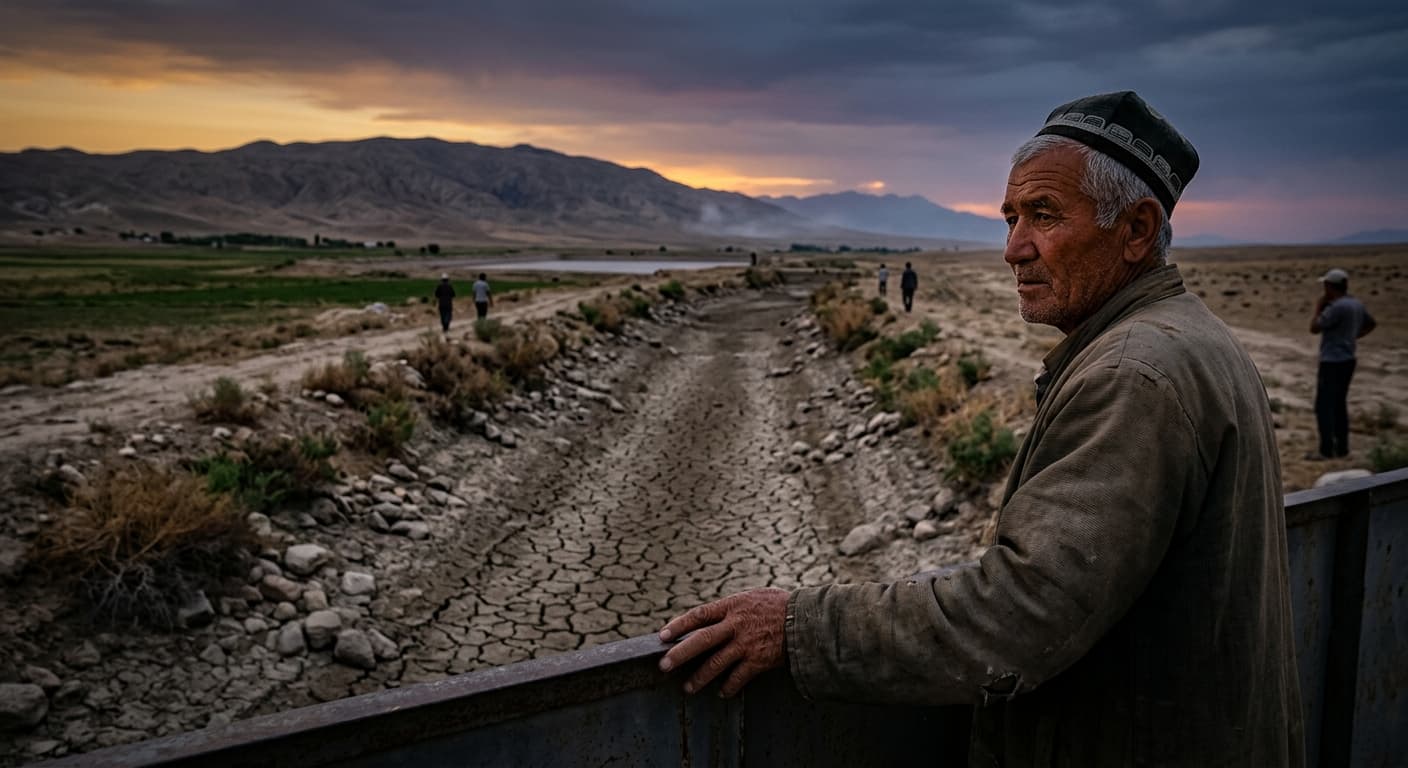
Uzbekistan's SDG 6 Push Hits a $6.1 Billion Wall in 2026
Uzbekistan's 2026 water strategy targets universal piped supply by 2030 — but 61% of the $10 billion cost is unfunded, and a canal in Afghanistan is draining the river it depends on.
Uzbekistan is on paper one of Central Asia's SDG 6 success stories: 80% of residents already rely on piped, safely managed water, according to the World Bank's newly published Uzbekistan Water Compact. Yet the 2026–2030 National Water Forward strategy signed with the Bank this year carries a $10 billion price tag and a $6.1 billion financing gap — and even fully funded, it cannot compensate for the roughly 10 cubic kilometres a year that Afghanistan's Qosh Tepa canal is set to withdraw from the Amu Darya by 2028. Uzbekistan's SDG 6 problem in 2026 is no longer plumbing; it is cotton politics at home and hydro-diplomacy abroad. The acceleration plan Tashkent will bring to the UN Water Conference in Abu Dhabi in December reads less like a WASH document than a fiscal and foreign-policy one.
The headline numbers hide a two-tier country
Uzbekistan's 2020 Voluntary National Review reported that 67.8% of the population was covered by centralized water supply in 2019, with a 2030 target of 91.2%, centralized sewerage rising from 15.6% to 31.4%, and wastewater treatment efficiency climbing from 55% to 80%. By the time the
second VNR went to New York in July 2023, Tashkent had folded those targets into the "Uzbekistan – 2030" strategy and added a WASH commitment on top: 100% clean drinking water and modern sanitation in preschools and general education by 2030, monitored via the UNECE Three Star Approach.
The Water Compact tells a more granular story. Sanitation access remains "relatively low, with only 27.1 percent covered by centralized sewerage systems, with functioning wastewater treatment," the Bank writes, and rural coverage of safely managed water sits near 70% — a full 10 points below the national headline. That gap is where SDG 6.1 and 6.2 will be won or lost. The 2018 European Parliament briefing noted that in Karakalpakstan, "where the Amu Darya River finally dries up, about 95% of the land is saline"; the WHO/Europe
health-system assessment still describes malnutrition, drinking-water shortages, and elevated rates of tuberculosis and bronchitis in the same region. Universal-access statistics that lump Tashkent together with Nukus flatter the average and obscure a health emergency in the country's most fragile province.
[Table: Uzbekistan SDG 6 indicators — baseline, 2026 status, 2030 target]
Nearly half of Uzbekistan's 38 million people live in villages, according to the World Bank's June 17, 2026 announcement of a $340 million second-phase Rural Infrastructure Development Program. The first phase, completed the same month, financed 160 rural water supply systems in 306 mahallas across five regions. Impressive — but a rounding error against the 21,500 kilometres of new water networks and 10,000 kilometres of sewerage the Water Forward says the country needs by 2030. Earlier flagship projects like the
Alat and Karakul Water Supply Project show what saturation looks like — coverage in those two Bukhara districts jumped from under 20% in 2012 to 87% by 2021, reaching 232,760 people — but that took a decade and $74 million for two districts. Scale that arithmetic across Karakalpakstan and Khorezm and the funding problem writes itself.
The financing hole is the story
The Water Compact, structured as a Memorandum of Intention between the government and the World Bank Group, is unusually candid. Renewable internal freshwater resources per capita have declined 25% in the past two decades, agriculture consumes more than 90% of abstraction, and "current infrastructure financing needs are at least six times higher than the historical spending; and tariffs are below full cost." Total estimated cost of the 2026–2030 investment package: $10 billion. Confirmed funding: state budget $1.31 billion, IFIs $1.275 billion, private capital $1.25 billion, other sources $30 million. Financing gap: $6.1 billion — 61% of the total, concentrated in the "water for food" pillar.
[Stat: The unfunded 61% — $6.1 billion gap in Uzbekistan's 2026–2030 water strategy]
That gap collides with a second constraint the IMF flagged in May 2025. Its Selected Issues Paper on Uzbekistan's transition reforms notes that water and heating tariffs remain "administratively determined and below cost recovery," and that price liberalization needs to be completed for utilities to function commercially. The Water Compact's reform annex commits Tashkent to "tariffs reforms to gradually enable cost recovery" and to "corporatization of the regional water utilities." Politically, the phrase "gradually" is doing heavy lifting: the IMF explicitly warns that adjusting utility prices carries "significant distributional effects," which is why electricity and gas hikes had to be paired with targeted compensation. A 2016 World Bank
social impact study already found that Uzbek Vodokanals are debt-laden and cannot cover basic operating costs — but that households not on the network already pay more than double what connected households pay. In other words, the political ceiling on tariffs is lower than the economics require, and closing the $6.1 billion gap through domestic revenue alone is not on the menu.
Cotton is still the veto player
Agriculture uses more than 90% of Uzbekistan's water, and the World Bank's May 2025 irrigation package — a $200 million concessional credit plus $23.2 million in co-financing — targets 259 kilometres of concrete-lined canals, 470 hydraulic structures, and SCADA-enabled gated outlets in five regions including Karakalpakstan. Expected savings: 540 million cubic metres of water and 165 million kWh of electricity each year. Real gains, but bounded ones. Climate projections cited in the same release forecast a 30–40% reduction in water availability and a 25% increase in irrigation demand. On current trajectory, efficiency gains will be swallowed by climate losses before 2030.
The elephant in the field is cotton. Cotton contributes roughly 17% of GDP, according to MP-IDSA, and one kilogram of purified cotton fibre requires up to 17,000 litres of water. As the
Atlantic Council put it in January 2025, "the Uzbekistani government still prioritizes its cotton industry over the protection of Aral Sea, parts of which are likely lost forever." Around 1.26 million hectares — 30% of irrigated land — now use drip or sprinkler systems. The Water Forward wants that at 1.7 million hectares. But a
2025 study in Nature Communications Earth & Environment mapping the Amu Darya basin from 1987 to 2019 found that total crop water consumption rose 10% and per-hectare consumption 18% — driven mostly by climate change, with less water-intensive cropping offsetting only 3% of the increase. The empirical finding is uncomfortable for policymakers: technology alone will not bend the curve while cotton remains the political base of provincial governors.
Qosh Tepa is the hydro-diplomatic ceiling
Even a fully funded, tariff-reformed, drip-irrigated Uzbekistan runs into an upstream problem it does not control. The Taliban government's Qosh Tepa canal, assessed by Carnegie in September 2025 as almost half of its planned 285 kilometres complete, is scheduled to be operational by 2028 and will divert up to 10 cubic kilometres a year — about a third of the Amu Darya's flow. Uzbekistan's own second VNR concedes that water availability in the Amu Darya basin is expected to fall 29.4% by 2030 because of the canal, and that mitigation depends on water-saving technologies. The MP-IDSA analysis is blunter: within 5–6 years of completion, Uzbekistan and Turkmenistan's average intake along the middle and lower reaches could drop from 80% to 65% of historical volumes.
Two second-order effects follow. First, salinity: reduced flow means higher concentration of dissolved solids and worse drinking-water quality precisely in Karakalpakstan, where 95% of land is already saline. SDG target 6.3 (ambient water quality) becomes harder even if pipe coverage improves. Second, transboundary politics: neither Uzbekistan nor Turkmenistan officially recognises the Taliban regime, and Afghanistan is not party to the Interstate Commission for Water Coordination. Tashkent has opted for pragmatism — a March 2023 delegation to Kabul, an November 22, 2025 trilateral water-and-electricity agreement with Kyrgyzstan and Kazakhstan, and reciprocal winter power supplies to keep the Toktogul reservoir filling — but there is still no quota deal with the Taliban for the Amu Darya. As BBC Uzbek reported in December 2025, the Qorasuv reservoir in Samarkand province, designed to hold 26.9 million cubic metres and irrigate 8,100 hectares, was completely dry.
Where the money is finding its way
Uzbekistan has been more creative than most peers about pulling in non-traditional finance. In July 2021, it became the first country in the region to issue SDG bonds worth $235 million, followed by the CIS's first sovereign green Eurobonds worth UZS 4.25 trillion in October 2023 — proceeds earmarked in part for water-saving technologies. UNDP's Integrated Insights work assessed the country as on track for 50 (or 30%) of its national SDG targets, a mid-table score that flatters SDG 6 relative to sanitation and salinity indicators. The Asian Development Bank has
flagged infrastructure expansion and private-sector participation as its 2026 priorities for Uzbekistan, and will host its Annual Meeting in Samarkand — a set-piece Tashkent intends to use to court concessional and private capital for the Water Forward gap.
That courtship is the acceleration story. WHO and UNICEF's January 26, 2026 GLAAS update, released in Dakar at the high-level preparatory meeting, warns that across the 20 countries measured, WASH financing gaps average 46% and non-revenue water averages 39%. Uzbekistan's 61% gap and its 30–40% projected drop in water availability sit at the wrong end of both curves. If Tashkent cannot convert its Water Forward pitch at the
December 2–4, 2026 UN Water Conference in Abu Dhabi into concrete co-financing commitments, the arithmetic points to a slippage of the 2030 SDG 6 targets into the mid-2030s, most visibly in Karakalpakstan.
Who benefits, who loses
Winners: the World Bank, EBRD and ADB, which now anchor the multilateral finance stack; JSC UzSuvtaminot and the Ministry of Water Resources, which capture centralised implementation authority under the Water Forward; and irrigation-technology suppliers positioned for the 1.7 million-hectare drip build-out. Losers: cotton-dependent regional elites facing a slow but real reallocation of water away from thirsty crops; ratepayers, whose tariffs will rise before service quality catches up; and rural Karakalpakstan, whose SDG 6 outcomes depend more on Kabul's canal engineers than on Tashkent's plumbers.
What to watch
- December 2–4, 2026: The UN Water Conference in Abu Dhabi, where Uzbekistan is expected to formally register the Water Forward as a voluntary commitment and seek co-financing pledges to narrow the $6.1 billion gap.
- Qosh Tepa milestone (2027–2028): Full operationalisation of the Afghan canal. Watch for a first formal quota negotiation — or its absence — between Tashkent and the Taliban.
- Tariff reform ordinance: The Water Compact commits Uzbekistan to a National Water Strategy to 2050 including tariff reform and utility corporatisation. Timing and sequencing of the first cost-recovery tariff hike will signal whether the IMF's reform prescription is politically deliverable.
The Bottom Line
Uzbekistan's SDG 6 acceleration case is not a story about pipes and pumps; it is a stress test of whether a middle-income transition state can finance climate-era water security while an unrecognised neighbour rewrites the hydrology of its main river. The Water Forward's $10 billion ambition is credible; the $6.1 billion gap and the 10 cubic kilometres a year flowing to Qosh Tepa are the two numbers that decide whether Tashkent hits its 2030 targets or slides into a mid-2030s catch-up.
Discover more

US Politics
House Ethics Committee Pushes Sexual Miscond.
The House Ethics Committee has shifted responsibility for sexual harassment settlement records to the Office of Congressional Workplace Rights, complicating disclosure efforts.
US Politics
Congress Targets AI Chatbot Access for Terror
The House passed the Generative AI Terrorism Risk Assessment Act, focusing on AI's role in terrorism and potential surveillance implications.
US Politics
US Military Strikes Drug Traffickers Pacific
A U.S. military strike in the eastern Pacific killed two amid an anti-drug trafficking campaign, raising questions over sovereignty and regional cooperation.

Economics
Fed's Amex AML order puts correspondent banking on notice
Federal Reserve's Amex AML order requires board-level controls and a 90-day plan; OCC fined the bank $350 million over enterprise-wide deficiencies.