US-Japan-South Korea Nuclear Pact Explained
Trilateral agreement targets Southeast Asia's nuclear market.
Model Diplomat9 min readAsia
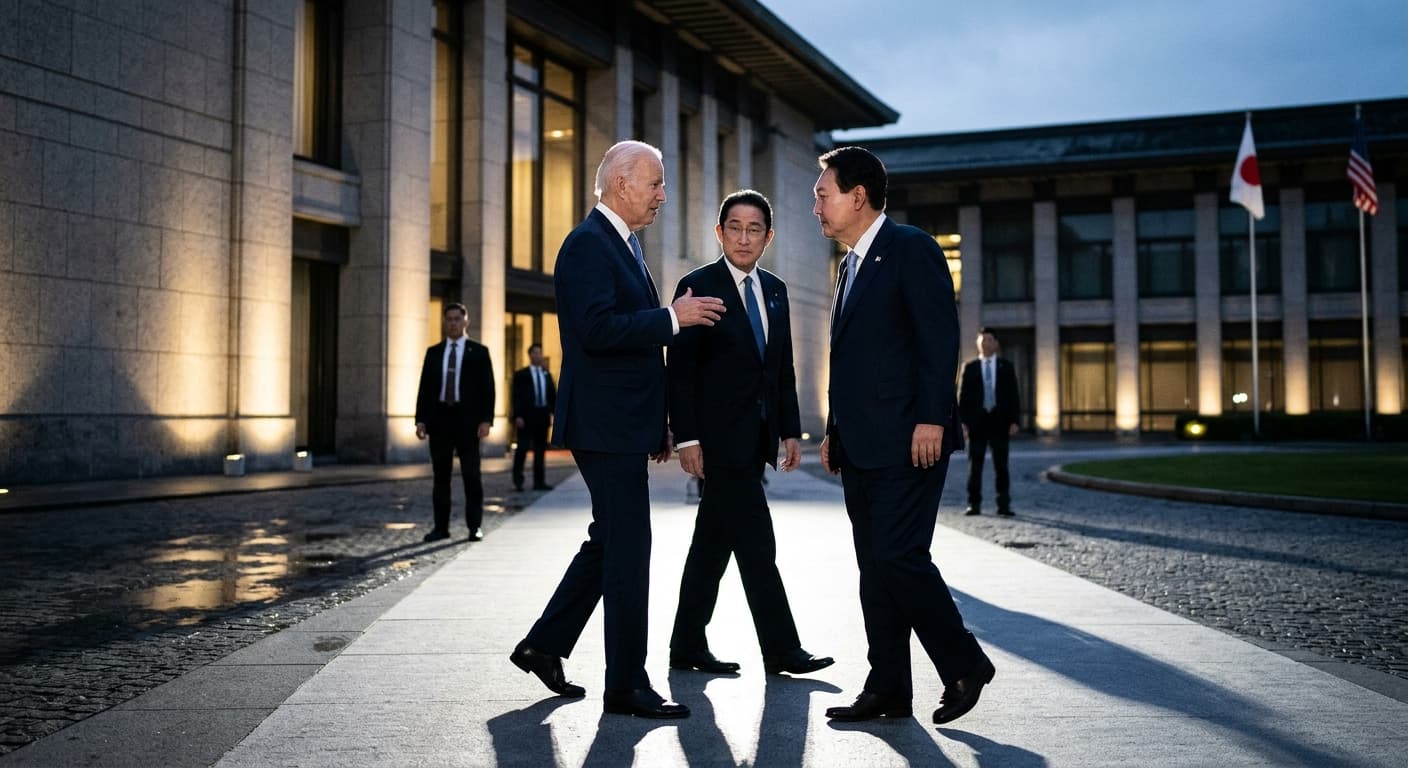
US-Japan-Korea Ankara Trilateral: Nuclear Reactors as Indo-Pacific Containment
U.S., Japan and South Korea signed an SMR export pact in Ankara on July 7, 2026. The real target isn't clean energy — it's Rosatom and CNNC in Southeast Asia.
The deliverable that Secretary of State Marco Rubio, Japanese Foreign Minister Motegi Toshimitsu and South Korean Foreign Minister Cho Hyun signed on the margins of the NATO summit in Ankara on July 7, 2026, was dressed up as a civil-nuclear cooperation memorandum. Read the primary text and it is something else: a coordinated bid to lock Russian and Chinese reactor vendors out of a $208 billion Southeast Asian nuclear build-out over the next quarter century — and to reweld a trilateral partnership that is quietly fracturing over Taiwan. The Ankara meeting matters less for what the three ministers said about deterrence and more for how they are converting security cooperation into industrial policy against Beijing and Moscow.
According to the U.S. State Department media note, the ministers signed a "trilateral memorandum of cooperation on civil nuclear energy in support of accelerating the deployment of small modular reactors in third partner countries, as well as diversification towards U.S. energy imports." Washington attached more than $10 million in new funding for a State Department program to seed Indo-Pacific SMR project development and a regional workforce training hub,
Yonhap reported. The rest of the communiqué reads like a checklist — denuclearization of North Korea, Taiwan Strait stability, opposition to economic coercion, freedom of navigation. The SMR pact is the only new instrument on the table.
The industrial angle hiding inside a security meeting
Southeast Asia is where the trilateral's real leverage will be tested. Wood Mackenzie projects the region will need $208 billion to build 25 gigawatts of nuclear capacity by 2050, with SMRs the preferred technology in every market except Vietnam. Indonesia has already written two 250 MW SMR units into its 2025–2034 electricity supply plan; Malaysia, Thailand, the Philippines and Singapore all have SMR targets on paper. None of these countries has an operating reactor today. Whoever wins the first tenders will set the region's technology standard, fuel-cycle dependency and safety regulator for a generation.
The competitors are moving fast. Russia's Rosatom signed an intergovernmental SMR agreement with Myanmar's junta in March 2025, Energy Intelligence reported, and locked in a large-reactor deal with Vietnam by April 2026. China's CNNC won Kazakhstan's second nuclear plant tender in June 2025 — beating both France's EDF and Korea Hydro & Nuclear Power (KHNP) — and is
pushing multiple SMR designs into the export pipeline. Beijing's advantage is state-directed financing that Washington cannot match one-for-one. That is the gap the Ankara MOU is designed to plug.
| Country | 2050 SMR target | Lead foreign partner | Status |
|---|---|---|---|
| Vietnam | 10.5–14.0 GW (mostly PWR) | Rosatom (April 2026 IGA) | Construction targeted by 2030s |
| Indonesia | 2 × 250 MW in 2025–34 plan | None finalized | SMR study phase |
| Philippines | 2.4 GW | US vendors (feasibility) | Regulatory build-out |
| Thailand | 3 GW (600 MW by 2037) | Undecided | Policy review |
| Malaysia | 1.2 GW by 2050 | Undecided | Delayed from 2031 |
| Singapore | 0.8 GW | Undecided | Exploratory |
| Myanmar | One Rosatom SMR | Rosatom (March 2025 IGA) | Financing unresolved |
The trilateral pitch is that South Korean manufacturing muscle plus Japanese balance-sheet capacity plus U.S. reactor IP and export-finance tools gives Rosatom something to worry about. Cho brings KHNP and Doosan's fabrication capability; Motegi brings Japanese megabank financing that Trump pressed for during his October 2025 Asia trip; Rubio brings Westinghouse — in which the U.S. federal government could take a 20% stake under a strategic partnership announced by the Commerce Department last autumn — plus X-energy, GE Vernova-Hitachi and roughly $17.5 billion in conditional Department of Energy loan commitments for AP1000 newbuilds. That is a considerably deeper bench than a joint statement usually reveals.
That coordination has a specific commercial predicate. In January 2026, KHNP and its parent Korea Electric Power settled a long-running intellectual-property dispute with Westinghouse. Under terms the Financial Times reported and E&E News summarized, KHNP will pay Westinghouse $825 million per exported reactor for 50 years and restrict its own sales to Southeast Asia, the Middle East, Latin America and Africa. Days after the settlement, KHNP
withdrew from Slovenia's JEK2 tender. South Korea's ruling Democratic Party called the deal a "humiliating slave contract" — but it is the precondition that made Ankara's MOU legally possible. Without it, Seoul and Washington would still be litigating in U.S. federal court instead of dividing up Jakarta and Manila.
The Team Korea concept is already operating on U.S. soil. In August 2025, Amazon, X-energy, KHNP and Doosan signed a memorandum to deploy more than 5 GW of Xe-100 SMRs across the United States by 2039, with Amazon alone targeting the purchase of 64 units. X-energy CEO J. Clay Sell told E&E News the arrangement could drive up to $50 billion in U.S. investment. Ankara internationalises that model. Read together, the January settlement, the Team Korea SMR agreement and the July MOU represent a single industrial architecture — a trilateral nuclear cartel with defined territories, cross-licensing and a pooled export bank.
The Taiwan Strait paragraph is stronger than it looks
The security language is where the Ankara statement did quiet but important work. The ministers "expressed concern about increasingly frequent destabilizing actions around Taiwan" — a formulation stronger than the July 2025 ASEAN-margins meeting used, and one that directly answers the November 2025 declaration by Japanese Prime Minister Sanae Takaichi that a Taiwan Strait contingency could be a "survival-threatening situation" for Japan. Beijing responded to Takaichi with export controls on 20 Japanese firms including Mitsubishi Heavy Industries, Kawasaki Heavy Industries and Subaru, Al Jazeera reported in February 2026, and
added dozens more entities to the list on June 29, 2026 — barely a week before the Ankara talks. Fudan University's Wu Xinbo
wrote for Brookings that Beijing has treated Takaichi's remarks as a red line and is prepared to "pay any price" to signal that any foreign military role in a Taiwan contingency is unacceptable. The Ankara language is Washington and Seoul standing behind Tokyo in the middle of that campaign.
That is significant because Cho's boss has been publicly hedging. President Lee Jae Myung told CCTV in early January that Seoul "respects the 'one China' principle," and said during his campaign that "we must keep our distance from a China-Taiwan contingency," as the BBC reported after his June 2025 election victory. He met Xi Jinping twice inside two months — at the Gyeongju APEC in October 2025 and in Beijing in January 2026,
per Al Jazeera — and declared a "comprehensive restoration" of Seoul–Beijing ties. The Asan Institute has
openly warned that Beijing is exploiting historical narratives with Seoul to drive a wedge into the trilateral. Cho signing off in Ankara on language about "destabilizing actions around Taiwan" walks the Lee doctrine back further than any statement his government has issued to date. That is the concession Washington extracted.
$208 billion — the projected Southeast Asian nuclear investment through 2050, per Wood Mackenzie's 2025 report. That is the prize the Ankara MOU is designed to compete for.
The Pyongyang problem the joint statement did not solve
Look at the North Korea paragraphs and the ministers held the traditional line — "complete denuclearization of the Democratic People's Republic of Korea" and stronger cooperation against DPRK cyber activity. But that line is diverging from Washington's own strategy. The Stimson Center noted that the November 2025 U.S. National Security Strategy contained no reference to North Korea and no mention of denuclearization — a striking omission compared to the 2017 NSS, which named Pyongyang 16 times. President Trump has meanwhile signalled openness to resuming talks with Kim Jong Un. The ministers' reaffirmation in Ankara is, in effect, Tokyo and Seoul pinning Rubio to a policy that Trump's own strategy document has abandoned.
The strategic backdrop for that language has hardened. The Council on Foreign Relations estimates that North Korea has sent 14,000–15,000 troops to fight for Russia since October 2024 and that South Korea's central bank recorded 3.7% GDP growth in Pyongyang in 2024 — its fastest in eight years — thanks to Russian oil transfers that shattered the UN cap. A BBC investigation of a new Pyongyang memorial
put the North Korean death toll at roughly 2,300 soldiers, with the ROK's National Intelligence Service estimating 6,000 dead or wounded by February 2026. Russia's March 2024 veto of the UN Panel of Experts — which CSIS
described as the third step in a "systematic effort to undermine the UN sanctions regime" — means the trilateral's cyber-cooperation pledge is now doing work that the Security Council no longer will. The U.S. Treasury accused Pyongyang in November 2025 of stealing $3 billion in digital assets over three years,
Al Jazeera reported, most of it through Lazarus Group activity routed via Chinese and Southeast Asian intermediaries. The Ankara text commits the three to disrupting exactly that pipeline — a task the UN system has abdicated.
Who wins, who loses
Named winners: Westinghouse, KHNP, Doosan, GE Vernova-Hitachi, X-energy, Amazon, the U.S. Export-Import Bank, and the Japanese megabanks that will syndicate SMR project finance. Named losers: Rosatom, which loses a Southeast Asian market it had begun to lock up through the Myanmar and Vietnam deals; CNNC, which now faces a coordinated Western alternative in every Wood Mackenzie–identified market; and, more subtly, EDF, which was already struggling to secure export projects and has just watched the Anglosphere close ranks around a Korean-Japanese-American consortium.
The historical parallel is not Camp David. It is the 1974 Sapporo-era negotiations that built the U.S.-Japan-Korea LWR consensus in the first place — trilateral industrial policy shaped by security cooperation. The August 2023 Camp David summit under Biden, Kishida and Yoon institutionalised the political vehicle, as Stimson catalogued. Ankara loads industrial content onto that vehicle at a moment when all three governments have changed — Trump replaced Biden, Takaichi replaced Kishida, Lee replaced Yoon — and yet the trilateral is still producing new deliverables. That is the durability test Stimson identified as the framework's original purpose.
What to watch next
- The first Southeast Asian tender: Indonesia's SMR unit selection process under its 2025–2034 plan is the earliest live test. Rosatom, CNNC or the Ankara consortium — whichever wins Jakarta will set the region's regulatory template.
- The next trilateral meeting: Rubio, Motegi and Cho committed to continue meeting at all levels. Watch for a full trilateral leaders' summit before APEC 2026 in Shenzhen this November, which China chairs.
- The Westinghouse-KHNP joint bid: Turkey has
proposed a trilateral partnership between KEPCO, Westinghouse and Türkiye Nükleer Enerji for one of its planned plants, alongside a 5 GW SMR build-out. If that deal reaches FID, the Ankara MOU has its first commercial validation.
Diplomat View
The Ankara MOU is the moment the Camp David trilateral stopped being a security alignment and became an industrial cartel with a security lease. That is a defensible upgrade because it gives the framework a commercial constituency in three capitals — Westinghouse and X-energy shareholders in the U.S., megabanks and reactor vendors in Japan, KHNP and Doosan in South Korea — which is exactly what the Camp David architects said would make trilateralism survive leadership turnover. The forecast: the Ankara consortium will win at least one Southeast Asian SMR contract by the end of 2027, most likely Indonesia or the Philippines, and Rosatom will retain Vietnam and Myanmar because both projects are already too far along to reverse. The forecast breaks if Lee's Beijing tilt hardens into an explicit ROK carve-out from the Taiwan Strait language at the next trilateral, or if Trump strikes an unrelated deal with Kim Jong Un that treats North Korea as a de facto nuclear weapons state — either move would strip the political cover from Cho's commercial cooperation with Rubio and Motegi. Watch Seoul, not Washington, for the signal.
The Bottom Line
The Ankara trilateral converted a Camp David-era security framework into an industrial instrument aimed at capturing a $208 billion Southeast Asian nuclear market that Russia and China have been quietly locking up. The SMR memorandum, not the Taiwan paragraph, is the load-bearing deliverable — and Seoul's willingness to sign it, weeks after Lee Jae Myung's Beijing summit, is the most concrete evidence yet that the pragmatic hedge has commercial limits.
Discover more

US Politics
SNAP Food Assistance Faces Legal Challenges
In 2026, SNAP faces stricter eligibility rules and mounting legal challenges, threatening food assistance for the millions of Americans who rely on the program.

US Politics
US Launches $166B Tariff Refund Portal
The US is launching a $166 billion tariff refund portal to aid importers hit by Trump-era tariffs, with major implications for trade and supply costs.
US Politics
U.S. House Passes Alert Act for Aviation
The House passed the ALERT Act 396–10, replacing the ROTOR Act after Pentagon intervention, impacting aviation safety regulations.

Economics
Fed's Amex AML order puts correspondent banking on notice
Federal Reserve's Amex AML order requires board-level controls and a 90-day plan; OCC fined the bank $350 million over enterprise-wide deficiencies.