U.S.-Iran Ceasefire Tensions Amid White House
Ceasefire hangs by a thread as midterm elections approach.
Model Diplomat8 min readMiddle East
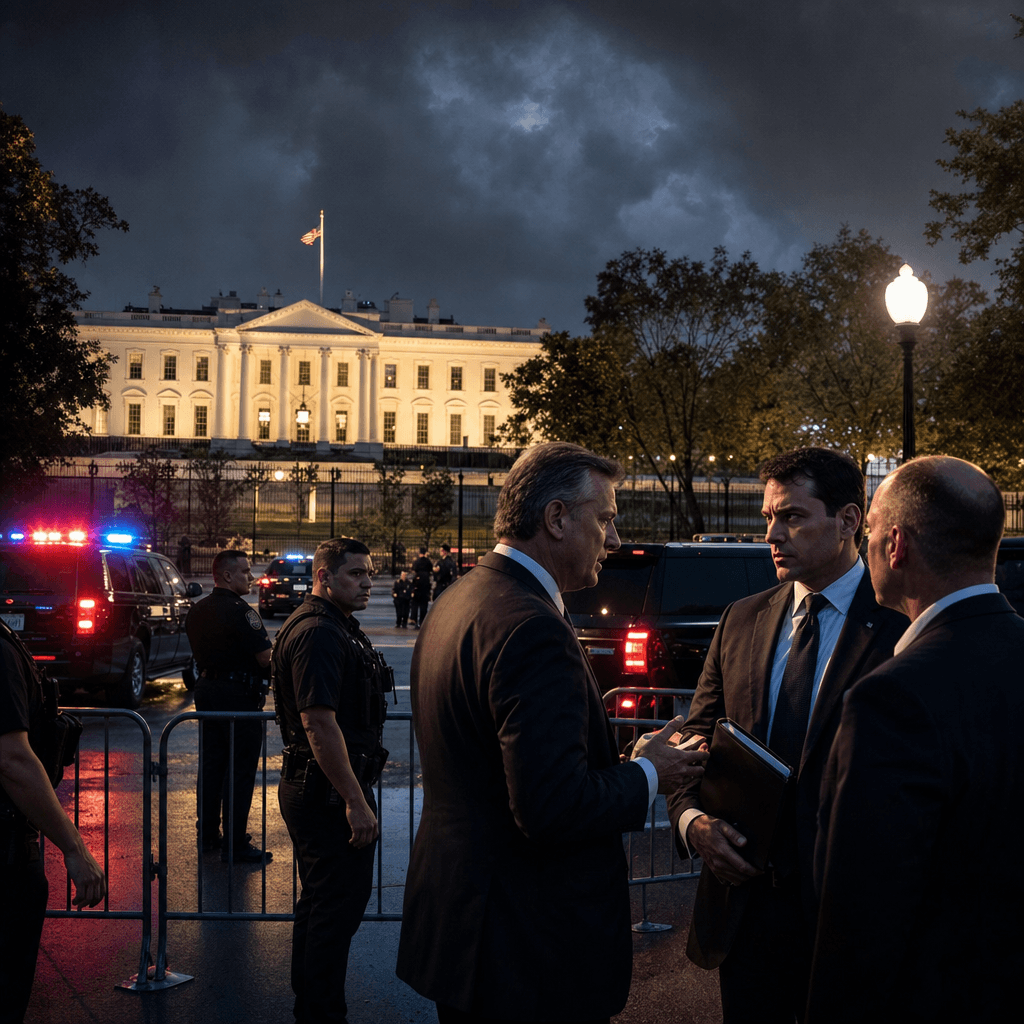
US-Iran Ceasefire Frays as White House Races a 60-Day Clock
Trump's June 17 memorandum with Iran is holding by a thread as Doha talks stall, Hormuz strikes resume and midterm politics close in on the White House.
The US–Iran ceasefire that ended a 40-day war is now the White House's most fragile foreign-policy asset — and its most politically expensive. Two weeks into the 60-day window opened by the June 17 memorandum of understanding, the parties have exchanged strikes in the Strait of Hormuz, failed to hold direct talks in Doha, and agreed only to a hotline to log each other's violations. The thesis: Trump does not need a good deal with Tehran, he needs the deal to look alive through November 3 — and Iran's new leadership has correctly priced that in, using Hormuz transit as the pressure point that costs Washington a percentage of GDP every week the war restarts.
The MoU nobody wants to enforce
The document itself is thin. According to the full text released by the BBC, the 14-point memorandum runs about a page and a half. It codifies an immediate ceasefire "on all fronts, including Lebanon," lifts the US naval blockade within 30 days, and gives Tehran 60 days to negotiate a final deal covering the Strait of Hormuz, sanctions relief, a $300 billion reconstruction pledge and the fate of Iran's stockpile of roughly 440 kg of uranium enriched to 60%. It was signed electronically by President Donald Trump at Versailles during the G7, and separately by Iranian President Masoud Pezeshkian in Tehran, on June 17, 2026, and later hailed by the White House as "
America First in Action."
Point 5, on the Strait of Hormuz, is where the wiring is exposed. It obliges Iran to make "best efforts" to allow safe passage "with no charge for 60 days," and to conduct dialogue with Oman on the strait's future administration. Point 9 requires both sides to maintain the status quo pending a final deal — no new sanctions, no additional US forces, and no changes to Iran's nuclear program.
Alan Eyre, a former senior US diplomat, told Al Jazeera the memorandum "was a one-and-a-half-page document where ambiguity was the feature and not the bug." That ambiguity produced the June 26 crisis, when an Iranian drone struck the Singapore-flagged Ever Lovely in the strait. US Central Command retaliated the same night against Iranian missile, drone and radar sites, calling the shipping attack a clear ceasefire violation. Iran's IRGC then hit US bases in the Gulf.
Doha: talks about talking about talks
The July 1 round in Doha did not close the gap; it papered over it. According to Al Jazeera's readout, Iranian Deputy Foreign Minister Kazem Gharibabadi confirmed after the meeting that Tehran would establish a "communication channel" with Washington to report breaches of the MoU. The two sides did not meet directly. US special envoy Steve Witkoff and Jared Kushner met Qatari Emir Sheikh Tamim bin Hamad Al Thani; Iran's technical team spoke to Qatari and Pakistani mediators, then to the Americans through them.
Vice President JD Vance called Tehran's refusal to acknowledge direct talks a "Persian negotiating tactic" — and told reporters in Virginia Beach that he "can't commit to anything" about a return to force before the MoU deadline, according to Al Jazeera. What was actually agreed in Doha, per Gharibabadi, was a mechanism to release part of a $6 billion tranche of frozen Iranian assets held in Qatar to pay for imported goods.
The BBC's diplomatic correspondent framed the picture bluntly in a July 2 analysis: "Are US and Iran close to peace or sliding back to war?" Trump the same day told his cabinet he was "not satisfied" with the terms on offer and warned that if Iran did not comply, "the man on my left [Defense Secretary Pete Hegseth] is going to finish them off."
Who benefits: Tehran's Hormuz doctrine, priced
The story most easily missed is that Iran's leverage has grown, not shrunk, since Ayatollah Ali Khamenei was killed in the opening US–Israeli strike on February 28. According to a BBC report from March 1, Iran's Red Crescent counted at least 201 dead across 24 provinces on day one; the toll rose to 555 within 72 hours per
Al Jazeera. On March 8, the Assembly of Experts named Mojtaba Khamenei, 56, as Supreme Leader — a candidate the IRGC pushed and Trump publicly called "unacceptable," per the
BBC's profile.
Yet it is the younger Khamenei's Iran that turned a chokepoint into a revenue line. Tehran stood up a new bureaucracy — the Persian Gulf Strait Authority — to demand transit fees from every vessel crossing Hormuz. Speaker Mohammad Bagher Ghalibaf, Iran's lead negotiator, said publicly on June 17 that "the Strait of Hormuz will not return to pre-war conditions" and that Iran would collect a "fee for services," according to Al Jazeera's breakdown.
The US Treasury sanctioned the PGSA on May 1, 2026, in a package titled "Economic Fury," and issued a companion alert on the "Sanctions Risks of Iranian Demands for Strait of Hormuz Passage." That designation is the primary US document nailing down what the strategic fight is actually about: not the nuclear file, but who owns the toll booth. Before the war, roughly 20 million barrels a day passed through Hormuz — about one-fifth of global oil and LNG.
The market has priced in a partial reopening. Brent crude closed at $72 on July 6, 2026, "below Brent's settlement price of $72.48 on February 27, the day before the US and Israel launched strikes on Iran," according to Al Jazeera's energy desk. It briefly topped $126 in April. But traffic remains thin: MarineTraffic recorded 38 transits on July 2 versus roughly 130 daily before the war. Iran, in effect, still controls the tap.
The White House's political clock
Inside Washington, the war is now the single foreign-policy issue capable of moving the House map. The Council on Foreign Relations' Jim Lindsay wrote on July 2 that Trump's approval rating has fallen "from 13.4 points underwater when the first bombs fell on Iran" to 19.4 points underwater today, with 38.5% approving and 57.9% disapproving, per CFR polling averages. Republicans hold a five-seat House majority. Since 1860, the president's party has gained seats in the House in only four of 41 midterms.
Congress has already started to bolt. On June 23, both chambers passed a war-termination resolution led by Rep. Gregory Meeks (D-N.Y.) — the first time both houses have voted to end a live conflict since the modern War Powers Resolution regime, Sen. Chuck Schumer noted in a statement circulated by Sen. Tim Kaine. A day later, on June 24, the Senate rejected a motion to proceed on Kaine's follow-on measure S.J. Res. 185, with Republicans Susan Collins and Lisa Murkowski crossing over — the
official roll call shows 47 yeas, mostly along party lines. Sen. Adam Schiff has since forced eight further procedural votes, per his
office's tally.
The Pentagon confirms 14 US service members have been killed since February 28. CFR's tracker put the national average at $4 a gallon in late June — well above pre-war levels. Gas prices retreated but the political damage did not.
The Warsaw-based OSW think tank reads the same picture from the other side: "From the US perspective, implementation of the agreement would make it possible to defuse the economic dimension of the crisis by reopening the Strait of Hormuz, which is of particular importance in light of the congressional midterm elections in the autumn."
The spoilers: Lebanon and the stockpile
Two variables can still detonate the MoU before August 16.
The first is Lebanon. Point 1 of the memorandum commits both parties to a permanent end of military operations "on all fronts, including in Lebanon." Israel has not stopped. On June 26, Prime Minister Benjamin Netanyahu signed a US-brokered "framework" with Beirut that allows Israeli forces to remain in southern Lebanon until Hezbollah is disarmed — a condition Hezbollah has rejected and Iran calls a direct violation of the MoU. The Atlantic Council called Lebanon "the variable most likely to play spoiler." The
CSIS state-of-play brief reached the same conclusion three weeks earlier.
The second is the enrichment file. Iran retained an estimated 440 kg of uranium enriched to 60% at the start of the war, according to IAEA Director-General Rafael Grossi, quoted by Al Jazeera on June 27. The MoU requires down-blending on site under IAEA supervision. Nothing has begun — no inspectors, no timeline, no agreed site access. Grossi's warning was blunt: "Intentions are not enough. We have to have a very strong verification system in place."
Diplomat View
The forecast: the MoU survives past August 16 in extended, deliberately ambiguous form — because neither side can afford the alternative before November 3. Trump cannot reopen a war whose approval sits at 35.7% while gas hovers near $4. Mojtaba Khamenei cannot deliver a nuclear concession without cracking the IRGC coalition that put him in office. So the ceasefire will hold — as a set of tit-for-tat strikes below the escalation threshold, with Doha as the pressure valve.
The trade Tehran is quietly making: cash and sanctions relief now, in return for permanent legitimacy over Hormuz traffic management. That is the second-order shift no communiqué will mention. If Iran ends 2026 collecting a per-vessel transit fee under some fig-leaf Iran–Oman authority, it will have converted a battlefield loss into a permanent geopolitical rent — the first Middle Eastern chokepoint privatized to a sanctioned state since Suez.
Two conditions would force revision of this forecast. First, a mass-casualty Hezbollah strike on Israel that pulls the IDF back into Lebanon at scale; the White House would lose the ability to argue the ceasefire exists. Second, a Republican defection in the Senate large enough to override a Trump veto on the next war powers resolution — currently four votes away.
Watch these:
- Aug. 16, 2026 — nominal 60-day MoU deadline under Point 3; a mutual-consent extension is expected but not guaranteed.
- Doha, mid-July — next scheduled technical round after Khamenei's six-day funeral processions conclude July 9 in Mashhad.
- UN Security Council — Bahrain's emergency session on Iranian "aggression" opened July 2; a follow-on resolution on Hormuz freedom of navigation is being drafted.
- November 3, 2026 — US midterms; the ceasefire's political half-life.
The bottom line: the US–Iran ceasefire is not a peace, it is a stall — and the stall benefits Tehran more than Washington. Every week the MoU technically holds, Iran normalizes its authority over the Strait of Hormuz and pockets sanctions waivers, while Trump buys political cover for a war that has become his party's biggest midterm liability. The deal will look successful until it doesn't.
Discover more
Global
Iran Strikes Bahrain and Kuwait Amid US Ties
Iran's IRGC claims missile strikes on 85 US sites in Bahrain and Kuwait after the US revokes its oil sales license, escalating regional tensions.
International Relations
US-Iran Talks: Disputed Agreements Unveiled
US-Iran talks expose deep disagreements over nuclear inspections and sanctions relief, leaving any agreement uncertain as both sides hold firm on core demands.
Global Politics
Iran's De-confliction Cells Face Lebanon Test
The US-Iran ceasefire's de-confliction cells face an early test as Israel presses strikes in Lebanon, straining the fragile deal and wider US-Iran relations.
International Relations
Nabatieh Ceasefire Unravels Amid Attacks
Israeli airstrikes resumed in southern Lebanon, killing 16 near Nabatieh as a fragile ceasefire with Hezbollah collapses and regional tensions escalate.