UN's 62nd Session Strengthens Lawyer Protec
New UN resolution addresses lawyer protections globally
Model Diplomat7 min readGlobal
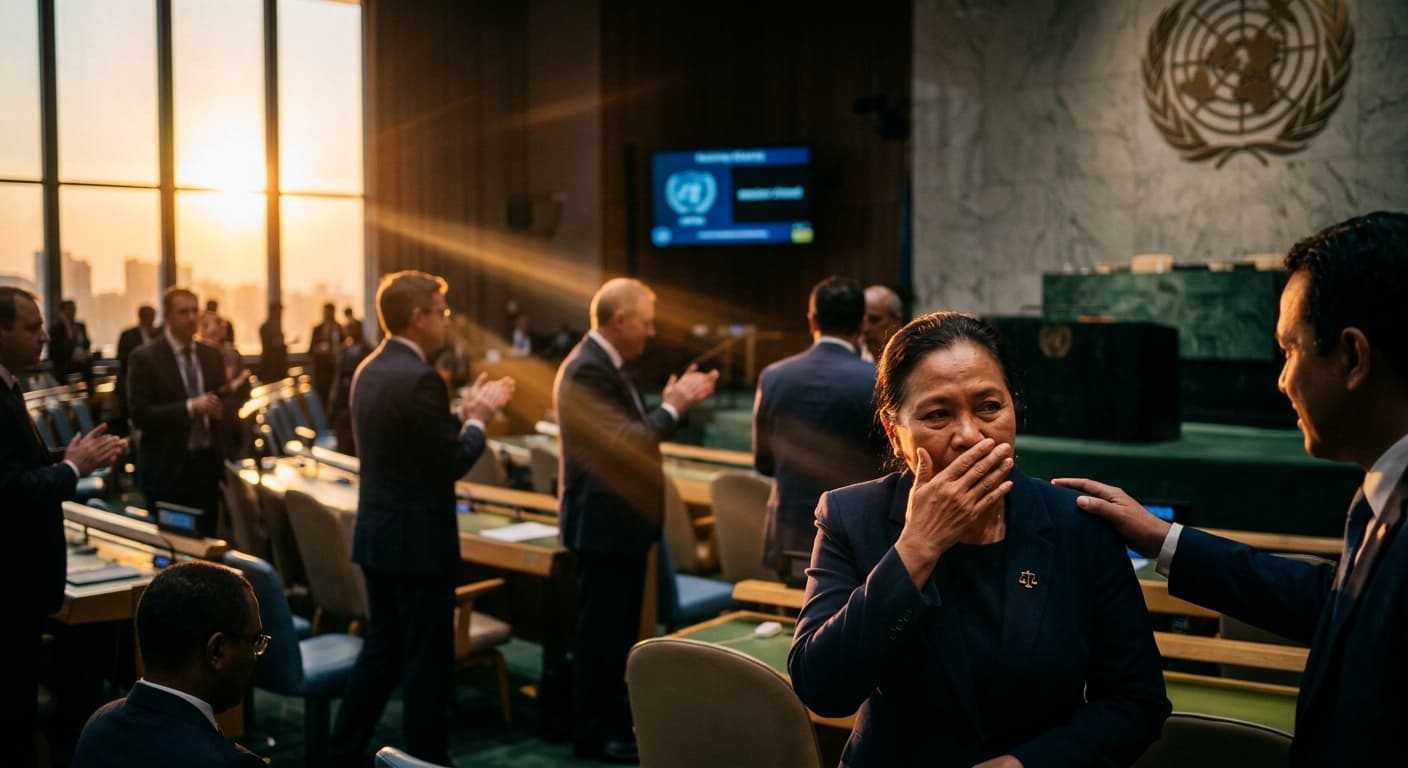
UN's 62nd Session Hardens Rules on Lawyer Crackdowns Worldwide
The Human Rights Council's 62nd session renewed the Special Rapporteur mandate and, for the first time, wrote SLAPPs, cross-border reprisals and surveillance of attorney-client contacts into UN law.
On July 7, 2026, the UN Human Rights Council closed its 62nd session by adopting — without a vote — a resolution that for the first time names SLAPPs, cross-border reprisals against lawyers, and state surveillance of attorney-client communications as attacks on the international rule of law. The subject was not a war or a treaty body. It was the people who argue cases in courtrooms. The move locks in — inside a UN instrument — the same protections the Council of Europe codified last year in its Convention for the Protection of the Profession of Lawyer, and it does so at the exact moment when Freedom House says at least 78 countries have detained, prosecuted or imprisoned legal professionals in the past decade. That convergence is the story: the UN's political organs have quietly caught up with a global pattern of criminalising defence lawyers, and states that jail their own bar now face a denser web of standards to answer for.
What the resolution actually changed
The renewed text — negotiated by a core group that included the International Bar Association's Human Rights Institute (IBAHRI) — does three things that earlier UN resolutions on the topic did not do. According to the International Service for Human Rights, the new language condemns "the increasingly frequent attacks on the independence of judges, lawyers, prosecutors and court officials, including those serving in international courts"; explicitly identifies SLAPPs and "cross-border attacks"; and requires that lawyer-client confidentiality be protected "from undue interference, including surveillance." A standalone paragraph obliges states to align judicial appointments with international, merit-based standards. The
IBAHRI summary confirms the resolution also references the new Council of Europe treaty as an authoritative regional benchmark.
The mandate, held since October 2022 by New York University law professor Margaret Satterthwaite, was previously extended in 2023 by resolution 53/12 for three years, according to the Office of the UN High Commissioner for Human Rights. HRC62 rolls that renewal forward and widens the mandate-holder's remit.
The primary document sits under symbol A/HRC/62/43. In her thematic report to the session, published by
OHCHR, Satterthwaite set out "principles aimed at ensuring that judicial selection and appointment reinforce independence and impartiality and sustain public confidence in the administration of justice." That report — and its annex on Guatemala, A/HRC/62/43/Add.1 — is the anchor the resolution builds on.
Why this session, and why now
Two forces pushed the Council past the vague language of previous years. The first is the Council of Europe's Convention for the Protection of the Profession of Lawyer, adopted in Strasbourg on March 12, 2025 and opened for signature on May 13, 2025 — the first binding international treaty designed solely to protect lawyers from harassment, threats and undue interference. Northern Ireland's Department of Justice publicised the
Stormont signing ceremony as a "landmark international agreement." The UN text explicitly cross-references this convention, giving it soft-law reach beyond Europe's 46 member states.
The second force is documentation. Freedom House's 2025 policy brief "Justice in Shackles" mapped politicised prosecutions of judges, prosecutors or lawyers in at least 78 countries between 2014 and 2024, with lawyers targeted in 75 of them. The examples are not marginal: over 1,600 lawyers were arrested in Turkey in the five years after the 2016 coup attempt; 44 Iranian defence lawyers were detained during the 2022 "Woman, Life, Freedom" protests; and the Assistance Association for Political Prisoners had documented 68 lawyer arrests in Myanmar as of March 5, 2025. In Russia,
UN News reported that the Special Rapporteur on Russia condemned the "extremism" sentences handed to three of Alexei Navalny's defence lawyers in January 2025 — the type of case the new SLAPP and confidentiality language is designed to catch.
The Council's crackdown clause is not academic. When Human Rights Watch summed up the session on July 8, it flagged Satterthwaite's specific denunciation of reprisals against Tunisian judge Anas Hmedi, president of the Association of Tunisian Magistrates, and the mass prosecution of defence lawyers in Tunis's "Conspiracy Case." Tunisian authorities responded by dismissing civil-society concerns from the floor of the Council.
The unexpected beneficiary: American Big Law
The most unusual audience for this resolution is not in Tehran or Ankara. It is in Washington. In April 2025, US federal court filings by the Union Internationale des Avocats and other bar bodies — filed in Case 1:25-cv-01107-LLA in the US District Court for DC, challenging an executive order targeting a US law firm — cited the UN Special Rapporteur's 2024 report and Human Rights Council resolution A/HRC/RES/56/3 as evidence that punishing lawyers for their clients' identities violates international norms. The brief called the executive order "an egregious infringement of a range of internationally-recognized rights designed to ensure the independence of lawyers." That American bar associations are now reaching for Geneva instruments to defend firms against their own executive branch is new — and it is exactly the pattern the HRC62 resolution attempts to entrench.
That matters because the strongest critique of UN lawyer-protection language has always been that it applies to weak states while the strong ignore it. When American firms cite the same instruments IBAHRI deploys against Beijing or Moscow, the standard becomes harder to dismiss as selective. The resolution's practical power lies less in enforcement than in its universal availability as a litigating norm.
The Guatemala case study — and its stress test
Satterthwaite's country visit annex focuses on Guatemala, where the pattern the resolution now names — instrumentalisation of criminal law against judges and prosecutors — has been unfolding for years. Amnesty International's 2025 country report documented the continued arbitrary detention of anti-corruption prosecutor Stuardo Campo, the prosecution of former CICIG staffer Claudia González, and the "undue influence of partisan actors and private interests" over judicial appointments that the Special Rapporteur denounced after her May 2024 visit. Twenty-two justice officials had already fled Guatemala since 2018, according to earlier
Amnesty submissions to the Universal Periodic Review.
Pakistan supplies the parallel case in Asia. On January 24, 2026, a district court in Rawalpindi sentenced human-rights lawyers Imaan Mazari and Hadi Ali Chattha to ten years each on cyber-terrorism charges over social-media posts, according to an Amnesty International urgent action. Amnesty separately documented amendments to Pakistan's Federal Constitutional Court that the Special Rapporteur has flagged as "court capture" risks in a
January 2026 briefing. Both cases now fit inside the categories the resolution formally names.
The stress test — the one to watch — is transnational. Freedom House's 2026 Transnational Repression report recorded Interpol Red Notices issued in May 2025 against two Spain-based Salvadoran lawyers, Ivania Cruz and Rudy Joya, whom UN experts recognised as targets of transnational repression "in direct connection with their legitimate human rights work." Interpol revoked the notices; Spain granted asylum in 2026. That is precisely the "cross-border attacks against legal professionals" phrase the new resolution puts into UN law.
The women-in-law side track
The 62nd session also revived a slower reform track: the pipeline into the profession itself. The IBAHRI side event "Women in Law: Overcoming Gender-Based Barriers and Advancing Access to Justice," co-organised with Lawyers for Lawyers and the International Commission of Jurists and moderated by IBAHRI's senior UN representative Francesca Restifo, brought Satterthwaite together with the UN Working Group on Discrimination against Women and Girls and the immediate past president of the Geneva Bar Association. The panel's argument — laid out in the IBAHRI's Mirage News summary — was that persistent pay gaps, harassment and underrepresentation in judicial leadership are not just equality issues but structural threats to judicial independence itself. Nineteen states and inter-governmental bodies co-sponsored, including France, Germany, the UK, Mexico, Colombia and the Commonwealth Secretariat.
The parallel emergency: Sudan
The session's other headline was the July 3, 2026 urgent debate on el-Obeid, requested by Germany, Ireland, the Netherlands, Norway and the United Kingdom — and the reason it will be remembered outside legal-professional circles. UN High Commissioner Volker Türk warned that "another human rights catastrophe is unfolding in Sudan," citing 45 civilians killed and 41 injured in 15 drone attacks on the North Kordofan capital between June 6 and 28, according to figures presented by Al Jazeera citing the UN human rights office. The
UK government's introductory statement framed the resolution as a preventive measure for roughly 500,000 civilians at risk. The debate connects to the lawyer-independence track through Sudan itself: Freedom House has documented that "both sides in the conflict have killed, forcibly disappeared, tortured, detained, and imprisoned numerous lawyers" who worked on transitional-justice files after the 2019 fall of Omar al-Bashir.
The bottom line
The HRC62 resolution is not a treaty. It creates no new enforcement mechanism. Its power is definitional: by naming SLAPPs, surveillance of attorney-client contacts and cross-border reprisals as violations of the independence of the legal profession, it gives bar associations, national courts and even US federal litigants a UN-endorsed vocabulary to challenge governments, including democratic ones, that go after their own lawyers. In a decade in which at least 78 countries have criminalised legal professionals, the political value of that vocabulary is precisely why states as different as Tunisia, Russia and China have historically resisted it — and why its adoption by consensus in Geneva last week matters.
What to watch
- October 2026 — the Special Rapporteur's annual report to the UN General Assembly, expected to test the new resolution's SLAPP and cross-border language against fresh country files, including Poland (a scheduled country visit) and follow-up on Guatemala.
- Late 2026 — the first CoE state ratifications of the Convention for the Protection of the Profession of Lawyer, which would trigger the treaty's entry into force and set the precedent the UN text now leans on.
- HRC63 (February–March 2027) — whether the core group behind the el-Obeid debate secures a follow-up resolution on Sudan's targeting of lawyers and judges, and whether any Council member formally invokes the new lawyer-protection language against a peer state.
Discover more
India
Rajnath Singh's Durga Squad for 2026 Polls
Rajnath Singh's Durga Squad promised women's safety in Bengal but has since disappeared from the agenda, revealing BJP's true priorities.
US Politics
SNAP Food Assistance Faces Legal Challenges
In 2026, SNAP faces stricter eligibility rules and mounting legal challenges, threatening food assistance for the millions of Americans who rely on the program.
Global Politics
US-Iran Tensions Rise
Tensions escalate in the Strait of Hormuz as Iran and the US clash over maritime control, with a ceasefire hinging on a contested MoU paragraph.

Conflict & Security
Drone Warfare Killing Aid Workers at Unprec
Over 1,000 humanitarian workers killed in three years as cheap armed drones collapse legal protections. Gaza, Sudan, Ukraine, and DRC see deliberate targeting of aid convoys and hospitals with zero prosecutions.