UN Ruling Challenges Israel's Detention Law
UN declares Israel's detention of Abu Safiya unlawful.
Model Diplomat9 min readMiddle East
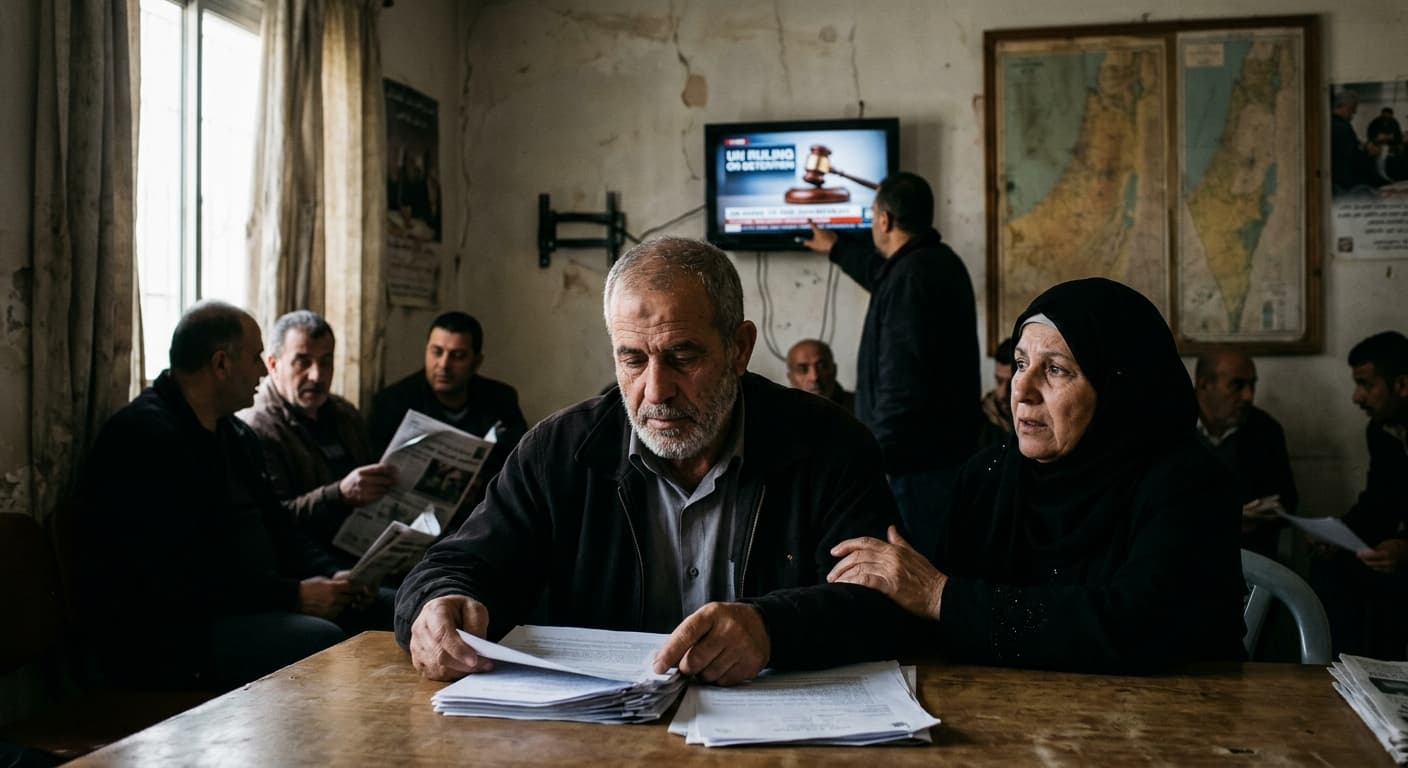
UN's Abu Safiya Ruling Opens Legal Front on Israel's Gaza Detention Regime
The UN Working Group on Arbitrary Detention has declared Israel's holding of Gaza paediatrician Hussam Abu Safiya unlawful — its first ruling on the Unlawful Combatants Law used against thousands of Gazans.
The UN Working Group on Arbitrary Detention on July 6, 2026 declared Israel's 18-month detention of Palestinian paediatrician Dr. Hussam Abu Safiya "arbitrary" on three separate grounds, and — for the first time in the body's history — took direct aim at the Israeli statute under which several thousand Gazans have been held without charge since October 2023. The opinion, secured by MENA Rights Group, does not free Dr. Abu Safiya. It does something more consequential: it converts a single high-profile case into a legal template that third states, the International Criminal Court and Israeli petitioners can now cite against the entire post-October 7 detention architecture — and it lands as Israel's own Supreme Court has repeatedly declined to intervene.

What the Working Group actually decided
The Working Group is a body of five independent experts created under UN Human Rights Council resolutions; it issues 70–90 opinions a year and, per the OHCHR, "recommends that the State take appropriate actions (usually the release of the individual)," according to the OHCHR page on WGAD opinions. Its rulings are not binding treaty judgments; they carry the weight of expert interpretation of the International Covenant on Civil and Political Rights (ICCPR) and the Universal Declaration.
In Dr. Abu Safiya's case, the Group found the detention arbitrary under three of its five recognised categories: no legal basis for the arrest, fair-trial violations, and discrimination against Palestinians as a group. It said the case "may indicate a widespread or systematic practice of arbitrary detention in the country," according to Al Jazeera's report on the opinion, which also carried the Group's demand that Israel accord him "an enforceable right to compensation and other reparations, in accordance with international law." The Israel Prison Service did not immediately respond, Al Jazeera noted; previously it has rejected allegations that Abu Safiya and other doctors have been mistreated.
The load-bearing detail is what the Group did not limit itself to. It reached the Unlawful Combatants Law itself — Israel's 2002 statute allowing indefinite detention without charge, amended in December 2023 and again in 2024 to lengthen pre-review windows and restrict access to counsel. The MENA Rights Group announcement confirms this is the first Working Group opinion on a Palestinian from Gaza detained under that specific framework. The framing invites universal-jurisdiction courts and the ICC to treat the Law, not just its application, as the source of the violation.
From Kamal Adwan to Nafha: what happened to the doctor
The facts underlying the opinion are not contested by mainstream reporting. Israeli forces raided Kamal Adwan Hospital on December 27, 2024, ordered Abu Safiya to evacuate patients and staff, and detained him along with medical colleagues; the raid put the last major functioning hospital in North Gaza out of service, according to Amnesty International's urgent action. He was held incommunicado for over a month before meeting counsel at Ofer prison on February 11, 2025, per a
UN Special Procedures communication transmitted to Israel by three special rapporteurs.
His trajectory since is a case study in the mechanics of the Law. On April 28, 2026 the Beersheba District Court extended his detention indefinitely without charge, according to Front Line Defenders. On June 6, 2026,
Legal Action Worldwide reported his transfer from Negev Prison to solitary confinement in Nafha Prison — a move that followed the filing of a Supreme Court appeal. On June 16, 2026 that court rejected the appeal on the basis of secret evidence, according to
Al Jazeera's coverage of the ruling. His lawyer Nasser Odeh has told the court that Abu Safiya has lost more than a third of his body weight, has fractures in his thigh and shrapnel in his foot, and continues to suffer chronic conditions untreated in isolation.
Why this ruling is bigger than one doctor
The point is not Abu Safiya. The point is the statute. Roughly three-quarters of Palestinians from Gaza held under Israel's Unlawful Combatants legislation do not appear on Israel's own intelligence roster of Hamas or Palestinian Islamic Jihad members, according to a joint investigation by +972 Magazine, Local Call and The Guardian summarised by Al Jazeera. Of about 6,000 detainees in May 2025, only 1,450 were on the classified list of 47,000 armed-group members. The overwhelming majority are held on the same procedural footing the Working Group has now labelled arbitrary in all three categories.
That number reframes the Israeli government's public rationale. If the Working Group's opinion is applied to the wider category — as its language explicitly invites — the finding does not concern a handful of edge cases; it concerns the modal detainee. Since October 2023, Israel has detained roughly 30,000 Palestinians, and nearly 10,000 remain in custody, of whom about 3,498 are held without charge or trial, according to Al Jazeera's April 2025 breakdown drawing on Addameer and Palestinian Prisoners' Commission data. The Working Group's opinion now applies, in principle, to a population an order of magnitude larger than the individual it names.
The Group also cross-refers to the International Court of Justice's July 19, 2024 advisory on the unlawfulness of Israel's occupation and to earlier warnings from the UN Special Rapporteur on counter-terrorism, Ben Saul. In a May 24, 2024 communication to the Israeli Supreme Court, Saul wrote that where detention under the Law is not properly authorised under international humanitarian law, it will violate "(a) unlawful confinement of civilians — a grave breach of IHL (GCIV article 147) constituting a war crime; (b) arbitrary detention under article 9 of the ICCPR; (c) enforced disappearance; and (d) the crime against humanity of imprisonment," according to the OHCHR communication. That is the escalator to Rome Statute liability. The Working Group has now supplied the adjudicated foothold.
The medical-personnel angle — and who is being erased
The Working Group singled out Abu Safiya's profession, warning his case "may indicate systematic targeting of health professionals." That finding is anchored in numbers most policymakers have not yet processed. Healthcare Workers Watch, cited by Al Jazeera, documented 431 detentions of Palestinian medics between October 7, 2023 and October 20, 2025; 95 remain in custody, most from Gaza, with an average detention of 511 days. Five have died in Israeli custody; five more are missing.
Kamal Adwan is not an outlier. At least 94 percent of Gaza's hospitals have been damaged or destroyed, per Healthcare Workers Watch data reported by Al Jazeera. The Palestinian Ministry of Health has counted at least 1,722 healthcare workers killed in Israeli strikes over two years. On April 30, 2026, Physicians for Human Rights–Israel filed a Supreme Court petition seeking the release of 14 Gaza doctors held without charge, including Abu Safiya, according to Al Jazeera. Israel has denied deliberately targeting medical workers and accuses Hamas of using hospitals militarily, but has "provided no credible evidence to support those claims," Al Jazeera reported.
For third states weighing whether to keep supplying weapons or intelligence to Israel — a question already litigated in courts in London, The Hague and Berlin — a UN body finding of a systematic pattern of arbitrary detention of medical personnel materially raises the domestic legal exposure of those governments. That is the second-order effect the Israeli foreign ministry will now have to manage.
The Israeli legal wall the ruling has to breach
Israel's Supreme Court is the immediate obstacle. It has long accepted the Unlawful Combatants Law's core structure, upholding the statute in Anonymous v. State of Israel (2008) — a decision analysed in Cambridge's International Legal Materials. What the Working Group has done, in effect, is reject the court's reconciliation of the Law with the Fourth Geneva Convention. The Special Rapporteur on counter-terrorism reached the same conclusion in a public
OHCHR blog post, writing that the 2023 and 2024 amendments are "inconsistent with Israel's international humanitarian law obligations."
Israel's carceral data has meanwhile become difficult to defend on the merits. Physicians for Human Rights–Israel documented at least 94 Palestinian deaths in Israeli custody between October 7, 2023 and August 31, 2025 — fewer than 30 died in the previous ten years — with 29 fatalities at the Sde Teiman military prison, according to the BBC. The IDF told the BBC it detains individuals "when there is reasonable suspicion of their involvement in terrorist activities" and that "detention orders and their duration are subject to judicial review as required by law." The Israel Prison Service said it "operates in accordance with the law and under the supervision of official oversight bodies."
The historical parallel is worth naming. The Working Group's first opinion against Israel on this specific pattern was Decision 17/1993, concerning Sami Abu Samhadanah, which found administrative detention without judicial review incompatible with ICCPR article 9, per UN documents archived on the Question of Palestine portal. Thirty-three years later, the Group is ruling on the same architecture — expanded, industrialised, and codified in a specific statute rather than emergency military order. The Group's third finding here — discrimination — is the most legally aggressive; it echoes the ICJ's July 2024 advisory conclusions on systemic discrimination in the occupied territory, and dovetails with a peer-reviewed legal analysis published on
PubMed that describes the post-October 7 regime as a "dual legal regime" — Palestinians facing military law, settlers on the same land facing civil law.
Who wins, who loses
The immediate winners are the litigation networks — MENA Rights Group, Physicians for Human Rights–Israel, Legal Action Worldwide, Adalah — that have been trying to convert scattered detentions into a categorical challenge to the Law itself. They now have a UN opinion that names the statute, applies three categories of arbitrariness at once, and asserts systemic discrimination. This is the closest thing available to a treaty-body ruling short of a full ICJ or ICC judgment.
The losers are, first, the Israeli government's public argument that its detention regime satisfies IHL — an argument the Special Rapporteur on counter-terrorism previously recommended the Knesset abandon by repealing the Law "without replacement," in a 2007 country-visit report reproduced by the UN Question of Palestine portal. Second, third states that have transferred arms or intelligence to Israel now face domestic litigation with a fresher, sharper documentary anchor. Third, the Israeli Supreme Court's credibility as an external check has been directly undermined; its reliance on secret evidence, cited in the June 16, 2026 rejection of Abu Safiya's appeal, is exactly the ground on which the Working Group ruled the fair-trial violation.
Dr. Abu Safiya himself is unlikely to see the inside of Kamal Adwan again soon. His lawyer told Al Jazeera he was denied medication and shackled during a June 10, 2026 video hearing, and the Working Group's opinion carries no enforcement mechanism. Israel has ignored 32 years of such findings, from the 1993 Abu Samhadanah decision through Opinion 13/2023 concerning Salah Hammouri, whose disposition is catalogued in the WGAD's annual report to the Human Rights Council. What has changed is the density of documentation and the number of parallel accountability tracks — an ICC investigation, an ICJ genocide case, Rome Statute domestic prosecutions — that can now cite this opinion.
What to watch
- Israel's six-month response window. Under WGAD procedure, both the state and the source are asked to report within six months on implementation. Israel's non-response, if it comes, will be recorded in the Working Group's next annual report — the same document that catalogues 32 years of ignored opinions.
- The ICC prosecutor's next filing. The Rome Statute crimes catalogued by Ben Saul — unlawful confinement, arbitrary detention, enforced disappearance, imprisonment as a crime against humanity — are now anchored to a specific UN adjudication. Watch whether the Office of the Prosecutor cites Opinion 2026 in its next Israel-related filing.
- The PHRI petition for 14 doctors. The Israeli Supreme Court's disposition of the April 30, 2026 petition will test whether the Working Group's opinion has any domestic traction. A rejection would deepen the divergence between the UN framework and Israeli constitutional law.
The Bottom Line
The bottom line: the Working Group has not freed one doctor — it has provided the first UN adjudicated ruling that Israel's Unlawful Combatants Law, as applied to Gazans, is arbitrary, unfair and discriminatory in all three categories the body recognises. That is a legal foothold third states, the ICC and universal-jurisdiction courts did not have on July 5, 2026 and now do. Abu Safiya remains in Nafha Prison; the statute holding him — and roughly 3,500 others without charge — is the target that has moved.
Discover more

US Politics
US Launches $166B Tariff Refund Portal
The US is launching a $166 billion tariff refund portal to aid importers hit by Trump-era tariffs, with major implications for trade and supply costs.

International Relations
Pakistan's Key Role in US-Israel-Iran Meddle
Pakistan is seeking to mediate the US-Israel-Iran conflict, balancing high-stakes diplomacy against severe economic pressures and steep regional challenges.
Global Politics
US-Iran Tensions Rise
Tensions escalate in the Strait of Hormuz as Iran and the US clash over maritime control, with a ceasefire hinging on a contested MoU paragraph.

Conflict & Security
Drone Warfare Killing Aid Workers at Unprec
Over 1,000 humanitarian workers killed in three years as cheap armed drones collapse legal protections. Gaza, Sudan, Ukraine, and DRC see deliberate targeting of aid convoys and hospitals with zero prosecutions.