UN Genocide Finding on Sudan's RSF
Accountability test at El-Obeid after RSF's actions.
Model Diplomat8 min readAfrica
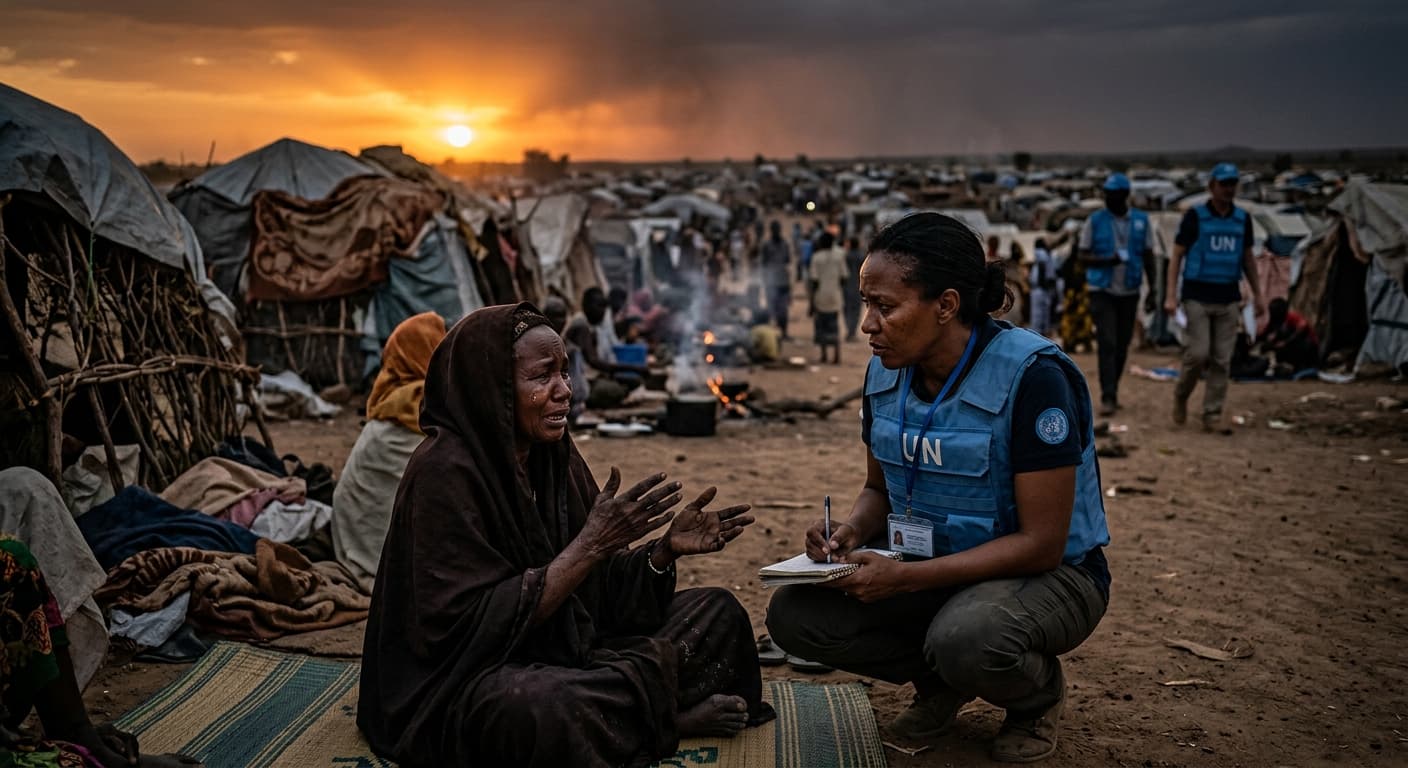
UN Genocide Finding on Sudan's RSF: Accountability Test at El-Obeid
A UN Fact-Finding Mission has ruled the RSF committed genocide in el-Fasher. What the finding triggers legally — and why el-Obeid is the next test — matters more than the label.
The UN's Independent International Fact-Finding Mission for the Sudan on July 8, 2026 concluded that the Rapid Support Forces (RSF) committed genocide in el-Fasher — a finding that, under Article I of the Genocide Convention, converts a moral demand for action into a legal duty to prevent. The immediate stakes are not in Darfur but 700 kilometres east, in the besieged Kordofan capital of el-Obeid, where the same UN body says the same playbook is being run against roughly half a million civilians. The report (A/HRC/61/77) is the strongest atrocity determination by a UN body since the Myanmar mission's 2018 findings on the Rohingya, and it lands in a system that has just watched its main enforcement route — an International Court of Justice case against the RSF's alleged sponsor — collapse on jurisdiction.
What the report actually says
The mission, chaired by former Tanzanian chief justice Mohamed Chande Othman, moves beyond its February assessment that RSF conduct in el-Fasher bore the "hallmarks of genocide." It now finds that mass killings, gang rapes, abductions and deliberate starvation formed part of "an intended policy" targeting the Zaghawa, Fur and other non-Arab communities, according to UN News. The finding activates three of the Genocide Convention's five predicate acts: killing members of a protected group, causing serious bodily and mental harm, and inflicting conditions of life calculated to destroy the group in whole or in part.
The scale is fixed by the Office of the UN High Commissioner for Human Rights (OHCHR): at least 4,400 civilians killed inside the city and more than 1,600 along exit routes during the three-day assault of October 26–29, 2025.
BBC News reports the mission drew on 140 victim and witness testimonies collected in Sudan's Northern state and eastern Chad. "The actual scale of the death toll" during the week-long operation, the report notes, is likely higher.
The RSF, whose leader Mohamed Hamdan "Hemedti" Dagalo commands what began as the Janjaweed militias of the 2003 Darfur genocide, has admitted "violations" but called the scale exaggerated. Al Jazeera reports the group again denied a systematic policy.
Why the label matters — and why it isn't the point
The word "genocide" is doing legal work here that political declarations cannot. When the Biden administration made its own genocide determination in January 2025, it triggered nothing binding under US law. A UN treaty-body finding is different: it establishes the factual predicate that other states — every one of the 153 parties to the Genocide Convention — can now cite to justify sanctions, arms restrictions, universal-jurisdiction prosecutions and, in principle, ICJ cases of their own.
That last route, however, has already been tested and lost. On May 5, 2025, the ICJ dismissed Sudan's case accusing the United Arab Emirates of complicity in the Darfur genocide through arms transfers to the RSF. As Al Jazeera and
BBC News reported, the court held it lacked jurisdiction because the UAE has a reservation to Article IX of the Convention — the compromissory clause that lets one state party sue another. That reservation, filed by Abu Dhabi decades ago, is the load-bearing wall in the RSF's external-support architecture. It does not exculpate the UAE from the underlying accusations, which
Foreign Affairs has documented in detail, but it walls off the world's highest court.
The July 8 finding routes around that wall without breaching it. It creates a factual record that any third state — Germany, Ireland, the Netherlands, the UK, or a Latin American joiner — could use to bring its own ICJ case, provided it can find a respondent without an Article IX opt-out. The Gambia used exactly this playbook against Myanmar in 2019. No European government has yet signalled it will.
The ICC has the harder case — and just told the BBC it has the evidence
The parallel track is criminal. On July 8, ICC Deputy Prosecutor Nazhat Shameem Khan told BBC News her office has "concrete evidence" linking RSF leaders to the el-Fasher and el-Geneina massacres, calling it a "breakthrough" in the investigation the Security Council referred to The Hague in 2005. That referral, Resolution 1593, gave the ICC jurisdiction over all of Darfur — meaning Hemedti and his commanders do not need Sudan to be a party to the Rome Statute for warrants to issue.
The court's Darfur docket already delivered its first conviction in 2024 against Janjaweed commander Ali Muhammad Ali Abd-Al-Rahman ("Ali Kosheib"), and prosecutors have signalled it will not be the last. The UN Security Council added its own designations on February 25, 2026, sanctioning four RSF figures including Hemedti's brother Abdul Rahim Hamdan Dagalo and Brigadier General Al-Fateh Abdullah Idris — the field commander known as "Abu Lulu" who filmed himself killing civilians during the el-Fasher assault. It is the fourth sanctions round against Abdul Rahim after US, UK and EU designations. The concentric penalties matter less as enforcement than as evidence: they build the international consensus a genocide case ultimately relies on.
The real test is el-Obeid, and the window is measured in weeks
The mission chair's warning was pointed. "The patterns we documented in el-Fasher — including encirclement, attacks on civilian infrastructure, restrictions on humanitarian access and widespread abuses against civilians — serve as a stark warning," Othman said, according to UN News. "The international community must heed these lessons and act to prevent further catastrophe."
El-Obeid, capital of North Kordofan and a strategic node linking Khartoum to Darfur, has faced siege-like conditions for 18 months. UN human rights chief Volker Türk said on July 3 that a "catastrophe" is unfolding, with 15 verified drone strikes killing at least 45 civilians in three weeks in June. Around 500,000 people are inside the encirclement, according to a coalition of 29 states led by Norway and the UK. On July 6, the Human Rights Council adopted an urgent-inquiry resolution — the same procedural step it took before el-Fasher fell, and which UN investigators now say was "not heeded."
The 18-month interval between the start of the el-Fasher siege and its fall is the reference case. El-Obeid's clock started earlier. The mission is now investigating in real time.

Who benefits from the status quo — and where the leverage sits
The system's failure has beneficiaries and they are identifiable. According to Foreign Affairs, the UAE has continued arms flows to the RSF while Sudanese gold moves through Emirati refineries. Russia has hedged, initially arming the RSF before signing a May 2024 Red Sea base agreement with the Sudanese Armed Forces (SAF). Iran and Turkey supply the SAF, whose own conduct — indiscriminate bombardment, use of starvation as a weapon — is under UN scrutiny but has not drawn a genocide finding.
The Security Council's 2004 Darfur arms embargo, imposed by Resolution 1591, remains formally in force and functionally porous. BBC News has documented Iranian and Emirati drones fielded by both sides in violation of it. Türk's July call for "third countries with influence" to respect the embargo is diplomatic language for Abu Dhabi.
The leverage that actually moves the RSF is narrower than it appears. It runs through two channels: the ICC, which can issue warrants that constrain Hemedti's travel and his family's asset architecture, and the UAE's Western partners. The US Congress has seen a bill from Representative Sara Jacobs that would condition US arms sales to the UAE on a presidential certification that Abu Dhabi has stopped arming the RSF. It has not moved. The UK sanctioned six figures fuelling the war in late June 2026, including three foreign nationals accused of recruiting Colombian mercenaries for the RSF, according to
BBC News.
The historical parallel that reframes the finding
The instructive comparison is not Rwanda but Darfur 2004. Then, a UN commission of inquiry declined to call the Janjaweed campaign genocide, calling it crimes against humanity instead — a determination that critics argued softened the international response. The Bush administration made its own genocide finding; the practical result was a Security Council referral to the ICC that yielded, twenty years later, one conviction of a mid-ranking commander.
This time the sequence is inverted. The UN body has issued the harder finding first. The question is whether the Convention's Article I obligation to prevent — a duty the ICJ described in its 2007 Bosnia v. Serbia judgment as one of "due diligence" — will produce anything more consequential than the 2004 crimes-against-humanity determination did. The Bosnia standard is exacting: states with capacity to influence the perpetrator can be held liable for failing to try. Every state that sells weapons to the UAE, or that could sanction Emirati gold refiners, is now on notice.
What to watch
- UN Human Rights Council, 63rd session (September 2026): The council must extend the Fact-Finding Mission's mandate. Human Rights Watch and 30+ civil society groups have urged a two-year extension in a joint letter published by
HRW. A shorter extension, or a compromise text, would signal member-state fatigue.
- ICC Pre-Trial Chamber, Darfur situation: Deputy Prosecutor Khan's "breakthrough" language suggests warrant applications are imminent. Watch for sealed applications targeting named RSF commanders — the deterrent value collapses if the first names are only mid-ranking.
- El-Obeid: The Fact-Finding Mission is now investigating in real time. If the city falls before its next report, the finding on el-Fasher will read as the epitaph for a prevention system that had one warning shot and failed to use it.
- US Congress, arms transfers to the UAE: Any move on Representative Jacobs's conditional-sales bill, or a Senate hold on a pending F-35 or MQ-9 sale to Abu Dhabi, would be the first concrete Western use of leverage on the RSF's principal external supporter.
The Bottom Line
The UN's genocide finding does not, by itself, save anyone in el-Obeid; the ICJ has already shown the treaty's enforcement architecture can be walled off by an Article IX reservation. What the finding does is shift the burden — every state party to the Genocide Convention now carries a due-diligence duty the Bosnia judgment made real, and every arms transfer to the UAE is legally cognisable evidence of failure to prevent. The next atrocity in Sudan will not be a surprise. It will be a policy choice by governments that were warned in writing.
Discover more
Human Rights
ICC's Darfur Breakthrough: RSF Warrants
The ICC has gathered evidence to charge RSF leaders for atrocities in Darfur, marking a significant step in accountability after years of inaction.
Conflict & Security
UN Report: Israel Targets Palestinian Kids
A UN report accuses Israel of genocide against Palestinian children in Gaza, citing grave human-rights violations and intensifying scrutiny of the war's toll.
International Relations
US Warns of Atrocities in El-Obeid
Washington warns of imminent atrocities as RSF fighters encircle El-Obeid, raising alarms of genocide and a deepening civilian crisis across Sudan's frontlines.

Conflict & Security
Drone Warfare Killing Aid Workers at Unprec
Over 1,000 humanitarian workers killed in three years as cheap armed drones collapse legal protections. Gaza, Sudan, Ukraine, and DRC see deliberate targeting of aid convoys and hospitals with zero prosecutions.