UN Calls Israel's Detention of Doctor Arbitr
Two UN bodies declare detention of Gaza doctor arbitrary
Model Diplomat7 min readMiddle East
Two UN Bodies in 72 Hours Call Israel's Detention of Gaza Doctor Abu Safiya Arbitrary
Two UN human-rights bodies ruled within 72 hours that Israel's 559-day detention of Dr. Hussam Abu Safiya is arbitrary — and a signal for 1,283 uncharged Gaza detainees.
Two separate UN human-rights organs — the Working Group on Arbitrary Detention on July 6 and the Independent International Commission of Inquiry on July 8, 2026 — demanded within 72 hours that Israel immediately release Dr. Hussam Abu Safiya, the paediatrician who ran Gaza's Kamal Adwan Hospital until Israeli forces detained him on December 27, 2024. The convergence matters because both bodies framed the case as evidence of a "widespread or systematic practice" — a treaty-body finding that reaches beyond one doctor to the 1,283 Palestinians Israel is currently holding without charge under its 2002 Unlawful Combatants Law. For Israel's Western partners, the rulings collapse the legal cover that has let allied governments treat Gaza detention as an internal-security matter rather than a category of atrocity finding.
The rulings, in precise terms
The UN Working Group on Arbitrary Detention adopted its opinion on July 6, finding that Israel's detention of Abu Safiya violates Articles 9 and 14 of the International Covenant on Civil and Political Rights and multiple articles of the Universal Declaration of Human Rights. According to Al Jazeera's summary of the opinion, the panel wrote that "the appropriate remedy would be to release [him] immediately and accord him an enforceable right to compensation and other reparations, in accordance with international law." The Working Group added that Abu Safiya's case was one of several "that may indicate a widespread or systematic practice of arbitrary detention in the country," as
reported by the BBC.
Two days later the UN Independent International Commission of Inquiry on the Occupied Palestinian Territory issued its own statement. It called for "the immediate, unconditional and safe release of Dr. Abu Safiya and of all medical personnel held in arbitrary detention by Israel," and linked his condition directly to state conduct: "The actions of the Israeli Prison Service guards towards Palestinian detainees raise grave concerns of violations of international law that likely amount to international crimes." That language, quoted by Al Jazeera, reads deliberately: the Commission does not name a defendant, but its September 2025 report already concluded that Israeli authorities had committed genocide by targeting Gaza's healthcare system.
The Israel Prison Service told Reuters the findings were "false, outrageous, and entirely without factual basis." Israel's foreign ministry has consistently rejected the Commission of Inquiry as biased.
Why a single doctor is now a treaty-body test case
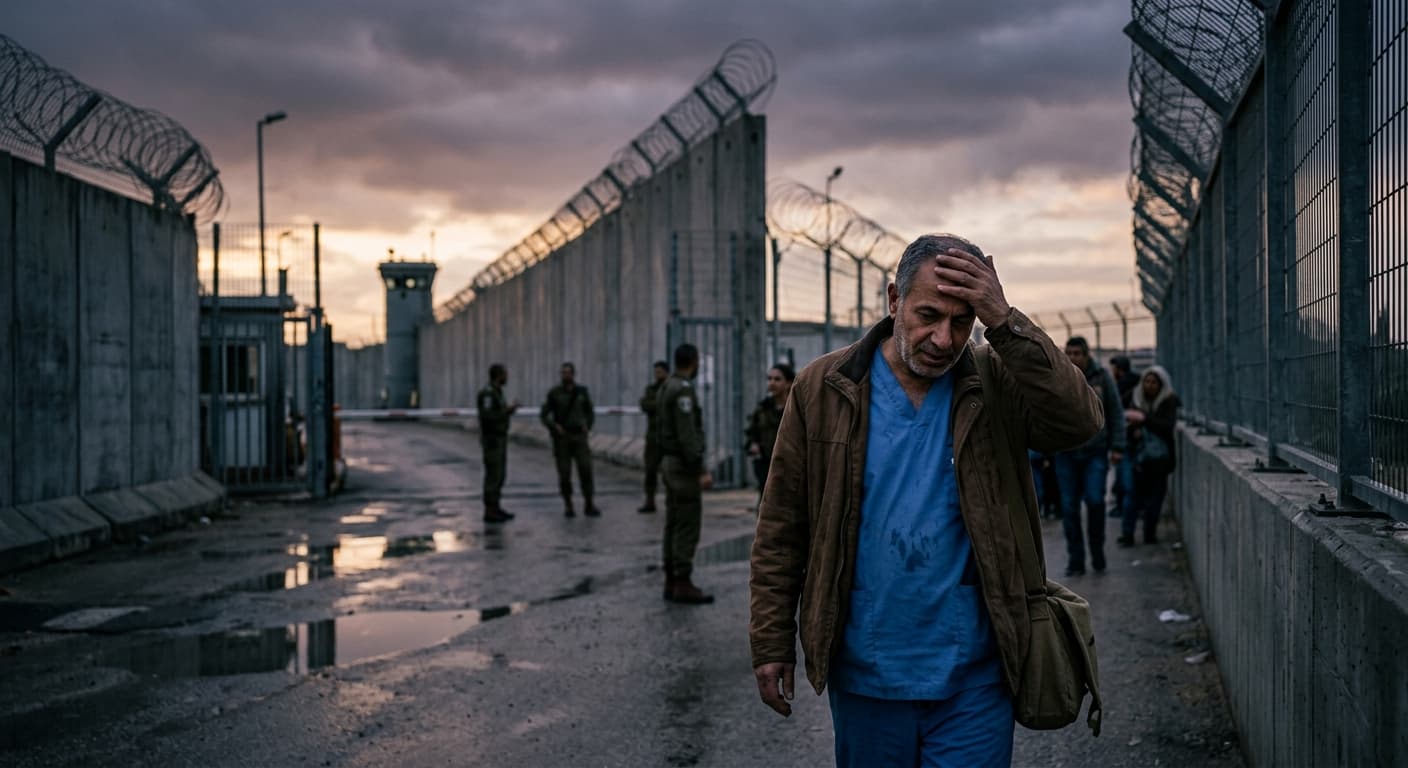
Abu Safiya is not an obscure detainee. He is the physician who, in the final days of 2024, refused evacuation orders and walked toward an Israeli tank in a stained white coat — an image that became iconic before his arrest. The Israel Defense Forces told the BBC he was apprehended for "suspected involvement in terrorist activities and for holding a rank in Hamas," pointing to his role in the health department of Gaza's Hamas-run interior ministry, which provided medical treatment to security personnel and their families. No indictment has been filed in 19 months.
Under Israel's Unlawful Combatants Law of 2002, that indefinite detention is legal. Under the ICCPR — to which Israel is a party — it is not. The Working Group's opinion is precisely the mechanism designed to adjudicate that gap. It is quasi-judicial, individual, and, once adopted, functions as an authoritative interpretation of Israel's treaty obligations. Israel's Supreme Court reached the opposite conclusion on June 16, 2026, upholding Abu Safiya's detention until at least October, according to Amnesty International's urgent-action document MDE 15/1242/2026. The two rulings — one domestic, one international — now sit in open contradiction.
That is what makes this a test case rather than a hardship story. Foreign ministries in London, Berlin, Paris and Ottawa have for two years relied on the argument that Israel's High Court provides a functioning check on wartime detention. A UN treaty body has now placed on the record that the check has failed in a documented pattern.
The number behind the ruling: 1,283
The Israeli Prison Service confirmed to the BBC in June 2026 that it holds 1,283 people as "unlawful combatants" without formal charge, the vast majority from Gaza. That figure sits inside a broader detention population of roughly 9,600 Palestinians as of April 2026 — up from about 5,250 before October 2023 — according to figures compiled by Al Jazeera from the Palestinian Prisoners' Club.
The most consequential number is not the total. It is the ratio. A joint investigation by +972 Magazine, Local Call and The Guardian, reviewing a leaked IDF intelligence database, found that of the roughly 6,000 Palestinians held in May 2025, only about a quarter appeared on the military's own list of 47,000 suspected Hamas or Palestinian Islamic Jihad members. Al Jazeera's summary of the investigation reports that three-quarters of "unlawful combatant" detainees are not, by Israel's own intelligence classification, fighters.
That statistic is the load-bearing evidence behind the Working Group's phrase "widespread or systematic practice." It is also the reason Physicians for Human Rights Israel filed an April 2026 Supreme Court petition on behalf of Abu Safiya and 13 other Gaza doctors held without charge. Two Palestinian physicians have died in Israeli custody. At least 94 Palestinian detainees have died in custody since October 2023, according to Physicians for Human Rights Israel data cited by both the BBC and Al Jazeera. In November 2025, the UN Committee against Torture — the treaty body for the Convention against Torture — flagged what it called "a de facto state policy of organised and widespread torture and ill-treatment" of Palestinian detainees.
The primary-document anchor: A/HRC/61/26
The July 8 statement did not appear in a vacuum. It builds on the High Commissioner for Human Rights' report to the 61st session of the Human Rights Council, document A/HRC/61/26, covering November 1, 2024 to October 31, 2025. Paragraph 57 states:
"There remains a pervasive climate of impunity in relation to gross violations of international human rights law and serious violations of international humanitarian law in the Occupied Palestinian Territory, some constituting war crimes and possibly other international crimes. No meaningful steps were taken by Israel's justice system in relation to accountability for violations committed by Israel's officials and/or settlers."
The Human Rights Council itself has locked in the framing. On March 27, 2026, it adopted Resolution 61/4, demanding Israel end its "unlawful presence" in the Occupied Palestinian Territory "as rapidly as possible" and lift the Gaza blockade — the second such demand in a year. The International Court of Justice's advisory opinion of July 19, 2024, and a follow-on ruling on October 22, 2025, referenced in A/HRC/61/26, are the legal spine underneath all of it.
Two things follow from anchoring the story to a treaty-body ruling rather than to a wire report. First, the finding is not disputable as "advocacy": it is the finding of the mechanism the ICCPR itself created. Second, it triggers third-state duties under the ICJ's 2024 advisory opinion — most concretely, obligations of non-recognition and non-assistance regarding conduct declared unlawful.
Who benefits, who loses
The immediate winner is not Abu Safiya, who remains in the Rakefet unit of Nitzan Prison. His lawyer Nasser Odeh reported after a July 2 visit that the doctor was near unconsciousness and unrecognisable from injuries — a description carried by Physicians for Human Rights Israel and the BBC. Israel's Supreme Court has already ruled against him; the government has signalled it will ignore the UN opinions as it has ignored the Commission of Inquiry's earlier findings.
The winner is the universal-jurisdiction docket. High Commissioner Volker Türk's report explicitly urged member states to pursue accountability through universal jurisdiction and ICC cooperation. A Working Group opinion is admissible evidence in national courts. So is a Commission of Inquiry statement. Prosecutors in Spain, Belgium, Ireland and South Africa now have documented, treaty-body-endorsed findings on a named detainee — the kind of evidentiary bloc that supports arrest warrants for named Israeli officials transiting through ICC states parties. The Times of Israel's daily edition noted on July 8 that the government was moving to defy Israeli High Court rulings on unrelated matters — a signal that even domestic legal constraints are eroding, narrowing the gap between what Israeli courts still block and what international bodies condemn.
The losers are Israel's Western partners. The German government must now approve a $4.2 billion Hapag-Lloyd port deal against a background in which two UN bodies have declared Israeli detention of a named doctor arbitrary in the same week. British and French export-licence litigation feeds on precisely these documents. And on Capitol Hill, the Working Group's language will surface in every appropriations markup on aid to the Israel Prison Service.
What to watch
- Israel's response deadline to the Supreme Court on the joint petition by Physicians for Human Rights Israel for the release of Abu Safiya and 13 other Gaza doctors, per the
BBC.
- October 2026: the expiry of Abu Safiya's current detention order upheld by the Israeli Supreme Court on June 16. A renewal in the face of two UN rulings would be the clearest possible test of whether Israel accepts treaty-body findings as binding in any form.
- The Commission of Inquiry's next report to the Human Rights Council, at the 62nd session; the Chair's statement of June 15, 2026 signalled the arms-transfer analysis mandated by Resolution 61/4 remains outstanding.
- The UN Committee against Torture's next periodic review of Israel, where the November 2025 "de facto state policy" finding will be tested against Israel's response.
The Bottom Line
Two UN human-rights bodies in three days have transformed Dr. Hussam Abu Safiya from a symbol of Gaza's shattered healthcare system into a treaty-body test case with named findings against Israeli state conduct. The ruling is not that one doctor was wronged — it is that Israel's Unlawful Combatants Law, applied to 1,283 uncharged detainees, constitutes a "widespread or systematic practice" of arbitrary detention. That language, once on the record, does not stay in Geneva; it migrates into universal-jurisdiction dockets, ICC filings, and the export-control law of every state that ships arms to Israel.
Discover more

Global Politics
US-Iran Tensions Rise
Tensions escalate in the Strait of Hormuz as Iran and the US clash over maritime control, with a ceasefire hinging on a contested MoU paragraph.

US Politics
US Launches $166B Tariff Refund Portal
The US is launching a $166 billion tariff refund portal to aid importers hit by Trump-era tariffs, with major implications for trade and supply costs.
US Politics
Virginia's Redistricting Referendum
Virginia's redistricting referendum is drawing a flood of dark money, shaping future elections and the fight for congressional control amid party stakes.

Conflict & Security
Drone Warfare Killing Aid Workers at Unprec
Over 1,000 humanitarian workers killed in three years as cheap armed drones collapse legal protections. Gaza, Sudan, Ukraine, and DRC see deliberate targeting of aid convoys and hospitals with zero prosecutions.