UN Backs Gaza Handover as Hamas Cedes Control
UN endorses Hamas's dissolution of Gaza government, raising concerns.
Model Diplomat7 min readMiddle East
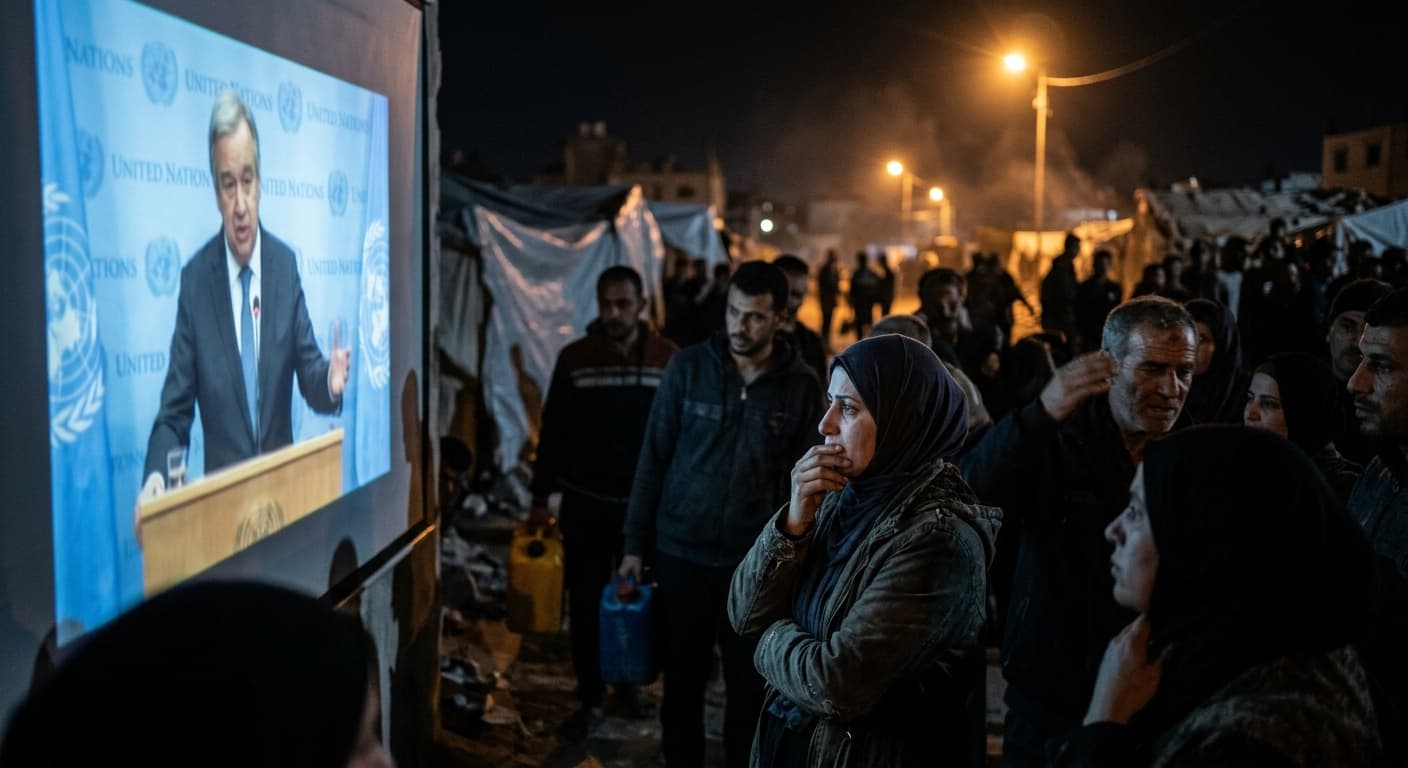
UN Backs Gaza Handover as Hamas Cedes Its 19-Year Grip
The UN endorsed Hamas's dissolution of its Gaza government on July 6, 2026, handing authority to a US-supervised technocratic committee — but the money, the disarmament and the Palestinian Authority are all missing.
Hamas dissolved the Government of Emergency Committee that has run Gaza since 2007 on July 6, 2026, and the United Nations welcomed the transfer of authority to a 15-member technocratic body sitting under Donald Trump's Board of Peace. The endorsement matters less than it looks: Gaza's new governance architecture is now legally in place under Security Council Resolution 2803, but it is starved of cash, blocked at the fence by the Israeli army, and shorn of the one actor — the Palestinian Authority — that could give it political legitimacy on the ground. The UN has effectively certified a shell administration, and that certification is now the diplomatic cover under which Israel, Hamas and Washington are each running incompatible endgames in Gaza.
According to Al Jazeera, the resignation of administration head Mohammed al-Farra formalises a decision Hamas had signalled since January, when its political bureau first said it would abolish its Gaza ministries. The UN spokesperson's response, carried by
Yeni Şafak, framed the step as a "potential pathway" toward unified Palestinian governance under a reformed PA — the exact end-state written into paragraph 2 of Resolution 2803.
What the UN Actually Signed Off On
Resolution 2803, adopted 13-0 with Russia and China abstaining on November 17, 2025, is the legal spine holding the entire Gaza transition together. According to the UN Security Council press release, the Council "endorsed" Trump's Comprehensive Plan, granted the Board of Peace "international legal personality," and authorised the Board to establish the International Stabilization Force under a unified command it approves.
Paragraph 9 of the resolution, published on UNISPAL, is the operative clause on Gaza's new administration:
"Gaza will be governed under the temporary transitional governance of a technocratic, apolitical Palestinian committee, responsible for delivering the day-to-day running of public services and municipalities for the people in Gaza."
The Palestinian Authority is mentioned only as a future beneficiary, once it has "satisfactorily completed its reform program." That distinction is the entire fight: Resolution 2803 endorses a transitional bypass of the PA, not a reunification of Palestinian institutions.
Secretary-General António Guterres called the January launch of Phase Two "an important step" in a January 15, 2026 statement, while recalling that "all efforts must be guided by relevant United Nations resolutions and international law." That is the diplomatic minimum. In February, he told the
Committee on the Inalienable Rights of the Palestinian People that Gaza and the West Bank must be "governed by a unified, legitimate, and internationally recognized Palestinian Government." That is not what Resolution 2803 delivers.
The Committee That Cannot Enter Gaza
The National Committee for the Administration of Gaza was constituted in January under Ali Shaath, a former PA deputy planning minister. According to the BBC, regional mediators Egypt, Qatar and Turkey welcomed the 15-member body as a step toward "consolidating stability."
Six months later, the NCAG has still not set foot inside Gaza. The Board of Peace's own report to the Security Council, S/2026/418, states plainly:
"As of the date of this report, the NCAG has not yet been able to enter Gaza in areas that remain under Hamas armed control… Hamas cannot be permitted to hold Gaza's future hostage."
An NCAG member, speaking to Al Jazeera on condition of anonymity, gave the committee's mirror version: it will not operate behind the Israeli-controlled "Yellow Line" or alongside Israeli-backed militias, and will not enter Gaza until the ISF is deployed in buffer zones. The result is a symmetrical stalemate: Israel demands full Hamas disarmament before the committee arrives; the committee demands Israeli withdrawal before it enters; Hamas has now legally dissolved its administration but retains its weapons and its interior ministry.
The BBC has confirmed that Hamas's Interior Ministry has restructured its executive apparatus, appointing new police directors and setting up detention facilities even as it publicly cedes governance. A displaced Gazan told the BBC bluntly: "Unfortunately, no-one is controlling Gaza right now except Hamas."
The Money Vanished with the Iran War
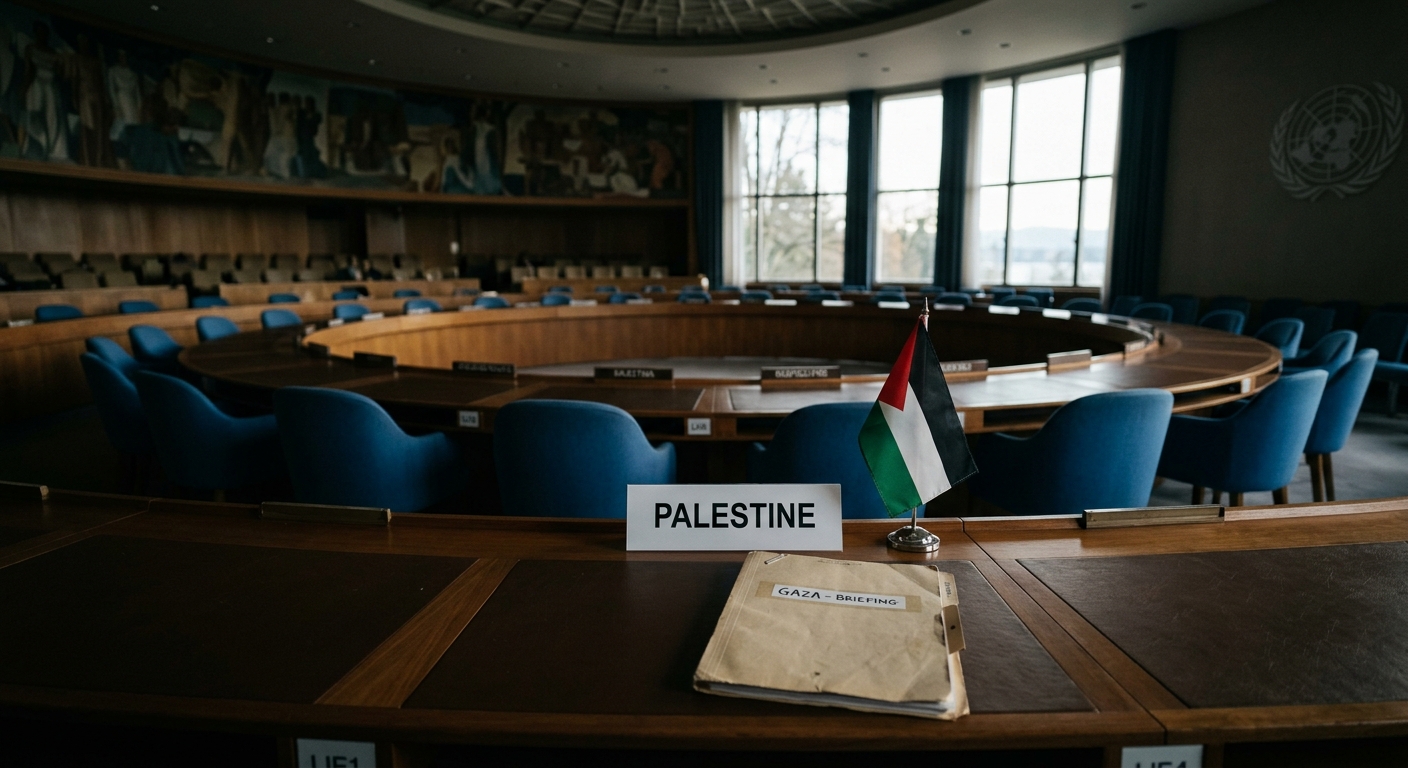
The February 2026 Washington donor conference produced roughly $7 billion in reconstruction pledges, primarily from Gulf states. By July, according to Al Jazeera's reporting from the Board of Peace's Cyprus meetings, donors had reneged on $17 billion in combined commitments, "largely due to the economic fallout from the recent regional war with Iran."
That collapse is the hinge nobody in the UN chamber is willing to state on the record. Nickolay Mladenov, the Board of Peace's High Representative, told Israel's i24 news that Gulf financing exists "only once conditions in Gaza are such that there will be no return to war," meaning full decommissioning of Hamas weapons. But as Amjad Iraqi of the International Crisis Group told the BBC, "There's a lot of pressure on Hamas to have to accept it, including from mediators as their attention drifts toward Iran." The Iran war did two things at once: it removed Hamas's primary state sponsor, and it removed the Gulf money that was supposed to finance the alternative. Both sides of the leverage equation collapsed simultaneously.
The PA Is Missing on Purpose
The most important sentence in Resolution 2803 is the one about the Palestinian Authority: it takes over "once it has completed reforms and can do so securely and effectively." That conditionality is the achievement of Israeli and US drafters. It elevates a Trump-chaired Board of Peace above any Palestinian institution and hands Israel an effective veto on when — or whether — the PA ever returns to Gaza.
PA Vice-President Hussein al-Sheikh has endorsed the plan, calling for "one system, one law, and one legitimate weapon," per the BBC. But Ramallah is a spectator to the July 6 handover, not a party. The Beijing Declaration of July 2024, which committed Hamas and Fatah to an
interim national unity government, is not the framework being executed; it has been overwritten by an American one that isolates both factions from formal power.
Writing in Foreign Affairs, analysts argue Hamas's willingness to transfer authority is "better understood as a distress signal" than a tactical concession — the movement's Shura Council has been unable to elect a leader since Yahya Sinwar's death in October 2024, and a February 2026 vote produced no winner. The dissolution of the government committee is what a fractured, decapitated organisation does when it can no longer administer, not what a confident political actor does when it wants to share power.
For Israeli Prime Minister Benjamin Netanyahu, the RAND Corporation's Raphael Cohen has noted that a durable PA return to Gaza would require a substantive political horizon toward Palestinian statehood — a horizon his coalition rejects on principle. Ahead of October 2026 elections, Netanyahu's incentive is to keep the transition ambiguous: to endorse the NCAG in principle, block its arrival in practice, and preserve the 40 Israeli military outposts that Al Jazeera has documented inside Gaza.
What to Watch Next
- The NCAG's first physical entry into Gaza. Any move by Shaath's committee into Rafah's Tal as-Sultan pilot area — reportedly scheduled within weeks — will be the first test of whether the July 6 handover has any operational meaning.
- The Board of Peace's next Security Council briefing. Mladenov's report S/2026/418 has already called on the Council to publicly demand Hamas decommissioning; a follow-up session is expected before the General Assembly opens on September 15, 2026.
- The October 2026 Israeli elections. Netanyahu's political survival is tied to keeping Hamas nominally alive as a threat. Whichever coalition emerges will decide whether the "Yellow Line" becomes a de facto annexation border.
- Gulf reconstruction pledges. Watch for a rescheduled donor conference; without a fresh $10–15 billion tranche, the NCAG remains a letterhead.
Diplomat View
The UN's endorsement of the July 6 handover is not the beginning of Palestinian unity — it is the formal ratification of a two-year Israeli–American project to route Gaza's future around both Hamas and the Palestinian Authority. Resolution 2803 gives that project the appearance of multilateral legitimacy, but the underlying structure — a Trump-chaired board, a Bulgarian high representative, a Palestinian committee that cannot cross the fence — is not a transition to sovereignty. It is a trusteeship with no exit clause and no financing.
The forecast: the NCAG will not achieve functional control of Gaza in 2026, Hamas will retain shadow governance in the areas the ISF cannot reach, and Israel will continue expanding its footprint behind the Yellow Line. What would change that call: a credible Gulf recapitalisation of at least $10 billion by Q1 2027, a Netanyahu election loss producing a government that accepts a political horizon, and Mladenov delivering a phased Israeli withdrawal tied to verified decommissioning. Absent all three, the July 6 dissolution will be remembered as the day the international community licensed an occupation by other means.
The Bottom Line
The UN did not midwife Palestinian unity on July 6, 2026 — it certified a governance vacuum. Hamas has surrendered its ministries but kept its guns; the technocratic committee has a mandate but no territory; the Palestinian Authority has an endorsement but no seat at the table. Until the Gulf money returns and the Yellow Line moves, "Gaza governance" is a paper architecture whose real function is to hold the ceasefire together while the region's other wars are fought.
Discover more
US Politics
SNAP Food Assistance Faces Legal Challenges
In 2026, SNAP faces stricter eligibility rules and mounting legal challenges, threatening food assistance for the millions of Americans who rely on the program.
US Politics
Congress Targets AI Chatbot Access for Terror
The House passed the Generative AI Terrorism Risk Assessment Act, focusing on AI's role in terrorism and potential surveillance implications.
Global Politics
US-Iran Tensions Rise
Tensions escalate in the Strait of Hormuz as Iran and the US clash over maritime control, with a ceasefire hinging on a contested MoU paragraph.

Conflict & Security
Drone Warfare Killing Aid Workers at Unprec
Over 1,000 humanitarian workers killed in three years as cheap armed drones collapse legal protections. Gaza, Sudan, Ukraine, and DRC see deliberate targeting of aid convoys and hospitals with zero prosecutions.