Ukraine's local aid groups outperform but get
Local groups deliver faster aid, but get under 4% of funding
Model Diplomat9 min readEurope
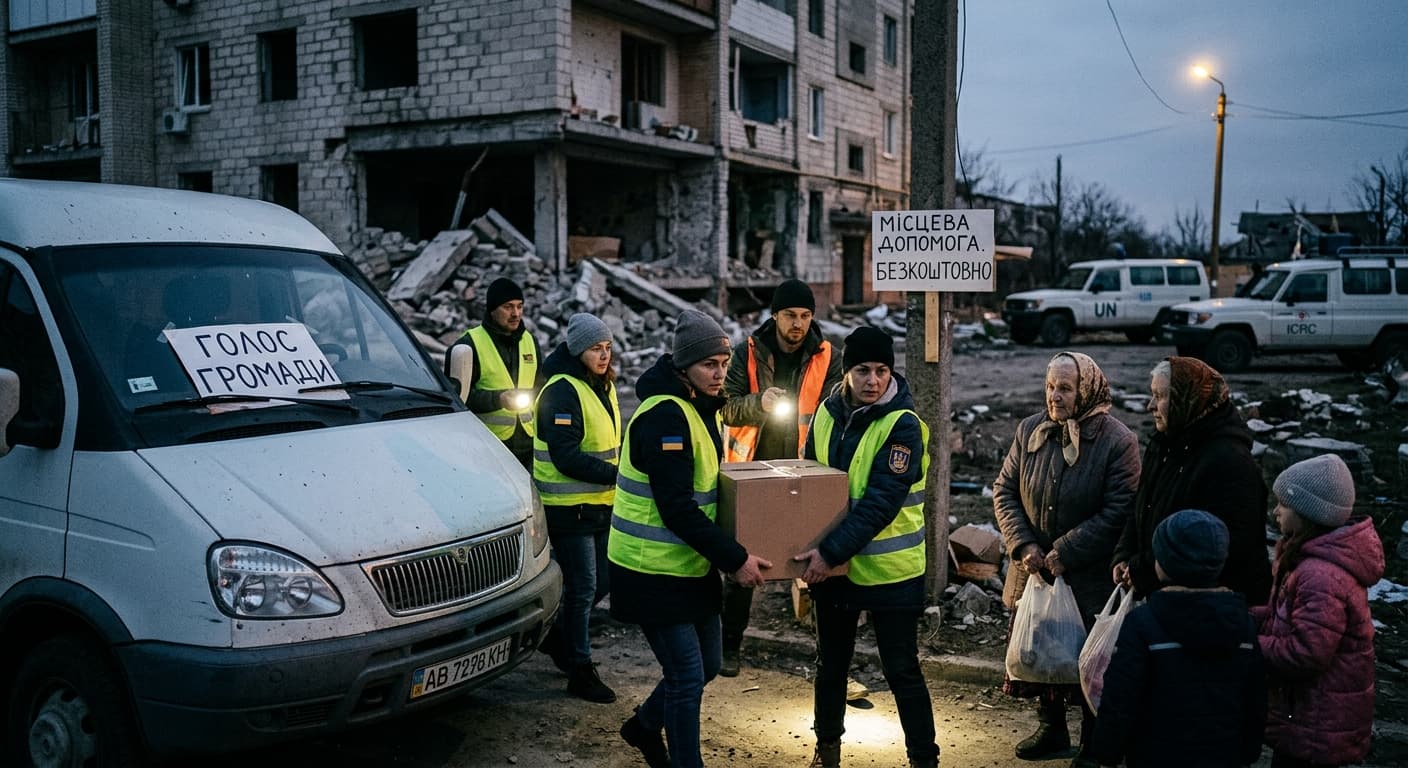
Ukraine's Local Aid Groups Outperform — But Get Under 4% of the Money
As major donors slash funding in 2025–26, Ukraine's civil society is proving local-led humanitarian response works — and exposing that the global funding architecture never moved to support it.
Ukraine's humanitarian response is delivering a lesson the aid system has spent a decade avoiding: local organizations deliver faster, more adaptive aid when they co-design programs — yet the global funding architecture channels under 4% of money directly to them, and the 2025 donor collapse is hollowing out the small, agile actors closest to the front lines rather than the bureaucracies that absorb most of the funding. A June 22, 2026 assessment by World Vision's Daria Musiienko and Viktor Stepaniuk, published via ReliefWeb, found that programs co-designed with Ukrainian partners produced high beneficiary satisfaction and results that "often exceed expectations." Yet globally, less than 4% of humanitarian funding reaches local actors directly, and in 2024 that figure collapsed to just 1% direct and 35% indirect. The disconnect is not a capacity problem. It is a donor plumbing problem that the withdrawal of U.S. and European aid is now forcing into the open.
Who loses when the money stops
The funding contraction hitting Ukraine in 2025–26 is not a uniform squeeze. It falls hardest on the organizations best positioned to deliver. The United States slashed aid to Ukraine by 74% in 2025, according to the Council on Foreign Relations, and eliminated USAID's Office of Transition Initiatives entirely — the agile small-grants program that had worked through embedded Ukrainian civil society partners since before the full-scale invasion. Germany, Ukraine's second-largest donor, cut assistance by 62%. A UN headquarters directive forced aid providers to prioritize only the most acute relief, rendering 1.2 million fewer people eligible for assistance. The CFR analysis notes that small national NGOs — "often the most agile and efficient responders" — were disproportionately affected by program cuts, leaving capacity gaps "particularly on the front lines."
The OECD confirmed the scale of the global pullback in April 2026: total development aid from its members dropped about 23% from 2024 to 2025, the largest annual decline since the organization began recording the data. The United States alone drove three-quarters of the decline, with U.S. official development assistance falling from roughly $63 billion in 2024 to just short of $29 billion, according to Al Jazeera reporting OECD preliminary data. This is not cyclical. The five largest OECD donors all simultaneously cut aid for the first time on record.
For Ukraine, where UN OCHA identifies 10.8 million people in need of urgent assistance in 2026, the contraction lands on a response that had operated at exceptional scale. The UN and humanitarian community supported 15.8 million people in 2022 and 11 million in 2023 through $6.45 billion in assistance, according to World Bank documentation. The European Union and its member states mobilized over €3.7 billion in humanitarian assistance since February 2022 and delivered 153,488 tons of aid through the Union Civil Protection Mechanism. Now the margins are narrowing. OCHA reported that a $2.3 billion funding plan for Ukraine had received only $845 million as of May 2026, according to
Al Jazeera. The health sector alone saw funding fall from $181 million in 2023 to an estimated $52 million in 2024, meeting only 36% of needs, per the
World Bank.
The named losers are concrete. Olena Horyacheva, who runs the medical charity Vykhid in Mykolaiv, told NPR that tuberculosis and HIV treatment programs had already shut down. In the frontline city of Oleshky, where roughly 2,000 residents remain cut off from fresh food and medicine for months, the
BBC documented residents relying on volunteers and aid groups for survival — the kind of last-mile delivery that local organizations are built for and that UN convoys, two of which were struck on May 12 and 14, 2026, struggle to reach.

What co-design actually delivers
The World Vision report's central claim is that the humanitarian system has mastered the appearance of localization without its substance. Over the last three years, approximately 85% of World Vision's programs in Ukraine were implemented with local partners, according to the ReliefWeb assessment. An internal review conducted between 2023 and 2024 found that these partnerships improved technical capacity, strengthened internal systems, and increased organizational confidence among local NGOs. But the review also identified where the model fell short. Three priorities emerged: earlier and more meaningful partner involvement in programme design; capacity strengthening that is tailored, demand-driven, and extends beyond project cycles; and funding that reflects the full cost of partnership, including overheads and investment in organizational development.
The distinction the report draws is between procedural localization — fulfilling donor expectations for partner engagement — and genuine localization, where local actors co-create programs from the design stage. The quote from Way Home, an Odesa-based NGO, captures it precisely:
"With this project we created something really based on needs, which would have been much harder if you imposed the design on us. Finally, we do a project that we developed for a target group and not the other way round, not looking for a target group for already designed project."
When co-creation happens, the report argues, programs are "more grounded, more adaptive and ultimately more effective." When it does not, localization "risks becoming procedural, fulfilling expectations without altering outcomes." External evaluations of trust-based partnerships showed strong performance and high beneficiary satisfaction — results the report says "often exceed expectations." The funding conditions, however, set the boundaries. Flexible, softly earmarked funding enabled adaptation and institutional growth. Rigid structures and cost-efficiency pressure narrowed the space for long-term capacity building. Donor choices, the authors conclude, shape not only what is delivered but how and by whom.
This finding aligns with a broader pattern. The World Bank reported in April 2026 that local governments — the actors responsible for implementing recovery — often lack sufficient capacity in project management, procurement, and coordination. The Bank's analysis identified a structural mismatch: not simply a labor shortage, but a gap between available skills and the demands of recovery, deepened by military mobilization, displacement, and migration. The report positioned civil society not as a participant but as "part of the delivery infrastructure itself," arguing that recovery is "not constrained only by the availability of funding, but by the availability of people who can turn that funding into results."
The Grand Bargain's broken promise
Ukraine is not the first place where the gap between localization rhetoric and funding reality has been exposed. At the 2016 World Humanitarian Summit, 30 governments and organizations agreed the Grand Bargain, committing to channel 25% of humanitarian funding to local and national responders "as directly as possible" by 2020, according to the Middle East Institute. The target was missed. The
Graduate Institute Geneva reported that funding to local organizations stood at 3.1% in 2016, saw small increases in 2017 and 2018, then decreased by 2.1% ($444 million) in 2019. By 2024, the share of humanitarian assistance to local and national NGOs fell to 7.5%, according to the
LSE — and that figure includes INGO affiliates counted as "local," inflating apparent progress.
The structural problem is well documented. In 2018, governments directed almost two-thirds ($15.6 billion, 62%) of their humanitarian assistance to multilateral organizations, according to the Graduate Institute Geneva, giving UN agencies direct access to funding without the compliance hurdles imposed on implementing partners. The
LSE analysis noted that UN agencies and INGOs compete for the same donor money and have limited incentive to pass it on — "even less so now that they are facing massive budget cuts." The incentive structure runs in the opposite direction of the stated commitment. Under the Biden administration, USAID Administrator Samantha Power set a goal of providing 25% of resources to local actors by 2025, according to
CSIS. USAID fell far short. Then the Trump administration terminated 83% of programs, per Secretary of State Marco Rubio, with a leaked list indicating 5,341 programs canceled.
The LSE's South Sudan policy report documented the same pattern in a different theater: in 2017, only 0.3% of humanitarian funding in South Sudan went directly to local and national NGOs, rising to 4.9% including indirect funding. The South Sudan Humanitarian Fund allocated 39% of its 2018 disbursements ($20.6 million of $53.4 million) to South Sudanese NGOs — a model that works but remains a small proportion of overall funding. The barrier, the report found, was not capacity but trust: international organizations' concerns about local NGOs' ability to manage international finance led to pre-financing requirements and short project cycles that "actively hinder the development of trust."
Ukraine's legislative workaround
While the global funding architecture has stalled, Ukraine's government has been building a parallel legislative framework that formalizes the role of local authorities and civil society organizations as primary partners in service delivery. Ukraine's Law on Social Services places responsibility for assessing and providing social services with local self-government bodies, according to Chatham House. Parliament amended the law in April 2022 to expand local authority powers and specify emergency provision under martial law. In April 2023, the Ministry of Social Policy issued guidance for local authorities to form working groups including civil society representatives and vulnerable people. The Action Plan for 2025–26, approved in March 2025, includes 34 key measures, with Task 24 explicitly recognizing the importance of increasing civil society's capacity to act as social service providers using state funds. In January 2026, a new government procedure simplified the provision of social services at the local level, further expanding opportunities for civil society to contract with local authorities.
The results are visible. By April 2026, the Ministry of Social Policy had established 386 Centres for Resilience providing psychosocial support and family counseling, with mobile rehabilitation modules delivering specialized care to veterans and civilians in remote areas. Caritas operates 40 local crisis centres that assisted 90,000 people in 2025 and expanded to 72 Centres of Resilience in 2026, according to Chatham House. Regional CSOs are doing the work: 35% of regional organizations reported providing basic humanitarian assistance in emergencies, compared to 14% of national-level CSOs.
The funding base for community-level recovery tells its own story. According to Chatham House, community recovery needs are currently financed by local budgets (68%), international grants (51%), and charitable organizations (32%), with central budget allocations accounting for 49%. The European Investment Bank is a rare international financial institution that funds local actors directly, allocating over €2 billion to Ukrainian towns and cities since 2022. At the Ukraine Recovery Conference in Gdańsk on June 25–26, 2026, a €478 million package was announced for municipal infrastructure and essential services, according to
CSIS. MIGA has issued $948 million in political-risk insurance for investments in Ukraine since 2022. The
World Bank approved an $880 million social protection project in May 2026 that will transform social services financing to allow clients to access services from community, nonprofit, and private providers — a structural reform aligned with EU accession requirements.
The named winners of this shift are Ukrainian civil society organizations like Right to Protect, which employs over 700 people and works with host cities to deliver humanitarian response for displaced populations, and organizations like Way Home in Odesa, which used World Vision partnership funding to conduct its first comprehensive strategic planning workshop. The losers are the small frontline NGOs that depended on now-eliminated U.S. programs and lack the scale to access World Bank or EIB financing directly.
The Bottom Line
Ukraine is not teaching the humanitarian system that local solutions work — that lesson was available in South Sudan, Jordan, and every Grand Bargain signatory's own reporting. Ukraine is teaching that the gap between evidence and architecture is a choice, and the 2025 donor collapse has made the cost of that choice visible. When flexible funding reaches local actors who co-design programs, results exceed expectations. When it does not, the organizations closest to the front lines disappear first, and the bureaucracies that absorbed 96% of the money remain.
What to watch
- Q3 2026: The $880 million World Bank SPIRIT project begins implementation. Whether its social services financing reform actually channels funds to community and nonprofit providers — or consolidates delivery through national-level structures — will test whether legislative localization translates into funding localization.
- 2027 URC in Estonia: The next Ukraine Recovery Conference will reveal whether the PPP pipeline and municipal infrastructure commitments announced in Gdańsk reach financial close, and whether any deals directly fund local civil society organizations.
- OCHA Ukraine Humanitarian Needs and Response Plan 2027: The next funding plan, expected late 2026, will show whether the UN system adjusts its partner funding architecture in response to the World Vision assessment or maintains the status quo under continued budget pressure.
Discover more
US Politics
Washington's Scrutiny of Iran War Prediction
The Iran war prediction market scandal exposes political ties and regulatory challenges in Washington, as insider trading concerns rise.
Global Politics
US-Iran Tensions Rise
Tensions escalate in the Strait of Hormuz as Iran and the US clash over maritime control, with a ceasefire hinging on a contested MoU paragraph.

US Politics
US Military Funding Request for Iran Looms
The White House Budget Director signals a formal funding request for military operations against Iran, foreshadowing rising tensions and congressional clashes.

Economics
Fed's Amex AML order puts correspondent banking on notice
Federal Reserve's Amex AML order requires board-level controls and a 90-day plan; OCC fined the bank $350 million over enterprise-wide deficiencies.