Ukraine Strikes 21 Russian Ships in 72 Hours
Ukrainian drones target Russian shadow fleet vessels
Model Diplomat8 min readEurope
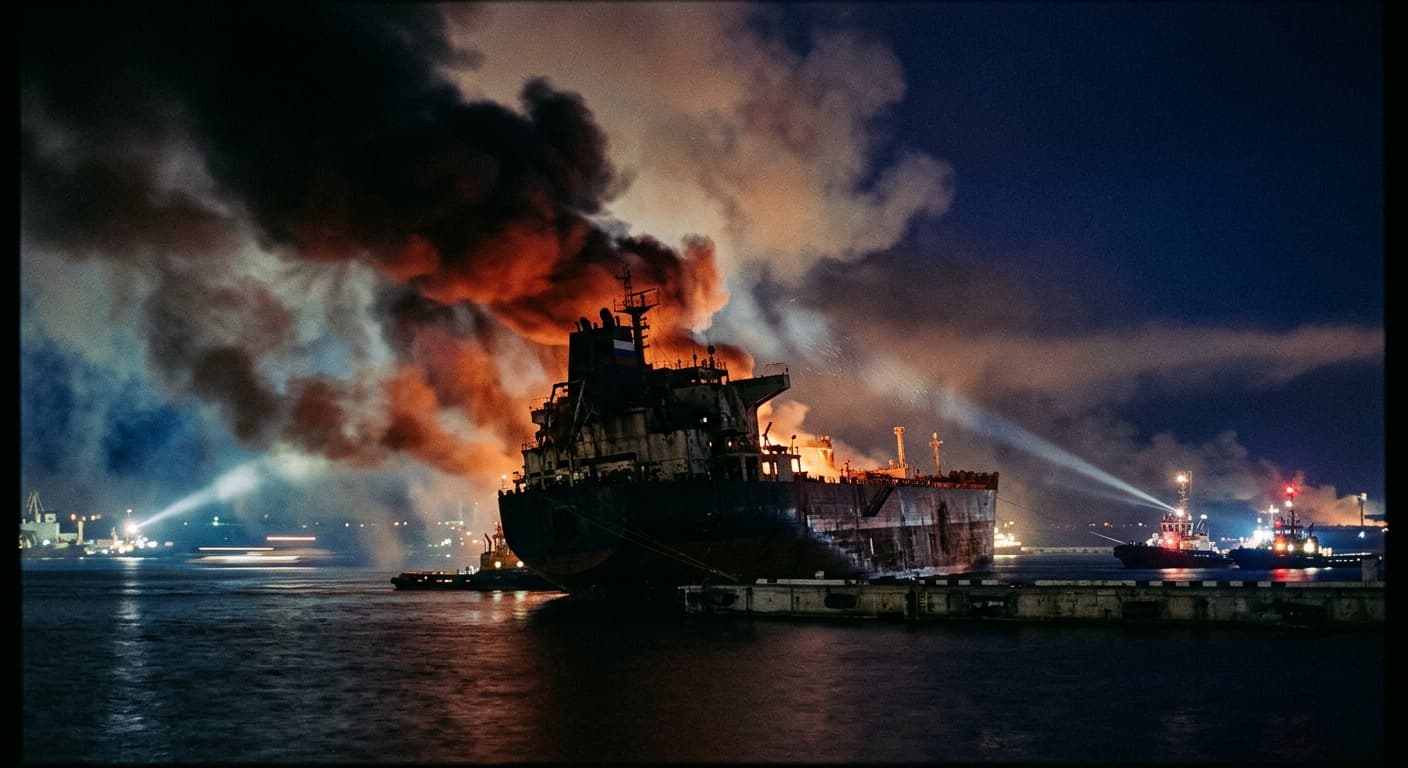
Ukraine drone strikes hit 21 Russian shadow fleet ships in 72 hours
Ukraine's Unmanned Systems Forces struck 21 Russian shadow-fleet vessels in the Sea of Azov between July 5 and July 8, 2026, severing Crimea's last viable maritime fuel corridor.
Ukraine's Unmanned Systems Forces (USF) hit 21 Russian-controlled vessels in the Sea of Azov and Kerch Strait in the 72 hours to July 8, 2026 — 19 tankers, one dry cargo ship and one ferry — in the most concentrated attack yet on Russia's "shadow fleet." According to USF commander Robert "Magyar" Brovdi, nine tankers were struck in a single overnight raid into July 8, following eight tankers on July 7 and two on July 6, as Rubryka first reported. The strikes convert the shadow fleet from a sanctions problem into a targeting category — and, more importantly, sever the maritime resupply lifeline that Moscow was using to keep occupied Crimea fuelled after Ukrainian FPV swarms shut down the overland "land bridge" from Rostov.
What actually happened between July 5 and July 8
The strikes were run by the Kairos Battalion of the 414th Unmanned Strike Aviation Brigade — "Magyar's Birds" — using Fire Point FP-1/FP-2 kamikaze drones flown from Ukrainian-held territory across the Azov littoral. Naval News identified six of the tankers hit on July 6–7 as the Sanar-1, Sanar-17, Klimena, Teti, Aleksey Savrasov and Penelope, each roughly 140 metres long with a 7,000-tonne deadweight, built between 2006 and 2012. Brovdi added the Venera-3 to that list on Telegram, cited by
BBC News Ukraine, and confirmed that the vessels were already under international sanctions and had been shuttling gasoline from Taganrog to Crimea since the collapse of the road corridor.
Ukraine's General Staff separately confirmed strikes on six tankers, one in the Black Sea and the remainder in the Azov. Kyiv Post reported that several ships were set ablaze, at least one was abandoned by its crew, and Russia acknowledged damage to two tankers in the Rostov region port, with two crew members evacuated. Trade press
Seatrade Maritime noted the strikes also targeted onboard accommodation blocks and shore-side moorings, and warned insurers that Russian retaliation against Ukraine-linked vessels is now the operative risk in the Black Sea war-risk market.
The 414th's own footage, distributed on Brovdi's Telegram channel and packaged as a four-and-a-half-minute compilation, shows tankers moored in loose clusters — "shoals," as Brovdi put it — with no anti-drone barriers and effectively no organic air-defence cover. "The battle for Crimea's gasoline in the Sea of Azov continues," Brovdi wrote on July 7. That absence of protection is the story inside the story: after two years of Ukrainian strikes methodically stripping S-400 and Pantsir sites from occupied southern Ukraine, the Azov coastal zone is now, in the words of Ukraine's drone commander to the BBC, no longer a "peaceful rear."
Why the shadow fleet has become a targeting category
Russia has spent three years distancing itself from the roughly 1,468-vessel shadow fleet that, per TankerTrackers.com data cited by the BBC, has tripled in size since 2022. The
Royal United Services Institute estimates that fleet moves nearly 70% of Russia's seaborne crude and generates around $85 billion annually for the Kremlin — the single largest cash line item funding the war. Western capitals responded with paper. The EU's 20th sanctions package, adopted April 23, 2026, brought the total number of designated shadow-fleet vessels to 632, subjecting them to port-access and services bans, according to the
Council of the EU. The UK has sanctioned more than 500 tankers under a framework that empowers Royal Marines to board sanctioned vessels in the English Channel — a power first used against the Smyrtos on June 15, 2026,
Al Jazeera reported. The US, by contrast, has designated 216 vessels and, per
Brookings, has not added a single tanker since January 10, 2025.
Sanctions asymmetry is why Kyiv is now doing kinetically what Washington will not do administratively. Ukraine's own tanker campaign began in earnest in late 2025; Naval News counted 14 Russian tankers damaged or sunk before this week's raid, rising to 15 after the March 2026 hit on the LNG carrier Arctic Metagaz in the Mediterranean. The 21 vessels hit in three days more than doubles that cumulative total. It also blurs the legal category: Brookings-cited data show that as of March 2025, some 264 of 343 tankers in the core shadow fleet were sanctioned by at least one Western jurisdiction, in a Brookings analysis that projected sanctions saturation as the limiting factor. Ukraine has now supplied the enforcement mechanism the coalition lacked.
The Atlantic Council had warned in January that Europe was allowing "legal gray zones" to shield the fleet, arguing in an Atlantic Council dispatch that Baltic states should "broadly interpret" UNCLOS to board and seize tankers. Ukraine has answered the question its European partners have refused to answer for two years: what if the tankers are not detained, but destroyed?
The Crimea logistics collapse — and the winners
Since mid-May 2026, Ukrainian drones have shredded the overland "land bridge" from Rostov to Crimea, with the Third Special Battalion claiming "aerial control" over the Melitopol–Chongar highway and mid-range FPVs hitting hundreds of fuel trucks. Al Jazeera documented seven-hour petrol-station queues near Simferopol in early June and cited Bremen University's Nikolay Mitrokhin: "Crimea's key problem is not that there's no fuel. The problem is that Ukrainian drones began barraging over the peninsula's domestic roads." By June 22, following a drone strike on the Kerch oil depot that killed four people, Moscow-appointed Crimea governor Sergey Aksyonov had suspended civilian fuel sales entirely, according to the
BBC. Russia's response was to run tankers from Taganrog across the shallow Azov — the shortest maritime shortcut into Crimea, since the Kerch bridge no longer accepts trucks over 1.5 tonnes.
That is the funnel Brovdi is now shutting. Each of the 7,000-tonne tankers hit this week was carrying enough gasoline to supply Crimea for roughly a day of civilian and light-military use. Twenty-one hulls in three days is not a symbolic strike — it is the maritime equivalent of what USF drones did to the "land bridge" in May.
The concrete winners of this week's raids are three: the Ukrainian General Staff, which now controls a de facto blockade of Crimea without possessing a navy; European insurers and P&I clubs, whose withdrawal from suspect voyages is now backed by physical risk pricing rather than administrative sanction; and the Ukrainian domestic drone industry — Fire Point, the manufacturer of the FP-1/FP-2 platforms, and the wider ecosystem that, per a Carnegie Endowment analysis, produced roughly four million drones in 2025. The losers are equally concrete: Russian shipowners and Greek intermediaries (identified in
Brookings as the source of over 40% of new shadow-fleet ships), Rosneft and Sovcomflot logistics, and the roughly two million residents of occupied Crimea now facing a compounding fuel and electricity crisis. USF drones also struck six electrical substations as part of a parallel "Crimean switch-off" campaign in the same 72 hours, bringing the number of power hubs hit since July 1 to 50.
The second-order effect: what shadow-fleet insurers now price
The most consequential effect of the Azov raid is not military — it is financial. Until this week, insurance withdrawal was the primary Western enforcement lever against the shadow fleet: the January 2026 EU-UK ban on refined products from third-country refineries processing Russian oil, described in a New Strategy Center report, forced insurers to price sanctions risk into every voyage. Ukrainian kinetic strikes now add a physical-loss premium on top. Any shadow-fleet operator running Azov, Black Sea or Mediterranean routes — the last of which saw the Arctic Metagaz hit in March 2026 — must now price a non-trivial probability of total hull loss. Russian re-registration of tankers under its own flag, a trend the
Royal United Services Institute documented accelerating from late 2025, becomes the only remaining option once neither Western insurance nor flag-of-convenience jurisdictions will absorb the risk. That makes Russian sovereign balance-sheet exposure to hull loss direct, and gives Ukraine a target category with legal cover it did not previously have.
The Stockholm-based Swedish Defence Research Agency has raised the parallel legal question: are Sea Baby and Magura V5/V7 uncrewed surface vessels "warships" under international law? The FOI's analysis concludes that current models "should not be classified as a ship or a warship" because they are launched and remotely piloted from land — a distinction that leaves Ukraine's aerial FP-series drones, used in this week's Azov raid, on even firmer footing. Russia has no straightforward path to litigate the strikes in any forum it does not itself control.
The historical parallel
The closest analogue is the US Navy's 1945 aerial mining campaign against Japanese coastal shipping — Operation Starvation — which strangled a home-island economy through the sea lanes it could no longer defend. Ukraine is doing the same in a smaller theatre with orders-of-magnitude cheaper munitions. USF drones, per Brovdi's Al Jazeera-cited June tally, hit a Russian target every 52 seconds and destroyed 50,147 military assets that month alone. A 2% force accounts for a third of all Russian battlefield losses; the same 2% has now delivered, in three nights, a maritime interdiction that Western sanctions took three years to approximate.
What to watch next
- July–August 2026 fuel prices in Crimea. Sustained tanker attrition should push the peninsula into open rationing within weeks. Aksyonov's next public statement is the leading indicator.
- The next EU sanctions package. Brussels is expected to move on a maritime services ban held on hold since 2025; Ukrainian kinetic evidence of shadow-fleet routing will strengthen the Baltic states' hand.
- Russian retaliation risk. Seatrade Maritime and Lloyd's List analysts have flagged the probability of Russian strikes on Ukraine-linked bulkers in the Black Sea — the war-risk premium for Odesa-departing grain cargoes is the market signal to track.
- US posture. No US tanker designation has been issued in 18 months. Whether the second Trump administration adds vessels — or quietly accepts Ukrainian enforcement — will define the Western coalition's shape by autumn.
The Bottom Line
Ukraine has done in three nights what 20 rounds of EU sanctions could not: made the operational cost of moving Russian oil at sea a function of hull loss, not paperwork. The Azov raids close Crimea's last resupply artery and quietly convert the shadow fleet from a legal category into a target list — a shift Western coalitions will now have to price into every future sanctions package, insurance renewal, and Black Sea grain manifest.
Discover more

US Politics
White House Pressures Congress for Crypto Leg
The Trump administration's push for the CLARITY Act aims to reshape crypto regulation, impacting trillions in market value and the Trump family's wealth.

US Politics
House Ethics Committee Pushes Sexual Miscond.
The House Ethics Committee has shifted responsibility for sexual harassment settlement records to the Office of Congressional Workplace Rights, complicating disclosure efforts.

US Politics
SNAP Food Assistance Faces Legal Challenges
In 2026, SNAP faces stricter eligibility rules and mounting legal challenges, threatening food assistance for the millions of Americans who rely on the program.

Conflict & Security
Drone Warfare Killing Aid Workers at Unprec
Over 1,000 humanitarian workers killed in three years as cheap armed drones collapse legal protections. Gaza, Sudan, Ukraine, and DRC see deliberate targeting of aid convoys and hospitals with zero prosecutions.