UK Immigration Bill Narrows Family Rights
New bill limits family definitions amid Strasbourg rulings.
Model Diplomat7 min readEurope
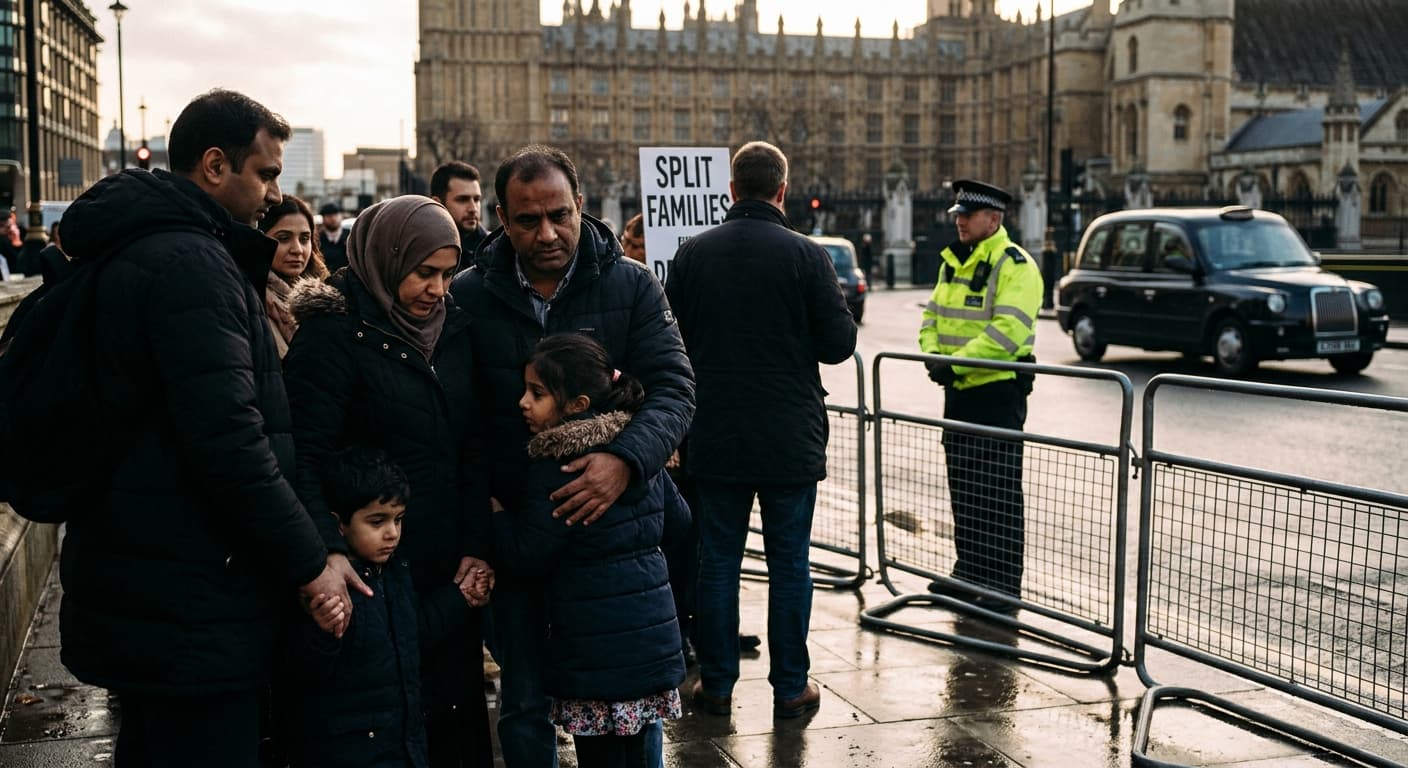
UK Immigration Bill narrows Article 8 as Strasbourg widens family rights
Shabana Mahmood's Immigration and Asylum Bill restricts family life to a "core cohabiting" unit — the same week Strasbourg and the High Court redrew the boundaries of who counts as family.
The UK government's Immigration and Asylum Bill, introduced by Home Secretary Shabana Mahmood on 30 June 2026, would statutorily define "family life" under Article 8 of the European Convention on Human Rights as "normally limited to their core cohabiting family" — and it lands in the same week that the European Court of Human Rights ruled Poland violated the Convention by refusing identity documents to the child of a same-sex couple, and the High Court in Alibiari upheld a Home Office policy that treats refugees who arrive irregularly as, by default, not of good character. Read together, the three moves push British immigration law in one direction while the Strasbourg court moves the ceiling of family rights in the other. The collision, not the Bill itself, is the story.
What the Bill actually does
The Bill's headline changes are structural, not rhetorical. Clause 18(4) redefines the reach of Article 8 in immigration decisions to a "core cohabiting family" — a narrower unit than the extended-family reading Strasbourg and the domestic courts have developed over two decades. Clause 19(7) rewrites section 117B of the Nationality, Immigration and Asylum Act 2002 so that it is only "unreasonable" to expect a child to leave the UK where they would receive no education in the destination country, face very significant obstacles to integration, or suffer a "very significant and long-lasting adverse effect". Clause 23 gives the Home Secretary the power to charge asylum-support recipients for the cost of their accommodation, and clause 36 makes delay or inconsistency in modern-slavery disclosures a formal ground to doubt credibility. The UK Human Rights Blog round-up sets out the clause map in detail.
Clauses 1 and 2 create an Independent Immigration Appeals Authority to absorb all immigration appeals. Only senior adjudicators must have practised law for two years; there is no such requirement for executive adjudicators. According to a Home Office release, the body will start hearing cases in phased stages from late 2027 and is expected to "dynamically scale" adjudicator numbers based on demand.
The framing is political as much as legal. Mahmood's gov.uk statement casts the Bill as reforms that will "save the asylum system for a generation", operationalising the November 2025 Restoring Order and Control paper. In her
5 March 2026 speech at the Institute for Public Policy Research, the Home Secretary said the qualifying period for settlement should shift "as a norm — from 5 years to 10", and confirmed that initial refugee leave has already been cut from five years to two and a half.
Why the caseload drives the politics
The Bill's speed cannot be understood without the appeals backlog. According to the Ministry of Justice's Tribunal Statistics Quarterly, January to March 2026, receipts to the First-tier Tribunal Immigration and Asylum Chamber (FTTIAC) rose 49% in 2025/26 to 118,000. Asylum, Protection and Revocation appeals hit the highest quarterly volume in the series, at roughly 15,000. Mean clearance time is 61 weeks — 11 weeks longer than a year earlier. The BBC, citing the same
official figures, put the appeals backlog at nearly 87,500 at the end of March 2026, up 70% year on year.
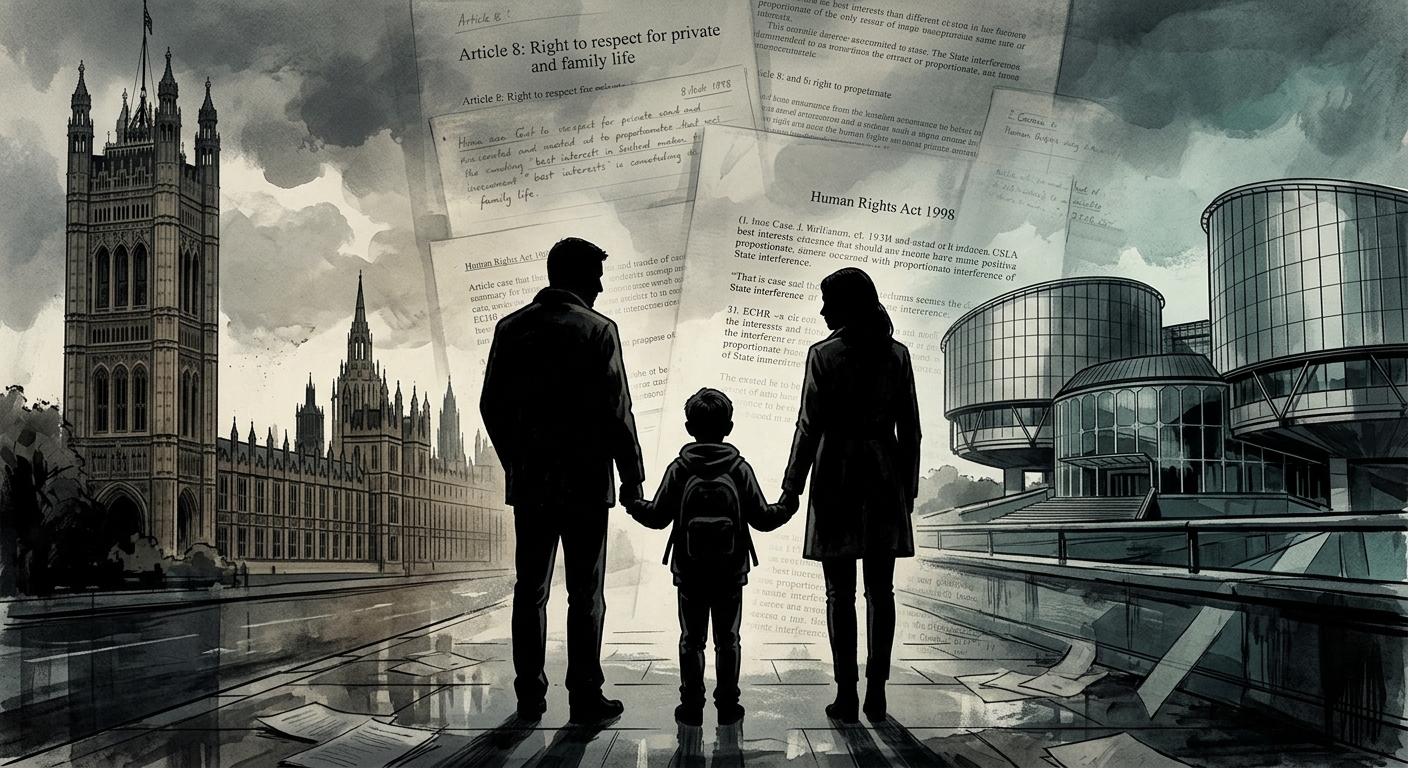
The numbers matter because the Bill's answer is to strip out one of the biggest categories of appeal — Article 8 family-life claims — by statute, and to route what remains through a new administrative body with lighter qualification requirements for its junior adjudicators. That is a design choice, not a legal necessity.
The Alibiari ruling: the good-character trap for refugees
Two days before the Bill's introduction, the Divisional Court handed down Alibiari, R (On the Application Of) v Secretary of State for the Home Department [2026] EWHC 1623. Lewis LJ upheld the Home Office's Nationality: good character requirement guidance, which treats illegal entry or irregular arrival as normally demonstrating that an applicant for naturalisation lacks good character. As the UK Human Rights Blog summarised the ruling, the court held that illegal entry indicates "a willingness to break or disregard the law" and that irregular arrival demonstrates "a willingness to make dangerous journeys and to use criminal gangs" [34]. The court dismissed Article 14/Article 8 discrimination claims and rejected the argument that the policy failed to make space for refugees who bore no moral responsibility for their journey.
Lewis LJ went further, observing that a refugee who transits a safe third country before entering the UK irregularly "is not doing so because he fears persecution" [53]. That sentence quietly narrows the space refugee claimants have historically had under section 31 of the Immigration and Asylum Act 1999 and Article 31 of the Refugee Convention, whose UK application is set out in the Home Office's own section 31 defence guidance. The case concerned Version 6 of the guidance; a
Version 7 was published on 30 April 2026, which now confirms that any application made after 10 February 2025 involving illegal entry will "normally" be refused, regardless of when the entry occurred.
The practical effect is a citizenship freeze for a specific cohort. According to a Cambridge University Press study of the good character regime in the BJPsych Bulletin, several hundred children raised in the UK have already been denied citizenship on character grounds under the pre-2025 regime. Post-Alibiari, that logic now sits on the statute books for adults who arrived on small boats — regardless of whether they were later recognised as refugees.
The A.P. and R.P. counter-signal from Strasbourg
The same week, the European Court of Human Rights ruled in A.P. and R.P. v. Poland (App no 1298/19) that Polish authorities' refusal to grant identity documents to a child of two same-sex parents breached the Convention. It is the sequel Strasbourg watchers have been waiting for since the Court of Justice of the EU's 2021 ruling in V.M.A. v Stolichna obshtina (Case C-490/20), where the Luxembourg court obliged Bulgaria to issue documents to the child of a same-sex couple resident in Spain — a case set out in a European Parliament briefing on rainbow families. Strasbourg has now moved onto that terrain from an ECHR footing rather than an EU-citizenship one, opening the door for children of same-sex couples across the 46 Council of Europe states — including those, like the UK, outside the EU legal order.
That is the point where the two tracks intersect. The UK Bill's "core cohabiting family" formula does not, on its face, exclude same-sex couples. But the direction of British reform — narrower categories, sharper credibility thresholds, faster removals — sits uneasily with a Strasbourg court that is expanding the definition of the family unit whose ties the state must respect. The Institute for Government has already flagged that the further Parliament pushes to constrain Article 8 domestically, "the greater the chance that the Strasbourg court will say it has gone too far". In Unuane v United Kingdom (2020), the Strasbourg court reserved the power to give "the final ruling" where domestic courts fail to balance individual and public interests.
Who wins, who loses
The winners are procedural. A Home Office facing a 123,000-case total backlog gets a statutory Article 8 test that shrinks the population of potential family-life appeals, a credibility rule that shortens modern-slavery arguments, and an administrative appeals body it can staff at speed. Ministers also get the political optics of a "firm but fair" system aligned with what the government has repeatedly called the Danish model — a framing set out in a March 2026 Home Office release.
The losers cluster in three groups. First, adult refugees who arrived irregularly — post-Alibiari, they can be recognised as refugees, integrate for a decade, and still be told they are not of good character enough to naturalise. Second, mixed-status families outside the "core cohabiting" definition: grandparents raising children, adult children caring for elderly parents, step-parents without formal ties. Third, children in cross-border same-sex families — for whom Strasbourg has just widened protection, precisely as UK statute is being narrowed.
The Bill's compatibility with the ECHR will hinge on how UK courts read clause 18(4) against the Strasbourg jurisprudence — including A.P. and R.P. — that domestic judges are still, under section 2 of the Human Rights Act, obliged to "take into account". The LSE analysis of past Article 8 reforms observed that "a child is not to be held responsible for the moral failures of either of his parents" — a Baroness Hale line the new section 117B test does not obviously accommodate.
What to watch
- Second reading of the Immigration and Asylum Bill in the House of Commons, expected before the summer recess. Watch whether the government publishes a section 19(1)(a) statement of ECHR compatibility, or resorts, as with the 2023 Illegal Migration Bill, to a section 19(1)(b) notice.
- The full published judgment in A.P. and R.P. v Poland and whether Poland seeks referral to the Grand Chamber within the three-month window. A Grand Chamber ruling would bind all 46 Council of Europe states, UK included.
- Any appeal in Alibiari to the Court of Appeal. Lewis LJ's paragraph [53] — that a refugee transiting a safe country "is not doing so because he fears persecution" — is the sentence most likely to be tested against Article 31 of the Refugee Convention.
- The commencement date of the Independent Immigration Appeals Authority, phased in from late 2027, and whether transitional arrangements preserve rights of appeal already lodged before the FTTIAC.
The Bottom Line
The Immigration and Asylum Bill's real innovation is not tougher rhetoric but a statutory redefinition of family life that shrinks the pool of Article 8 claims exactly as Strasbourg is widening the pool of families whose ties the state must respect. Combined with Alibiari, it leaves refugees who arrived irregularly with protection but no path to citizenship, and cross-border rainbow families with rights on paper but a domestic regime moving the other way. If the Bill passes in its current form, the next major UK immigration ruling will not be handed down in London — it will be handed down in Strasbourg.
Discover more

US Politics
House Ethics Committee Pushes Sexual Miscond.
The House Ethics Committee has shifted responsibility for sexual harassment settlement records to the Office of Congressional Workplace Rights, complicating disclosure efforts.

International Relations
Pakistan's Key Role in US-Israel-Iran Meddle
Pakistan is seeking to mediate the US-Israel-Iran conflict, balancing high-stakes diplomacy against severe economic pressures and steep regional challenges.
US Politics
Congress Targets AI Chatbot Access for Terror
The House passed the Generative AI Terrorism Risk Assessment Act, focusing on AI's role in terrorism and potential surveillance implications.

Economics
Fed's Amex AML order puts correspondent banking on notice
Federal Reserve's Amex AML order requires board-level controls and a 90-day plan; OCC fined the bank $350 million over enterprise-wide deficiencies.