UK Debt Crisis: OBR Warns of Unsustainable
OBR warns UK needs £100bn yearly to stabilize debt.
Model Diplomat9 min readEurope
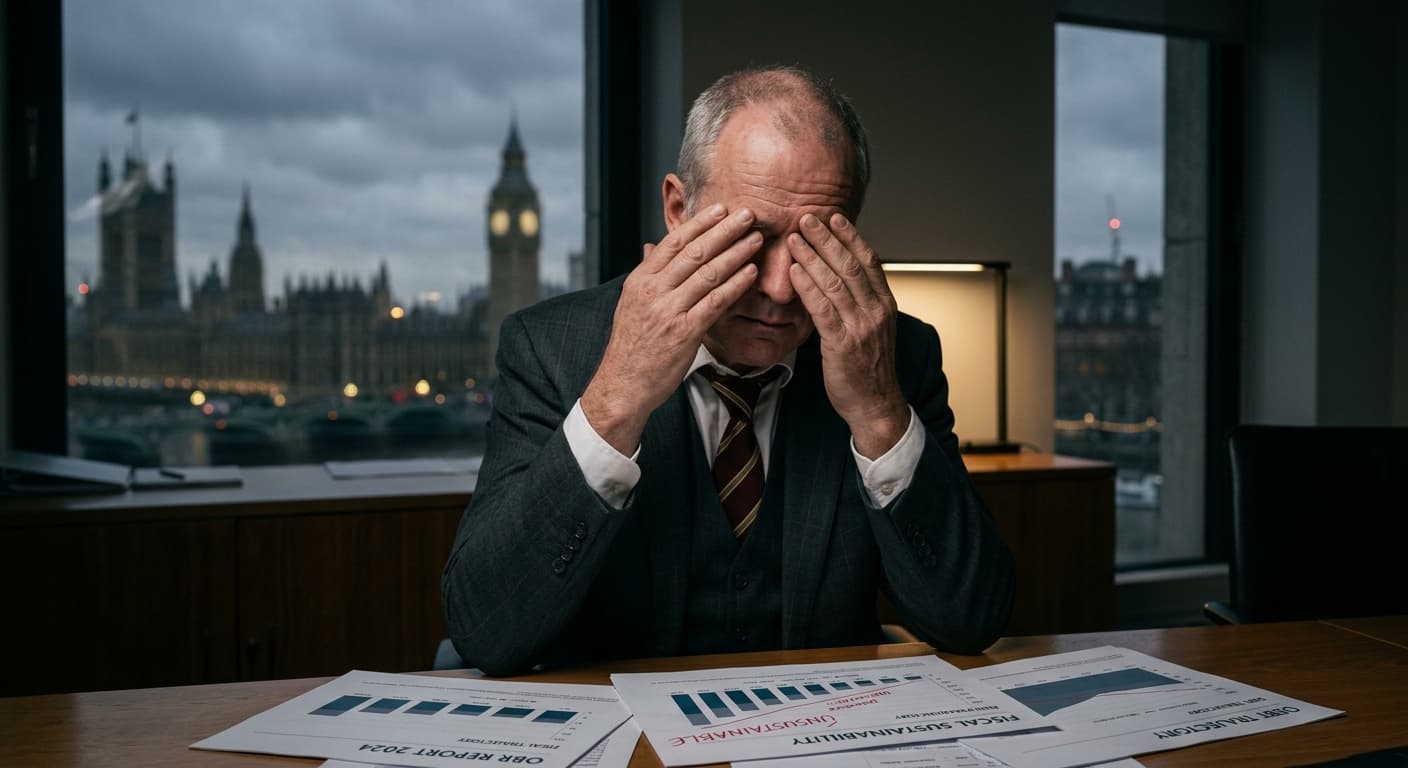
UK Debt: OBR Warns of 'Unsustainable Path' as Bond Markets Watch
The OBR says Britain needs £100bn a year to stabilise debt at 95% of GDP. Gilt yields already sit at G7 highs. Whoever is prime minister by autumn inherits the bill.
The Office for Budget Responsibility told Parliament on July 7, 2026 that UK public finances are on an "unsustainable path," projecting debt to nearly triple as a share of GDP over 50 years unless successive governments raise taxes or cut spending by roughly £100 billion a year — a demand landing precisely as Labour prepares to swap prime ministers, gilt yields sit at their highest levels since 1998, and the International Monetary Fund warns of "limited fiscal space." The report's real function is not to describe long-run demography. It is to hand the bond market a fresh veto over the autumn Budget, and to force Andy Burnham — the presumptive next occupant of Downing Street — to choose between his manifesto tax pledges, the pension triple lock, and the credibility premium British debt now trades at.
What the OBR actually said
The 148-page Fiscal Risks and Sustainability report, laid before Parliament under Section 8 of the Budget Responsibility and National Audit Act 2011, is unusually blunt for a technocratic document. Its baseline 50-year scenario shows primary non-interest spending rising from around 45% to 49% of GDP, driven by healthcare (from 8% to roughly 13% of GDP), state pension costs (5% to 9% under the triple lock), adult social care (1.2% to 1.8%), and defence tracking toward 3.5% of GDP by 2035. Debt interest alone reaches 12% of GDP by the late 2040s under current gilt-yield assumptions, according to the OBR's report on gov.uk.
To stabilise net debt at its current level of about 95% of GDP, the watchdog says the exchequer needs a permanent fiscal tightening on the order of £100 billion a year — described by The Edge as "equivalent to the entire education budget" or the total onshore corporation tax take — the OBR's own framing, not a journalist's gloss. OBR chair Richard Hughes has framed the finding in evidence cited by the
BBC: "The UK cannot afford the array of promises that are displayed to the public if you leave those unchanged based on a reasonable assumption about growth rates in the economy and in tax revenues."
The report's base scenario points to net debt near 270% of GDP by 2071 absent policy change — a projection the OBR first floated in 2024 and has since sharpened, according to the BBC's summary of the trajectory. Chief Secretary to the Treasury Darren Jones was cited in the same piece conceding the UK now faces its "highest debt since the 1960s, highest taxes since the 1940s, and debt on track to be almost three times our GDP." That is not analyst commentary; it is the government's own framing.
Why this warning lands harder than the 2024 version
OBR sustainability reports arrive every July. Most are ignored. This one is not, for three specific reasons.
First, the gilt market is already pricing a credibility problem. UK 30-year yields hit 5.81% on June 30, the highest since 1998, and 10-year yields briefly touched 5.13% — levels last seen in the 2008 financial crisis — according to the BBC. The IMF's 2025 Article IV report specifically flagged the vulnerability: the gilt market has become "more vulnerable" as pension funds and insurers scale back long-dated holdings while the Bank of England runs down its balance sheet through quantitative tightening, leaving hedge funds and non-residents — roughly 25–30% of the buyer base — to fill the gap, according to the
IMF's UK country report. The IMF's 2026 Article IV mission concluded in May that "given limited fiscal space and elevated borrowing costs, broad-based measures should be avoided," per the
IMF concluding statement.
Second, the OBR is publishing into a leadership vacuum. Andy Burnham won the Makerfield by-election in June and is widely expected to replace Sir Keir Starmer this month. His position ricocheted between wanting to loosen fiscal rules — Berlin-style defence carve-outs, Tribune-group investment exemptions — and, by July 6, publicly committing to keep them intact after gilts sold off on speculation he might not, per the BBC's Faisal Islam. He has also pledged to retain the pension triple lock, according to the
Financial Times — the single largest structural driver of the OBR's unsustainable trajectory. Mohamed El-Erian told the BBC that Burnham's fiscal-rules commitment "contributed to this morning's outperformance of the UK bond market" — a rare instance of a UK politician moving gilt yields by promising not to act.
Third, the demographic maths has hardened. The over-65 population is projected to rise from 13 million to 22 million over 50 years, pushing the old-age dependency ratio from around 30% to nearly 50%, according to the BBC's analysis of OBR data. The triple lock has cost roughly three times its original 2011 estimate, and the annual bill is projected to reach £15.5 billion by 2030, per the same
BBC report on the OBR's pension analysis.
Who benefits, who pays
The distributional politics of the OBR's arithmetic are unusually explicit. Any credible £100bn-a-year adjustment falls somewhere on a spectrum between three groups.
Pensioners are the largest single beneficiary of the current path. The state pension rose 4.1% in April 2026 to £230.25 a week for the full new flat rate, and OBR analysis cited by the BBC shows the state pension's share of GDP rising from 2% in the post-war era to 5% today and 7.7% by the early 2070s under the triple lock. If the lock were replaced with earnings-only indexation, state pension spending would only rise to 6% of GDP by 2070 — a roughly £60 billion difference in today's money, per
BBC calculations. The Institute for Fiscal Studies has already called for scrapping the lock in favour of earnings indexation with a target replacement rate.
Working-age taxpayers carry the cost. The UK tax take is already at its highest share of GDP since the 1940s. Chancellor Rachel Reeves has previously acknowledged the UK is "still very reliant on the goodwill of strangers in buying our government bonds," per the BBC. Barclays' Moyeen Islam, writing in the IFS Green Budget and cited by the
Financial Times, estimates the private sector must now absorb around 6% of GDP in annual gilt supply, against 3% during the QE decade — a doubling of the effective funding burden. His conclusion is stark: "there are two options available: raise taxes or cut spending. The alternative is an inexorable rise in gilt supply."
Bondholders are the residual beneficiaries. The higher the credibility premium, the more they earn — and the higher the interest costs paid out of general taxation. Debt interest already accounts for about £1 in every £10 the government spends, per the BBC. In May 2026 alone, interest payable on government debt hit £11.7 billion, the highest ever recorded for that month, according to ONS figures cited by the
BBC. That figure is a direct transfer from taxpayers to gilt holders — increasingly overseas hedge funds and non-residents, per the buyer-base data in the IMF report.
The historical parallel — and why it flatters the present
The OBR's chart of long-run public spending shows total outlays rising from 45% to over 60% of GDP by 2071. That would put Britain's state above French levels — an outcome no post-war UK government has planned for, funded, or explained to voters. What makes the current moment different from prior fiscal warnings — the 1976 IMF bailout, the 2010 austerity turn — is that the OBR is not warning about a discretionary borrowing decision. It is warning that the structural baseline, absent any new policy, is now the unsustainable path. The 1976 crisis was a currency-and-confidence event resolved by a specific loan; the 2010 turn was a political choice about the pace of adjustment. Today's problem is that even faithful adherence to Reeves's "iron-clad" rules, over five years, does not solve a 50-year debt trajectory driven by ageing.
That reframes what markets are actually pricing. UK gilt yields are the highest in the G7, per the FT, despite the IMF projecting UK deficits to shrink faster than most peers. The premium is not about the next Budget — it is about whether any UK government can credibly close a structural gap of this size without either breaking a manifesto pledge on VAT, income tax and national insurance, or dismantling the triple lock. Burnham has ruled out both, telling
the BBC via LBC he would stick to Labour's 2024 manifesto tax lock while defending the pension guarantee. That leaves welfare, capital spending, and stealth taxes — the same three levers Reeves has already pulled.
The international dimension
The sovereign-debt story is inseparable from the geopolitical one. The US-Israel-Iran conflict drove Brent above $100 in June, pushed G7 borrowing costs to multi-decade highs, and forced the Treasury to shift issuance toward shorter-dated gilts to reduce refinancing risk — a strategy the IMF endorsed in its 2025 Article IV as "well received by the market," per the IMF report. Meanwhile, the government's Defence Investment Plan raised military spending by £15 billion over four years, with a £4.7 billion funding gap that Burnham's first Budget will inherit, according to the
BBC. The OBR's 3.5%-of-GDP defence trajectory to 2035 is not a hypothetical — it is Cabinet policy the report simply projected forward.
For the UK's international economic position, the second-order effect is credibility drift. Sterling fell more than 1% against the dollar to $1.3388 on the day 30-year yields hit a 27-year high, per the BBC — the lowest level for the pound since early August 2025. The pound has held its trading band since Brexit, as Bank of England governor Andrew Bailey has emphasised, per the
BBC. But if a Burnham government were seen as fiscally looser, Capital Economics analysts warned in the same coverage that yields would rise further and sterling would weaken — a small-open-economy trap in which every act of political change tightens financial conditions on the domestic economy.
What to watch next
- Autumn Budget 2026 (October–November): Burnham's first Budget as PM must fund the £4.7bn defence gap and demonstrate a credible medium-term path against the OBR's headline £100bn number. Watch whether the OBR's next Economic and Fiscal Outlook downgrades headroom against the fiscal rule below the £9.9bn set at the Spring Statement 2026.
- Government response by July 2027: Under the Charter for Budget Responsibility, the Treasury must respond to the FRS within a year — per the
government's response to the 2025 report. That document will reveal whether the triple lock is being defended or quietly reformed.
- Debt Management Office issuance calendar: Continued skew toward shorter-dated gilts signals the Treasury believes the long-end premium is structural, not cyclical.
Diplomat View
The OBR has not identified a new problem — it has removed the last excuse for ignoring the old one. The £100 billion figure is the point where the arithmetic ceases to be about political preference and becomes about market permission. Burnham's bind is that the coalition that will install him — Labour's left, backed by public-sector unions and pensioner voters — is precisely the coalition that cannot deliver the tightening the OBR demands. The forecast to revise if this changes: a government that scraps or reforms the triple lock (a genuine structural saving worth ~£60bn a year by 2070), or a coordinated shift toward wealth-based taxation that spreads the burden off working-age income. Absent one of those, the market's price for UK sovereign risk will keep rising — and every future Budget becomes an exercise in stealth taxation dressed as fiscal responsibility. The specific signal to watch: whether Burnham's first Budget touches the lock. If it doesn't, the OBR will be back next July with the same warning and a bigger number.
The Bottom Line
The OBR's July 2026 report is not a forecast — it is a fiscal ultimatum. Britain cannot simultaneously keep its 2024 manifesto tax pledges, the triple lock, rising defence spending, and a stable debt ratio; one of those four must give, and the bond market is pricing which. Whoever occupies Downing Street this autumn will govern under the veto of gilt investors before the veto of voters.
Discover more
US Politics
Congress Targets AI Chatbot Access for Terror
The House passed the Generative AI Terrorism Risk Assessment Act, focusing on AI's role in terrorism and potential surveillance implications.
India
Romanian Coalition Party Demands PM Resign
Romania's Social Democrats withdrew from coalition, joining far-right AUR to topple PM Bolojan, risking €10 billion in EU funds by August 2026.

US Politics
SNAP Food Assistance Faces Legal Challenges
In 2026, SNAP faces stricter eligibility rules and mounting legal challenges, threatening food assistance for the millions of Americans who rely on the program.

Economics
Fed's Amex AML order puts correspondent banking on notice
Federal Reserve's Amex AML order requires board-level controls and a 90-day plan; OCC fined the bank $350 million over enterprise-wide deficiencies.